
数字医疗

Search documents
健康160港股募4亿港元首日涨137% 收入增近3年均亏损
Zhong Guo Jing Ji Wang· 2025-09-17 08:45
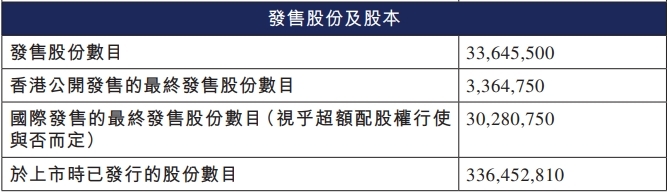
Core Viewpoint - Health 160 International Limited (Health 160) has successfully listed on the Hong Kong Stock Exchange, with a closing price of 28.22 HKD, reflecting a significant increase of 137.34% from its opening price of 29.98 HKD. The company operates as a wholesaler of pharmaceutical health products and a provider of digital healthcare solutions in China [1]. Group 1: IPO Details - Health 160 issued a total of 33,645,500 shares in its global offering, with 3,364,750 shares allocated for the Hong Kong public offering and 30,280,750 shares for international offering [2]. - The final offer price for the shares was set at 11.89 HKD, resulting in total proceeds of 400 million HKD. After deducting estimated listing expenses of 83.9 million HKD, the net proceeds amounted to 316.1 million HKD [3]. Group 2: Use of Proceeds - The net proceeds from the global offering are intended to be used for expanding healthcare resource coverage, enhancing research and development capabilities, diversifying product and service offerings, exploring strategic partnerships and acquisitions, and for general working capital purposes [3]. Group 3: Financial Performance - Health 160 reported revenues of 525.6 million RMB, 628.6 million RMB, and 620.7 million RMB for the years 2022, 2023, and 2024 respectively, with quarterly revenues of 94.2 million RMB and 100.5 million RMB for the first quarters of 2024 and 2025 [5]. - Despite revenue growth, the company recorded operating losses of 79.2 million RMB, 99.5 million RMB, and 104.6 million RMB for the years 2022, 2023, and 2024, respectively, indicating ongoing challenges in achieving profitability [6]. - The adjusted net losses for the same periods were 118.9 million RMB, 111.2 million RMB, and 108.2 million RMB, with quarterly adjusted net losses of 40.6 million RMB and 17.1 million RMB for the first quarters of 2024 and 2025 [7].

健康160首挂上市 早盘高开152.14% 公司为数字医疗综合服务提供商
Zhi Tong Cai Jing· 2025-09-17 05:38
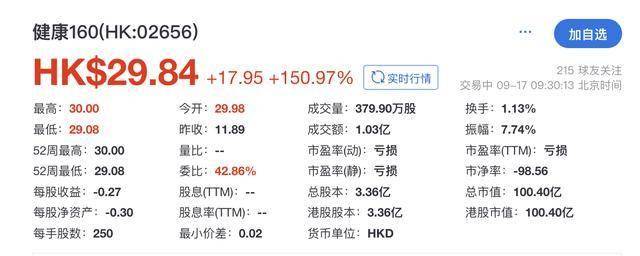
Group 1 - The core viewpoint of the article highlights the successful listing of Health 160 (02656) on the stock market, with a significant initial price increase of 152.14% from the offering price of HKD 11.89 to HKD 29.98 [1] - Health 160 issued a total of 33.6455 million shares, with net proceeds amounting to approximately HKD 316 million [1] - The company is recognized as an experienced wholesaler of pharmaceutical health products and a leading provider of integrated digital healthcare services in China [1] Group 2 - Health 160's platform has connected over 44,600 healthcare institutions since its establishment, including more than 14,400 hospitals, of which 3,430 are tertiary hospitals [1] - The company collaborates with over 6,800 private healthcare institutions that primarily offer consumer medical services such as dental, ophthalmology, and health check-up services [1] - The digital healthcare solutions provided by Health 160 empower various participants across the healthcare industry chain through its online medical health service platform [1]
新股首日 | 健康160(02656)首挂上市 早盘高开152.14% 公司为数字医疗综合服务提供商
智通财经网· 2025-09-17 05:35
Group 1 - The core viewpoint of the article highlights the successful listing of Health 160 (02656) with a share price of HKD 11.89, raising approximately HKD 316 million from the issuance of 33.6455 million shares [1] - As of the report, the stock price surged by 152.14%, reaching HKD 29.98, with a trading volume of HKD 101 million [1] - Health 160 is described as an experienced wholesaler of pharmaceutical health products and a leading provider of digital healthcare services in China [1] Group 2 - The company offers a wide range of pharmaceutical health products and comprehensive digital healthcare solutions [1] - Health 160 operates an online healthcare service platform that connects various stakeholders in the healthcare industry [1] - As of March 31, 2025, the platform has connected over 44,600 healthcare institutions, including more than 14,400 hospitals and over 30,200 grassroots healthcare institutions [1] Group 3 - Among the partnered healthcare institutions, over 6,800 private entities provide consumer medical services such as dental, ophthalmology, and health check-up services through the platform [1]
【IPO追踪】又一只新股上市!健康160首日高开逾150%
Sou Hu Cai Jing· 2025-09-17 03:30
Group 1 - Several new stocks have recently been listed on the Hong Kong stock market, including Jiaxin International Resources, Shuangdeng Co., Yinnuo Pharmaceutical-B, and Zhonghui Biotechnology-B, which performed well on their debut [2] - On September 17, a new stock named Health 160 was listed, opening over 150% higher and reaching a peak increase of 174%, before settling at a gain of 146.43% at the time of reporting [3] - Health 160's public offering was highly subscribed, with a subscription rate of 751.77 times, resulting in 3.36475 million shares being allocated for public sale, which is about 10% of the total shares offered [4][5] Group 2 - Health 160 is a leading wholesaler of medical health products and a digital healthcare service provider, offering a range of medical health products and comprehensive digital healthcare solutions [4] - As of March 31, 2025, Health 160 has connected over 44,600 healthcare institutions, including more than 14,400 hospitals, and has registered 55.2 million personal users on its platform [6] - The company's revenue for the years 2022 to 2024 was 526 million, 629 million, and 621 million RMB respectively, with losses of 120 million, 106 million, and 108 million RMB during the same periods [6]

健康160登陆港交所开盘涨151%、总市值100亿港元,CEO曾是大学教师
Sou Hu Cai Jing· 2025-09-17 02:27
Core Viewpoint - Health 160 (02656) was listed on the Hong Kong Stock Exchange on September 17, 2023, opening with a significant increase of 150.97%, resulting in a total market capitalization of HK$100.4 billion [1]. Company Overview - Health 160 is a Chinese wholesale distributor of medical health products and a provider of comprehensive digital healthcare solutions, offering a variety of medical health products and digital healthcare services to clients [2]. - As of March 31, 2025, Health 160 has connected over 44,600 healthcare institutions, including more than 14,400 hospitals and over 30,200 grassroots healthcare institutions [3]. - The company has established partnerships with over 902,300 healthcare professionals, including approximately 46,200 registered doctors, and has a registered user base of 55.2 million individuals [3]. Financial Performance - Health 160's revenue for the years 2022, 2023, and 2024 was RMB 525.646 million, RMB 628.606 million, and RMB 620.682 million, respectively, with corresponding losses of RMB 120.065 million, RMB 106.199 million, and RMB 108.246 million [4]. - In the first quarter of 2025, the company reported revenue of RMB 100.475 million, a year-on-year increase of 6.7%, with a loss of RMB 17.128 million compared to a loss of RMB 40.246 million in the same period the previous year [4][3]. Shareholding Structure - Prior to the IPO, Roning Zheng controlled approximately 33.99% of the voting rights through his wholly-owned companies, LNZ Management Limited and Luo Holdings Limited [5]. - Following the share split and global offering, Roning Zheng is expected to control about 34.08% of the company's issued share capital [5][6]. Leadership - Roning Zheng, the founder, executive director, chairman, and CEO of the group, has over 25 years of industry experience and is responsible for the overall strategy and management of the company [7].
我国学者揭示医生激励机制心理规律研究 助力数字医疗治理体系化升级
Sou Hu Cai Jing· 2025-09-16 07:57
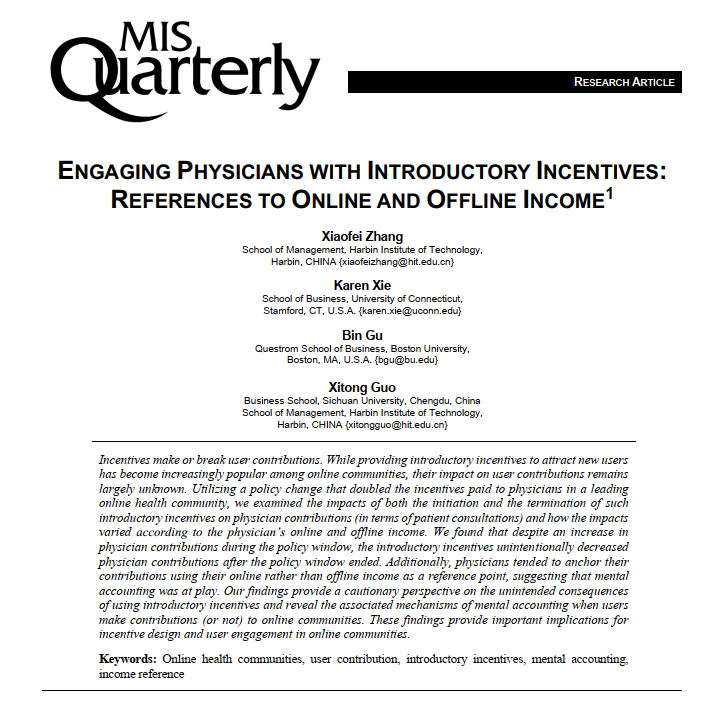
中新网黑龙江新闻9月16日电(记者 史轶夫)近日,哈尔滨工业大学张晓飞教授、郭熙铜教授与海外合作 者在数字医疗平台激励机制研究方面取得突破性进展。研究成果以"Engaging Physicians with Introductory Incentives: References to Online and Offline Income"为题,发表于国际管理学顶级期刊《管理 信息系统季刊》(MIS Quarterly,2025年9月刊)。 在"健康中国2030"战略稳步推进和平台治理体系持续完善的背景下,该研究聚焦数字医疗平台中广泛应 用的"入门激励"措施。 研究团队基于中国某大型在线问诊平台的自然实验数据,识别并分析了一项真实的激励政策变动:自 2016年起,平台向新医生提供首月双倍在线酬金,此后恢复为常规支付。研究发现,激励期内医生线上 工作量显著增长(+8.48%),但政策终止后贡献迅速回落,低于未参与激励医生约10.6%,显示出明显 的"激励后滑坡"现象。 (patient) 咨询标题:小儿皮肤有红疙瘩 Title: Red pimples on child's skin Disease: 个月大婴儿虚 ...
IPO一周资讯|纳斯达克提交代币化证券交易提案
Sou Hu Cai Jing· 2025-09-15 07:39
Group 1: Recent IPOs - Daoyuan Group, a diversified consulting and fintech solutions provider from Macau, successfully listed on NASDAQ, raising $6 million by issuing 1.5 million shares, with a market capitalization of $32.09 million [1] - Dahon Technology, a folding bicycle company from Shenzhen, successfully listed on the Hong Kong Stock Exchange, raising HKD 392 million by issuing 7.92 million shares, with a market capitalization of HKD 1.57 billion [2] Group 2: Companies Filing for IPO - Banjet Electronics, an automotive wireless sensor SoC company from Shanghai, filed for an IPO on the Hong Kong Stock Exchange, recognized as the third-largest globally and the largest in China in its sector [3] - Sige New Energy, a renewable energy solutions provider from Shanghai, refiled for an IPO on the Hong Kong Stock Exchange after a previous application expired, aiming to lead in distributed energy storage systems with a projected market share of 28.6% in 2024 [4] - Fokang Pharmaceutical, a biopharmaceutical company from Shanghai focused on breakthrough therapies for cancer and viral diseases, filed for an IPO on the Hong Kong Stock Exchange [5] - Shengwei Times, a city road passenger transport information service provider from Shanghai, refiled for an IPO on the Hong Kong Stock Exchange, aiming to enhance digital solutions in the transport sector [6] - Barentsz, a management and technology consulting firm from Hong Kong, submitted an IPO application to the SEC for a NASDAQ listing, planning to raise approximately $5 million [7] - EvoNexus, a mobile application developer from Hong Kong, filed for an IPO on NASDAQ, aiming to raise $8 million by issuing 2 million shares [8] Group 3: Upcoming IPOs - Hesai Technology, a lidar research and manufacturing company, is set to offer 2.55 million shares from September 8 to September 11, aiming to raise approximately HKD 4.16 billion, with a listing expected on September 16 [9] - Health 160, a digital healthcare service provider, plans to offer 33.6455 million shares from September 9 to September 12, targeting a maximum fundraising of HKD 500 million, with a listing expected on September 17 [10] - Jinfang Pharmaceutical, a biopharmaceutical company, will offer 77.6 million shares from September 11 to September 16, aiming to raise approximately HKD 1.582 billion, with a listing expected on September 19 [11] Group 4: Market Developments - NASDAQ submitted a proposal to the SEC to allow trading of tokenized securities, which would integrate traditional and blockchain finance, potentially implemented by Q3 2026 [12] - The upcoming Hong Kong Policy Address is expected to propose a phased reduction or elimination of stock stamp duty and reforms to the Growth Enterprise Market, aimed at enhancing market vitality [13]

数贸会看见创新未来
Mei Ri Shang Bao· 2025-09-15 00:09
Group 1: Event Overview - The fourth Global Digital Trade Expo will take place from September 25 to 29, 2025, at the Hangzhou International Expo Center, marking its return as China's only national-level global expo in the digital trade sector [1] - The event will feature a larger scale and more diverse content compared to last year, covering approximately 150,000 square meters with eight major exhibition areas [1] Group 2: Exhibition Areas - The eight exhibition areas include: Theme Pavilion, Artificial Intelligence Zone, Digital Entertainment Zone, Smart Mobility Zone, Digital Healthcare Zone, Silk Road E-commerce Zone, Smart Space Zone, and Smart Logistics Zone [1] - The expo aims to cater to various audiences, including tech enthusiasts, families, and consumers interested in global technology [1] Group 3: Interactive Experiences - A unique program called "Star Wish Landing on the Dark Side of the Moon" will allow participants to interact with AI robots and upload their wishes to be sent to the moon by 2029 [2] - The "Dunhuang Experience" will utilize AI technology to recreate the ancient art of the Tang Dynasty, allowing visitors to interact with the art in real-time [3] Group 4: Digital Entertainment and Gaming - The Digital Entertainment Zone will feature immersive experiences, including a pop-up store and interactive gaming areas, appealing to various demographics [4][5] - Attendees can experience cutting-edge VR and AR technologies, including the latest games and interactive robots [6] Group 5: Robotics and AI Innovations - The event will showcase the "Six Little Dragons" of Hangzhou, featuring advanced robotics and AI technologies across multiple fields, including healthcare and gaming [7] - Notable exhibits include humanoid robots and medical-grade robots capable of lifting significant weights [7] Group 6: Future Mobility and Healthcare Technologies - The expo will highlight innovations in future mobility, including Tesla's public test drives and various autonomous vehicles [8] - The Digital Healthcare Zone will present advanced technologies such as smart robots for elderly care and remote monitoring devices [9][10] Group 7: Global Collaboration and Opportunities - The expo will also feature international participation, with representatives from various countries discussing digital investment and smart city collaborations [10] - Activities such as innovation competitions and forums will provide networking opportunities for entrepreneurs [10] Group 8: Engagement and Promotions - Attendees can participate in promotional activities, including receiving digital coupons and collecting cards for prizes [11] - The event emphasizes an engaging experience, encouraging visitors to explore and interact with the latest digital technologies [11]
方舟健客(06086):H2H 大会消息非内幕消息 不知股价上涨原因
智通财经网· 2025-09-14 12:06
Group 1 - The company, Ark Health (06086), has observed a recent increase in its share price on the Hong Kong Stock Exchange as of September 12, 2025 [1] - The company announced its proprietary "Xing Shi" large model, which serves as the foundation for five flagship applications aimed at enhancing clinical diagnostic support and personalized chronic disease management [1] - A strategic partnership has been established with Innovent Biologics to integrate Ark's H2H digital health ecosystem with Innovent's weight management therapy pipeline, utilizing the "Xing Shi" model for personalized digital maintenance and compliance support in China's growing weight management market [1] - The company has also formed a strategic collaboration with Zhejiang Otsuka Pharmaceutical Co., Ltd. to develop comprehensive digital solutions that combine AI technology with Otsuka's innovative drug portfolio, focusing on drug support services, targeted patient outreach programs, and health education initiatives [1] Group 2 - The board confirmed that the information contained in the press release does not constitute insider information as defined under the relevant listing rules and securities regulations [2] - The board is not aware of any reasons for the increase in share price or any information that would require disclosure to prevent a false market in the shares [2]
“蓝皮书”面世 将成推动医疗数字化转型的“工具书”和“路线图”
Zhong Guo Xin Wen Wang· 2025-09-14 04:46
Core Insights - The release of the "Blue Book" marks a significant step in promoting the digital transformation of healthcare, serving as a comprehensive guide and roadmap for the industry [1][3] - The "Blue Book" provides an in-depth analysis of global and Chinese digital healthcare trends, emphasizing the integration of digital health into national strategic development plans [1][2] Group 1: Digital Healthcare Development - The digital healthcare ecosystem in China is undergoing profound changes, driven by the rapid integration of new scientific technologies [2] - Despite rapid advancements, the digital healthcare system in China faces multiple challenges that require a systematic support framework encompassing standard formulation, regulatory innovation, clinical validation, and ecosystem collaboration [2] Group 2: Clinical Applications and Case Studies - The "Blue Book" focuses on specific fields such as gastroenterology, liver disease, and hospital pharmacy, analyzing their respective demands, scenarios, classic cases, and core challenges in digital healthcare [2] - It also summarizes representative successful models and benchmark cases from both domestic and international contexts, extracting replicable and scalable development patterns for China's digital technology innovation [2] Group 3: Impact on Healthcare Services - The rapid development of digital healthcare has expanded the boundaries of medical services through internet hospitals, telemedicine, and wearable devices, enhancing medical efficiency and optimizing patient experiences [3] - The "Blue Book" is recognized for filling the gap in China's overall framework and standard guidelines for digital healthcare, providing authoritative, forward-looking, and practical guidance for the sector [3]