玛仕度肽

Search documents
CSIWM个股点评:信达生物
citic securities· 2026-03-30 11:49
Financial Performance - In FY2025, Innovent Biologics reported a revenue increase of 38.4% to CNY 13.042 billion, aligning with market expectations[5] - The net profit was CNY 814 million, a significant recovery from a net loss of CNY 95 million in FY2024, although it fell short of market forecasts due to higher-than-expected sales expenses[5] - Product revenue grew by 44.6%, driven by contributions from seven newly launched oncology drugs, particularly the GLP-1/GCGR dual agonist, which showed strong performance[5] Globalization and R&D Progress - Innovent is expected to become a benchmark for globalization among Chinese biopharmaceutical companies, supported by its R&D capabilities and cash flow from its Chinese operations[6] - Key data for the PD-1/IL-2 dual antibody IBI363 and CLDN18.2 ADC IBI343 is anticipated in 2026, with IBI363 also planning to release data for non-small cell lung cancer and colorectal cancer[6] - The management prioritizes the oral small molecule GLP-1 drug IBI3032, with Phase I data expected in 2026, and IBI3042 is set to enter clinical trials this year[6] Catalysts and Risks - Key catalysts for 2026 include updates on IBI363's new concept validation data in non-small cell lung cancer and the initiation of multiple global Phase III projects with Takeda[7] - Risks associated with drug development include potential delays in clinical trials, regulatory approval challenges, and market acceptance issues for candidate drugs[8][9]
创新药最新观点-四因素催化创新药新行情
2026-03-30 05:15
Summary of Key Points from Conference Call Records Industry Overview - **Industry Focus**: Innovative pharmaceuticals, particularly in the context of China's biopharmaceutical sector and its international expansion - **Market Growth**: The total value of BD (Business Development) transactions for innovative drugs is projected to reach $137.7 billion by 2025, a 1.6 times increase year-on-year, significantly surpassing the electric vehicle sector's $74 billion in the same timeframe [1][2][3] Core Insights and Arguments - **International Expansion**: The innovative drug sector is experiencing explosive growth in international markets, with Q1 2026 BD transactions already reaching $60 billion, accounting for 46% of the total for 2025 [1][2] - **Policy Support**: Biopharmaceuticals have been designated as a new pillar industry by the Chinese government, shifting focus from public welfare to GDP contribution, indicating a supportive policy environment for growth [2][3] - **Performance Expectations**: Companies like Heng Rui Medicine are expected to see over 30% growth in innovative drug revenue by 2026, with significant contributions from key products [1][3] - **Clinical Developments**: Major clinical data releases are anticipated from key conferences such as AACR and ASCO, which could catalyze market movements [1][5] Notable Companies and Their Prospects - **Heng Rui Medicine**: Expected to achieve over 30% growth in innovative drug revenue, with a strong pipeline of 53 products anticipated for approval between 2022 and 2028 [15] - **Kangfang Biopharma**: Key product AK112 is set to release critical clinical data in 2026, which could significantly impact its market position [11][13] - **Baiyi Shenzhou**: Projected profits of $700-800 million in 2026, indicating a rapid profit climb [1][8] - **Xinda Biopharma**: Anticipated to benefit from new product approvals and commercial launches, with a focus on expanding its product pipeline [6][8] Investment Opportunities - **Recommended Stocks**: Key investment targets include Kangfang Biopharma, Xinda Biopharma, Baiyi Shenzhou, and Kelong Biotechnology in the H-share market, and Xintai, Haishike, and Heng Rui Medicine in the A-share market [4][8] - **Undervalued Stocks**: Companies like Hot Scene Biopharma and Yifang Biopharma, which have seen significant price declines, are suggested for bottom-fishing opportunities [4][8] Emerging Trends - **Small RNA Technology**: The small RNA sector is entering a critical phase with breakthroughs in liver-targeted delivery technologies, and several companies are expected to announce significant clinical data in 2026 [18][22] - **Clinical Data Impact**: Recent clinical data from companies like Serapta and Wave Life Sciences highlight the potential and challenges within the small RNA space, influencing market sentiment and investment strategies [20][21] Conclusion - The innovative pharmaceutical sector in China is poised for significant growth driven by international expansion, supportive policies, and strong company performances. Key clinical events and emerging technologies present substantial investment opportunities, particularly in small RNA and innovative drug development.



每日投资策略-20260330
Zhao Yin Guo Ji· 2026-03-30 03:04
Industry Insights - The electrolytic aluminum industry faces heightened supply risks following the attack on EGA's Al Taweelah smelter in Abu Dhabi, which has suffered significant damage due to missile and drone strikes [2][6][7] - EGA's production capacity accounts for approximately 2% of global electrolytic aluminum supply by 2025, indicating a substantial impact on the market [7] - The attack is viewed as a planned action, suggesting that more smelting facilities in the Middle East could be at risk, further increasing supply-side concerns [7] Company Analysis - BYD's 4Q25 earnings fell short of expectations, with net profit down 18% compared to forecasts, attributed to a decrease in gross margin and lower financial income [8][9] - The company is expected to benefit from increased exports and energy storage solutions, projecting a sales volume of 5 million units in 2026, with 1.5 million units coming from exports [8][9] - BYD's revenue is anticipated to grow by 9% and 8% in 2026 and 2027, respectively, maintaining a gross margin of 17.8% [9] Company Analysis (Continued) - Great Wall Motors reported a 16% year-on-year revenue increase in 4Q25, reaching a record high, with core net profit aligning with expectations despite a slight decline in gross margin [10][11] - The new platform is expected to enhance pricing competitiveness, with an upward revision of sales expectations for the WEY brand to 200,000 units in 2026 [10][11] - The company anticipates a 19% increase in net profit for 2026, reaching 11.8 billion yuan, supported by export growth and product structure optimization [11] Company Analysis (Continued) - GAC Group's 4Q25 performance met profit warnings, with revenue up 22% year-on-year, although net losses were reported due to increased impairment losses [12][13] - The launch of the Qijun brand in collaboration with Huawei is expected to be a key catalyst for stock performance, alongside a target to double export volumes to 250,000 units by 2026 [12][13] - The company is projected to narrow net losses to 4.8 billion yuan in 2026, supported by cost reduction efforts [13] Company Analysis (Continued) - Innovent Biologics reported a strong 2025 performance with total revenue reaching 13 billion yuan, driven by new product launches [18][19] - The company is transitioning towards a fully integrated global biopharmaceutical company, with significant partnerships enhancing its development capabilities [19][20] - Key catalysts for 2026 include pivotal clinical data readouts for IBI363 and IBI343, which could significantly impact the company's valuation [20] Company Analysis (Continued) - Kangfang Biotech achieved a 52% increase in product sales in 2025, with expectations for further growth driven by new indications being added to the national insurance directory [22][23] - The company is focusing on global expansion for its key products, with pivotal trials underway for its lead assets [25][26] - Anticipated data readouts for IBI363 and IBI343 in 2026 are expected to be significant value drivers for the company [24][25] Company Analysis (Continued) - Xunfei Medical reported a 24.7% revenue increase in 2025, although growth was slower than expected in the G-end business [26][27] - The company is expanding its customer base significantly, with services now covering over 77,000 grassroots medical institutions [27][28] - The synergy between G-end and B-end businesses is expected to enhance long-term revenue growth resilience, with a shift towards more recurring revenue models [28][29] Company Analysis (Continued) - China Tower's FY25 revenue grew by 2.7% to 100.4 billion yuan, with net profit increasing by 8.4% [30][31] - The company experienced a decline in EBITDA due to increased bad debt provisions and reduced asset disposal gains [31] - A dividend payout of 0.458 yuan per share was announced, reflecting a payout ratio of 77% [31]



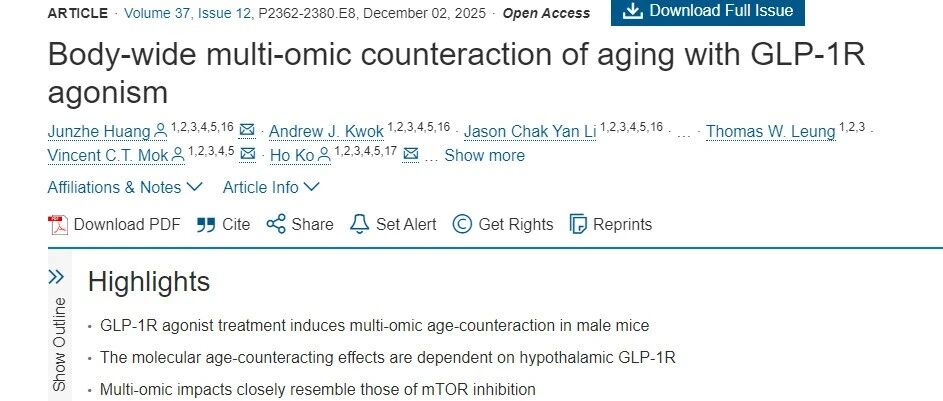
香港中文大学重磅发现:GLP-1不只是减肥药,它可能正在“系统性逆转衰老”
GLP1减重宝典· 2026-03-25 08:15
Core Viewpoint - The recent research indicates that GLP-1 receptor agonists have potential beyond weight management and metabolic improvement, showing systemic anti-aging effects at the molecular level in aged mice, which could redefine the long-term value and boundaries of GLP-1 drugs [4][5]. Group 1: Research Findings - Long-term, low-dose GLP-1 receptor agonist intervention in aged mice resulted in significant changes in gene expression related to aging, reversal of DNA methylation abnormalities, and a trend towards normalization of metabolic disorders [5]. - The observed anti-aging effects were not solely due to reduced appetite or weight loss, suggesting an independent biological mechanism at play [5]. - The changes were primarily noted in high-energy, aging-prone tissues such as the hypothalamus, cortex, hippocampus, heart, skeletal muscle, adipose tissue, and immune cells, indicating a closer biological state to younger individuals [5]. Group 2: Mechanism Insights - The hypothalamus plays a crucial role in mediating the systemic anti-aging effects of GLP-1, indicating a central regulatory axis that influences aging processes throughout the body [8]. - The action trajectory of GLP-1 at the multi-omics level shows similarities to mTOR inhibition, suggesting that GLP-1's health benefits may arise from overlapping underlying pathways, positioning it as a potential platform for health intervention beyond single disease treatment [8]. Group 3: Industry Implications - The indications for GLP-1 drugs are expanding from obesity and diabetes to include cardiovascular, neurodegenerative diseases, and "healthy aging," significantly extending the lifecycle of the patient population [9]. - The valuation logic for companies involved in GLP-1 production may fundamentally change, as these drugs could become central to anti-aging and long-term health management, rather than just weight management tools [9]. - The research highlights the potential for GLP-1 to influence not just metabolic health but also broader aspects of aging, which could reshape the pharmaceutical industry's approach to aging interventions [9].

Med:国产减肥药玛仕度肽安全有效减轻中国肥胖患者体重,并改善心血管代谢健康
生物世界· 2026-03-24 04:33
Core Viewpoint - Mazdutide, developed by Innovent Biologics, is a dual receptor agonist targeting GLP-1 and GCG, showing potential for weight loss and improvement in liver fat metabolism in obese individuals without diabetes [2][3]. Group 1: Clinical Trial Results - A Phase 2 randomized controlled trial demonstrated that Mazdutide 9 mg led to a weight reduction of 15.4% compared to the placebo group at 24 weeks, with further weight loss observed at 48 weeks [3][5]. - The trial involved 80 participants with a mean BMI of 34.3 and mean weight of 96.9 kg, showing significant efficacy in weight management [4][5]. - At 24 weeks, 81.7% of patients on Mazdutide experienced a weight loss of 5% or more, with 31.7% losing 15% or more, while the placebo group showed no significant weight loss [5][8]. Group 2: Safety and Side Effects - The treatment was associated with improvements in cardiovascular metabolic risk factors, with common side effects including nausea (50% in the treatment group), diarrhea (38.3%), and vomiting (36.7%), mostly mild to moderate [7][8]. - The safety profile of Mazdutide 9 mg was deemed acceptable for the target population of Chinese adults with obesity and no diabetes [8].

司美格鲁肽等GLP-1用了以后怎么吃饭?这件事比你想的更重要
GLP1减重宝典· 2026-03-23 11:32
Core Viewpoint - The article discusses the emerging concept of "GLP-1 Friendly" foods, highlighting the need for dietary adjustments among GLP-1 users due to changes in appetite and satiety caused by GLP-1 medications. It emphasizes the importance of nutritional density in meals as overall food intake decreases [2][4][10]. Dietary Adjustments - GLP-1 medications lead to reduced appetite and food intake, necessitating a focus on the quality of nutrition rather than merely eating less. Users may experience decreased interest in high-calorie foods and an earlier onset of satiety [2][4]. - Insufficient protein intake during weight loss can result in muscle loss, affecting physical strength and metabolic state. Therefore, protein, dietary fiber, and hydration become crucial for GLP-1 users [6][9]. GLP-1 Friendly Foods - The term "GLP-1 Friendly" does not refer to a specific diet or commercial products but rather to prioritizing essential nutrients in limited meal opportunities. Users should focus on protein sources and include vegetables, fruits, and whole grains in their meals [6][10]. - While GLP-1 Friendly products may offer convenience for busy users, they lack a standardized medical definition and may not always meet nutritional needs. Users should evaluate the nutritional content of these products rather than relying solely on labels [8][9]. Practical Dietary Recommendations - Users are encouraged to rearrange their daily meals to ensure adequate protein intake, followed by vegetables, fruits, and whole grains. Smaller, more frequent meals can help maintain stable nutrient intake [9]. - Hydration is often overlooked but is essential for preventing constipation and fatigue. Users should avoid high-fat, high-sugar, or overly stimulating foods that may cause discomfort during medication use [9][10].

信达生物启动IBI128头对头III期研究,新一代XOI有望为痛风患者提供更优治疗选择
Xin Lang Cai Jing· 2026-03-23 04:47
Core Insights - The article discusses the initiation of a Phase III clinical trial for IBI128, a new generation xanthine oxidase inhibitor, aimed at providing an effective and safe treatment option for millions of gout patients in China [1][6]. Disease Background - Gout is one of the fastest-growing metabolic diseases in China, with a hyperuricemia prevalence rate of 17.7% and a gout prevalence rate of 3.2%, affecting over 177 million people, including tens of millions of gout patients [1][6]. - The disease is increasingly prevalent among younger populations, with nearly 60% of patients aged between 18-35 years, and the average onset age dropping to 48.28 years, linked to high-purine diets, sugary beverage consumption, and sedentary lifestyles [1][6]. Mechanism Innovation - IBI128 is a novel non-purine selective xanthine oxidase inhibitor designed to lower blood uric acid levels by inhibiting the key enzyme xanthine oxidase, aiming for higher selectivity and better safety compared to first-generation and second-generation inhibitors [7][8]. - Current treatments face challenges regarding safety and efficacy, including cardiovascular risks and limitations in clinical application due to hypersensitivity reactions and acute kidney injury risks from high uric acid excretion [2][7]. Phase II Data - The Phase II study (CIBI128A201) results presented at the 2025 Asia Pacific League of Associations for Rheumatology Congress showed an 81% target achievement rate for IBI128 at a 100mg dosage, significantly outperforming the 40mg dose of febuxostat [2][8][9]. - This data indicates that IBI128 has the potential to surpass existing standard treatments in uric acid reduction efficacy [9]. Phase III Study Design - The Phase III study is designed as a randomized, double-blind, multi-center trial, enrolling 600 Chinese patients who meet the 2015 ACR/EULAR gout diagnostic criteria, with a treatment period of one year [3][9]. - The primary endpoint is the proportion of patients achieving blood uric acid levels <360 μmol/L at 24 weeks, with long-term observation to validate treatment benefits [3][9]. Strategic Layout - The company is systematically building its portfolio in the gout and hyperuricemia treatment space, aiming to enhance its competitive edge by offering a comprehensive range of treatment options tailored to different disease stages and patient needs [5][10]. - The ongoing advancements of IBI128 from Phase II to the initiation of Phase III trials are seen as a beacon of hope for gout patients, potentially overcoming existing efficacy and safety limitations of current medications [10].
10000亿减肥药生意背后,谁在闷声发大财?
GLP1减重宝典· 2026-03-17 10:49
Core Viewpoint - The article discusses the significant price drop in the domestic weight loss drug market, driven by major pharmaceutical companies like Eli Lilly and Novo Nordisk, which are adopting a "price for volume" strategy to capture market share and establish long-term user habits [3][5]. Market Dynamics - The weight loss drug market is projected to become increasingly competitive, with a potential market size of approximately $150 billion (10465 billion RMB) over the next decade, as major players and over 80 domestic GLP-1 drug development pipelines are actively pursuing opportunities [8][10]. - The introduction of GLP-1 drugs, such as tirzepatide and semaglutide, is reshaping the pharmaceutical landscape, previously dominated by cancer drugs, highlighting the growing concern over obesity [6][8]. Financial Performance - Eli Lilly reported a revenue of $45.887 billion in the first three quarters of 2025, with tirzepatide sales reaching $24.837 billion, accounting for 54.1% of total revenue [8]. - Novo Nordisk's semaglutide generated $25.4 billion in sales during the same period, representing 73.6% of its total revenue [8]. Injection Pen Market - The injection pen market, essential for administering GLP-1 drugs, is expected to see a demand exceeding 200 million units annually, with the production cost of the active drug being significantly lower than that of the injection pen itself [10][11]. - The global injection pen market is projected to reach $74.126 billion by 2030, with a compound annual growth rate of 7.9% from 2024 to 2030 [13]. Competitive Landscape - The expiration of core patents for semaglutide in March 2026 has prompted numerous companies, including Jiuyuan Gene and East China Pharmaceutical, to submit applications for generic versions, indicating a race to capture market share in the lucrative weight loss drug sector [9][10]. - Domestic companies are focusing on vertical integration and cost-effective manufacturing to compete with established international players, while also navigating the challenges posed by high patent barriers [19][21]. Technological and Manufacturing Challenges - The injection pen industry faces significant technological barriers, with complex manufacturing processes and stringent patent protections making entry difficult for new players [14][16]. - Companies like Ypsomed have established strong patent portfolios and are capitalizing on the growing demand for self-administration devices, particularly in the GLP-1 market [16][17]. Future Outlook - The domestic injection pen market is poised for growth as the expiration of key drug patents opens opportunities for local manufacturers to innovate and compete on a global scale [17][21]. - The focus on high-quality manufacturing and compliance with international standards will be crucial for domestic companies aiming to penetrate the global market [21].


减肥药太多,中国胖子要不够用了
GLP1减重宝典· 2026-03-14 12:41
Core Viewpoint - The Chinese weight loss drug market is rapidly evolving from a two-player competition between foreign companies to a multi-player landscape that includes local innovations and subsequent entrants [2] Group 1: Market Dynamics - The approval and market entry of multiple GLP-1 drugs in China, including Wegovy and Mounjaro, indicate a shift towards a competitive environment with various players [2][3] - The first tier of products includes established players like Novo Nordisk and Eli Lilly, which have proven market capabilities and are targeting self-paying consumers in China [3] - The second tier consists of local innovative drugs like Innovent's Ma Shidu and Senwa's Enoglutide, which aim to differentiate themselves through efficacy and commercialization speed [5] Group 2: Competitive Landscape - The influx of new drugs leads to increased competition for doctors, patients, and distribution channels, creating a challenging environment for new entrants [9] - Upcoming oral GLP-1 drugs, such as Eli Lilly's orforglipron, could change the competitive dynamics by lowering barriers to use and shifting focus to convenience and cost [7] - Multi-target products are raising the efficacy standards, with candidates like UBT251 showing significant weight loss results, indicating a push for better performance in the market [7] Group 3: Future Outlook - The market is expected to favor products that demonstrate clear efficacy, convenient administration methods, competitive pricing, and additional metabolic benefits [11] - Many projects may struggle to reach the market due to the crowded landscape, with only a few types of products likely to survive [11][12] - The window for new entrants is narrowing as the market becomes increasingly saturated with established and upcoming competitors [12]
那些爱打减肥针的男子
经济观察报· 2026-03-14 07:42
Core Viewpoint - The article discusses the increasing trend of men using weight loss injections, highlighting personal stories and motivations behind their decisions to lose weight, often driven by health concerns rather than aesthetic reasons [1][18]. Group 1: Personal Experiences and Motivations - Chen Jun, a 44-year-old man, experienced severe health issues due to obesity, including sleep apnea and heart discomfort, which motivated him to lose weight after a frightening incident on the subway [3][4][5]. - Xu Yong, a 48-year-old executive, faced multiple health crises, including heart surgery, which prompted him to take weight loss seriously after realizing the risks associated with his weight [6][12]. - Ding Hongliang, a 32-year-old man, initially sought weight loss for aesthetic reasons but later faced challenges maintaining his weight after significant loss through diet and exercise [7][8]. Group 2: Weight Loss Methods and Results - Chen Jun successfully lost weight using the drug Semaglutide, dropping from 95 kg to 82 kg over five months, which also improved his overall health metrics [10][11]. - Xu Yong reported a significant weight loss of nearly 23 pounds after using the drug Tirzepatide, which helped him break through a weight loss plateau he had previously encountered [12][13]. - Ding Hongliang experienced rapid weight loss with Semaglutide but faced weight regain after stopping the medication, indicating the challenges of maintaining weight loss without lifestyle changes [9][10]. Group 3: Side Effects and Concerns - Many men face familial opposition when using weight loss injections due to concerns about potential side effects, such as gastrointestinal issues [15][19]. - Side effects like diarrhea and nausea were reported by users, raising questions about the long-term safety and acceptability of these medications [15][19]. - The article notes that while some users experienced positive health outcomes, others faced significant side effects that impacted their daily lives [15][19]. Group 4: Gender Differences in Weight Loss Motivation - The article highlights a notable difference in weight loss motivations between genders, with men often focusing on health concerns while women may pursue more aesthetic goals [18]. - Observations indicate that men are less likely to seek weight loss for cosmetic reasons compared to women, who may seek extreme measures even when not significantly overweight [18]. Group 5: Medical Recommendations - Medical professionals suggest that individuals with a BMI over 27 may consider medication or surgical options if lifestyle changes are insufficient for weight management [18][19]. - The article emphasizes the importance of a scientific approach to weight loss, warning against the blind use of weight loss drugs without medical guidance [19].