Robotics

Search documents
AMC Robotics Establishes Vietnam Subsidiary to Expand Local Partnerships and Support Robotics Manufacturing
Globenewswire· 2026-01-05 12:30
Core Viewpoint - AMC Robotics Corporation has established a wholly owned subsidiary in Vietnam to enhance the manufacturing and production scale-up of its quadruped robotic dog, Kyro™️ [1][3]. Group 1: Subsidiary Establishment - The new subsidiary, AMCV Company Limited, will serve as a regional manufacturing and operations hub focused on robotics manufacturing execution, including supplier coordination, mechanical and electronic assembly, systems integration, quality control, and supply-chain management for Kyro™️ [2][4]. - This expansion is a strategic move to build a globally distributed manufacturing footprint for AMC Robotics' hardware products [3]. Group 2: Manufacturing Strategy - By establishing operations in Vietnam, a cost-efficient and tariff-stable country, the company aims to improve production efficiency, enhance cost structure, shorten lead times, and support scalable commercial deployments of Kyro™️ across various sectors [3][5]. - Vietnam is recognized for its advanced manufacturing capabilities, skilled workforce, and robust ecosystem for electronics manufacturing and robotics components [4]. Group 3: Future Plans - AMC Robotics plans to collaborate with local suppliers to support end-to-end manufacturing workflows, from component sourcing to final system integration and testing of Kyro™️ units [4][6]. - The company is also considering the establishment of a Research and Development Center in Vietnam to support ongoing product innovation and next-generation robotics initiatives [6].


打工机器人在电影院正式“上班”!卖了1000杯还零失误 一台19.9万元起
Mei Ri Jing Ji Xin Wen· 2026-01-05 12:01
Core Insights - The article highlights the successful deployment of the fully autonomous humanoid robot by Yuejiang Robotics at the K11 Art House cinema in Shenzhen, marking a global first in complex commercial environments [1][3]. Group 1: Company Achievements - Yuejiang's humanoid robot can operate continuously for 14 hours a day, independently producing and selling over 1,000 cups of popcorn without human assistance [1][3]. - The robot operates with "zero errors," demonstrating capabilities in recognizing commands, grasping items, and executing tasks with high precision, showcasing its adaptability in confined spaces [3]. - The breakthrough is attributed to Yuejiang's self-developed "big and small brain" collaborative intelligent system, which allows the robot to perceive its environment and adapt to changes [3]. Group 2: Technical Capabilities - The robot features advanced task planning and real-time error correction systems, enabling it to autonomously decompose complex tasks like selling popcorn into manageable steps [3]. - It can identify and respond to unexpected disturbances, such as refilling popcorn if it spills or adjusting to moved containers without external instructions [3]. - The robot's design includes millimeter-level grasping force control, ensuring it can handle items without damage and operate effectively in narrow spaces [3]. Group 3: Industry Context - The humanoid robot market is expected to see significant growth, with companies like Yushutech and others projected to achieve mass production by 2025, and Tesla expected to produce 50,000 to 100,000 units by 2026 [21]. - The humanoid robot industry has made milestone advancements over the past year, transitioning from product development to initial commercialization, with projections indicating a shipment of 14,000 units in China by 2026 [22]. - The market is anticipated to grow exponentially, potentially reaching over one million units by 2034, with annual sales expected to match the scale of the Chinese passenger car market [22].

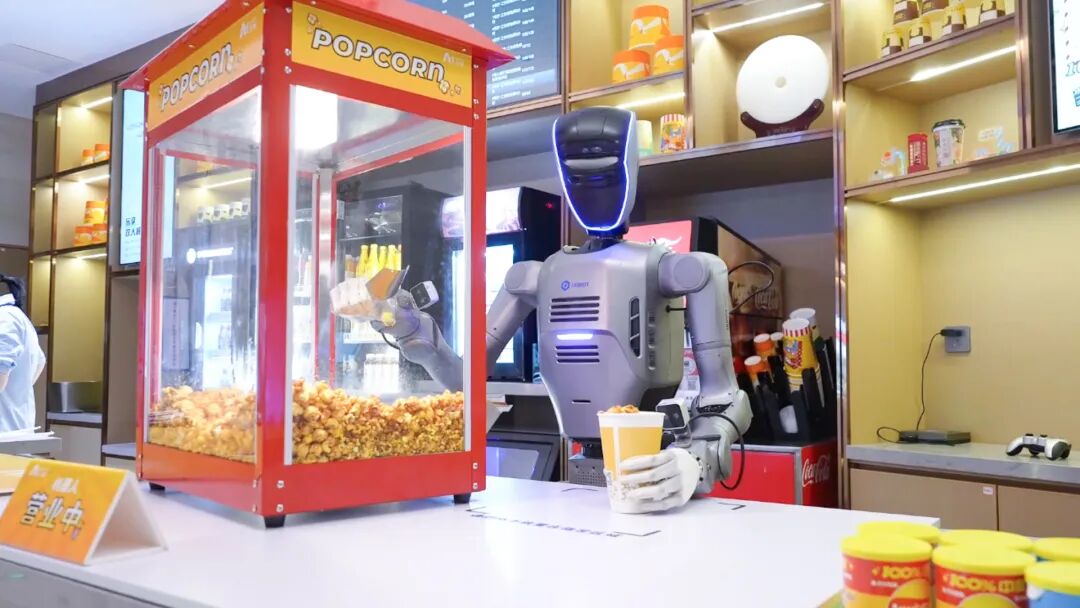
人形机器人上岗打工,连续14小时零失误
21世纪经济报道· 2026-01-05 11:55
Group 1 - The core technology of the Atom robot lies in autonomous task planning and real-time error correction systems, enabling it to decompose and sequence complex tasks like "selling popcorn" [1][2] - The robot can autonomously monitor its state during execution and quickly identify task deviations when encountering unexpected situations, such as spilled popcorn or container displacement [2] - It can perform dynamic re-planning without external instructions, allowing it to correct errors and continue tasks, such as autonomously refilling popcorn when it detects insufficient quantity in the cup [2] Group 2 - The Atom robot operates autonomously for 14 hours a day and can produce over 1,000 cups of popcorn daily [1] - It utilizes the Dobot-VLA end-to-end visual language action model, which integrates visual perception, language understanding, and action generation to convert task instructions into structured reasoning chains [1] - The robot's capabilities include environmental perception, task understanding, order recognition, and status judgment, enabling it to handle disruptions effectively [1]

Kandi Technologies and Zhejiang University Establish Joint Intelligent Robotics Research Center to Strengthen R&D of the Cutting-edge Technology
Globenewswire· 2026-01-05 08:00
Core Insights - Kandi Technologies Group, Inc. has announced a strategic partnership with Zhejiang University to establish the Zhejiang University–Kandi Intelligent Robotics Joint Research Center, marking a significant step in Kandi's R&D roadmap for embodied intelligence [1][2][4] Group 1: Partnership and Research Center - The Center will focus on developing AI core technologies, particularly in intelligent perception and spatial computing, aimed at advancing quadruped robots for security inspection applications [2] - This collaboration combines Zhejiang University's research capabilities with Kandi's strengths in product engineering and intelligent manufacturing, creating a streamlined pipeline from technology development to real-world deployment [2][4] Group 2: Strategic Commitment and Business Optimization - Kandi's CEO emphasized the partnership as a commitment to technological differentiation and a step towards enhancing the company's presence in high-tech areas like intelligent equipment [4] - The establishment of the Center is expected to support Kandi's long-term strategic growth by developing a systematic R&D framework for embodied intelligence and related technologies [4]

人形机器人出货量有望翻倍增长,机器人ETF易方达(159530)获资金持续涌入,规模创历史新高
Mei Ri Jing Ji Xin Wen· 2026-01-05 07:07
Group 1 - The core index of the robot industry, the National Certificate Robot Industry Index, rose by 0.9%, with notable increases in stocks such as Hanwei Technology up over 15% and Tianzhihang-U up over 9% [1] - The robot ETF E Fund (159530) saw a trading volume exceeding 1 billion yuan, with net subscriptions surpassing 130 million shares, marking a new high of 15.2 billion yuan since its inception [1] - The humanoid robot industry has made significant progress over the past year, transitioning from product development to initial commercialization, with projections indicating that 14,000 humanoid robots could be shipped in China by 2026, doubling annually and potentially reaching over 1 million units by 2034 [1] Group 2 - The National Certificate Robot Industry Index focuses on humanoid robots and core components, covering companies like Sanhua Intelligent Control and Lingyi Technology, which together account for approximately 80% of the index, leading other similar indices [2] - Investors can leverage products like the robot ETF E Fund (159530) to gain exposure to opportunities within the humanoid robot industry chain [2]
Aptiv Powers Intelligent Edge Applications From Automotive to Robotics at CES 2026
Businesswire· 2026-01-05 06:01
Core Insights - Aptiv PLC is showcasing its intelligent edge solutions at CES 2026, which enable devices to sense, think, and act in real time, optimizing performance throughout their lifecycle [1][2][16] - The company emphasizes the importance of local data processing at the edge, which enhances response times and system-level optimization [2][16] Automotive Innovations - Aptiv is presenting its next-generation end-to-end (E2E) AI-powered Advanced Driver Assistance Systems (ADAS) platform, aimed at delivering safer and more human-like driving experiences [4][18] - The platform features Gen 8 radars that provide industry-leading range, resolution, and object detection, combined with advanced machine learning algorithms for robust driving solutions [5][18] Digital Cockpit Technologies - The latest Digital Cockpit innovations are designed to enhance safety and in-cabin experiences for both passenger and commercial vehicles, facilitating collaboration between drivers and vehicles during hands-free driving [6][18] - Aptiv's Driver Monitoring System (DMS) and Cabin Monitoring System (CMS) utilize advanced vision and radar sensing to improve safety and reduce complexity in occupant detection [7][18] Connectivity and Collaboration - Aptiv is collaborating with Verizon to explore Cellular Vehicle-to-Everything (C-V2X) technology, integrating 5G connectivity and edge computing to enhance road safety [9][10] - The Aptiv LINC™ Software Platform is designed for real-time embedded features, enabling software-defined vehicles and facilitating advanced functionalities like C-V2X [11][18] Multi-Industry Applications - The CES 2026 pavilion will showcase Aptiv's solutions for robotics and aerospace applications, including AI-powered collaborative robots and next-generation Autonomous Mobile Robots [12][18] - The company is committed to enabling mission-critical applications across various end markets, highlighting its versatility and technological advancements [12][18] Speaking Engagements - Aptiv will host two key discussions at CES 2026, focusing on the impact of edge computing and 5G on the future of mobility and intelligent systems [13][18]


FUTR Partners with Realbotix to Bring AI Agents Into the Physical World
TMX Newsfile· 2026-01-05 05:01
Core Viewpoint - The FUTR Corporation has entered a strategic partnership with Realbotix Corp to integrate its AI Agent platform with Realbotix's robotics technology, aiming to create a human-like interface for users to interact with their personal AI Agents in a physical environment [1][2]. Group 1: Partnership Details - The pilot partnership will enable users to interact with FUTR's AI Agents through a physical interface provided by Realbotix, enhancing user experience with voice, expression, and movement [2]. - The initial robotic AI Agent pilot is expected to commence in the first half of 2026, with plans to evaluate results and explore broader commercial opportunities thereafter [3]. Group 2: Company Overview - FUTR Corporation specializes in high-fidelity AI systems and next-generation payment infrastructure, focusing on unlocking consumer financial potential across various industries [4]. - The company emphasizes a privacy-first, token-enabled platform that allows consumers to manage personal data and automate financial tasks securely [2][4]. Group 3: Realbotix Overview - Realbotix designs and manufactures AI-powered humanoid robots for applications in entertainment, customer service, and companionship, positioning itself as a leader in human-centric robotics [5][6]. - The company's patented technologies enable lifelike expressions and social engagement, enhancing the interaction experience with AI [6].

奥比中光将携“端侧AI之眼”亮相CES 2026,3D视觉赋能具身智能新生态
Xin Lang Cai Jing· 2026-01-05 04:09
Core Viewpoint - The company, Orbbec (688322.SH), will showcase multiple 3D vision products and its robotic manufacturing capabilities at CES 2026, emphasizing its role as a leader in the robotics and AI vision sectors, focusing on the development of "edge AI eyes" to support embodied intelligence and various AI edge devices [1][6]. Product Matrix and Full Chain Layout - Orbbec will launch several new 3D cameras aimed at humanoid robots and outdoor autonomous mobile robots (AMR) during the exhibition, addressing key needs for precise operation perception, complex environment adaptation, and system collaboration [1][3]. - The company will highlight its collaboration with NVIDIA's Jetson Thor platform, which enhances system integration efficiency for robot manufacturers, facilitating faster product deployment from R&D to market [2][7]. - Orbbec's manufacturing capabilities include providing OEM services for various intelligent hardware, significantly reducing product launch cycles and production costs for clients [2][7]. Industry Positioning and Market Opportunities - The company is strategically positioned in the booming sector of embodied intelligence, with humanoid robots and outdoor AMRs gaining traction in various industries, including ports and mining [3][8]. - The global market for 3D vision devices in humanoid robots is projected to reach 160 billion yuan by 2030, driven by the increasing adoption of 3D sensors among leading manufacturers [3][8]. - Orbbec holds approximately 70% market share in China's 3D vision sensor market and 72% in South Korea's commercial and industrial mobile robot market, demonstrating its strong market penetration and commercial viability [4][9]. Historical Development and Achievements - Since its debut at CES in 2014, Orbbec has evolved from showcasing 3D camera products to developing comprehensive solutions, establishing a robust capability matrix that includes core technology, standard products, scene solutions, and manufacturing services [5][10]. - The company has filed nearly 2,000 patents in the 3D perception field, maintaining a leading position in intellectual property reserves globally [10]. - In the first three quarters of 2025, Orbbec reported revenues of 714 million yuan, a year-on-year increase of 103.5%, and a net profit of 108 million yuan, marking a significant turnaround towards high-quality development [6][10].

CES 2026:Ludens AI展示系列陪伴机器人 拥抱后会“升温”
Huan Qiu Wang Zi Xun· 2026-01-05 03:45
Core Viewpoint - Ludens AI showcased two companion robots, Cocomo and Inu, at CES 2026, emphasizing their interactive and affectionate designs aimed at building relationships with users [1] Group 1: Cocomo - Cocomo is a robotic pet designed to follow its owner around the house and respond to voice and touch [1] - The robot features a fluffy egg-shaped body and moves on a wheeled base, with its outer shell temperature close to human body temperature [1] - Cocomo's temperature increases during high-contact interactions, such as hugging, and it communicates through buzzing sounds and other noises [1] - The design intent of Cocomo is to establish a close relationship with its owner over time, learning what makes them laugh, feel comforted, and when to surprise them [1] Group 2: Inu - Inu is a smaller, cute robot described as a "desktop alien toy," intended to remain on the user's desk rather than move between rooms [1] - It interacts with users through audio and motion, with its small tail responding to sound and touch, and its single eye capable of "blinking" [1]
本周交易热度上升,人形板块持续贡献超额收益
Zhong Guo Neng Yuan Wang· 2026-01-05 02:33
Group 1 - The SW auto parts index increased by 2.91% this week, ranking first in the SW automotive sector, with a year-to-date increase of 42.58% since the beginning of 2025 [2][3] - The latest trading day PE (TTM) for the SW auto parts index is at the 79.44% historical percentile, while the PB (LF) is at the 75.50% historical percentile [3] - The robot index rose by 3.73% this week, with a year-to-date increase of 62.08% since the beginning of 2025, outperforming the SW auto parts index by 0.83% [2][3] Group 2 - Key companies' weekly changes include Silver Wheel Co., which invested 380 million yuan in Sichuan Silver Wheel for capacity construction of water-cooled plates and front-end modules, expected to reach production capacity by 2029 [3] - Huada Technology announced a mid-term dividend plan for 2025, proposing a cash dividend of 0.15 yuan per share (tax included), totaling 70.46 million yuan [3] - Fuda Co. completed the transfer of 25% equity in Guilin Fuda Alfin for 48 million yuan [3] Group 3 - The top five companies by weekly increase are Xinquan Co. (+14.05%), Beite Technology (+11.64%), Top Group (+8.26%), Daimai Co. (+8.01%), and New Coordinates (+7.97%) [4] - Investment recommendations for auto parts focus on product-oriented companies and those entering high-value sectors, prioritizing potential leaders with production capacity in Europe, North America, and Southeast Asia [4] - For the robotics sector, the focus is on certainty opportunities, with the Optimus V3 expected to launch in Q1 2026, and attention on domestic applications from companies like Xiaopeng, Yushu, and Zhiyuan [4]