Investment Banking

Search documents
X @Investopedia
Investopedia· 2025-07-16 17:00
Goldman Sachs reported second-quarter revenue and profits that came in well above what analysts had anticipated. https://t.co/RgLqRSRHqH ...

Goldman Gains as Q2 Earnings Beat Estimates, Boosts Dividend 33.3%
ZACKS· 2025-07-16 16:26
Core Insights - The Goldman Sachs Group, Inc. (GS) reported adjusted earnings per share of $10.91 for Q2 2025, exceeding the Zacks Consensus Estimate of $9.43 and up from $8.62 in the same quarter last year [1][9] Financial Performance - Net revenues increased by 15% year over year to $14.6 billion, surpassing the Zacks Consensus Estimate by 8.1% [4] - Net earnings on a GAAP basis rose 22% from the prior-year quarter to $3.7 billion [3] - The Global Banking & Markets division generated revenues of $10.1 billion, a 24% increase year over year, driven by strong performance in Equities and Fixed Income, Currency, and Commodities (FICC) trading [6][9] Segment Performance - Equities revenues surged by 36% year over year to $4.3 billion, while FICC revenues rose by 9% to $3.5 billion [2] - Investment Banking fees increased by 26% year over year to $2.2 billion, supported by strong advisory revenues in the Americas and EMEA [2] - The Asset & Wealth Management division saw revenues decline by 3% year over year to $3.8 billion, attributed to lower net revenues in equity and debt investments [5] Expenses and Capital Management - Total operating expenses rose by 8% year over year to $9.2 billion, with provisions for credit losses increasing by 36% to $384 million [4] - The standardized Common Equity Tier 1 capital ratio decreased to 14.5% from 14.8% year over year, and the supplementary leverage ratio fell to 5.3% from 5.4% [7] Capital Distribution - GS returned $3.96 billion to common shareholders in the reported quarter, including $3 billion in share repurchases and $957 million in dividends [8] - The quarterly dividend was raised by 33.3% to $4.00 per share following the successful completion of the 2025 Fed stress test [10]


PPI Remained Unchanged
ZACKS· 2025-07-16 16:21
Economic Indicators - The Producer Price Index (PPI) for June showed a month-over-month change of 0.0%, which was lower than the expected +0.2% and down from the revised +0.3% of the previous month [2][3] - Year-over-year, the headline PPI increased by +2.3%, which is 30 basis points below expectations and the lowest since +2.1% reported in September of the previous year [4] - Core PPI year-over-year reached +2.6%, slightly below estimates and down 40 basis points from the May figure of +3.0% [4] Financial Sector Performance - Bank of America reported earnings of 89 cents per share, beating expectations by 3 cents, although revenues missed estimates by 0.5% [7] - Goldman Sachs delivered a strong Q2 earnings report with earnings of $10.91 per share, surpassing expectations by +15.7% and revenues of $14.58 billion, exceeding estimates by +8% [8] - Morgan Stanley reported earnings of $2.13 per share and revenues of $16.79 billion, outperforming consensus estimates by +10.36% and +5.5% respectively [9] Company-Specific Highlights - Johnson & Johnson's Q2 earnings beat expectations with earnings of $2.77 per share, exceeding projections of $2.66, and revenues of $23.7 billion, which were higher than the expected $22.80 billion [10]



RBC Capital Markets' Gerard Cassidy: Resiliency of consumer credit quality prevails
CNBC Television· 2025-07-16 15:26
Financial Performance - Bank results were quite good, particularly regarding the resiliency of consumer credit quality [1] - Goldman Sachs' numbers were very strong, especially in equity trading and M&A activity [4] - Year-over-year loan growth has started to pick up for banks in the second quarter [6] Market Trends & Activities - M&A and ECM activity picked up, particularly at the end of the second quarter [2][3] - Loan growth is starting to pick up, evidenced by weekly H8 data from the Fed [6] - There's a broadening of the possibility when it comes to acquisitions, though with a high bar [12][13] Regulatory Environment - The regulatory approach is becoming less onerous, evidenced by changes to the supplementary leverage ratio and positive stress test results [8][9] - Basel 3 endgame final capital rules are expected to be less onerous than the original proposal [9] - The ability for banks to give back more excess capital is increasing [10] Investment Outlook - Some deregulation benefits are factored into stock valuations, but not entirely due to uncertainty about the Basel 3 endgame [11] - High valuations and excess capital levels could lead to more acquisitions by large investment banks or regional banks [13]

摩根士丹利:中国思考-GDP:年度预测上调,但增长动能减弱
摩根· 2025-07-16 15:25
Investment Rating - The report raises the full-year 2025 GDP growth forecast to 4.8% from a previous estimate, indicating a positive outlook despite anticipated slower growth in the second half of the year [1][3]. Core Insights - The report highlights a stronger-than-expected real GDP growth of 5.2% year-on-year in the second quarter, driven by fiscal measures and local government bond issuance [2][3]. - However, a slowdown in growth is expected in the second half of 2025, with projections of 4.5% in the third quarter and 4.2% in the fourth quarter due to weaker exports, fading fiscal impulse, and ongoing deflation [3][11][12]. Summary by Sections Economic Growth - The report notes that the net impact of fiscal rollout has been more positive compared to export front-loading, with 85% of Rmb2 trillion in bonds issued in the first half of the year to alleviate local government liquidity stress [2][3]. - The anticipated slowdown in export growth is expected to drag GDP growth by 60-70 basis points in the second half, with a significant impact from earlier export front-loading [3][4]. Fiscal Policy - The fading fiscal impulse is highlighted, as the front-loaded nature of government bond issuance in the first half means less fiscal support in the second half, especially compared to a high base from the previous year [11][12]. - An additional fiscal package is expected in the fall, estimated at Rmb0.5-1 trillion, but this is considered relatively small given the current economic context [11][12]. Deflationary Pressures - The report emphasizes the persistence of deflation, with nominal GDP growth falling to 3.9% year-on-year in the second quarter, indicating weaker corporate earnings and potential impacts on household consumption [12][13]. - The GDP deflator is projected to remain subdued, with expectations of -0.9% year-on-year in the second half of 2025 and -0.7% in 2026, reflecting ongoing deflationary pressures [13].
American Trust Investment Services Serves as Sole Underwriter for K-TECH Solutions Co., Ltd. IPO
Prnewswire· 2025-07-16 15:23
Core Insights - American Trust Investment Services, Inc. (ATIS) successfully executed the initial public offering (IPO) of K-TECH Solutions Co., Ltd. on Nasdaq, marking a significant achievement in capital markets [1][5] - The IPO involved the offering of 1,600,000 ordinary shares at a price of $4.00 per share, generating gross proceeds of $6.4 million before any discounts and expenses [2] - K-TECH Solutions specializes in educational toys and learning kits, with a diverse product range serving customers in North America, Europe, and other markets [3] Financial Details - The offering generated gross proceeds of $6.4 million, with an additional 240,000 shares available for purchase by the underwriter to cover over-allotments [2] - The net proceeds from the offering will be allocated for product development, production capacity expansion, and general corporate purposes [4] Company Background - ATIS is a leading investment bank providing tailored capital markets solutions for both emerging and established companies, with a strong focus on IPOs and follow-on offerings [6] - The firm is recognized for its hands-on approach and extensive experience in guiding businesses through complex financial transactions [6]


X @Bloomberg
Bloomberg· 2025-07-16 15:07
Market Expansion - Goldman Sachs is negotiating to include its private-market investments in US retirement funds [1] - The move aims to broaden access to the Wall Street firm's products for more mainstream investors as regulations become more flexible [1]
Morgan Stanley(MS) - 2025 Q2 - Earnings Call Transcript
2025-07-16 13:30
Financial Data and Key Metrics Changes - For Q2 2025, the company reported revenues of $16.8 billion, EPS of $2.13, and a return on tangible equity (ROTCE) of 18.2% [6][12] - Year-to-date revenue reached $34.5 billion, with EPS of $4.73 and ROTCE of 20.6% [6] - The firm has achieved six consecutive quarters of durable earnings, indicating consistent performance across varying market conditions [6] Business Line Data and Key Metrics Changes - Wealth and Investment Management saw total client assets increase to over $8.2 trillion, with a record profit before tax of $2.2 billion and margins exceeding 28% [7][22] - Institutional Securities generated revenues of $7.6 billion, with equity markets contributing $3.7 billion despite a slowdown in activity during part of the quarter [8][14] - Investment banking revenues were $1.5 billion, with a notable rebound in equity underwriting, while fixed income underwriting revenues were $532 million, reflecting a decline from the previous year [15][16] Market Data and Key Metrics Changes - The company noted a strong performance in Asia and EMEA regions, contributing to the overall revenue growth in institutional securities [14] - The investment banking pipeline remains healthy, with increased activity expected as market conditions stabilize [32] Company Strategy and Development Direction - The company is focused on generating returns on incremental capital deployment and investing for growth across its integrated firm globally [6][10] - Management emphasized the importance of deepening client relationships and expanding lending capabilities, particularly in wealth management and investment banking [37][38] - The firm is also exploring inorganic growth opportunities that align with its core strategy, while maintaining a high bar for acquisitions [40][81] Management's Comments on Operating Environment and Future Outlook - Management expressed a constructive outlook on the market environment, anticipating continued growth in wealth and investment management despite ongoing economic and geopolitical uncertainties [11][31] - The firm is witnessing increased client engagement and a willingness to navigate market volatility, which is expected to support future performance [9][44] Other Important Information - The company announced a quarterly dividend increase to $1 per share, reflecting its commitment to returning capital to shareholders [10][31] - Total spot assets increased by $54 billion from the prior quarter, with a standardized CET1 ratio of 15% [30] Q&A Session Summary Question: Thoughts on incremental return on capital and regulatory environment - Management highlighted the potential for increased profitability through regulatory reform and organic growth in investment banking and wealth management [36][40] Question: Impact of tariff policy on corporate sentiment - Management noted that if tariff policies remain within expected parameters, it could clear uncertainty and lead to increased strategic activity [44] Question: Inorganic growth opportunities - Management stated that any acquisitions must align with the core strategy of raising, managing, and allocating capital for clients, with a focus on organic growth [48][50] Question: Net new assets and advisor recruitment - Management reported strong net new assets driven by workplace channels and emphasized the strength of recruiting across all channels [52][54] Question: Stablecoins and market structure legislation - Management is actively discussing the implications of stablecoin legislation and its potential impact on the business [62][64] Question: Market backdrop and trading environment - Management indicated that the trading environment has been resilient, with strong retail engagement and inflows across various channels [70][72] Question: Asset management and capital deployment - Management acknowledged the potential for growth in asset management but emphasized the focus on organic opportunities within existing businesses [78][80] Question: Net interest income in a lower rate environment - Management discussed the potential for increased lending balances to offset lower rates, indicating a stable outlook for net interest income [82][83] Question: Lending through capital markets division - Management noted a shift in lending dynamics and the potential for increased participation in corporate lending as regulatory environments normalize [88][90]
X @The Wall Street Journal
The Wall Street Journal· 2025-07-16 12:53
Goldman Sachs profit surges, fueled by trading and investment banking revenue https://t.co/SWBqc2kqmn ...
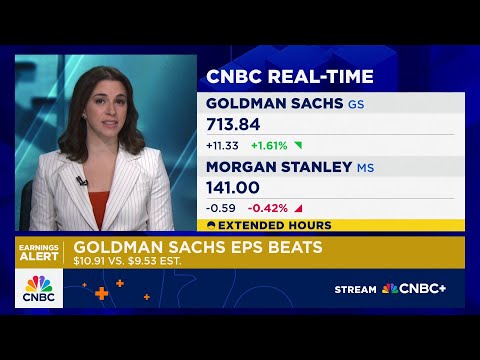
Goldman Sachs, Morgan Stanley earnings top estimates
CNBC Television· 2025-07-16 12:10
Goldman Sachs and Morgan Stanley just releasing quarterly results. I know Goldman Sachs is trading higher. Let's get over to Leslie Per picker.She's looking through the numbers on that. Hey Leslie. Hey Becky.Yeah, Goldman Sachs reporting top and bottom line beats driven by huge gains in the business that advises on acquisitions as well as equity trading. The firm's global banking and markets division which houses those two businesses generated 10 billion in revenue up 24% year-over-year. advisory, which lar ...