Food

Search documents
Cramer's week ahead: New economic data and earnings from FedEx, Jabil
CNBC· 2025-12-12 23:14
Group 1: Economic Data and Market Trends - The Labor Department's nonfarm payroll report is expected on Tuesday, with a strong jobs report potentially questioning the need for more rate cuts from the Federal Reserve, while weaker figures could support continued easing [3] - Wall Street has been largely unaware of macroeconomic data due to a lengthy government shutdown, making upcoming reports critical for market direction [3][2] Group 2: Company Earnings Reports - Jabil, a major manufacturer for data centers, is set to report earnings on Wednesday, which could influence the performance of AI stocks [4] - General Mills will also report on Wednesday, with recent struggles in food stocks attributed to the popularity of GLP-1 weight loss drugs and a shift towards healthier eating [4] - On Thursday, Darden, Cintas, Nike, and FedEx will report earnings, with Darden's Olive Garden chain being less affected by rising beef prices, and FedEx expected to perform well due to ongoing e-commerce growth [5] - Friday will see earnings from Carnival, Conagra, and Paychex, providing insights into discretionary spending, home cooking trends, and the health of small and medium-sized businesses [6]



Analysts set Campbell's stock price target
Finbold· 2025-12-12 15:57
Core Viewpoint - Campbell's shares have reached a 16-year low, trading at $28.58, a decline of nearly 7% since the '3D printed meat' controversy [1][2] Stock Performance - The ongoing slump has erased all gains made over the past four years, with the stock trading well below its 2022 and 2023 averages [2] Analyst Ratings and Price Targets - DA Davidson lowered Campbell's stock price target from $32 to $30 while maintaining a "Neutral" rating, citing weakness in consumer spending and competition in the food sector [5] - Deutsche Bank adjusted its price target to $31 from $33, keeping a "Hold" rating, while RBC Capital cut its target from $35 to $30 with a "Sector Perform" rating [6] - Bernstein lowered its target from $39 to $33 but maintained a "Buy" rating, believing the company's products align with consumer trends [8] - Stifel Nicolaus and Wells Fargo both lowered their price outlooks to $30, opting for a "Hold" rating [9] Market Sentiment - The average stock price target for Campbell's over the next 12 months has an upside potential of 8.47%, sitting at $31.13 [12] - Overall, the sentiment among analysts is mixed, with ten "Hold" ratings, three "Sell" ratings, and only two "Buy" ratings from Bernstein and Stephens [10]


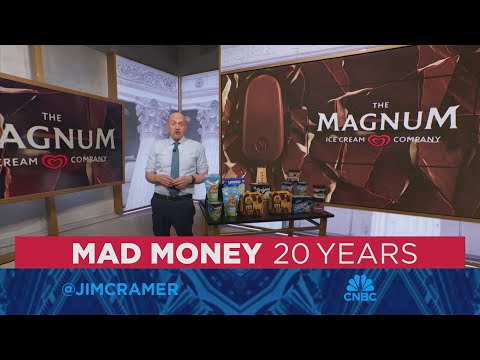
Magnum Ice Cream might be worth more as an independent company, says Jim Cramer
CNBC Television· 2025-12-12 00:11
Earlier this week, Unilver spun off its ice cream business as the Magnum Ice Cream Company, MICC, for all you home gamers, creating the first pure play ice cream stock that I can recall. Unilver announced this nearly two years ago, but to be honest, I really didn't pay a lot of attention to it. So, it took me by surprise when I came into work yesterday to see this multi-story tall banner of ice cream outside the New York Stock Exchange with free samples flowing ON THE FLOOR.CLAWIKE BARS FOR ALL. I'm still m ...
Darling Ingredients and Tessenderlo Group Sign Definitive Agreement to form New Company to Accelerate Growth in Attractive Collagen-Based Health, Wellness and Nutrition Sector
Businesswire· 2025-12-10 21:35
Core Viewpoint - Darling Ingredients Inc. and Tessenderlo Group have signed a definitive agreement to combine their collagen and gelatin segments into a new company, aiming to leverage global collagen market growth without requiring cash or initial investment from either party [1][2]. Group 1: Joint Venture Details - The new company will merge Darling Ingredients' Rousselot business with Tessenderlo Group's PB Leiner business, with Darling holding an 85% ownership stake and Tessenderlo holding 15% [2]. - The combined entity is projected to generate approximately $1.5 billion in annual revenue and will have a total gelatin and collagen capacity of about 200,000 metric tons across 22 facilities in South America, North America, Europe, and Asia [2]. Group 2: Strategic Benefits - The integration is expected to create significant synergies and opportunities to develop the Nextida product portfolio, which aims to deliver targeted health benefits and enhance earnings potential [3]. - The partnership is anticipated to foster growth and enhance shareholder value for Darling Ingredients, as collagen is identified as the fastest-growing segment within its food division [4]. Group 3: Company Backgrounds - Darling Ingredients is a leader in circularity, processing about 15% of the world's animal agricultural by-products and producing approximately 30% of the world's collagen [5]. - Tessenderlo Group operates in over 100 countries, focusing on agriculture, bio-residual valorization, and industrial solutions, employing more than 7,000 people globally [6].


Sugar-free versions of Oreos to be sold in U.S. for first time in January
NBC News· 2025-12-10 16:34
Product Innovation - Oreo Zero Sugar and Oreo Double Stuff Zero Sugar will launch in the US in January [1] - The no sugar Oreos took four years to develop to maintain the original taste [1] Health & Consumer Trends - Regular Oreos contain 13 grams of added sugars, representing 26% of the daily recommended amount [1] - New Oreo Zero Sugar products will contain zero added sugars [1] Market Expansion - Oreo Zero Sugar products are already sold in Europe and China [1]

Campbell Soup Company (NASDAQ:CPB) Surpasses Earnings Estimates
Financial Modeling Prep· 2025-12-09 18:00
Core Insights - Campbell Soup Company reported earnings per share of $0.77, surpassing the estimated $0.73, indicating strong financial performance [1][6] - The company achieved a revenue of approximately $2.68 billion, exceeding the estimated $2.66 billion, driven by strong consumer demand for its products [2][6] - CEO Mick Beekhuizen highlighted the effectiveness of Campbell's in-market execution and reaffirmed guidance for fiscal year 2026, reflecting confidence in the company's strategic direction [3][6] Financial Metrics - Campbell's P/E ratio is approximately 14.87, suggesting a reasonable valuation compared to its earnings [4] - The price-to-sales ratio is about 0.87, indicating the market's valuation of its sales [4] - The enterprise value to sales ratio is around 1.56, reflecting the company's total valuation in relation to its sales [4] - The enterprise value to operating cash flow ratio is approximately 14.03, providing insight into cash flow efficiency [4] Investment Considerations - The earnings yield of 6.72% offers a return on investment relative to the share price [5] - The debt-to-equity ratio of 1.85 indicates a higher reliance on debt financing compared to equity [5] - The current ratio of 0.77 highlights the company's ability to cover short-term liabilities with short-term assets, suggesting areas for potential improvement in liquidity management [5]
Dow Surges Over 100 Points; Campbell's Posts Upbeat Earnings
Benzinga· 2025-12-09 14:43
Market Overview - U.S. stocks exhibited mixed trading patterns, with the Dow Jones index increasing by over 100 points, up 0.25% to 47,857.83, while the NASDAQ decreased by 0.31% to 23,474.03 and the S&P 500 fell by 0.02% to 6,845.04 [1] - Energy shares experienced a notable rise of 1.1%, while communication services stocks declined by 0.5% [1] Company Earnings - Campbell's Co (NASDAQ:CPB) reported first-quarter earnings of 77 cents per share, surpassing the analyst consensus estimate of 73 cents per share. The company also achieved quarterly sales of $2.677 billion, exceeding the consensus estimate of $2.657 billion [2] Commodity Market - In commodity trading, oil prices decreased by 0.2% to $58.78, while gold prices increased by 0.1% to $4,219.80. Silver rose by 1.3% to $59.150, whereas copper fell by 2.3% to $5.3195 [4] European Market Performance - European shares showed mixed results, with the eurozone's STOXX 600 declining by 0.1%. Spain's IBEX 35 Index rose by 0.1%, London's FTSE 100 increased by 0.1%, Germany's DAX 40 gained 0.3%, and France's CAC 40 fell by 0.6% [5] Asian Market Performance - Asian markets closed predominantly lower, with Japan's Nikkei rising by 0.14%, while Hong Kong's Hang Seng fell by 1.29%, China's Shanghai Composite decreased by 0.37%, and India's BSE Sensex declined by 0.51% [6] Job Market - U.S. private employers added an average of 4,750 jobs per week during the four weeks ending November 22 [7] Stock Movements - Netcapital Inc (NASDAQ:NCPL) shares surged by 90% to $1.25. Exicure Inc (NASDAQ:XCUR) shares increased by 68% to $8.94 following positive Phase 2 trial results. AlphaVest Acquisition Corp (NASDAQ:ATMV) shares rose by 62% to $12.71. Conversely, Top Wealth Group Holding Ltd (NASDAQ:TWG) shares dropped by 69% to $6.74 after announcing a public offering. Orangekloud Technology Inc (NASDAQ:ORKT) shares fell by 44% to $1.31, and Safe and Green Development Corp (NASDAQ:SGD) decreased by 40% to $0.42 [8]