地质调查

Search documents
地质调查局发布我国东北地区黑土地“家底儿”,总体稳定性较好
Xin Jing Bao· 2025-06-25 04:10
Core Insights - The National Land Day event highlighted the results of a surface substrate survey conducted by the China Geological Survey in Northeast China, covering 83 key black soil protection counties, with a total area of 411,700 square kilometers [1] - The survey, initiated in 2021, involved an investment of 107 million yuan, with 711 personnel and 538 sets of equipment, resulting in the collection of 184,643 samples and the analysis of 115 indicators [1] - The survey identified a black soil resource distribution area of 387,500 square kilometers, with an average surface black soil thickness of 56.85 centimeters, and some points reaching up to 610 centimeters [1] Summary by Categories Black Soil Resource Stability - The evaluation of black soil resource stability was based on six indicators, revealing that the stable area is 162,500 square kilometers, accounting for 39.48% of the surveyed area, a decrease from the previous stable area of 192,900 square kilometers [2] - The total carbon storage in the top 2 meters of the surface substrate layer was calculated to be 3.401 billion tons, with organic carbon accounting for 2.117 billion tons [2] - The carbon storage from 0 to 20 centimeters was 612 million tons, representing 18% of the total carbon storage in the top 2 meters [2] Surface Substrate Layer Configuration - The survey provided insights into how the surface substrate layer configuration affects black soil resources, with different substrate types showing varying average thicknesses and organic matter contents [3] - Rock substrates had an average black soil thickness of 39.06 centimeters, while clay substrates had the highest average thickness of 70.03 centimeters [3] - The study indicated a close relationship between substrate configuration and black soil degradation issues, offering new perspectives for addressing soil erosion, land desertification, and salinization in black soil areas [3]
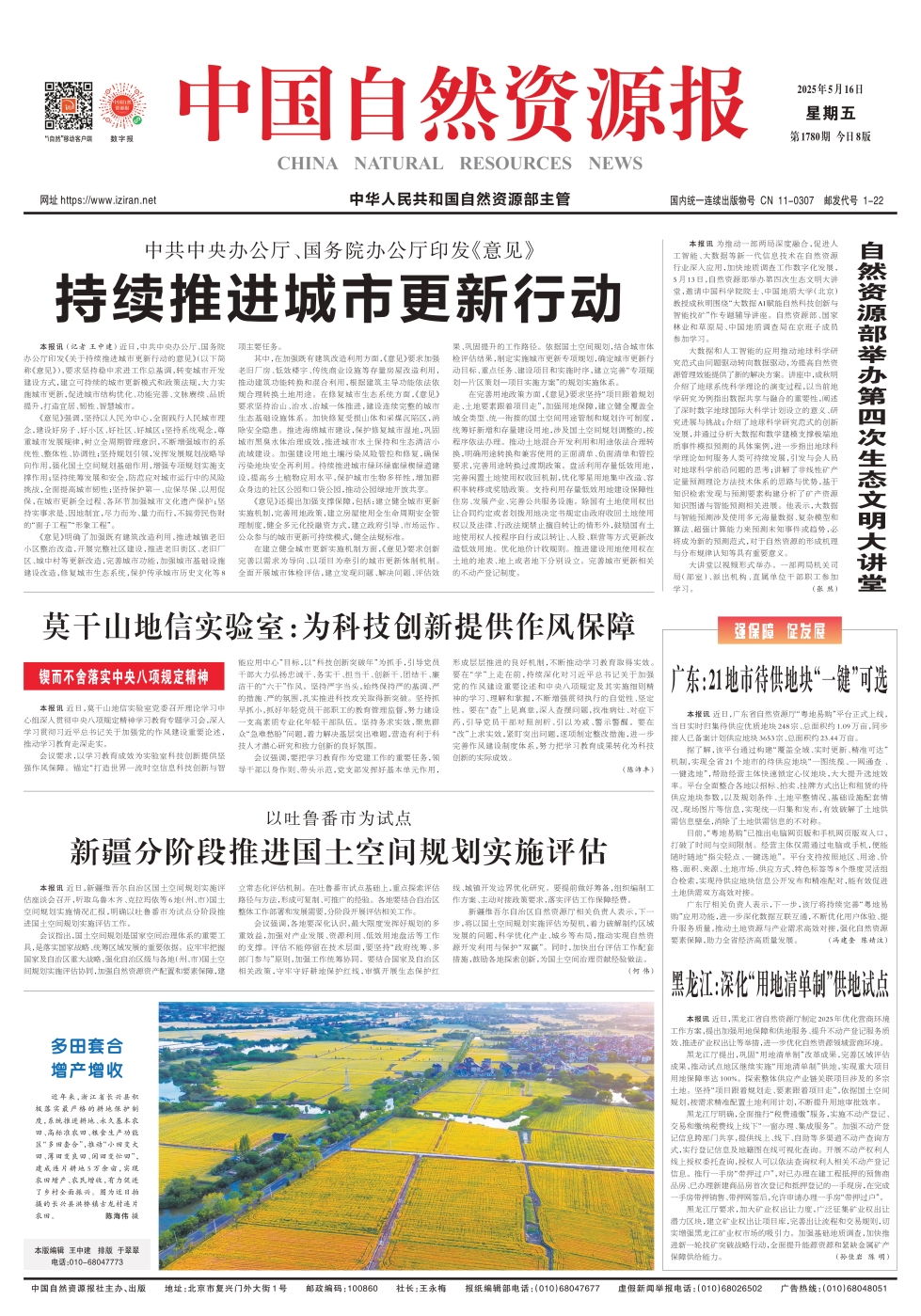
莫干山地信实验室:为科技创新提供作风保障
Zhong Guo Zi Ran Zi Yuan Bao· 2025-05-16 02:32
Group 1 - The core viewpoint emphasizes the importance of learning and implementing the spirit of the Central Eight Regulations to enhance the work style and innovation capabilities of the Mogan Mountain Geoinformation Laboratory [1][10] - The meeting highlighted the goal of creating a world-class center for spatiotemporal information technology innovation and intelligent applications, focusing on a "breakthrough year for technological innovation" [1][10] - The laboratory aims to cultivate a high-quality, professional, and youthful cadre team while addressing pressing issues faced by the public to foster an environment conducive to scientific research and innovation [1][10] Group 2 - The meeting stressed the need for continuous education as a key task in party building, with leaders setting an example and party branches playing a fundamental role [2] - It called for a proactive approach in learning, identifying issues, and implementing effective reforms to translate educational outcomes into tangible results in technological innovation [2][10] - The emphasis was placed on maintaining a strict and serious atmosphere to ensure effective progress in scientific research and problem-solving [1][2][10] Group 3 - The "Opinions" issued by the Central Government focus on promoting urban renewal actions, emphasizing sustainable development and the creation of resilient, smart cities [5][6] - The document outlines the need for a systematic approach to urban development, prioritizing the protection of cultural heritage and enhancing urban infrastructure [5][6] - It also highlights the importance of integrating public participation and market operations in urban renewal processes to ensure effective implementation [6][7]