
测绘

Search documents
“度”量中国这五年:以科技创新丈量中国“高度”
Zhong Guo Xin Wen Wang· 2025-10-17 06:01
Core Insights - The article highlights China's significant advancements in space exploration and technology innovation over the past five years, particularly during the "14th Five-Year Plan" period [3][6]. Group 1: Space Exploration Achievements - China's space station has been fully constructed and is now in the application and development phase, having hosted 9 crewed missions and 6 "space rendezvous" events, with a total of 23 astronauts and 27 spaceflights [3]. - The Chang'e 6 mission marked the first successful sample return from the far side of the moon, showcasing China's capabilities in lunar exploration [3]. - The establishment of China's first commercial space launch site and the initiation of the first asteroid exploration mission further solidify China's status as a major space power [3]. Group 2: Technological Innovations - The article emphasizes the role of technological innovation in measuring the height of Mount Everest, which has seen advancements from traditional triangulation to satellite remote sensing and intelligent calculations [4][5]. - Innovations in intelligent surveying technology are being applied in various fields, including emergency mapping and spatial planning, contributing to the construction of a digital China [5]. Group 3: Research and Development Growth - China's total number of R&D personnel ranks first globally, with a significant proportion of young scientists leading key projects, indicating a robust and dynamic research environment [6]. - Basic research funding reached 249.7 billion RMB in 2024, reflecting a growth of over 70% since 2020, which is crucial for establishing a strong foundation for scientific advancement [6]. - The number of highly cited papers from China accounts for about one-third of the global total, maintaining the country's position as the second-largest contributor in this area for four consecutive years [6]. Group 4: Future Strategic Goals - The article outlines strategic goals set by the 20th National Congress of the Communist Party of China, aiming for high-level self-reliance in technology and the establishment of a strong technological nation by 2035 [6]. - Plans for the next five years include the development of major national science and technology projects, the establishment of verification platforms, and the continuation of the "Belt and Road" technology innovation action plan [6].

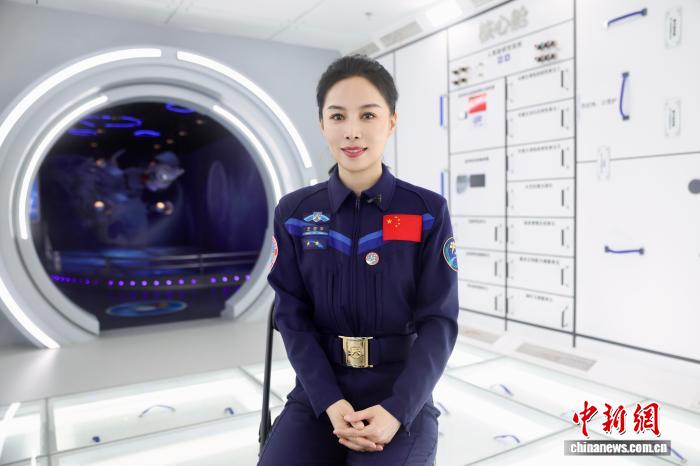
济宁市勘测院4项成果获山东省优秀测绘地理信息工程奖
Qi Lu Wan Bao Wang· 2025-10-17 02:29
Core Points - The Shandong Provincial Surveying and Mapping Geographic Information Association announced the results of the 2025 Excellent Surveying and Mapping Geographic Information Engineering Award, with the Jining Surveying Institute winning four awards, including one second prize and three third prizes [1] - The project "Obstacle Investigation and Comprehensive Surveying Technical Service for Jining Da'an Airport" received the second prize, while three projects, including "Completion Survey of Jining Jimei Liyue Project Planning," won third prizes [1] - The Jining Surveying Institute adheres to the principle of "quality first, innovative development," continuously introducing new technologies and methods, strengthening talent development, and enhancing project management [1] - The institute aims to optimize its technical system and enhance core capabilities such as real-time 3D modeling and spatiotemporal data analysis to support the high-quality development of natural resources and planning in Jining City [1]
测绘地理信息创新发展先行区建设交流会召开
Zhong Guo Zi Ran Zi Yuan Bao· 2025-10-13 08:22
Core Insights - The meeting focused on the construction of the Innovation Development Pilot Zone for Surveying and Geographic Information, aiming to enhance collaboration and promote the innovative development of the industry [1][2] - The construction of the pilot zone is seen as a key measure to support the implementation of responsibilities related to "two unifications" and to facilitate the transformation and upgrading of the surveying and geographic information sector [1] Group 1 - The meeting discussed key tasks, challenges, and practical paths for the construction of the pilot zone, emphasizing the need for focused directions and collaborative efforts [1] - The China Academy of Surveying and Mapping reported on the preliminary organization of the pilot zone construction and analyzed the intentions of various regions regarding construction achievements [1] - Representatives from multiple regions, including Beijing, Shanghai, and Guangdong, shared their progress, existing issues, and expected outcomes related to the pilot zone [1] Group 2 - The meeting outlined three main approaches to advance the pilot zone construction: integrating basic surveying data with natural resource management and socio-economic development data, enhancing technological innovation, and creating replicable and promotable typical achievements [2] - Emphasis was placed on breaking down data barriers to ensure that surveying results are actively utilized and to promote the transformation and upgrading of the surveying and geographic information sector [2] - The goal is to establish a solid foundation for the development of the surveying and geographic information sector during the "14th Five-Year Plan" period by increasing public awareness and application levels [2]
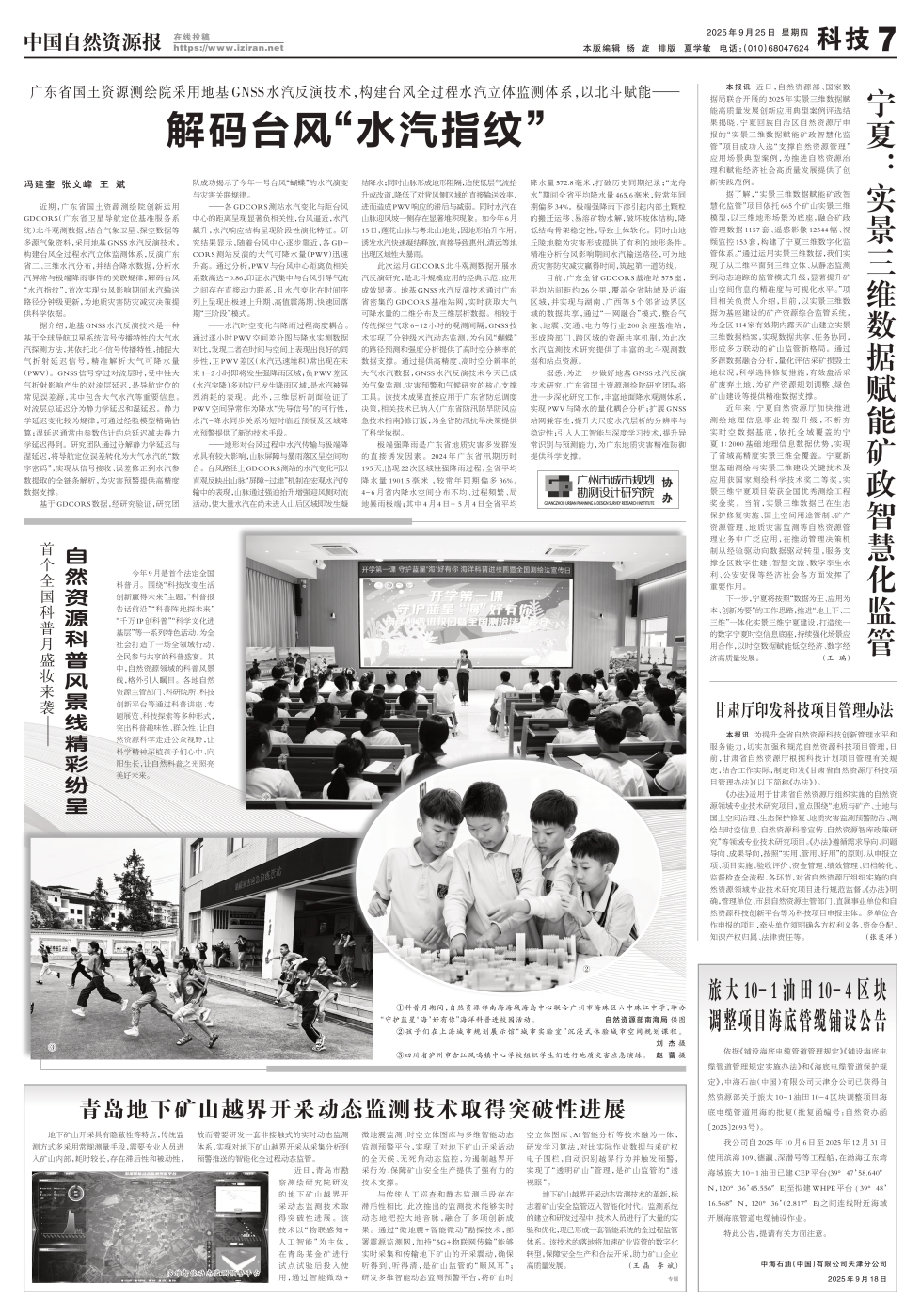
解码台风“水汽指纹”
Zhong Guo Zi Ran Zi Yuan Bao· 2025-09-25 01:27
Core Viewpoint - The Guangdong Provincial Land Resources Surveying and Mapping Institute has innovatively utilized GDCORS (Guangdong Satellite Navigation Positioning Reference Service System) data to establish a comprehensive monitoring system for typhoon-related water vapor, providing scientific support for geological disaster prevention and mitigation. Group 1: Technology and Methodology - The ground-based GNSS water vapor inversion technology captures atmospheric refractive delay signals to accurately analyze Precipitable Water Vapor (PWV) [1][4] - This technology allows for minute-level updates of water vapor transport paths during typhoon events, significantly enhancing disaster warning capabilities [1][4] - The GDCORS network consists of 575 stations with an average spacing of approximately 26 kilometers, covering the entire province and facilitating data sharing with neighboring provinces [5][12] Group 2: Findings and Analysis - The study revealed a significant negative correlation (-0.86) between water vapor changes at GDCORS stations and the distance to the typhoon center, indicating a direct dynamic relationship [2][9] - Water vapor changes exhibit a three-phase pattern in relation to typhoon proximity: rapid increase, high-value oscillation, and quick decline [2][9] - The spatial and temporal changes in water vapor are highly coupled with rainfall processes, providing new technical means for short-term forecasting and regional precipitation warnings [2][9] Group 3: Impact of Geography - Topography significantly influences water vapor transport and extreme precipitation during typhoons, with mountain barriers affecting the distribution of rainfall [3][10] - The study highlighted that the presence of mountains can enhance convective activity on the windward side, leading to significant water vapor accumulation and precipitation before reaching the leeward side [3][10] Group 4: Application and Future Directions - The GNSS water vapor inversion technology has become a core tool for meteorological monitoring, disaster warning, and climate research, directly applied in provincial disaster management strategies [4][11] - Future research will focus on enhancing the ground precipitation observation system, improving the compatibility of GNSS networks, and integrating artificial intelligence for better anomaly detection and prediction capabilities [6][12]
我国首个低空高光谱遥感数据获取行业标准发布
Zhong Guo Zi Ran Zi Yuan Bao· 2025-09-22 11:45
Core Points - The newly approved standard for low-altitude hyperspectral remote sensing data acquisition is the first of its kind in China, set to be implemented on December 1, 2025 [1] - The standard addresses long-standing issues in the industry, including the lack of guiding standards, inconsistent technical processes, varying equipment performance, and significant differences in result quality [1] Group 1 - The standard was developed over nearly five years, initiated in 2020, involving multiple rounds of research, technical discussions, experiments, and expert validations [1] - It unifies technical standards, fills a gap in the industry, and provides a reference for production operations in related projects [1] - The standard clarifies technical parameters, serving as a basis for the development of related software and hardware products [1] Group 2 - The implementation of the standard is expected to enhance the quality and reliability of results, supporting more precise applications [1] - The standard will accelerate technological innovation and application, empowering industry development [1] - Low-altitude hyperspectral remote sensing technology is widely applied in various fields, including precision agriculture, ecological environment monitoring, mineral resources exploration, and emergency mapping [2]
【省测绘局】陕西开展自然灾害综合风险基础数据更新工作
Shan Xi Ri Bao· 2025-09-21 22:48
Group 1 - The Natural Resources Department's Second Topographic Survey Team is conducting a comprehensive risk data update for natural disaster prevention in Shaanxi Province, involving multiple industries and covering 23 core data categories across 107 counties [1][2] - The data update includes major disaster-causing data, disaster-bearing body data, comprehensive disaster reduction resources, key hazard data, historical disaster data, assessment and zoning product data, and basic base maps [1] - A "three-level linkage" mechanism is being implemented to promote the work, with technical standards established and training organized for local counties to ensure data quality through a "dual-check" system [1][2] Group 2 - The Second Topographic Survey Team is utilizing software-assisted quality inspection to build a robust data quality control system, ensuring high-quality data collection, updating, and storage [2] - Strict data security management responsibilities are being enforced, including the establishment of confidentiality management systems and training to prevent data leaks [2] - The team emphasizes the principles of "quality first, safety paramount, and application-based" to provide solid data support for building a comprehensive disaster prevention system in Shaanxi Province [2]
陕西推动工程建设项目“多测合一”
Shan Xi Ri Bao· 2025-09-21 22:48
Core Points - The article discusses the implementation of the "Multi-Measurement Integration" approach in engineering construction projects in Shaanxi Province, aimed at streamlining measurement processes and improving efficiency [1] Group 1: Implementation Details - The "Multi-Measurement Integration" implementation plan has been jointly developed by several provincial departments, including the Natural Resources Department and the Housing and Urban-Rural Development Department [1] - The plan outlines the overall requirements and applicable scope of the "Multi-Measurement Integration" initiative, aiming to optimize and consolidate measurement tasks in phases [1] - The initiative seeks to ensure that the same object is measured only once, providing necessary measurement results for planning, land use, housing management, and registration [1] Group 2: Responsibilities and Management - Responsibilities for the "Multi-Measurement Integration" reform are assigned to the Natural Resources and Housing and Urban-Rural Development departments, with other relevant departments contributing according to their roles [1] - The management system for "Multi-Measurement Integration" is detailed, emphasizing a market access principle of "non-prohibition means entry," which aims to make the measurement service market more transparent and open [1] - The plan specifies requirements for credit and supervision management, as well as for the quality and sharing of measurement results [1] Group 3: Future Applications and Goals - The Natural Resources Department plans to collaborate with relevant departments to unify technical standards and promote information management, expanding the application scenarios of the reform [1] - The initiative aims to enhance the sharing and mutual recognition of measurement results, improve approval efficiency, and reduce the burden on enterprises [1] - The overall goal is to inject new momentum into optimizing the business environment in the province [1]
河南省测绘条例(2025年9月7日河南省第十四届人民代表大会常务委员会第十九次会议通过)
He Nan Ri Bao· 2025-09-19 23:58
Core Viewpoint - The "Henan Province Surveying and Mapping Regulations" aims to enhance surveying work, promote the development of the geographic information industry, and ensure high-quality service for economic and social development, effective from December 1, 2025 [2][43]. Chapter Summaries Chapter 1: General Principles - The regulations are established to strengthen surveying work and meet the public's needs for a better life, aligning with national laws [3]. - The regulations apply to all surveying activities within the province and emphasize the importance of data sharing and application [4]. - The government is tasked with integrating surveying into economic and social development plans [4][5]. Chapter 2: Surveying Standards and Systems - The establishment of independent coordinate systems for major projects requires approval from relevant authorities [9]. - A unified satellite navigation positioning service system will be established to provide public services [12]. Chapter 3: Basic Surveying and Other Surveys - Basic surveying is recognized as a public service and is managed at different administrative levels [16]. - The provincial government is responsible for organizing various basic surveying projects, including the maintenance of control networks and the creation of geographic information databases [17][18]. Chapter 4: Surveying Results - Surveying results must be submitted to the relevant authorities, ensuring data security and compliance with national standards [25][26]. - The regulations stipulate that surveying results should be updated regularly to meet the needs of government decision-making and public service [20]. Chapter 5: New Surveying Applications - The government is encouraged to support the development of new surveying technologies and applications, promoting the integration of geographic information into various sectors [31][34]. - There is a focus on enhancing public service capabilities through improved geographic information infrastructure [32]. Chapter 6: Supervision and Management - The regulations establish a framework for the supervision of surveying activities, including quality control and compliance with legal standards [36][37]. - Measures are outlined for addressing violations of the regulations, ensuring accountability among surveying units [38][39]. Chapter 7: Legal Responsibilities - Specific penalties are defined for non-compliance with the regulations, including fines for failing to adhere to technical standards [56][57]. Chapter 8: Supplementary Provisions - The regulations will replace the previous "Henan Province Surveying Management Regulations" and will take effect on December 1, 2025 [43].
枣庄测绘基础设施全面升级,提供24小时毫米级测绘测量导航定位
Qi Lu Wan Bao Wang· 2025-09-11 07:41
Core Insights - The press conference highlighted significant advancements in the surveying and mapping sector in Zaozhuang City, emphasizing the successful establishment of a comprehensive surveying infrastructure and the increasing richness of mapping data [1][2]. Group 1: Policy and Investment - The Zaozhuang Natural Resources and Planning Bureau has implemented various policies, including the "14th Five-Year" Basic Surveying Plan and emergency response plans, leading to a gradual improvement in the legal and regulatory framework for surveying [2]. - A total investment of 15.2 million yuan has been made in basic surveying since the beginning of the "14th Five-Year" period, focusing on major projects such as aerial imagery acquisition and updating basic geographic information data [2]. Group 2: Infrastructure and Capabilities - The city has established a complete planar control network and elevation control network, with 218 measurement markers of various grades, and a satellite positioning continuous operation reference station system that supports the BeiDou system [2][3]. - The surveying infrastructure now offers full coverage, real-time services, and standardized data systems, marking three significant breakthroughs in service capabilities [2]. Group 3: Data Acquisition and Products - The city has acquired a total of 1,397 GB of provincial basic surveying data and produced 1,571 GB of its own, significantly expanding the scale and types of data resources available [3]. - Traditional surveying results have been enhanced, achieving full coverage of 0.5-meter resolution orthophotos and digital terrain models across the city, along with large-scale topographic maps updated regularly [3]. Group 4: Remote Sensing and Public Services - The establishment of the Zaozhuang City-level node of the Shandong Province Natural Resources Satellite Application Technology Center has led to a "zero breakthrough" in satellite remote sensing image acquisition, with quarterly updates of 0.8-meter resolution images [4]. - The bureau has published various thematic maps and provided over 61,000 maps to the public, supporting key projects such as airport site selection and land space planning [4].
AI加持,湖南打造“调查监测大脑”
Zhong Guo Zi Ran Zi Yuan Bao· 2025-09-05 04:43
Core Insights - The article highlights the integration of artificial intelligence and modern surveying technologies in Hunan Province, creating a comprehensive monitoring system that enhances governance capabilities and efficiency in natural resource management [2][4][10]. Group 1: Technological Integration - Hunan Province has developed a "Sky-Ground Network" monitoring system that integrates over 100 satellites and more than 200 drones, along with 25,000 video monitoring stations, to enhance real-time data collection and analysis [1][4]. - The "Investigation and Monitoring Brain" serves as the central hub of this system, incorporating six modules: perception, interconnection, scheduling, analysis, service, and management, which utilize AI, cloud computing, and big data [4][5]. - The system has achieved a fivefold increase in efficiency for intelligent detection and extraction of remote sensing changes, significantly improving data processing capabilities [1][6]. Group 2: Data Processing and Analysis - The integration of various sensing technologies allows for comprehensive observation of land parcels, enhancing the accuracy of agricultural monitoring and enabling real-time assessments of crop conditions [6][7]. - The data analysis capabilities have transformed from county-level statistics to a province-wide "one-click" analysis, reducing the time for data processing from three days to just 30 minutes [7][8]. - The system has developed over 300 ready-to-use business models to support precise decision-making in areas such as farmland optimization and conflict assessment [8]. Group 3: Proactive Governance - The monitoring system enables proactive risk management by capturing potential hazards in real-time and issuing alerts, thus enhancing public safety and emergency response [10][11]. - The "Iron Tower Sentinel" system has successfully identified and prevented numerous drowning incidents among minors by monitoring swimming activities and issuing alerts [10]. - In environmental monitoring, the system has facilitated rapid responses to natural disasters, such as floods and forest fires, by integrating satellite imagery and video data for timely action [11][12]. Group 4: Environmental Protection and Carbon Monitoring - Hunan Province is leveraging remote sensing technology to assess the carbon absorption capabilities of various ecosystems, with a reported transaction value of 81.39 million yuan from carbon credits [13][14]. - The "Ecological Easy Measurement" software enhances field verification processes by providing high-precision location data and integrating various ecological monitoring resources [15]. - The province's three-year action plan aims to further enhance the "Sky-Ground Network" system by integrating AI into monitoring processes, creating a scalable and customizable model for future applications [15].