
自然灾害防治

Search documents
2026年应急管理工作将重点聚焦自然灾害防治等
Xin Lang Cai Jing· 2026-01-07 22:25
Core Viewpoint - The 2026 emergency management work will focus on natural disaster prevention, safety production, disaster warning, grassroots emergency management, and fire safety governance [1] Group 1: Natural Disaster Prevention - Implementation of anti-seismic reinforcement and governance for prefabricated houses and hospital wards will be promoted [1] Group 2: Safety Production - The central safety production assessment and inspection for 2026 will be innovatively conducted [1] Group 3: Disaster Warning - Development of an integrated natural disaster monitoring system that encompasses air, space, and ground will be advanced [1] Group 4: Performance Metrics - In 2025, the number of national production safety accidents and fatalities decreased by 9.4% and 7.7% year-on-year, respectively [1] - The number of people affected by natural disasters and the number of deaths and missing persons due to disasters decreased by 28.8% and 10.9% year-on-year, respectively [1]
应急管理部:2026年将重点聚焦自然灾害防治等
Xin Hua She· 2026-01-07 08:47
Core Viewpoint - The focus of emergency management work in 2026 will be on natural disaster prevention, safety production, disaster warning, grassroots emergency management, and fire safety governance [1] Group 1 - Emergency management work will prioritize natural disaster prevention [1] - Safety production will be a key area of focus [1] - Disaster warning systems will be enhanced [1] Group 2 - Grassroots emergency management will receive increased attention [1] - Fire safety governance will be a critical component of the strategy [1]
预测今年气候状况整体偏差,应急部提出系统提升灾害防治能力
Nan Fang Du Shi Bao· 2026-01-06 07:46
Group 1 - The overall climate situation in China is predicted to be poor this year, leading to significant pressure on disaster prevention, reduction, and relief efforts [1] - The national emergency management meeting emphasized the need to systematically enhance natural disaster prevention capabilities and improve disaster warning and response mechanisms [1][2] - Responsibilities for flood and drought prevention must be reinforced at all levels, with a focus on addressing risk hazards and improving disaster reduction capabilities [1] Group 2 - A comprehensive monitoring system for natural disasters integrating air, space, and ground is to be developed, along with enhanced research and development of monitoring equipment [2] - The establishment of a disaster monitoring and warning system will involve collaboration among various disaster-related departments, improving data sharing and risk monitoring capabilities [2] - Emphasis will be placed on the management and service of displaced persons during emergencies, ensuring timely and effective evacuation measures for vulnerable groups [2]
筑牢安全屏障 护航美好安庆安庆应急管理实现体系、治理、防治、能力、服务“五大跨越”
Xin Lang Cai Jing· 2026-01-05 02:15
Core Viewpoint - The city of Anqing has made significant advancements in emergency management and safety production during the "14th Five-Year Plan" period, achieving a stable safety production situation with notable reductions in accident rates and fatalities [1][2][3][4][5] Group 1: Emergency Management System - The emergency management system has transitioned from a "single-line approach" to a "systematic restructuring," establishing a comprehensive safety production committee and a multi-layered work structure [1] - A total of 165 safety production responsibilities have been clearly defined across 45 municipal departments, enhancing coordination and accountability [1] Group 2: Safety Production Governance - Safety production governance has evolved from "key prevention" to "comprehensive intelligent governance," with over 99% of major accident hazards rectified after inspecting 82,000 production units [2] - Significant infrastructure improvements include the renovation of 312 kilometers of old gas pipelines and the installation of QR codes on 1.05 million gas cylinders [2] Group 3: Natural Disaster Prevention - Natural disaster prevention has shifted from "passive response" to "active defense," with the establishment of a comprehensive disaster monitoring network and the deployment of 288 geological disaster monitoring points [3] - The city successfully managed major natural disasters, ensuring zero casualties during events like the 2022 drought and 2024 flood [3] Group 4: Emergency Capability Building - Emergency capability has progressed from "individual efforts" to "multi-party collaboration," with the establishment of interconnected emergency command centers and the enhancement of professional rescue teams [4] - A total of 8,813 grassroots disaster prevention equipment units have been deployed, bolstering the emergency response framework [4] Group 5: Public Service Enhancement - Public services in emergency management have transitioned from "offline services" to "online empowerment," achieving a 100% on-time completion rate for government service matters [5] - The total amount of natural disaster insurance reached 43.98 million yuan, with 8,000 claims processed, ensuring financial support for affected residents [5]
数说“十四五”成就丨筑牢“安全盾”!应急管理迈上新台阶
Xin Hua She· 2025-09-25 00:30
Core Insights - The article discusses the achievements of China's emergency management reforms during the "14th Five-Year Plan" period, highlighting significant improvements in safety production and disaster management. Group 1: Safety Production Achievements - The number of deaths from production safety accidents in 2024 is projected to decrease by 28.4% compared to the end of the "13th Five-Year Plan," with major accidents dropping to single digits, a 43.8% reduction [3][4] - A three-year action plan has been implemented to address fundamental issues in safety production, leading to an 86% reduction in casualties from electric bicycle fire incidents after targeted interventions [6][7] - A total of 64 major accident hazard identification standards have been established, with over 1.16 million hazards identified and a rectification rate of 98.4% [6] Group 2: Natural Disaster Management - From 2021 to 2024, the average number of people affected by natural disasters, the number of deaths and missing persons, and direct economic losses as a percentage of GDP have decreased by 31.3%, 23%, and 34.3% respectively compared to the "13th Five-Year Plan" period [4] - Key projects have been implemented to enhance natural disaster prevention capabilities, significantly improving the overall level of disaster management in the country [4] Group 3: Emergency Response Enhancements - A national emergency command headquarters has been established, ensuring 24-hour audio and video connectivity with provincial, municipal, and county emergency command centers, creating a coordinated emergency response system [9] - During the "14th Five-Year Plan" period, 85 national disaster emergency responses have been initiated, effectively addressing major disasters such as earthquakes and floods [9] Group 4: Capacity Building and Resource Allocation - The national comprehensive fire rescue team has grown to nearly 220,000 personnel, with the establishment of six regional emergency rescue centers and various specialized rescue teams [10][11] - Investment in emergency management has increased, with 3,538 new fire stations built, raising the total to 11,500, a 44% increase compared to the "13th Five-Year Plan" [11] - The central reserve of emergency materials has increased by 39.6% compared to the end of the "13th Five-Year Plan," achieving full coverage of emergency material reserves at provincial, municipal, and county levels [9][11]


提高自然灾害防治能力 治理模式向事前预防转型 “十四五”应急管理主要指标提前完成(权威发布·高质量完成“十四五”规划)
Ren Min Ri Bao· 2025-09-24 23:05
Core Points - The "14th Five-Year Plan" for emergency management has achieved its main indicators ahead of schedule, marking a significant improvement in governance from reactive to proactive disaster prevention [1][2] Group 1: Emergency Management Achievements - The number of major accidents has decreased to single digits for the first time, with a 43.8% reduction compared to the end of the "13th Five-Year Plan" [2] - Natural disaster indicators have improved, with average annual disaster-affected population, fatalities, and direct economic losses as a percentage of GDP decreasing by 31.3%, 23%, and 34.3% respectively compared to the "13th Five-Year Plan" [2] - A total of 116 million major hazards have been identified and rectified, achieving a 98.4% rectification rate [2] Group 2: Infrastructure and Response Improvements - The establishment of a national emergency command headquarters has enabled 24-hour communication across various levels of emergency response [4] - The number of urban fire stations has increased by 44% compared to the "13th Five-Year Plan" [6][8] - The national comprehensive fire rescue team has grown to nearly 220,000 personnel, with significant increases in specialized rescue teams and equipment [7][8] Group 3: Risk Management and Prevention - A comprehensive risk survey has been conducted, with 7,081 mines surveyed and a major risk monitoring and early warning network established [3] - The emergency management system has implemented a rapid disaster relief fund allocation mechanism, improving the speed of aid to disaster-affected populations [5] - The number of monitoring stations has increased significantly, enhancing the early warning capabilities for natural disasters [4]
高质量完成“十四五”规划 | 走好新时代中国特色应急管理之路——国新办发布会聚焦“十四五”时期应急管理改革发展成就
Xin Hua She· 2025-09-24 16:08
Core Viewpoint - The article highlights the achievements and advancements in emergency management during the "14th Five-Year Plan" period in China, emphasizing a shift towards proactive prevention and improved response capabilities. Group 1: Prevention and Safety Measures - The number of casualties from electric bicycle fire accidents has decreased by 86% after special rectification efforts [2] - Central emergency rescue material reserves have increased by 39.6% compared to the end of the "13th Five-Year Plan," achieving full coverage of emergency material reserves at provincial, municipal, and county levels [2] - Over 7,600 hazardous chemical enterprises, 3,300 coal mines, 3,800 industrial and trade enterprises, and 1,200 fireworks production enterprises have implemented online monitoring [2] Group 2: Emergency Response Efficiency - A national emergency command headquarters has been established, maintaining 24-hour audio and video communication with emergency command centers at provincial, municipal, and county levels [4] - A total of 85 national disaster emergency responses have been initiated during the "14th Five-Year Plan," effectively addressing major disasters such as the Sichuan Luding earthquake and severe floods in the Beijing-Tianjin-Hebei region [4] Group 3: Team Capability Enhancement - The number of fire rescue calls has reached 10.27 million by the end of August during the "14th Five-Year Plan" [6] - 3,538 new urban fire stations have been built, increasing the total to 11,500, a 44% increase compared to the "13th Five-Year Plan" [6] - The national comprehensive fire rescue team has grown to nearly 220,000 personnel, with significant improvements in equipment and training [7] Group 4: Support and Assurance Mechanisms - China has established the world's largest earthquake early warning system, covering over 90% of key hazardous areas [8] - A rapid disbursement mechanism for central disaster relief funds has been established to address urgent needs in disaster-stricken areas [8] - Legal standards for safety production have been strengthened, with 90% of safety standards now being mandatory [8]
【省测绘局】陕西开展自然灾害综合风险基础数据更新工作
Shan Xi Ri Bao· 2025-09-21 22:48
Group 1 - The Natural Resources Department's Second Topographic Survey Team is conducting a comprehensive risk data update for natural disaster prevention in Shaanxi Province, involving multiple industries and covering 23 core data categories across 107 counties [1][2] - The data update includes major disaster-causing data, disaster-bearing body data, comprehensive disaster reduction resources, key hazard data, historical disaster data, assessment and zoning product data, and basic base maps [1] - A "three-level linkage" mechanism is being implemented to promote the work, with technical standards established and training organized for local counties to ensure data quality through a "dual-check" system [1][2] Group 2 - The Second Topographic Survey Team is utilizing software-assisted quality inspection to build a robust data quality control system, ensuring high-quality data collection, updating, and storage [2] - Strict data security management responsibilities are being enforced, including the establishment of confidentiality management systems and training to prevent data leaks [2] - The team emphasizes the principles of "quality first, safety paramount, and application-based" to provide solid data support for building a comprehensive disaster prevention system in Shaanxi Province [2]
台风天硬闯“禁区”?深圳开出全国首张罚单
Yang Shi Wang· 2025-08-19 16:12
Core Viewpoint - Shenzhen has issued its first administrative penalty under the "Shenzhen Special Economic Zone Natural Disaster Prevention Regulations" for individuals entering a designated natural disaster danger zone during a blue typhoon warning, highlighting the enforcement of disaster management laws [2][5][10] Summary by Relevant Sections Incident Details - On July 19, during the blue warning for Typhoon "Wipha," two tourists entered a designated natural disaster danger zone without permission, leading to a rescue operation that lasted 12 hours [3] - The tourists were fined 5,000 yuan each on August 15 after an investigation confirmed their violation of the regulations [3][5] Regulatory Framework - The "Shenzhen Special Economic Zone Natural Disaster Prevention Regulations" came into effect on November 1, 2023, prohibiting unauthorized entry into temporary danger zones [6] - The regulations stipulate fines for individuals ranging from 5,000 to 20,000 yuan for entering these zones without government approval [6] Importance of the Regulations - This incident marks the first penalty issued under these regulations, emphasizing a shift from lenient advisories to strict enforcement of disaster management protocols [5][6] - The regulations aim to reduce risks associated with natural disasters by monitoring and designating danger zones, thereby protecting public safety and minimizing potential losses [7] Public Awareness and Future Actions - Legal experts note that such penalties serve to raise public awareness about the dangers of entering hazardous areas and the importance of adhering to safety regulations [8] - The authorities plan to enhance public education on disaster prevention and management to foster a culture of compliance and respect for natural hazards [6][8]
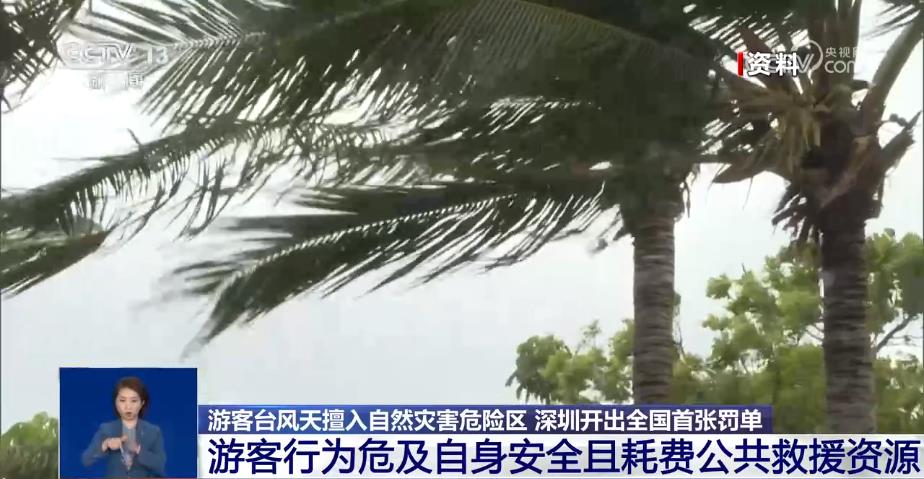
台风天擅自登山 两名游客被罚款 深圳开出全国首张自然灾害综合法规罚单
Shen Zhen Shang Bao· 2025-08-16 23:55
Core Points - Shenzhen's Dapeng New District Emergency Management Bureau issued a fine of 5,000 yuan to two tourists for entering a natural disaster risk zone without permission after the blue alert for Typhoon "Wipha" was activated, marking the first fine issued under the new natural disaster regulations in Shenzhen and nationwide [1][2] Group 1 - The Dapeng New District has excellent mountain and sea resources, attracting many tourists, but some disregard warnings during severe weather, posing challenges for disaster response efforts [2] - The Shenzhen Special Economic Zone Natural Disaster Prevention Regulations allow the government to designate areas as natural disaster risk zones and impose fines ranging from 5,000 to 20,000 yuan for violations [2] - The Dapeng New District was the first in the city to designate natural disaster risk zones after expert evaluations and public consultations, including areas like the Dapeng Peninsula National Geopark [2] Group 2 - Following the blue alert for Typhoon "Wipha" on July 19, tourists were found climbing in the designated risk zone, leading to a rescue operation that lasted 12 hours as the typhoon escalated to an orange alert [2] - The fine issued on August 15 was a result of the enforcement of the regulations aimed at preventing unauthorized access to these hazardous areas during natural disasters [1][2]