金属开采

Search documents
鹏欣资源股价涨5.23%,南方基金旗下1只基金位居十大流通股东,持有1431.31万股浮盈赚取543.9万元
Xin Lang Cai Jing· 2025-10-10 02:43
Core Viewpoint - Pengxin Resources has experienced a significant stock price increase of 20% over the past three days, with a current price of 7.64 CNY per share and a market capitalization of 16.906 billion CNY [1]. Group 1: Company Overview - Pengxin Resources Co., Ltd. is located in Minhang District, Shanghai, and was established on September 29, 2000, with its listing date on June 26, 2003 [1]. - The company primarily engages in the mining, smelting, processing, and sales of metals such as copper, gold, and cobalt, with additional business areas including trade, finance, and ecological restoration [1]. - The revenue composition of the company is as follows: trade business accounts for 51.07%, industrial business for 48.68%, and other supplementary activities for 0.25% [1]. Group 2: Shareholder Information - Among the top ten circulating shareholders of Pengxin Resources, a fund under Southern Fund holds a significant position. The Southern CSI 1000 ETF (512100) increased its holdings by 2.8112 million shares in the second quarter, totaling 14.3131 million shares, which represents 0.72% of the circulating shares [2]. - The estimated floating profit from the recent stock price increase is approximately 5.439 million CNY, with a total floating profit of 17.3189 million CNY during the three-day price rise [2]. Group 3: Fund Manager Profile - The fund manager of Southern CSI 1000 ETF (512100) is Cui Lei, who has been in the position for 6 years and 339 days, managing a total fund size of 94.976 billion CNY [3]. - During Cui Lei's tenure, the best fund return achieved was 164.18%, while the worst return was -15.93% [3].

鹏欣资源股价跌5.07%,南方基金旗下1只基金位居十大流通股东,持有1431.31万股浮亏损失429.39万元
Xin Lang Cai Jing· 2025-09-04 07:37
Group 1 - The core point of the news is that Pengxin Resources experienced a decline of 5.07% in stock price, trading at 5.62 CNY per share, with a total market capitalization of 12.436 billion CNY [1] - The company, established in 2000 and listed in 2003, primarily engages in the mining, smelting, processing, and sales of metals such as copper, gold, and cobalt, with trade accounting for 51.07% of its revenue and industrial operations 48.68% [1] - The company is located in Shanghai and has diversified its business into trade, finance, and ecological restoration [1] Group 2 - Among the top shareholders, Southern Fund's Southern CSI 1000 ETF (512100) increased its holdings by 2.8112 million shares in Q2, now holding 14.3131 million shares, representing 0.72% of the circulating shares [2] - The Southern CSI 1000 ETF has a current scale of 64.953 billion CNY and has achieved a year-to-date return of 22.23%, ranking 1837 out of 4222 in its category [2] - The fund manager, Cui Lei, has been in position for 6 years and 303 days, with the fund's best return during this period being 136.9% [3]
逃离美股的资金,去哪儿了?
Sou Hu Cai Jing· 2025-04-30 20:36
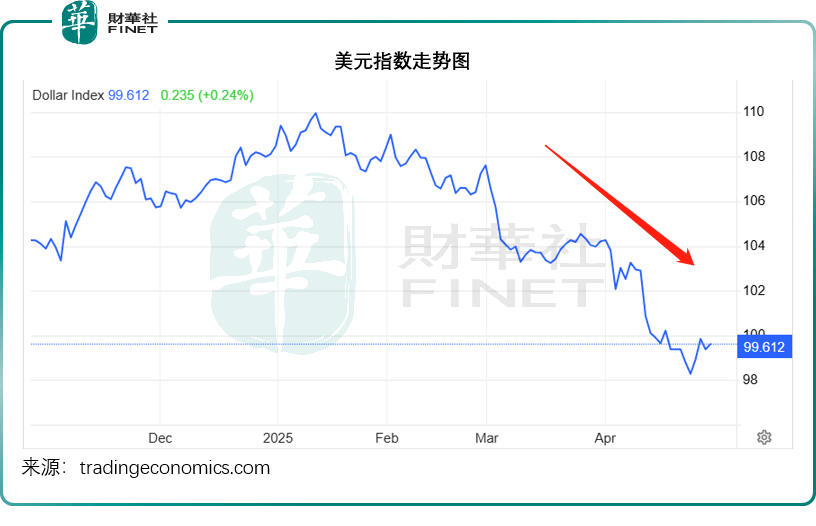
Core Points - Trump announced a delay in "reciprocal tariffs" for most regions, leading to a significant drop in U.S. stock prices, while other global markets showed signs of recovery [1] - The U.S. stock market has underperformed compared to other major global markets since April 9, with the Dow Jones, Nasdaq, and S&P 500 indices showing cumulative changes of -1.27%, 0.24%, and 0.51% respectively [1][10] - The strengthening of the Euro and Yen against the Dollar aligns with Trump's intention to boost trade advantages through a weaker Dollar, while simultaneously indicating a shift of smart money away from U.S. risk assets [7] U.S. Market Performance - The U.S. stock market has seen a significant outflow of funds, with the major indices underperforming compared to global counterparts [1][11] - The 10-year U.S. Treasury yield rose to a panic level of 4.5%, and the Dollar index remains below 100, indicating a lack of confidence in U.S. assets [1] - The cumulative performance of the U.S. indices since April 9 shows a stark contrast to the performance of other global markets, highlighting investor concerns about the U.S. economic outlook [1][10] Global Market Performance - Other global markets, particularly in Europe and Japan, have shown strong performance since April 9, with the Nikkei 225 index rising by 12.59% and the DAX index increasing by 12.17% [8][10] - European stocks have benefited from the European Central Bank's interest rate cuts and a potential easing of geopolitical risks, leading to a more optimistic outlook for the region's economy [9] - The performance of blue-chip stocks in Europe, particularly in the financial sector, has been robust, with Santander and HSBC showing gains of over 16% [9] Economic Implications - The delay in tariff implementation provides breathing room for European and Japanese markets, but the uncertainty surrounding future tariff policies remains a concern for companies heavily reliant on exports to the U.S. [11][12] - The potential for future adjustments to tariff policies could significantly impact the profitability of industries in Japan and Europe, particularly in the automotive and technology sectors [12] - Long-term investment decisions by European and Japanese companies may become more cautious due to the uncertainty surrounding U.S. trade policies, potentially hindering economic growth [12]