
Satellite Navigation

Search documents
解码“人工智能+北斗”的武汉实践
Chang Jiang Ri Bao· 2025-08-29 00:32
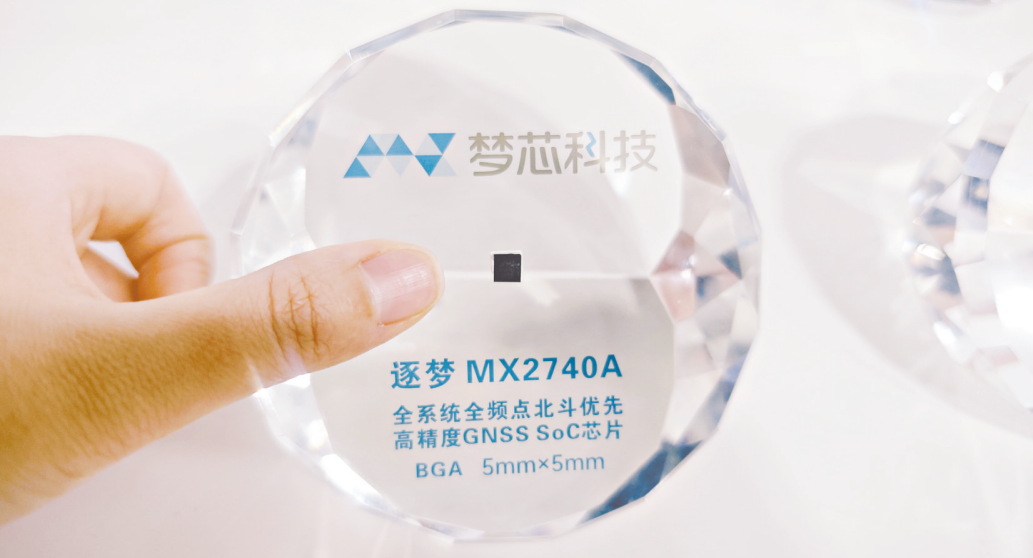
Core Insights - Wuhan is emerging as a significant hub for the "Artificial Intelligence + Beidou" industry, showcasing various applications such as autonomous taxis and drone monitoring systems [1][10] - The Beidou industry in Wuhan is projected to exceed 339 billion yuan by mid-2025, marking a 31% year-on-year growth, positioning it as the largest Beidou industry cluster in Central China [3][7] Industry Developments - Dream Chip Technology has developed a new generation of Beidou chips that are significantly smaller and more efficient, with a 50% reduction in size and a 40% decrease in power consumption, while improving signal capture speed by 20 times [5][4] - Wuhan's Beidou industry is supported by over 300 companies, including 22 specialized "little giant" enterprises and 5 listed companies, creating a complete ecosystem that spans chip development, terminal manufacturing, and service provision [7][8] Technological Advancements - The Beidou chips developed in Wuhan support all six major satellite navigation systems, marking a significant advancement in China's Beidou technology [5][4] - Wuhan has established a national-level laboratory in the field of Earth space information and has seen a 35% year-on-year increase in international patent applications related to Beidou technology, with 70% of these involving artificial intelligence [6] Future Projections - The Beidou industry in Wuhan is expected to reach 640 billion yuan by 2024, reflecting a 14.3% growth, with the current year's scale anticipated to surpass 800 billion yuan [7][12] - The city aims to implement 80 new Beidou application projects to enhance industrial manufacturing upgrades, indicating a strategic focus on integrating Beidou technology with AI, 5G, and high-precision indoor positioning [9][12]

伊朗探索从GPS迁移至北斗导航系统,行业应用已进入市场化、国际化关键阶段
Xuan Gu Bao· 2025-07-31 00:30
Group 1 - Iran is planning to migrate its positioning services from GPS to China's BeiDou navigation system, emphasizing its advanced architecture and high positioning accuracy, particularly in Asia [1] - The BeiDou system has been recognized as a core global satellite navigation system by the United Nations, with extensive international cooperation agreements and product exports to over 140 countries [1] - The development of BeiDou is entering a critical phase of marketization, industrialization, and internationalization, supported by a three-step construction plan [1][2] Group 2 - The low Earth orbit satellite constellation plan is progressing, with BeiDou technology making breakthroughs and establishing a solid infrastructure for high-precision positioning and spatiotemporal data industries [2] - The "Star Network + BeiDou" framework is expected to form a benchmark technical support system for spatiotemporal data elements [2] Group 3 - Companies involved in BeiDou high-precision navigation chips include Haige Communication, BeiDou Star, and Zhenxin Technology [3] - High-precision time synchronization is provided by Tianao Electronics, while various companies are engaged in boards/terminals and spatiotemporal applications [3]



北斗三号建成开通五年来,能力不断增强,应用快速发展 北斗帮忙,为千行百业“定位”“导航”
Ren Min Ri Bao· 2025-07-30 22:03
Core Insights - The Beidou system has transitioned from a distant concept to an integral part of daily life, enhancing service capabilities and expanding application scenarios across various sectors [1][2]. Group 1: Public Applications - In Zhuzhou, Hunan, citizens can use a mobile app to dynamically book buses based on real-time demand, showcasing the Beidou system's role in optimizing public transport [2]. - The daily call volume for Beidou positioning services in domestic electronic navigation maps is projected to reach 600 billion times in 2024, indicating widespread usage [2][3]. - Approximately 98% of the 294 million smart devices shipped in 2024 support Beidou positioning, making it a standard feature in various smart terminals [3]. Group 2: Industry Applications - The Beidou system is empowering various industries, including agriculture and robotics, by providing precise positioning and operational capabilities [4][5]. - In agriculture, Beidou technology has improved planting precision to within 2 centimeters, enhancing crop distribution and growth conditions [5]. - The total number of Beidou terminal devices in major industries reached nearly 30 million units, with an application penetration rate exceeding 85% [5]. Group 3: Industry Development - The satellite navigation and positioning service industry in China is projected to reach a value of 575.8 billion yuan in 2024, with a core output related to satellite navigation technology reaching 169.9 billion yuan, reflecting a year-on-year growth of 5.46% [6]. - The number of satellite navigation patent applications in China has surpassed 129,000, marking a 4.8% increase year-on-year [6]. - The integration of Beidou with technologies like 5G and AI is fostering new applications such as unmanned farms and digital construction sites, supporting the digital economy [7].
武汉加速北斗产业融合发展 2025年规模有望突破800亿
Chang Jiang Shang Bao· 2025-07-28 23:35
Core Insights - The Beidou industry in Wuhan is entering a stage of marketization, industrialization, and internationalization, with a projected industry scale of approximately 339 billion yuan in the first half of 2025 and expected to exceed 800 billion yuan for the entire year [1][4] Group 1: Industry Development - Wuhan has successfully attracted over 100 leading companies, including Huawei and Aerospace Hongtu, covering various fields such as geographic information services and AI, effectively driving the development of strategic emerging industries [2] - The city has established a collaborative innovation mechanism integrating production, education, research, and application, achieving breakthroughs in key technologies like high-precision positioning chips and Beidou-5G integration [3] Group 2: Technological Innovation - The latest Beidou chips released by Dream Chip Technology, such as the Zhumeng 2740A and Qimeng IV 2730A, have reduced size by 50% and power consumption by 40%, achieving millimeter-level positioning accuracy [2] - The Beidou technology's application has expanded significantly, with 52,000 shared bicycles equipped with Beidou positioning systems, enhancing urban traffic management [3] Group 3: Industry Ecosystem - Wuhan has built a competitive Beidou industry ecosystem, with over 300 related enterprises covering the entire chain from chip development to application services, demonstrating initial cluster effects [3][4] - Major achievements include the first domestic satellite precision orbit determination software and the first wide-area real-time precision positioning system, with technologies reaching international leading levels [4]
高盛:华测导航-管理层电话会议要点_卫星导航向自动驾驶拓展_机器人作为新应用场景
Goldman Sachs· 2025-07-14 00:36
Investment Rating - The report does not provide a specific investment rating for Huace Navigation (300627.SZ) as it is categorized as "Not Covered" [1]. Core Insights - Huace Navigation is a leading provider of MEO satellite navigation, positioning, and mapping services in China, focusing on enterprise clients and expanding applications into various sectors including autonomous driving and robotics [1][3]. - The global LEO satellite market is expected to grow significantly, with a total addressable market (TAM) projected to increase from US$15 billion in 2024 to US$108 billion by 2035, indicating a favorable environment for companies like Huace [2]. Summary by Sections Product Development - Huace is expanding its product line to capture new use cases, including the launch of the AA10 airborne measuring system that integrates LiDAR and industrial cameras, enhancing its geospatial information offerings [4][7]. - The company is also developing autonomous driving solutions, such as the P-Box for Baidu Apollo Go's robotaxi, which provides accurate geospatial data for vehicles [7]. Market Expansion - Huace aims to expand its satellite navigation solutions into overseas markets, having established a strong distribution network across regions including Southeast Asia, Europe, and South America [8]. - In 2024, revenues from non-China markets increased by 30% year-on-year to RMB 937 million, accounting for 29% of total revenue, with expectations for continued growth in overseas contributions [8]. Competitive Advantages - Huace's competitive edges include in-house algorithm development, competitive pricing, and accumulated expertise in MEO applications, which enhance its market position [9]. - The company's GNSS analysis platform offers high precision and data compatibility, further solidifying its competitive stance in the satellite navigation market [9].


美媒:与中国的北斗系统脱钩是短视行为
Huan Qiu Wang Zi Xun· 2025-06-10 23:21
Core Viewpoint - The article discusses the implications of China's BeiDou satellite navigation system, arguing that it is not a weapon but a critical technology that enhances global navigation reliability and precision, and that the U.S. risks national security and economic competitiveness by limiting access to it [1][2][3] Group 1: Technology and Security - The BeiDou system is a competitor to GPS and has raised suspicions among U.S. officials, leading to investigations by the Federal Communications Commission [1] - Limiting access to BeiDou could weaken the resilience of Positioning, Navigation, and Timing (PNT) systems, ultimately harming U.S. national security and commercial operations [1] - Tests indicate that disabling BeiDou could reduce positioning accuracy by 30% to 40%, significantly impacting navigation, logistics, and emergency services [1] Group 2: Economic Impact - Precision positioning is foundational for key industries such as logistics, agriculture, aviation, and automation; excluding foreign satellite navigation systems could lead to increased costs, deployment delays, and reduced competitiveness for U.S. companies [3] - China is likely to continue forming partnerships with countries seeking open and reliable navigation services, which could further enhance its influence in international technology standards [3] - The BeiDou system is viewed as a tool for soft power rather than a weapon, contradicting claims that it could be used as an active warfare tool [3]
湖南:全力打造北斗规模应用引领区 全景展示北斗规模应用新成效
news flash· 2025-06-05 04:52
Core Viewpoint - Hunan Province aims to establish itself as a leading area for the large-scale application of the BeiDou system, with a focus on high-quality development and significant improvements over the next three years [1] Group 1: Development Goals - The provincial government emphasizes the need for market-oriented, industrialized, and internationalized approaches to achieve the goal of "one year of change, three years of significant transformation" in BeiDou applications [1] - The initiative includes expanding application scenarios and accelerating the construction of key projects to create a nationwide demonstration city for BeiDou applications [1] Group 2: Industry Collaboration - The government highlights the importance of collaborative innovation across the entire industry chain, including upstream and downstream partners [1] - There is a focus on building public service platforms and pilot testing bases to enhance the capabilities of the "BeiDou+" initiative in promoting high-quality development, efficient governance, and improved quality of life [1] Group 3: On-Site Engagement - The provincial leadership, including Governor Mao Weiming, actively engages with local technology companies and innovation centers to understand product innovations and application demonstrations [1]