皮革

Search documents
哈森股份: 2024年年度股东大会会议资料
Zheng Quan Zhi Xing· 2025-05-13 08:15
Core Points - The company held its 2024 Annual General Meeting to discuss various agenda items, including the board's work report and voting procedures for shareholder proposals [1][3][5] Meeting Agenda - The meeting included the reading of voting results, discussion of the board's work report, and the election of directors and supervisors [3][5] - The meeting was scheduled for May 20, 2025, at 14:30 in Kunshan, Jiangsu Province [3] Shareholder Rights - Shareholders or their authorized representatives have the right to speak, inquire, and vote during the meeting [2][4] - Specific requirements for attending the meeting include identification and authorization documents [2][4] Business Performance - In 2024, the company achieved operating revenue of 821.01 million yuan, a year-on-year increase of 1.12%, but reported a net loss attributable to shareholders of 96.41 million yuan [5][6] - The company expanded its business by acquiring 45% of Suzhou Langkes Precision Hardware Co., Ltd. and 55.2% of Jiangsu Langxun Industrial Intelligent Equipment Co., Ltd., diversifying into precision metal components and related equipment [5][6][7] Revenue Breakdown - The online sales of shoes and bags generated 217.90 million yuan, a 13.06% increase, accounting for 66.92% of total revenue [6][7] - The company has established production bases for precision metal components in Yancheng and Yangzhou, focusing on consumer electronics and new energy sectors [7][11] Financial Overview - The company's operating costs increased by 9.92% to 401.61 million yuan, while management expenses rose by 42.58% due to acquisition-related costs [6][8][16] - The net cash flow from operating activities was -23.54 million yuan, a significant decline compared to the previous year [17] Future Plans - The company aims to enhance its existing business assets, optimize store operations, and strengthen brand management to boost profitability [18] - Plans include expanding into the precision metal structure and related equipment sectors, focusing on consumer electronics and new energy markets [18][19]

关税对就业,影响有多大?
2025-05-12 01:48
Summary of Key Points from Conference Call Records Industry or Company Involved - The discussion primarily revolves around the impact of tariff policies on the Chinese employment market and the broader economic implications. Core Points and Arguments - **Tariff Impact on Employment**: The estimated impact of tariff policies on China's employment market is between 1% to 1.5%, which is lower than the initial expectation of 3%. The actual employment reduction is estimated to be between 6 million to 10 million jobs [1][3] - **Export Contribution to Economy**: Exports contribute more to the economy than their share of employment due to rising labor productivity, a shift towards capital and technology-intensive industries, and the creation of new job opportunities in emerging sectors [1][4] - **Simplified Tariff Impact Assessment**: Key assumptions for assessing the impact of tariffs include that tariffs only affect goods trade, with manufacturing exports accounting for over 90%, and a baseline tariff level of an additional 34% [1][6] - **Non-Significant Employment Impact**: The non-significant impact of exports on employment is noted, with estimates suggesting a reduction of only 0.16% to 0.2% in employment due to tariffs, indicating that current employment pressures are not as severe as portrayed by some media [1][7] - **Sector-Specific Effects**: Light industries such as leather, wood furniture, and electronics are significantly affected by tariffs, especially those reliant on U.S. revenue. However, their overall impact on total employment is relatively small due to their low share in domestic employment [1][7] - **Economic Environment and Employment**: The slowing GDP growth in China has led to rising unemployment rates, with a structural contradiction arising from industries with high external circulation having stronger job absorption capabilities compared to those with high internal circulation [1][8] Other Important but Possibly Overlooked Content - **Challenges in Service Industry Development**: The service industry faces challenges such as demand hierarchy, non-linear growth, and regional disparities, necessitating policy support and structural adjustments to increase its share in the economy [2][9] - **Artificial Intelligence Impact**: The development of artificial intelligence is changing employment demand, with some jobs being replaced, while a significant number of job seekers, particularly youth, face high unemployment rates [11] - **Labor Market Supply Changes**: Changes in labor market supply are influenced by generational wealth transfer, rising educational levels, and a preference for stable jobs, leading to mismatches in the job market [12] - **Policy Measures for Employment Stability**: Current policies to stabilize growth and employment include economic development, service industry enhancement, education reform, and improved job matching through information platforms [13] - **Pathways for Service Industry Development**: The service industry can develop through deregulation, allowing outstanding companies to thrive, while addressing potential structural unemployment among traditional industry workers [14]
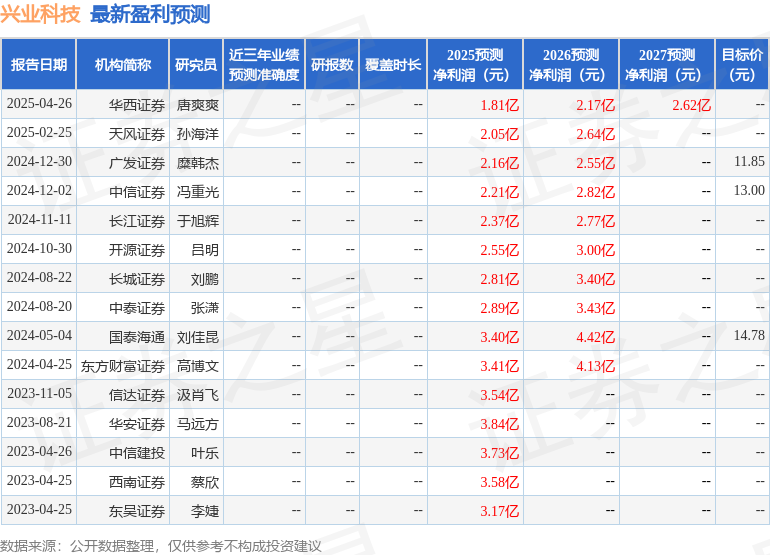
天风证券:给予兴业科技增持评级
Zheng Quan Zhi Xing· 2025-05-01 14:02
Core Viewpoint - The report by Tianfeng Securities on Xingye Technology highlights the company's ongoing development in the automotive interior leather business, maintaining a "buy" rating for the stock [1]. Financial Performance - For Q1 2025, the company reported revenue of 600 million, a year-on-year increase of 5%, while net profit attributable to shareholders was 20 million, down 45% year-on-year [1]. - In Q4 2024, revenue was 900 million, up 24% year-on-year, with net profit attributable to shareholders at 30 million, a significant increase of 150% year-on-year [1]. - The full year 2024 saw revenue of 3 billion, a 9% increase year-on-year, but net profit attributable to shareholders decreased by 24% to 140 million [1]. Dividend and Management Changes - The company plans to distribute a cash dividend of 1.5 yuan per 10 shares, amounting to an expected payout of 40 million, with a dividend payout ratio of 31% [2]. - Wu Meili resigned as the board secretary but continues as the vice president, while Zhang Liang has been appointed as the new board secretary [2]. Product Segmentation and Market Expansion - Revenue from leather for shoes and bags in 2024 was 2 billion, an 8% increase, accounting for 68% of total revenue, with a gross margin of 18% [3]. - Revenue from automotive interior leather reached 700 million, a 20% increase, representing 24% of total revenue, with a gross margin of 34% [3]. - The company has successfully entered the supply chains of international brands such as Adidas and COLEHAAN [3]. Regional Performance - Revenue from East China was 1.9 billion, an 8% increase, accounting for 65% of total revenue, with a gross margin of 22% [3]. - Revenue from South China was 600 million, down 1%, representing 21% of total revenue, with a gross margin of 22% [3]. - International revenue surged by 97% to 300 million, accounting for 10% of total revenue, with a gross margin of 21% [3]. Subsidiary Performance - The subsidiary Hongxing Automotive Leather reported a net profit of 150 million, up 51% year-on-year, driven by increased sales and improved gross margins [4]. - Lianhua Leather reported a net loss of 10 million, down 62% year-on-year, primarily due to increased financial expenses [4]. Profit Forecast Adjustments - The profit forecast for 2025-2027 has been adjusted, with expected net profits of 150 million, 180 million, and 230 million respectively [5]. - Earnings per share (EPS) are projected to be 0.5, 0.6, and 0.8 yuan for 2025, 2026, and 2027 respectively [5]. - Price-to-earnings (PE) ratios are expected to be 20x, 16x, and 12x for the respective years [5].