皮革

Search documents
兴业科技:大股东减持886.65万股,减持计划实施完毕
Xin Lang Cai Jing· 2026-02-27 09:56
Group 1 - The major shareholder, Chunhong Investment, has completed its share reduction plan, which was disclosed in a pre-announcement in 2025, intending to reduce no more than 8.8665 million shares, accounting for 3% of the total share capital [1] - As of February 26, 2026, Chunhong Investment has reduced its holdings by 2.9555 million shares through centralized bidding, representing 1% of the total shares, at an average price of 14.51 yuan per share [1] - Additionally, 5.911 million shares were reduced through block trading, accounting for 2% of the total shares, at an average price of 12.73 yuan per share [1] Group 2 - After the reduction, Chunhong Investment's holdings decreased to 22.5975 million shares, representing 7.65% of the total shares [1] - The share reduction was conducted in compliance with regulations and did not result in a change of control of the company, nor did it affect the company's governance and operations [1]

2025年全国规模以上纺织工业企业利润同比下跌12%
Guo Jia Tong Ji Ju· 2026-02-26 03:19
Core Insights - In 2025, the total profit of industrial enterprises above designated size in the country reached 73,982.0 billion yuan, reflecting a year-on-year growth of 0.6% [1] Textile Industry - The total profit of the textile industry amounted to 73.83 billion yuan, showing a year-on-year decline of 12% [1] - The textile and apparel sector reported a total profit of 45.06 billion yuan, down 27.3% compared to the previous year [1] - The leather, fur, feather, and related products and footwear industry generated a total profit of 36.52 billion yuan, experiencing a year-on-year decrease of 17.9% [1] - The chemical fiber manufacturing industry achieved a total profit of 31.53 billion yuan, which is a decline of 4.5% year-on-year [1]
明新旭腾:诉讼二审终审,获赔1.9亿元
Xin Lang Cai Jing· 2026-02-24 09:03
Core Viewpoint - The company has received a favorable judgment in a contract dispute, resulting in a significant financial recovery from the defendants [1] Group 1: Legal Outcome - The company announced the final judgment in a lawsuit against Zhejiang Guoli and Shanghai Guoli, with a total amount involved of 185 million yuan (excluding interest and other fees) [1] - Zhejiang Guoli is ordered to pay 177 million yuan in principal and overdue interest, while Shanghai Guoli is held jointly liable for the payment [1] Group 2: Financial Implications - The company will incur a total cost of 114,000 yuan for the first and second instance court fees [1] - As of February 14, 2026, the company has received 190 million yuan from the defendants, which includes the principal and overdue interest, and will adjust its impairment provisions based on the execution status [1]

从部分皮革企业“欣欣向荣”看传统产业生命力
Xin Lang Cai Jing· 2026-02-23 21:43
Industry Overview - The leather industry is a traditional sector in China, which is the largest producer, exporter, and consumer of leather globally. The industry faces significant challenges due to changing consumer trends, raw material price fluctuations, rising labor costs, and increasing environmental pressures [1][8]. Decline of Traditional Leather Factories - In Jiangmen, Guangdong Province, a key leather manufacturing base, the industry peaked in the 1990s with around 200 enterprises and tens of thousands of employees, forming a trillion-yuan industrial cluster. However, the number of factories has drastically decreased to about ten from over a hundred [2][3]. - The decline is attributed to multiple factors, including environmental regulations classifying leather as a "heavily polluting industry," reduced orders from Western markets, and a lack of interest from the younger generation in continuing family businesses [3][4]. Struggles of Remaining Factories - Remaining factories in the region report significant drops in business, with some experiencing over a 70% reduction in foreign orders compared to peak levels. Many are now focusing on domestic markets and developing new products to survive [4][5]. Resilience of Some Leather Companies - Despite the overall decline, some leather companies in Jiangmen are thriving. For instance, Yixing Leather Co., a Sino-American joint venture, has maintained stable growth by focusing on quality and market adaptation, benefiting from a strong international client base [5][6]. - Another example is Bawei Leather Factory, a German-funded enterprise that has shown healthy growth, with an annual output value exceeding 400 million yuan and tax contributions of nearly 30 million yuan [6]. Diversification and Adaptation Strategies - Some domestic companies are adopting diversification strategies to navigate the industry's challenges. For example, Zhujiang Industrial Co. has expanded its product range and established itself as a key player in high-end leather production [7]. The Value of Traditional Industries - Industry experts argue that traditional industries like leather should not be dismissed as "low-end" but rather recognized for their resilience and potential for transformation. The leather industry continues to play a significant role in economic value creation and employment [8][10]. - The shift in consumer preferences towards leather products in automotive and aviation sectors indicates that the overall market for leather remains stable, despite declines in traditional uses [9][10]. Future Directions - The industry must adapt to new consumer trends and enhance technological capabilities, brand value, and international competitiveness. There is a call for government support to nurture these traditional sectors rather than pushing them towards obsolescence [9][10].
2025年1-12月皮革、毛皮、羽毛及其制品和制鞋业企业有8783个,同比下降1.38%
Chan Ye Xin Xi Wang· 2026-02-22 03:41
Group 1 - The core viewpoint of the article highlights the decline in the number of enterprises in the leather, fur, feather, and footwear industries in China, with a total of 8,783 enterprises reported for the period from January to December 2025, representing a decrease of 123 enterprises or a 1.38% year-on-year decline [1][1][1] - The proportion of these enterprises within the total industrial enterprises stands at 1.67%, indicating a relatively small segment of the overall industrial landscape [1][1][1] - The data reflects a change in the threshold for scale industrial enterprises, which was raised from an annual main business income of 5 million yuan to 20 million yuan starting in 2011 [1][1][1] Group 2 - The report referenced is published by Zhiyan Consulting, which is recognized as a leading industry consulting firm in China, specializing in in-depth industry research and providing comprehensive consulting services [1][1][1] - Zhiyan Consulting has been active in the industry research field for over a decade, offering services such as industry research reports, business plans, feasibility studies, and customized consulting solutions [1][1][1] - The firm emphasizes its professional approach, quality service, and keen market insights to empower investment decisions [1][1][1]


身价超20亿生物制造公司被收购!合作过爱马仕、凯迪拉克
合成生物学与绿色生物制造· 2026-02-11 03:16
Core Viewpoint - MycoWorks, a pioneer in sustainable mycelium leather, has been acquired by DFX Corp, aiming for business restructuring and expansion with significant backing from high-profile investors [2][4]. Group 1: Company Overview - MycoWorks has achieved commercial success over its eight years, collaborating with luxury brands like Hermès and Cadillac, with a pre-acquisition valuation of $300 million (approximately 2 billion RMB) [2]. - The company closed its self-built biomanufacturing facility in the U.S. last November, shifting from in-house mycelium cultivation to sourcing materials from external suppliers in Eurasia [4]. - CEO Matthew Scullin noted that the production model faced cost challenges in the current market environment, leading to a strategic pivot towards material processing and increased investment in Rei-Tan tanning technology [5]. Group 2: Industry Insights - China is positioned to lead in the large-scale application of bio-based leather within 3-5 years, with significant discussions at the Sustainable Application Forum focusing on commercialization timelines [6][9]. - Experts predict that bio-based leather will see widespread adoption in the casual footwear and bag sectors within 3-5 years, partial application in the automotive sector, and full integration as a luxury leather alternative may take over 10 years [9]. - SynMetabio is recognized as a leader in low-carbon bio-based leather production, with an annual production capacity of 6 million meters, expected to reach 20 million meters by 2026 [10]. Group 3: Future Events and Developments - The 11th Bio-based Industry Conference & Exhibition is scheduled for May 20-22, 2026, in Shanghai, aiming to foster collaboration and innovation in the bio-based materials sector [16][17]. - The event will feature 11 thematic forums and 7 concurrent activities, including the DT New Leaf Award, which recognizes innovation in the bio-based industry [17].

“政策+场景”双轮驱动 海宁皮城打造春节消费新地标
Quan Jing Wang· 2026-02-09 14:08
Core Viewpoint - The 2026 Spring Festival will see a revitalization of the national consumer market, driven by the "2026 'Shopping New Year' Special Activity Plan" issued by the Ministry of Commerce and other departments, aiming to create a comprehensive consumption feast through the integration of commerce, travel, culture, sports, and health [1] Group 1: Business Strategy - Haining China Leather City is responding to the national consumption promotion call with a dual-driven strategy of "policy + scenario," showcasing resilience and innovative vitality during the Spring Festival consumption peak [1][5] - The operational plan for the Spring Festival is not a one-size-fits-all approach but a refined strategy tailored to different customer needs and business characteristics, reflecting the company's "scenario-driven" strategy [2] Group 2: Operational Details - Core retail shopping areas will have extended operating hours from the 28th day of the twelfth lunar month to the seventh day of the first lunar month, with only a slight reduction on New Year's Eve, ensuring convenient shopping throughout the holiday [2] - The new e-commerce and live streaming areas will operate year-round, with only minor adjustments during the holiday, aligning with the call to encourage online reservations and offline experiences [3] Group 3: Market Positioning - The Spring Festival strategy emphasizes the integration of cultural and tourism elements, with Haining China Leather City being recommended by travel platforms as a key destination, enhancing its appeal as a shopping and tourism hub [4] - The company is evolving from a professional procurement site to a comprehensive destination for shopping, tourism, and experiential activities, enriching the market's connotation and expanding its consumer base [4] Group 4: Long-term Strategy - The Spring Festival strategy reflects the company's long-term vision, optimizing its business structure and strategically investing in emerging sectors like healthcare and industrial services [4] - The "non-stop" operation during the Spring Festival is expected to enhance property rental value, increase merchant sales, and ultimately boost rental income, while attracting diverse customer traffic through e-commerce and varied business formats [4][5]

嘉兴时尚产业,为全国打样!
Xin Lang Cai Jing· 2026-02-03 23:52
Core Viewpoint - The fashion industry in Jiaxing is a key traditional industry with a projected output value of 321.59 billion yuan by 2025, aiming to transition from manufacturing advantages to high-end design, branding, and value chain segments, establishing itself as a model for innovation and transformation in the Yangtze River Delta and nationwide [1][4]. Industry Overview - Jiaxing's fashion industry has evolved over 40 years, developing a complete industrial chain from raw material production to market sales, covering textiles, clothing, leather, and more [4][6]. - The industry is characterized by strong regional features, with notable clusters in Tongxiang, Haining, and Pinghu, each specializing in different segments such as textiles, leather, and clothing [5][6]. Technological Advancements - Companies in Jiaxing are actively pursuing digital transformation and green upgrades, utilizing technologies like big data, 5G, and artificial intelligence to enhance product quality and shift from manufacturing to intelligent manufacturing [6][15]. - Qisheng Technology, a leader in smart sleep technology, has captured approximately 38% of the U.S. smart bed market, showcasing the potential for technology-driven growth in the fashion sector [7]. Brand Development - Jiaxing is focusing on building a "brand matrix" to elevate industry value, with leading companies like Yayun and Anzheng aiming to create globally influential fashion brands that embody Eastern aesthetics [16]. - Jiaxin Silk, a major player in the silk industry, is enhancing its brand image and market presence by focusing on quality and modern aesthetics, thus transitioning from manufacturing advantages to brand value [8]. Globalization Strategy - Jiaxing's enterprises are increasingly focusing on globalization, with companies like Xinxiu Group implementing a three-pronged strategy of manufacturing, branding, and exhibitions to expand their market reach [9]. - The region's high-end textile companies are also making strides in international markets, with Jin Yuan Linen and Xin Ao Textile leading in their respective segments [9][10]. Educational Initiatives - The establishment of the Jiaxing Fashion Knitting Industry Academy aims to foster talent development and industry service ecosystems, supporting the high-quality growth of the fashion industry [16].
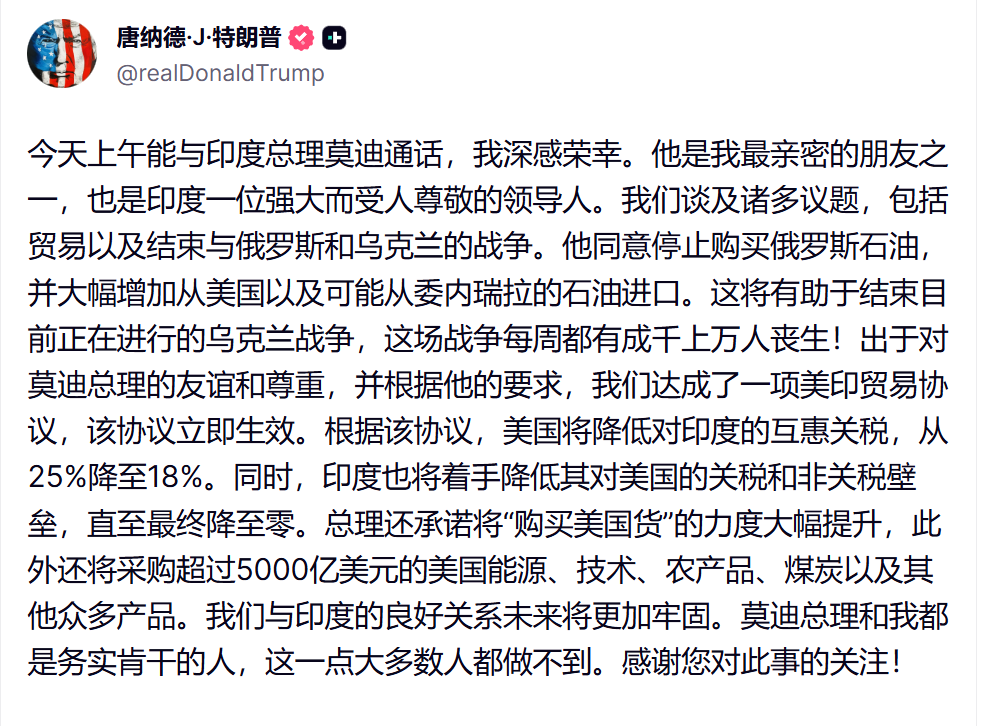
凌晨,直线猛拉!特朗普:莫迪同意不买俄罗斯石油,美国将降低对印关税
Hua Xia Shi Bao· 2026-02-03 00:33
Group 1 - The core point of the news is the announcement of a trade agreement between the United States and India, where the U.S. will reduce tariffs on Indian goods from 25% to 18%, effective immediately, while India will lower its tariffs and non-tariff barriers to zero [1][2][4] - The agreement includes a commitment from India to significantly increase its procurement of U.S. products, including over $500 billion worth of energy, technology, agricultural products, and coal [1][4] - The U.S. has requested India to stop purchasing oil from Russia and to increase its oil imports from the U.S., with potential purchases from Venezuela also mentioned [1][2] Group 2 - The reduction in tariffs is expected to provide significant relief for India, which has been seeking to negotiate lower tariffs with Washington, as exports to the U.S. account for about 20% of India's total exports [4] - The high tariffs previously imposed by the U.S. had affected approximately 55% of India's exports to the U.S. and posed challenges to India's ambition of becoming a manufacturing powerhouse [4] - Analysts view this agreement as a major turning point in U.S.-India trade relations, potentially opening a new chapter in their trade relationship and impacting the global energy market [4]
印度股指直线拉升!特朗普宣布:降低关税
Zhong Guo Ji Jin Bao· 2026-02-02 22:40
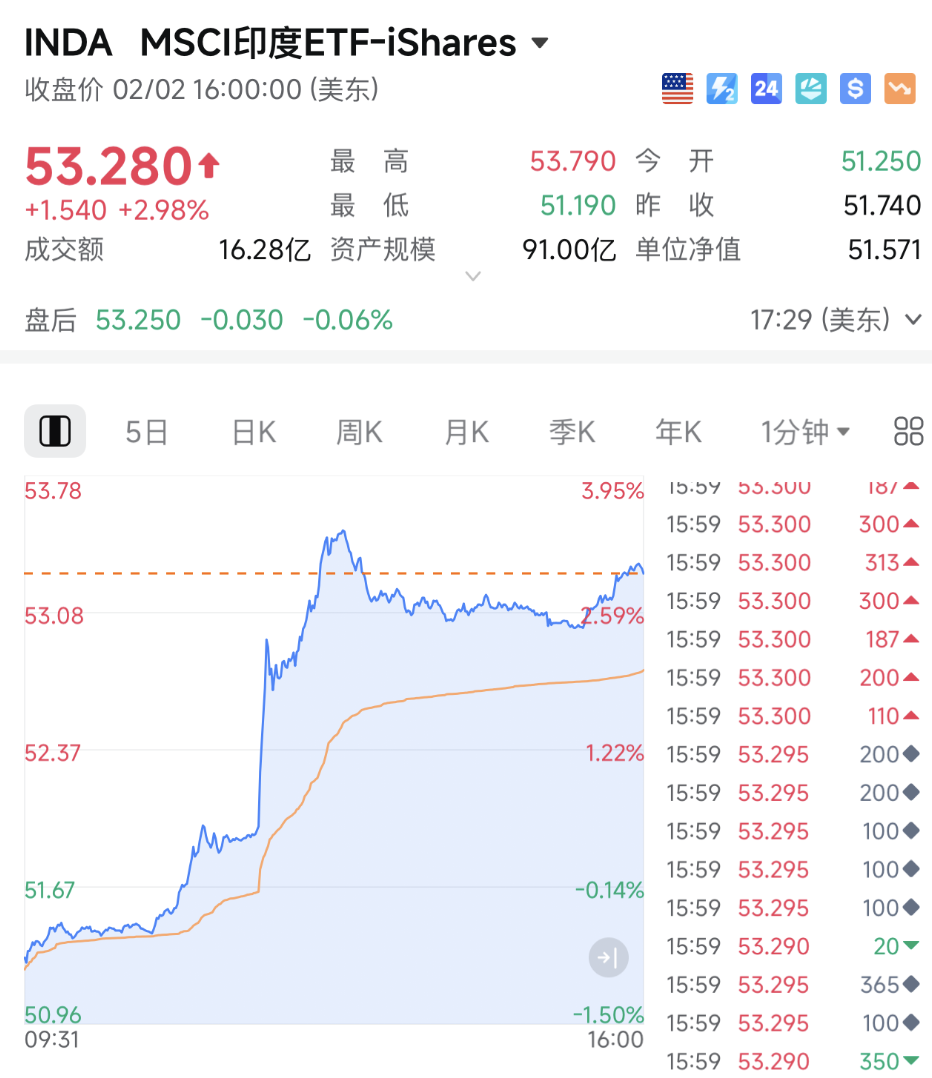
Group 1 - The core point of the news is the trade agreement between the United States and India, which involves reducing tariffs on Indian goods from 25% to 18%, easing tensions between the two countries [1][2][3] - The agreement will significantly lower the overall tax burden on many Indian products from 50% to 18%, particularly benefiting textiles and machinery [1][11] - India is expected to purchase over $500 billion worth of American energy, technology, agricultural products, coal, and other goods as part of the agreement [1] Group 2 - The announcement led to a surge in India's benchmark stock index Nifty 50 futures and a nearly 3% increase in the iShares MSCI India ETF listed in the U.S. [7] - The Indian rupee strengthened against the dollar, rising by 1% in offshore markets following the news [7] - High tariffs had previously impacted approximately 55% of India's exports to the U.S., affecting its ambition to become a manufacturing powerhouse [11]