Housing

Search documents
Housing Affordability Crisis Deepening as Prices Soar 60% Since 2019, Harvard Report Warns
Yahoo Finance· 2025-10-05 14:00
Core Insights - Homeownership rates in the U.S. fell in 2024 for the first time in eight years due to soaring home prices, making ownership unattainable for many [1] - As of early 2025, home prices have increased by 60% nationwide since 2019, with the median existing single-family home price reaching a new high of $429,400 [2] - Rising mortgage rates since 2020 have further exacerbated affordability issues, with the average 30-year fixed mortgage rate increasing from approximately 3.72% in January 2020 to around 6.30% today [3] Housing Market Trends - The increase in home prices and mortgage rates has led to a significant rise in the income required to afford a typical home, estimated at $117,000 for the average American household [3] - Despite the challenges, there are strategies to make homeownership more attainable, such as exploring home-buying assistance programs that can help with down payments and closing costs [5] - Alternative property types, such as condos, townhomes, and smaller single-family homes, can serve as more affordable entry points into homeownership [6] - Expanding the search radius for potential homes can lead to more affordable options, particularly in up-and-coming neighborhoods or suburbs [7]
Flying In The Dark
Seeking Alpha· 2025-10-05 13:00
Core Insights - The article discusses the investment landscape in the real estate sector, particularly focusing on the performance and potential of various real estate investment trusts (REITs) and housing-related companies [2][3]. Group 1: Company Insights - Hoya Capital Research & Index Innovations is affiliated with Hoya Capital Real Estate, which provides investment advisory services and focuses on publicly traded securities in the real estate industry [2]. - The commentary emphasizes that the information provided is for educational purposes and does not constitute investment advice or recommendations for specific securities [2][3]. Group 2: Industry Insights - The real estate industry is highlighted as having unique risks associated with investments in real estate companies and housing industry companies, which may not be suitable for all investors [2]. - The article notes that past performance of market data does not guarantee future results, indicating the inherent volatility and unpredictability of the real estate market [3].


Global Tensions Escalate with Ukraine Attacks; OPEC+ Weighs Oil Hike Amid U.S. Shutdown’s Housing Strain
Stock Market News· 2025-10-05 09:38
Group 1: Ukraine Conflict - A new wave of Russian missile and drone attacks occurred on October 5, resulting in at least 5 fatalities and 14 injuries across regions including Lviv and Zaporizhzhia, involving over 50 missiles and approximately 500 drones [2][3] - There was a 36% surge in Russian long-range drone and missile strikes in September compared to August, with a total of 5,638 drones and 185 missiles fired [3][8] - Russian forces likely stockpiled ballistic and cruise missiles during September in preparation for large-scale strikes aimed at overwhelming Ukrainian air defense systems [3] Group 2: Oil Market - OPEC+ is nearing an agreement for a modest increase in oil supply for November, considering a base case of 137,000 barrels per day (bpd), with discussions of larger increases up to 411,000 bpd or 500,000 bpd [4][5] - Global oil prices remain under pressure, with Brent crude trading near $65 per barrel and West Texas Intermediate (WTI) below $61 [5] - Analysts project a "sizeable surplus" in the oil market for the fourth quarter of 2025 and into early 2026, driven by increased OPEC+ output and softening demand [5] Group 3: D.C. Housing Market - The D.C. housing market is under strain due to a federal government shutdown that began on October 1, 2025, affecting approximately 800,000 federal employees and another 700,000 working without pay [6][9] - The median listing price in D.C. plunged nearly 15% annually, with active inventory surging 48.7% year-over-year as of September 2025 [7][9] - The current shutdown is expected to cause delays in federally backed mortgages and could stall sales in flood-prone areas, with potential impacts similar to previous government shutdowns [9]

2025年9月 英国房价指数报告:平均房价27万英镑,年增值仅1.4%
Sou Hu Cai Jing· 2025-10-05 06:50
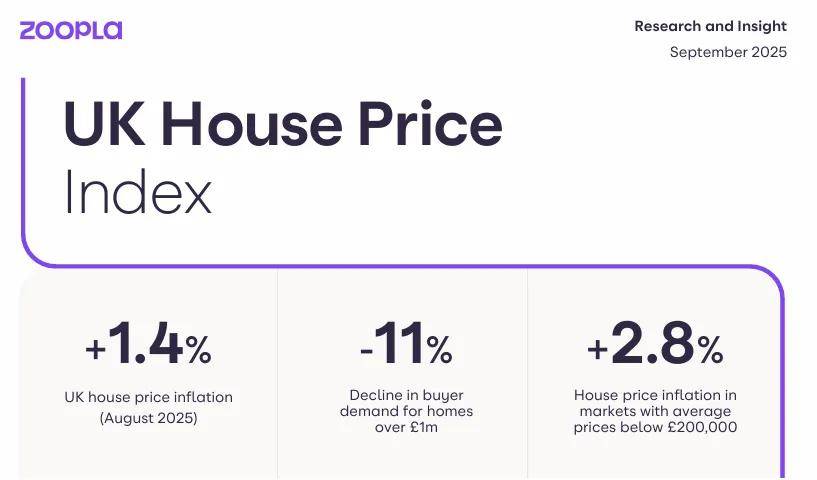
Core Insights - The average house price in the UK as of August 2025 is £271,000, reflecting a year-on-year increase of 1.4% or £3,870 [1][11] - Uncertainty surrounding potential tax changes from the upcoming autumn budget is impacting buyer behavior, particularly in the high-value property market [3][8] Price Trends - The average house prices for June, July, and August 2025 were £270,100, £271,100, and £271,000 respectively, with an annual change of £3,870 [4] - The inflation rate for UK house prices stands at 1.4%, down from 1.9% in December 2024, indicating a slowdown in price growth [9][11] Property Type Performance - Average prices for different property types in August 2025 are as follows: - Apartments: £192,000, down £1,230 year-on-year - Terraced houses: £240,200, up £4,980 year-on-year - Semi-detached houses: £277,500, up £7,090 year-on-year - Detached houses: £452,300, up £6,850 year-on-year [5] High-Value Property Market - Demand for high-value properties (over £1 million) has decreased by 11% compared to the same period last year, while properties over £500,000 saw a 4% decline in demand [6][8] - New listings for properties over £1 million have dropped by 9%, and those over £500,000 have decreased by 7%, indicating sellers are also hesitant to enter the market [8] Regional Variations - The southern regions of England, including London, are experiencing the weakest price growth, with some areas showing increases of less than 0.5% [11] - The North West region has seen a year-on-year price increase of 3.1%, while Northern Ireland has the highest increase at 7.9% [11] Mortgage Rates and Market Activity - Mortgage rates have stabilized between 4% and 5%, contributing to a recovery in housing market activity [12][15] - Recent changes in affordability rules allow buyers to borrow approximately 20% more than six months ago, boosting demand, especially among first-time buyers [15] - As of September 21, 2025, the average number of homes for sale has increased by 20% compared to 2023, with an 8% rise from the previous year [15]
I’m single and making $61K/year. I really want to buy my first home — but can I swing it without becoming house poor?
Yahoo Finance· 2025-10-04 14:00
Core Insights - The median monthly costs for U.S. homeowners with a mortgage have risen to $2,035, making homeownership increasingly unaffordable for many households [1][4] - A household earning $61,000 annually would spend approximately 40% of their income on housing costs, exceeding the recommended 30% guideline [2][3] - Homeownership costs vary significantly across the U.S., with some regions experiencing median costs above $3,000 per month [4] Affordability Analysis - Experts suggest that housing costs should not exceed 30% of monthly income, which translates to $1,500 for a household earning $61,000 [2] - The financial strain of high housing costs can lead to a situation where homeowners feel "house poor," having limited cash for other expenses [3] Additional Costs - Median monthly housing costs do not include maintenance expenses, which can add significantly to the overall cost of homeownership [5] - Homeowners spent an average of $12,050 on house projects in 2024, equating to an additional $1,000 per month in costs [6]
Housing market sea change ahead? Buyers hope for a tailwind as sellers face choppy waters
Yahoo Finance· 2025-10-04 11:13
Core Insights - Experts express concerns that tariff policies may lead to an economic recession, which could reduce homebuyer demand and lower home values, although major job hubs might be less affected [1][2] - The U.S. housing market is experiencing a gradual normalization of inventory, which may stabilize or reduce home prices, despite high mortgage rates keeping many homeowners from selling [3][4] Housing Market Trends - In February, housing inventory increased by 5.1% month-over-month and 17% year-over-year, indicating a growing supply that could help stabilize home prices [3] - The median home price in the U.S. for Q2 2025 was $410,800, a decrease of $12,300 from the previous quarter, with expectations from major real estate organizations that home price growth will slow in 2025 [4] - The S&P CoreLogic Case-Shiller Index reported a year-over-year increase of 4.1% in January, followed by a 3.8% annual increase in existing home costs reported by the NAR for February [4] Economic Considerations - Concerns about a potential recession are rising, with a Deutsche Bank survey indicating a 43% probability of a U.S. recession occurring between now and June 2026 [10] - Mortgage rates have remained stable or decreased since January, with the Federal Reserve maintaining an overnight interest rate of 4.00% to 4.25% as of September 8 [2] Home Equity and Investment Opportunities - As of Q3 2024, the average U.S. homeowner had approximately $311,000 in home equity, suggesting potential for leveraging this equity through options like home equity lines of credit (HELOC) [5][6] - Homeshares is providing a new avenue for accredited investors to gain exposure to the $36 trillion home equity market without the burdens of property management, allowing investments starting at $25,000 [11][12] - Homeshares offers risk-adjusted target returns ranging from 14% to 17%, presenting a low-maintenance alternative to traditional property ownership [13]
The U.S. Is 'One Of The Cheapest Countries On Earth To Buy A House,' Someone Pointed Out. It Could Get Much Worse If It Follows Global Trends
Yahoo Finance· 2025-10-03 15:46
Core Insights - A recent Reddit discussion highlighted that the U.S. is among the most affordable countries for home buying, with a lower housing price to income ratio compared to many Western nations [1][2] Global Housing Trends - The U.S. ranks third globally in housing affordability by price-to-income ratio, with a ratio of 3.3, trailing only Oman and Saudi Arabia [3] - In contrast, countries like the U.K. (9.1), Canada (10.4), and Portugal (13.3) exhibit significantly higher ratios, indicating less affordability [3] - The discussion emphasized that while national averages suggest affordability, local markets, especially in major cities, can present extreme price-to-income ratios [4] Local Market Dynamics - An example from San Diego illustrates the disparity, where an average middle-class home costs $1.4 million, highlighting the challenges in urban areas [4] - Despite rising home prices, the original poster noted that U.S. housing remains cheaper than in many other countries, citing personal experience of purchasing a home for double the previous selling price [4] - Comparatively, countries like France (11.2), South Korea (20.7), and China (29.4) have much worse price-to-income ratios, with Syria at the bottom with a ratio of 112.2 [4]
X @Tesla Owners Silicon Valley
Tesla Owners Silicon Valley· 2025-10-03 13:21
.@BOXABL is truly bringing innovation to the absurdly antiquated housing industry.Affordability, modern design, setup within hours.. this is the way forward!https://t.co/Ax60Zk7sV6 ...
How a Shutdown Could Slow the Housing Market
Barrons· 2025-10-02 14:04
Group 1 - The government shutdown is expected to impact GDP negatively, with potential job cuts being discussed in a meeting involving Trump [1] - Home sales are not expected to stop entirely during the shutdown, but the housing market will face challenges, especially if the shutdown is prolonged [1][2] - The shutdown introduces delays and uncertainty, particularly affecting first-time buyers and those with limited financial flexibility [2] Group 2 - The home buying process may take longer than usual due to potential processing delays for FHA, VA, or USDA loans, which represent about 25% of all mortgage applications [2]
August pending home sales +3.8% year-over-year
Youtube· 2025-09-29 15:18
Group 1 - Pending home sales in August rose 4% from July and were 3.8% higher year-over-year, indicating strong market performance [1] - Mortgage rates in August were slightly lower than in July, contributing to the increase in signed contracts for home sales [2] - A survey of realtors indicated that 19% expect an increase in buyer traffic over the next three months, up from 16% the previous month [3] Group 2 - Inventory in August fell for the first time since the beginning of the year, suggesting a tightening market [4] - Sales increased in three out of four regions, with the Midwest showing the strongest performance due to lower home prices [4]