
计算机设备

Search documents
沸腾了 | 谈股论金
水皮More· 2026-01-12 10:18
Market Performance - The A-share market continues to show strong performance, with the Shanghai Composite Index achieving a 17-day winning streak, closing at 4165.29 points, up 1.09% [2] - The Shenzhen Component Index rose by 1.75% to 14366.91 points, while the ChiNext Index increased by 1.82% to 3388.34 points [2] - The total trading volume in the Shanghai, Shenzhen, and Beijing markets reached 36.45 trillion, a significant increase of nearly 500 billion compared to the previous trading day, marking the highest trading volume in A-share history [2] Market Sentiment - The strong performance of the A-share market has exceeded market expectations, with a focus on trading volume rather than the number of consecutive gains [3] - The market is experiencing a "heating up" phase, with retail investors showing high enthusiasm, making it difficult for the market trend to reverse easily [3] - Despite some intraday sell-off signals, buying interest surged whenever there was selling pressure, indicating strong support from bullish investors [3] Sector Performance - The market's focus has shifted to small and mid-cap stocks, with the AI application sector showing the most significant gains, with top sectors rising over 7% [4] - The AI application sector's rally was sparked by the listing of companies like Zhizhu and MINI MAX, which saw substantial price increases, further fueling investor interest [4] - The commercial aerospace sector also saw a notable increase of nearly 6%, driven by positive news regarding satellite planning and development [5] Capital Flow - The market exhibited a broad upward trend, with 3900 stocks rising and only 1200 declining, although there was a net outflow of 34.4 billion from major funds and 29.4 billion from northbound trading [5] - The AI hardware sector, in contrast, experienced a corrective phase, with major blue-chip stocks in finance and petrochemicals also showing signs of adjustment [6] Overall Market Outlook - The current environment for small and mid-cap stocks is characterized by self-reinforcing speculation, reflecting a short-term risk accumulation despite the ongoing strong market performance [6]


智明达:商业航天嵌入式计算机对公司营收贡献存在不可预见性
Xin Lang Cai Jing· 2026-01-12 10:04
Core Viewpoint - The company has experienced a significant stock price fluctuation, with a cumulative increase of 30% over three consecutive trading days, indicating abnormal trading activity [1] Group 1: Company Overview - The company's main business focuses on airborne embedded computers and missile-mounted embedded computers [1] - The current stage of the commercial aerospace-related products is still in the early phase of industrialization [1] Group 2: Financial Performance - As of the first three quarters of 2025, the revenue from commercial aerospace embedded computers is 20.23 million yuan, accounting for a small proportion of total revenue at 3.97% [1] - By the end of 2025, the company has approximately 20 million yuan in hand orders for commercial aerospace embedded computers, representing a minor share of 4.8% [1] - The contribution of commercial aerospace embedded computers to the company's revenue remains unpredictable [1]

联想集团(00992.HK)2月12日举行董事会会议审议及批准首九个月业绩
Ge Long Hui· 2026-01-12 09:38
格隆汇1月12日丨联想集团(00992.HK)公布,集团董事会会议将于2026年2月12日举行,旨在(其中包括) 审议及批准(如适用)集团截至2025年12月31日止九个月的未经审核财务业绩。 ...

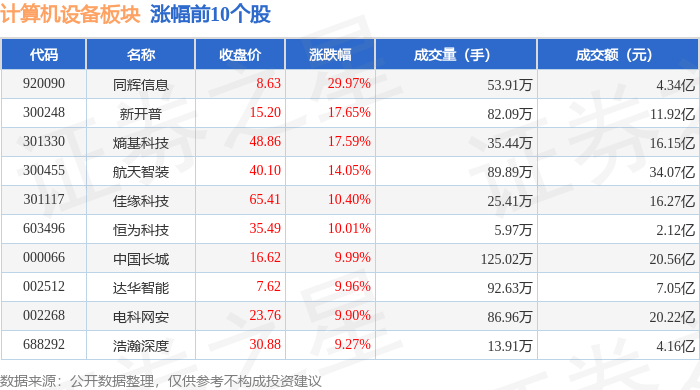
计算机设备板块1月12日涨4.63%,同辉信息领涨,主力资金净流入20.93亿元
Zheng Xing Xing Ye Ri Bao· 2026-01-12 09:10
Group 1 - The computer equipment sector experienced a significant increase of 4.63% on January 12, with Tonghui Information leading the gains [1] - The Shanghai Composite Index closed at 4165.29, up 1.09%, while the Shenzhen Component Index closed at 14366.91, up 1.75% [1] - Notable individual stock performances included Tonghui Information with a closing price of 8.63, up 29.97%, and Xinkaiyin with a closing price of 15.20, up 17.65% [1] Group 2 - The computer equipment sector saw a net inflow of 2.093 billion yuan from institutional investors, while retail investors experienced a net outflow of 1.14 billion yuan [2] - The stock with the highest net inflow from institutional investors was China Great Wall, with 914 million yuan, representing 44.46% of its trading volume [3] - Conversely, retail investors showed a significant outflow from stocks like Hikvision and Dahua Technology, indicating a shift in investor sentiment [3]




收评:三大指数均涨超1% 两市成交额创新高
Zhong Guo Jing Ji Wang· 2026-01-12 07:28
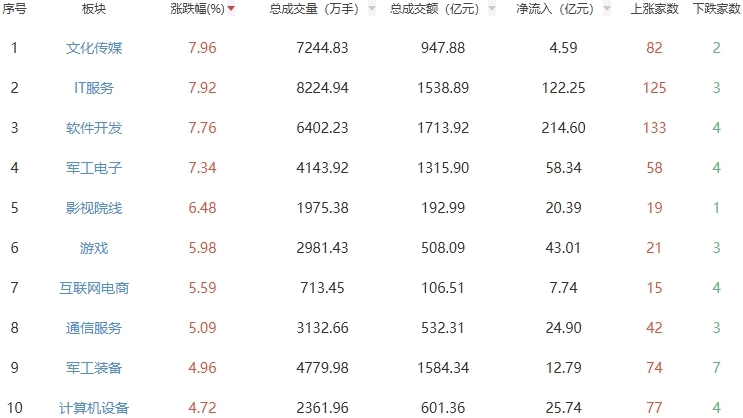
Market Overview - The A-share market indices collectively rose today, with total trading volume exceeding 3.6 trillion yuan, marking the second consecutive trading day above 3 trillion yuan, an increase of 478.7 billion yuan compared to the previous trading day, setting a new historical record for trading volume in 2024 [1] Index Performance - The Shanghai Composite Index closed at 4165.29 points, up 1.09%, with a trading volume of 1.446 trillion yuan - The Shenzhen Component Index closed at 14366.91 points, up 1.75%, with a trading volume of 2.155 trillion yuan - The ChiNext Index closed at 3388.34 points, up 1.82%, with a trading volume of 1.086 trillion yuan [1] Sector Performance - The leading sectors in terms of growth included: - Cultural Media: up 7.96%, with a trading volume of 724.48 billion yuan and a net inflow of 94.79 billion yuan - IT Services: up 7.92%, with a trading volume of 822.49 billion yuan and a net inflow of 122.25 billion yuan - Software Development: up 7.76%, with a trading volume of 640.22 billion yuan and a net inflow of 214.60 billion yuan [2] Declining Sectors - The sectors with the largest declines included: - Insurance: down 0.81%, with a trading volume of 18.93 billion yuan and a net outflow of 10.62 billion yuan - Oil and Gas Extraction and Services: down 0.34%, with a trading volume of 164.48 billion yuan and a net outflow of 8.16 billion yuan - Agricultural Chemicals: down 0.22%, with a trading volume of 182.31 billion yuan and a net outflow of 22.81 billion yuan [2]
A股收评 | 三大指数集体收涨 A股诞生新纪录!成交3.6万亿
智通财经网· 2026-01-12 07:15
Market Overview - The market continued to rise with all three major indices closing higher, and trading volume exceeded 3.6 trillion, setting a new record since October 8, 2024 [1] - Over 4,100 stocks rose, indicating strong market momentum [1] Sector Performance - The GEO concept saw a strong surge, with stocks like Yidian Tianxia, Zhongwen Online, and Tianlong Group hitting a 20% limit up [1] - The commercial aerospace sector also performed well, with China Satellite, a leading player, hitting the limit up [1] - The photovoltaic sector rose, with stocks like Maiwei Co. and Dongfang Risheng increasing over 10% [2] - The robotics sector experienced upward movement, with stocks like Aowei New Materials reaching historical highs [2] Key Stocks - Tianpu Co., a 16-fold bull stock, faced a one-day limit down due to a significant announcement regarding trading anomalies [2] - The overall market saw 4,144 stocks rise and 1,182 fall, with 202 stocks hitting the limit up and 9 hitting the limit down [2] Fund Flow - Main funds focused on software development, IT services, and computer equipment, with notable net inflows into stocks like Yanshan Technology, China Satellite, and Haige Communication [3] Industry Insights - The Brain-Machine Interface (BMI) technology is projected to have significant applications in healthcare, consumer electronics, and military aerospace, indicating a transformative potential for future economic cycles [4] - The Ministry of Industry and Information Technology emphasized the importance of stabilizing growth in ten key industries, which account for 80% of industrial output [5] - Several storage and packaging companies have raised prices by approximately 30% due to high demand and full capacity utilization, with potential for further price increases [6] Future Market Outlook - Huaxi Securities suggests that the spring bullish window may continue, supported by positive PMI and inflation data, as well as increased market participation from external funds [8] - Huatai Securities indicates that the spring market may still have room for growth, recommending focus on gaming, duty-free, and battery sectors [9] - CITIC Construction emphasizes the positive impact of investment and demand-side policies, suggesting attention to cyclical sectors like steel structure and infrastructure [10]
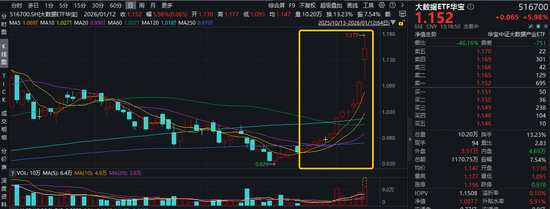
暴涨8%!大数据ETF华宝(516700)冲击12连阳!GEO概念强势,易点天下等6股涨停!GEO是什么?一文搞懂!
Xin Lang Cai Jing· 2026-01-12 05:33
Core Viewpoint - The market is experiencing a significant surge in the domestic computing power sector, particularly in IDC and AI application areas, as evidenced by the strong performance of the Huabao Big Data ETF, which saw an increase of 8.28% and is currently up 5.98%, marking a 12-day consecutive rise [1][9]. Group 1: Market Performance - The Huabao Big Data ETF (516700) is heavily invested in sectors such as data centers, cloud computing, and big data processing, focusing on leading companies like Zhongke Shuguang, Keda Xunfei, and China Software [5][14]. - Notable stock performances include: - Tuorisi up 20.02% - Yidian Tianxia up 20.00% - Xindian Software up 19.67% - Zhongke Changtu up 15.73% - Runze Technology up 14.00% [2][6][11]. Group 2: Industry Insights - The IDC industry is expected to see improved supply-demand dynamics driven by increased capital expenditure (Capex) returning to AI, rising acceptance of domestic computing power, and improvements in high-end chip availability [3][12]. - The demand for data centers is being fueled by the high growth in the computing power market, particularly in North America and China, with significant projects still pending in overseas markets [4][13]. - The concept of Generative Engine Optimization (GEO) is emerging as a critical strategy for businesses to capture AI traffic and enhance conversion rates by optimizing content models for AI large models [3][12]. Group 3: Strategic Focus - The government is emphasizing "technology as a priority," which is expected to accelerate the development of new productive forces and the process of domestic substitution [7][14]. - The digital China initiative aims to activate digital productivity, further supporting the growth of the domestic computing power sector [7][14]. - The "Xinchuang 2.0" wave is anticipated to accelerate, presenting a broad outlook for technology self-reliance [7][14].
午评:沪指半日涨0.75% 文化传媒板块走强
Zhong Guo Jing Ji Wang· 2026-01-12 03:46
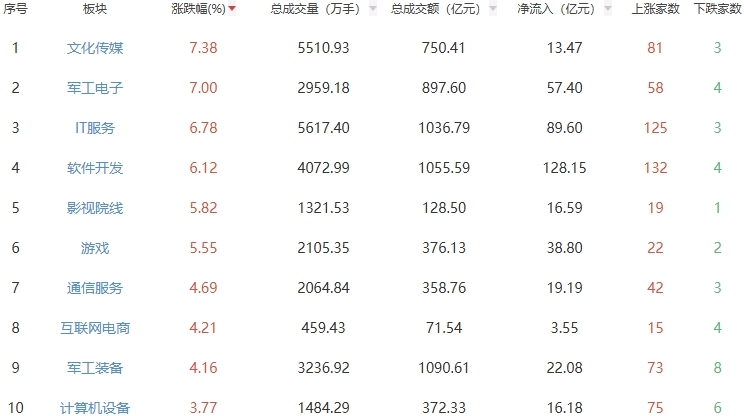
Core Viewpoint - The A-share market experienced a collective rise in the three major indices, with significant gains in specific sectors such as cultural media, military electronics, and IT services, while sectors like oil and gas extraction, coal mining, and agricultural chemicals faced declines [1][2]. Sector Performance - The cultural media sector led the gains with an increase of 7.38%, achieving a total transaction volume of 55,109.3 million hands and a net inflow of 7.5041 billion [2]. - The military electronics sector rose by 7.00%, with a transaction volume of 29,591.8 million hands and a net inflow of 8.976 billion [2]. - The IT services sector saw a 6.78% increase, with a total transaction volume of 56,174.0 million hands and a net inflow of 10.3679 billion [2]. - Other notable sectors with positive performance included software development (6.12%), film and cinema (5.82%), and gaming (5.55%) [2]. Declining Sectors - The oil and gas extraction and services sector experienced a decline of 0.60%, with a transaction volume of 11,090.9 million hands and a net outflow of 0.626 billion [2]. - The coal mining and processing sector fell by 0.38%, with a transaction volume of 8,006.8 million hands and a net outflow of 1.129 billion [2]. - The agricultural chemicals sector decreased by 0.33%, with a transaction volume of 11,814.7 million hands and a net outflow of 1.559 billion [2].
兴业证券:如何看待A股本轮开门红的结构与延续性?
智通财经网· 2026-01-11 10:36
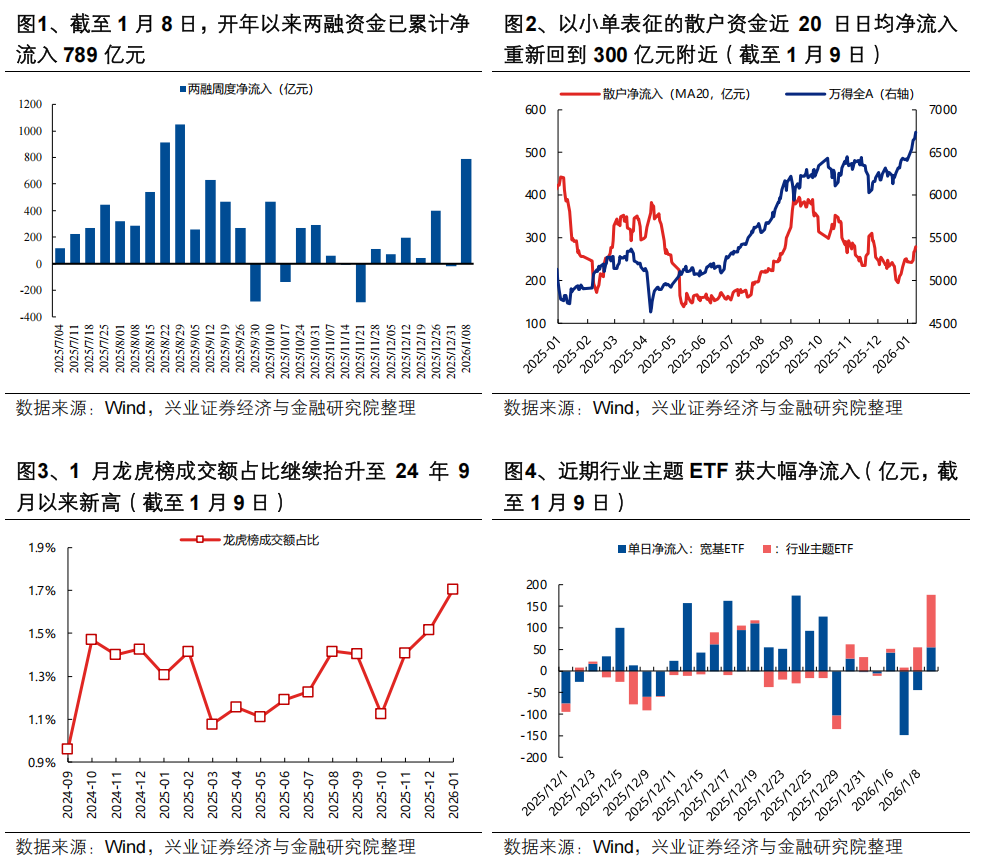
Core Viewpoint - The recent "opening red" in the A-share market reflects a favorable macroeconomic environment and abundant liquidity, which supports market risk appetite and attracts incremental capital inflow, creating a positive feedback loop between capital inflow and market rise [2][18]. Group 1: Market Dynamics - The A-share market has experienced a strong start with the Shanghai Composite Index breaking key levels and achieving a "sixteen consecutive days" rise, exceeding many investors' expectations [1][19]. - Historical data indicates that after a single-day trading volume exceeds 3 trillion yuan, there is typically at least a monthly-level market rally [19]. - Various types of trading funds have shown signs of accelerated entry, including a net inflow of 78.9 billion yuan in margin financing since the beginning of the year and a return of retail investor net inflow to around 30 billion yuan daily [2][5]. Group 2: Structural Characteristics - The inflow structure of different funds shows a strong consensus on key themes, primarily focusing on TMT (storage, AI applications), military industry (commercial aerospace), non-ferrous metals, new energy (controlled nuclear fusion), machinery (robots), and pharmaceuticals (innovative drugs, brain-machine interfaces) [5][36]. - The global stock market has also seen a strong start in 2026, driven by macroeconomic and industrial narratives, with A-shares reflecting similar trends [13][18]. Group 3: Future Directions - As companies begin to disclose annual reports, earnings will become a key factor driving market dynamics, leading to a structural adjustment where previously hot sectors face performance validation, while some low-performing sectors may attract new capital inflows [36]. - Industries with significant upward revisions in profit forecasts since November include technology (consumer electronics, computing), advanced manufacturing (new energy, military), cyclical sectors (building materials, non-ferrous metals), and consumer sectors (food processing, retail) [37][38].

史海钩沉系列:“亲历”一次科网泡沫,我们能学到什么?-国联民生
Sou Hu Cai Jing· 2026-01-11 09:12
Core Insights - The U.S. tech bubble from 1995 to 2000 was driven by technological advancements, macroeconomic changes, regulatory relaxation, and monetary policy adjustments, providing valuable lessons for today's market [1] Group 1: Formation of the Bubble - The bubble was fueled by multiple core drivers, including the internet revolution that significantly increased U.S. labor productivity and a macroeconomic environment that maintained resilience during the 1997-1998 overseas crisis [1][2] - The 1996 Telecommunications Act created a unified internet market, while relaxed financial regulations encouraged mixed operations, contributing to the bubble's formation [1][2] - The monetary policy under Alan Greenspan was initially flexible and technology-friendly from 1995 to 1999, only shifting to a restrictive stance in 2000 to curb stock market overheating [1][2] Group 2: Evolution of the Bubble - The bubble's evolution can be divided into three phases: - 1995-1997 marked the prologue, with the IPO of Netscape in 1995 igniting a tech IPO boom and a balanced market development [2][31] - 1998-1999 saw an investment climax, with capital flowing into the U.S. due to overseas turmoil and the Federal Reserve's emergency rate cuts, leading to a surge in tech stocks [2][42] - The bubble burst in 2000 due to multiple factors, including continuous rate hikes by the Federal Reserve, cash flow crises in internet companies, and the Microsoft antitrust case, resulting in a significant drop in the Nasdaq index [2][42] Group 3: Underlying Logic of the Bubble - The core logic behind the bubble is evident: loose liquidity and responsive monetary policy formed the foundation, while the profit-seeking nature of capitalism and regulatory relaxation acted as the driving force [2][3] - Uncontrolled leverage expansion, driven by credit descent, was crucial in pushing the bubble to extremes, with stock option incentives and lax accounting rules contributing to capital inflation [2][3] Group 4: Lessons Learned - The essence of technological progress is productivity improvement, and excessive capital investment during periods of enthusiasm can hinder efficiency gains [3] - Investors should be cautious of narratives detached from fundamentals, emphasizing cash flow and real profitability [3] - Regulatory frameworks must balance innovation and risk to prevent excessive leverage, while monetary policy should consider multiple objectives and carefully manage liquidity adjustments [3]

