
农药

Search documents
江山股份涨2.01%,成交额1.04亿元,主力资金净流出267.55万元
Xin Lang Zheng Quan· 2026-01-06 02:52
Core Viewpoint - Jiangshan Co., Ltd. has shown a mixed performance in stock price and financial results, with a notable increase in net profit year-on-year, indicating potential growth in the agricultural chemicals sector [1][2]. Financial Performance - For the period from January to September 2025, Jiangshan Co. achieved a revenue of 4.516 billion yuan, representing a year-on-year growth of 5.20% [2]. - The net profit attributable to shareholders reached 425 million yuan, marking a significant increase of 147.91% compared to the previous year [2]. Stock Performance - As of January 6, Jiangshan Co.'s stock price increased by 2.01% to 25.35 yuan per share, with a trading volume of 1.04 billion yuan and a turnover rate of 0.97% [1]. - Year-to-date, the stock price has risen by 0.28%, but it has decreased by 4.41% over the last five trading days [1]. Shareholder Information - As of September 30, 2025, the number of shareholders decreased by 9.05% to 19,100, with an average of 22,509 circulating shares per shareholder, which is an increase of 9.95% [2]. - The company has distributed a total of 2.693 billion yuan in dividends since its A-share listing, with 384 million yuan distributed over the last three years [3]. Major Shareholders - Among the top ten circulating shareholders, China Europe Fund Pioneer Stock A holds 13 million shares, remaining unchanged from the previous period [3]. - Hong Kong Central Clearing Limited, ranked eighth, reduced its holdings by 662,000 shares to 4.667 million shares [3].

扬农化工(600486):农药拐点将至 优创项目助力成长
Xin Lang Cai Jing· 2026-01-05 00:23
Core Viewpoint - The company, a leading player in the domestic pesticide industry, is expected to benefit from the gradual recovery of pesticide prices and the ramp-up of its Youchuang project, leading to potential growth in both volume and price [1][4]. Group 1: Company Overview - The company, established in 1999 and backed by Syngenta Group, is a top-tier player in the agricultural chemical sector in China, specializing in pyrethroid active ingredients [2]. - It is a core supplier of pyrethroid products globally, with a comprehensive product range including insecticides, herbicides, fungicides, and plant growth regulators, achieving a total production capacity exceeding 100,000 tons [2][4]. - The company has nearly 70 varieties of active ingredients and anticipates production and sales of raw materials to reach 96,913.34 tons and 99,872.64 tons respectively in 2024, reflecting year-on-year growth of 6.67% and 3.50% [2]. Group 2: Market Dynamics - The pesticide market is experiencing a supply-demand optimization, with prices stabilizing and rebounding after significant declines since 2022 [3]. - The agricultural price index has shown a recovery trend, with the raw material index reflecting improvements in various categories, including herbicides [3]. - The implementation of stricter regulations, such as the "one product, one certificate" policy, is expected to benefit leading companies with abundant registration certificates [3]. Group 3: Project Developments - The Youchuang project is set to enhance production capacity, increasing the output of high-efficiency chlorfenapyr from 5,500 tons/year to 8,500 tons/year, thereby solidifying the company's position in the pyrethroid market [1][3]. - The company is also advancing a technical transformation project for 3,000 tons of pyrazole ester, which is expected to contribute additional revenue [3]. Group 4: Financial Outlook - The company is projected to achieve a compound annual growth rate (CAGR) of 13.86% in net profit attributable to shareholders over the next three years, with a target price of 84.70 yuan based on a 22x PE ratio for 2026 [4].

注意!双酚A等23种类化学品,被列入优先控制化学品名录!
Zhong Guo Hua Gong Bao· 2026-01-04 09:14
Core Viewpoint - The Ministry of Ecology and Environment and the National Health Commission have jointly issued the "Priority Control Chemical List (Third Batch)," which includes 23 chemical substances such as 1,1,2,2-tetrachloroethane and bisphenol A, focusing on high-risk chemicals with significant environmental and health impacts [1][2]. Group 1: Chemical Substances and Their Risks - The list includes 23 chemical substances, particularly those with persistent, bioaccumulative, and aquatic chronic toxicity properties, as well as carcinogenic, mutagenic, reproductive toxicity, and endocrine-disrupting characteristics [1][2]. - Notable substances in the list include 1,1,2,2-tetrachloroethane, bisphenol A, and various perfluoroalkyl and polyfluoroalkyl substances, which are linked to industries such as petrochemicals, plastics, pharmaceuticals, textiles, and pesticides [1][2]. Group 2: Regulatory Measures and Industry Response - The management of the chemicals listed is primarily based on environmental impact assessments for construction projects, pollution discharge permits, and soil and groundwater pollution prevention measures [1]. - Companies are encouraged to recognize the potential environmental and health risks associated with these chemicals and to proactively upgrade processes, enhance waste treatment, and develop environmentally friendly alternatives to minimize risks [2].

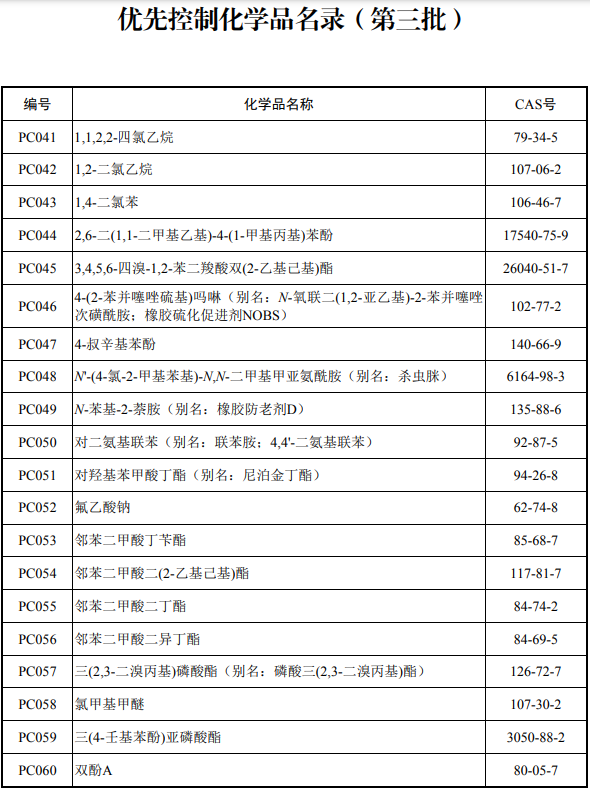
《优先控制化学品名录(第三批)》公布,生态环境部答记者问
Xin Lang Cai Jing· 2026-01-02 07:09
Group 1 - The core viewpoint of the article is the issuance of the "Priority Control Chemical List (Third Batch)" by the Ministry of Ecology and Environment and the National Health Commission, emphasizing the importance of managing new pollutants to protect ecological and public health [1][2] - The list aims to prioritize the management of chemical substances that pose significant environmental and health risks, serving as a foundational support for managing toxic pollutants in water, air, and soil [2][3] - The compilation of the list involved a comprehensive assessment of chemical substances based on their inherent hazards, potential exposure levels, and international control measures, focusing on high-risk chemicals such as persistent, bioaccumulative, and toxic substances [2][3] Group 2 - The list includes 23 categories of chemical substances, such as 1,1,2,2-tetrachloroethane and bisphenol A, which are recognized as carcinogens and endocrine disruptors, affecting various industries including petrochemicals, plastics, and pharmaceuticals [3][4] - Companies producing or using the listed chemicals are encouraged to enhance their environmental risk management practices, including upgrading processes and controlling emissions, to mitigate potential risks [4][5] - Current management of the chemicals in the list is based on existing regulations regarding environmental impact assessments, pollution permits, and soil and groundwater pollution prevention [5]
生态环境部固体废物与化学品司有关负责人就《优先控制化学品名录(第三批)》答记者问
Yang Shi Wang· 2026-01-02 06:42
Core Viewpoint - The Ministry of Ecology and Environment and the National Health Commission have jointly issued the "Priority Control Chemical List (Third Batch)" to enhance the management of new pollutants and protect ecological and public health [2][5]. Group 1: Background and Purpose - The issuance of the list is part of a broader initiative by the Chinese government to address new pollutant management, as emphasized in various party meetings and documents, aiming for effective environmental risk control by 2035 [2]. - The list aims to provide foundational support for managing environmental risks associated with toxic pollutants in water, air, and soil, while also raising awareness among the public and enterprises regarding the environmental and health hazards of chemical substances [3]. Group 2: Compilation Process - The compilation of the list involved a comprehensive assessment of chemical substances based on their inherent hazards, potential exposure levels, and international control measures, focusing on high-risk chemicals such as persistent, bioaccumulative, and toxic substances [3][4]. - The process adhered to an "openness" principle, soliciting public opinions and conducting expert consultations to ensure a wide range of inputs were considered [4]. Group 3: Included Chemicals - The list includes 23 categories of chemical substances, such as carcinogens and endocrine disruptors, affecting various industries including petrochemicals, plastics, pharmaceuticals, and textiles [5]. - Notably, some high-concern persistent organic pollutants were not included in the list, indicating a need for compliance with existing environmental management regulations for new chemical substances [5]. Group 4: Management Requirements - The issuance of the list provides a framework for companies to proactively manage environmental risks associated with the listed chemicals, encouraging practices such as process upgrades and the development of environmentally friendly alternatives [6]. - Current management of the listed chemicals is guided by various regulations, including environmental impact assessments and pollution discharge permits [6][7].
化工行业可转债专题研究系列之一:农化制品可转债梳理-20251231
EBSCN· 2025-12-31 14:24
Report Summary 1. Industry Investment Rating The report does not provide an investment rating for the agrochemical products industry. 2. Core Viewpoints The agrochemical products industry has stable demand supported by the "stable grain supply" policy and the growth of fertilizer and pesticide exports. The supply - side ecosystem is expected to optimize under the "anti - involution" policy, and the industry's profitability is expected to increase. Policy support for food security has strengthened the demand for agrochemical products, and multi - dimensional factors such as domestic consumption and exports have further boosted the demand. Meanwhile, the supply - side reform in the fertilizer and pesticide sectors is promoting industry concentration and high - quality development [1][12]. 3. Summary by Directory 3.1 Agrochemical Products Industry Overview - **Policy Support and Demand Foundation**: The government has continuously strengthened food security policies. In 2025, the national grain output reached 14297.5 billion jin, an increase of 1.2% year - on - year, providing core support for agrochemical product demand. Domestic food consumption is rigid, and the demand for agrochemical products is driven by multiple factors such as domestic food, feed consumption, and exports. In 2025, from January to November, the export volume of fertilizers increased by 45.52% year - on - year, and the export volume of pesticides also increased significantly [12][13]. - **Supply - side Optimization**: The government and the industry are jointly promoting "anti - involution." The Chinese Pesticide Industry Association launched a three - year "Rectifying Involution" action, and the Chinese Phosphate and Compound Fertilizer Industry Association issued an initiative to strengthen industry self - discipline. As backward production capacity exits and new capacity is limited, the industry ecosystem is expected to improve [14]. 3.2 Fertilizer Industry - **Industry Chain and Supply - side Reform**: The fertilizer industry includes phosphate fertilizers, nitrogen fertilizers, potassium fertilizers, and compound fertilizers. In recent years, the supply - side reform has advanced, with an increase in fertilizer production but a decrease in application and an improvement in utilization efficiency. In 2025, from January to November, the export volume of fertilizers increased by 45.52% year - on - year, mainly driven by nitrogen fertilizers and compound fertilizers, while the import volume decreased by 1.22% year - on - year [15][20]. - **Phosphate Fertilizer Sub - sector**: The supply of phosphate fertilizers is restricted by phosphate rock resources. In 2025, from January to November, the production of monoammonium phosphate and diammonium phosphate decreased year - on - year. The price of phosphate fertilizers has been rising due to the tight balance of phosphate rock supply and demand and strict policies on new phosphate ammonium capacity [32][54]. 3.3 Pesticide Industry - **Industry Structure and Policy - driven Supply Improvement**: Pesticides are used for pest control and plant growth regulation. China is the world's largest producer of pesticide technicals, but there is a problem of over - capacity. In 2025, the Chinese Pesticide Industry Association proposed a three - year "Rectifying Involution" action plan, and new policies such as the revised "Pesticide Registration Management Method" will optimize the industry's competition pattern [61][62]. - **Production, Demand, and Price Trends**: In 2025, from January to November, the growth rate of China's pesticide technical production decreased, but the export volume increased. The global demand for pesticides is rigid, and pesticide prices are expected to recover as over - capacity is alleviated [63][71]. - **Glyphosate Sub - sector**: Glyphosate is the most widely used single - product pesticide globally. Policy restricts new capacity, and the inventory has been decreasing since 2025. The growth of global transgenic crop planting area drives the demand and export of glyphosate, and the price is expected to rise, and the industry's prosperity is expected to increase [75][90]. 3.4 Agrochemical Products Industry Convertible Bonds Basic Situation - **General Information**: As of December 26, 2025, the outstanding balance of convertible bonds in the agrochemical products industry totaled 9.767 billion yuan, accounting for 25.27% of the convertible bond balance in the basic chemical industry. The un - converted ratio of all convertible bonds is over 90%, and the credit ratings range from AA - to AA + [91][94]. - **Trading and Valuation**: The trading volume of Hebang Convertible Bonds is the highest, with an annual trading volume exceeding 24 billion yuan. Since 2025, both the prices of agrochemical convertible bonds and their underlying stocks have risen, and the price increase of underlying stocks is generally stronger than that of convertible bonds. All agrochemical convertible bonds are balanced - type, with Yangfeng Convertible Bonds having a relatively high conversion premium rate of over 40% [95][99]. - **Financial Performance**: From Q1 to Q3 in 2025, the profitability of most issuers of agrochemical convertible bonds has recovered. The operating net cash flow of most issuers has shown continuous inflow or improvement, and the asset - liability ratio at the end of Q3 in 2025 is generally controllable [3][103]. 3.5 Individual Bond Situations - **Xingfa Convertible Bonds**: The issuer, Xingfa Group, is a leading enterprise in the phosphate chemical industry, with advantages in phosphate rock mining rights and power costs. It has a complete phosphate chemical industry chain, and its new energy materials business is advancing. In 2025, from Q1 to Q3, its profitability was stable, and the net profit increased year - on - year [108][110]. - **Suli Convertible Bonds**: The issuer, Suli Co., Ltd., is engaged in pesticides, flame retardants, and other fine chemical products. In 2025, the demand in the agrochemical market recovered, and the quantity and price of its products such as chlorothalonil and decabromodiphenylethane increased, driving the growth of the company's performance [111][112]. - **Fengshan Convertible Bonds**: The issuer, Fengshan Group, is involved in pesticides, new energy electronic chemicals, and fine chemical new materials. In 2025, the company's net profit turned from loss to profit in the first three quarters, and its operating performance improved [113][115]. - **Hebang Convertible Bonds**: The issuer, Hebang Biotech, is engaged in mining, chemicals, photovoltaic glass, etc. The company has strengthened its mining layout, and the phosphate rock business has been prosperous. Since the second quarter of 2025, the quantity and price of glyphosate have increased [116][117]. - **Yangfeng Convertible Bonds**: The issuer, New Yangfeng, is a leading enterprise in phosphate compound fertilizers. It has a complete industrial chain layout, and its new fertilizer business is developing. In 2025, from Q1 to Q3, its profitability was stable, and the net profit increased year - on - year [118][119].




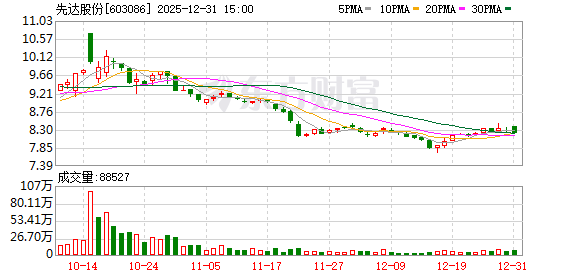
先达股份:公司创新产品吡唑喹草酯海内外市场处于推广开发阶段,海外市场登记布局正在进行中
Mei Ri Jing Ji Xin Wen· 2025-12-31 10:33
Group 1 - The company is currently in the promotion and development stage for its innovative product, Pyrazolylbutyric acid, in both domestic and international markets [2] - The company is actively working on overseas market registration and layout, indicating a strategic approach to expand its market presence [2] - Future market prospects for the product are considered broad due to the enhancement of relevant registration documents and collaboration plans with multinational companies [2]

先达股份:公司吡唑喹草酯已获登记证,目前正处于推广阶段
Mei Ri Jing Ji Xin Wen· 2025-12-31 10:33
Group 1 - The core point of the article is that the company has successfully obtained the registration certificate for Pyrazole Acetate and is currently in the promotion phase [2] Group 2 - An investor inquired about the registration status of Pyrazole Acetate and expressed concerns about the delay after public announcement [2] - The company responded on the investor interaction platform, confirming the registration and outlining the current promotional efforts [2]
和邦生物:扩产35万吨草甘膦产能消化有难度,团队仍有信心
Xin Lang Cai Jing· 2025-12-31 08:36
Core Viewpoint - The company is expanding its glyphosate production capacity by 350,000 tons per year, but faces significant challenges in market absorption and securing sales confirmations from downstream customers [1] Group 1 - The company acknowledges the difficulty in absorbing the new production capacity, indicating that achieving good operational efficiency requires tackling challenging tasks [1] - The company expresses confidence in its technical processes and product competitiveness despite the challenges ahead [1]
先达股份:烯草酮价格一单一议,具体参考中农立华指数
Xin Lang Cai Jing· 2025-12-31 08:35
Group 1 - The company implements a "one order, one negotiation" pricing policy for its product, isocarbophos, meaning prices vary for different customers [1] - For specific pricing information, it is recommended to refer to the Zhongnong Lihua original drug price index [1]