Autonomous Driving

Search documents
WeRide to Launch GXRs and Robobus in Singapore as part of Grab's New Ai.R Autonomous Service
Globenewswire· 2025-09-22 09:14
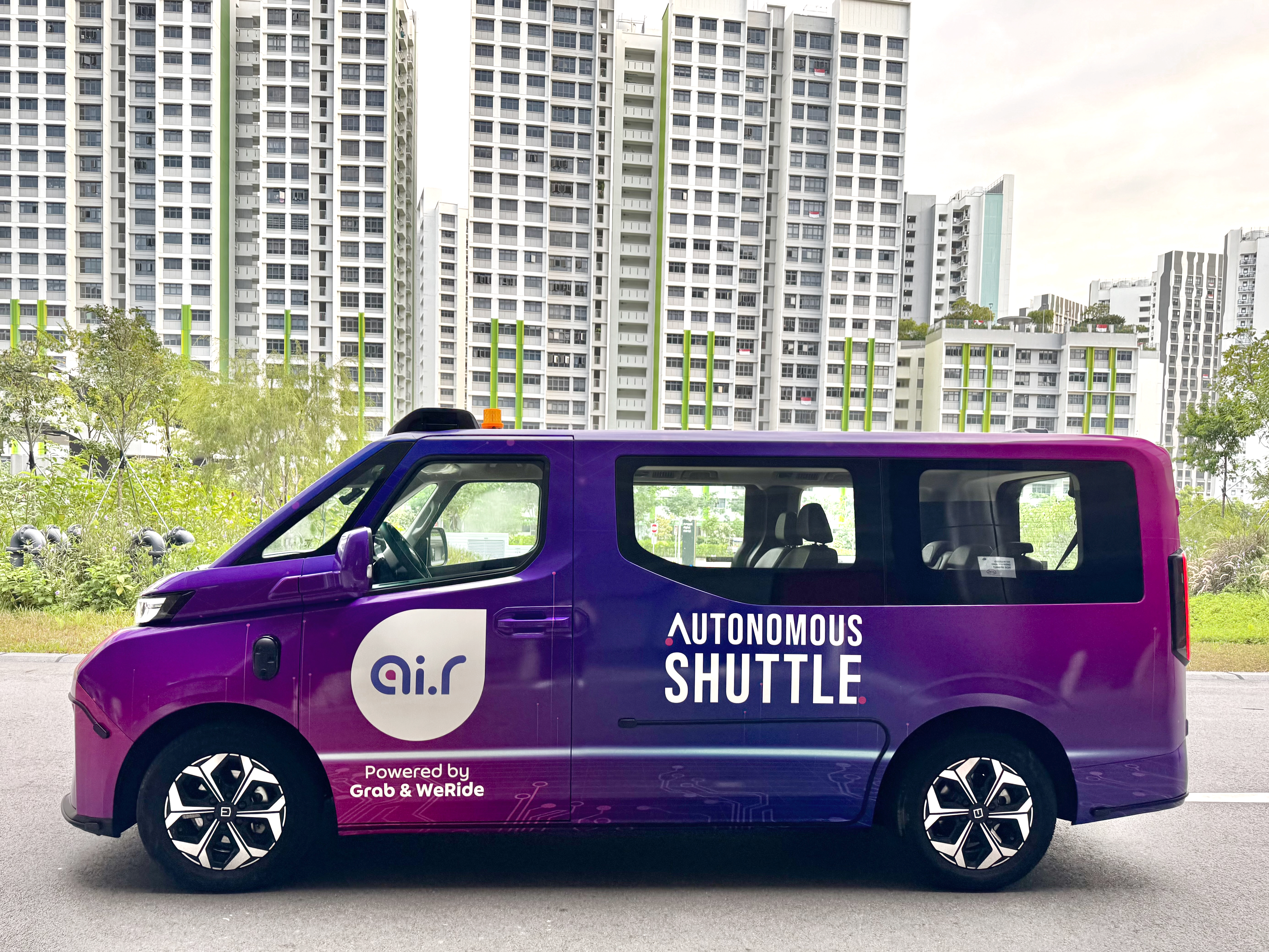
Core Viewpoint - WeRide, a leader in autonomous driving technology, is launching its autonomous vehicle service Ai.R in Singapore in partnership with Grab, marking a significant step in urban transportation in Southeast Asia [1][8]. Company Overview - WeRide is recognized as a global leader in the autonomous driving industry and is the first publicly traded Robotaxi company, having tested or operated its vehicles in over 30 cities across 11 countries [21]. - Grab is a leading super app in Southeast Asia, providing a wide range of services including mobility, deliveries, and digital financial services across eight countries [22]. Service Launch Details - The Ai.R service will operate in Punggol, Singapore, utilizing WeRide's GXR and Robobus vehicles, with a fleet of 11 vehicles initially deployed [2][6]. - Ai.R is the only service selected by the Land Transport Authority (LTA) to operate on two designated routes in Punggol [2][6]. Vehicle Specifications and Safety - The five-seater WeRide GXR and eight-seater Robobus have successfully passed Singapore's Milestone 1 (M1) assessment, confirming their ability to operate safely on public roads [4][6]. - Ai.R vehicles are equipped with advanced cameras and LiDAR technology, allowing them to detect objects up to 200 meters away and navigate safely even in adverse weather conditions [12]. Training and Safety Measures - Grab has initiated training for over 10 driver-partners to become autonomous vehicle Safety Operators, ensuring safety during the initial phase of the service [7][15]. - A trained Grab Safety Operator will be present on every Ai.R ride during the initial phase to monitor operations and ensure passenger safety [7][18]. Future Plans and Community Impact - By early 2026, Ai.R is expected to start taking its first batch of passengers, enhancing access to key amenities in the Punggol area [11]. - The service aims to improve connectivity within underserved neighborhoods, providing a smarter travel experience for residents [9][8].


Pony AI: A Solid Autonomous Mobility Bet
Seeking Alpha· 2025-09-21 13:22
Group 1 - The autonomous driving technology has been maturing and consolidating over the last 1-2 years [1] - Continuous advancements in computing, sensors, and AI technologies are driving growth in the autonomous driving sector [1] - Companies like Google are increasingly involved in the development of autonomous driving technologies [1]
How Ride-Hailing Platforms Could Be The Real Winners Of The Autonomous Driving Push - Uber Technologies (NYSE:UBER)
Benzinga· 2025-09-20 15:01
Core Insights - The U.S. is increasing its focus on autonomous driving, with companies like Tesla, Waymo, and Zoox leading the charge, while ride-hailing platforms like Uber and Lyft stand to benefit significantly from this trend [1] Cost Savings - Autonomous taxis can reduce costs by eliminating the need for human drivers, allowing companies to offer more competitive prices, which could enhance adoption and profit margins [2] - A comparison showed that a Tesla Robotaxi ride was over $13 cheaper than a regular Uber ride for a trip to a coffee shop in Downtown San Jose [3] Growing Customer Adoption - There is a growing preference for Robotaxis over traditional cabs, as evidenced by Uber users in Atlanta opting for Waymo Robotaxis [4] - Tesla's Robotaxi app became one of the most downloaded free travel applications on the Apple App Store, surpassing Uber's own 30-day rollout record [4] Improved Safety Outcomes - Research indicates that autonomous vehicles may be safer than human drivers, with Waymo reporting a 91% higher likelihood of avoiding serious injuries compared to human drivers [5] - Waymo also noted a 79% reduction in airbag deployments and an 88% reduction in property damage claims compared to human drivers [6] Partnerships Could Be The Way Forward - Uber and Lyft are forming partnerships with companies like Waymo to integrate Robotaxis into their platforms, which could enhance their market reach [7] - Uber's CEO highlighted a $1 trillion total addressable market (TAM) opportunity for the autonomous driving industry, suggesting various revenue models for Robotaxis [8] Market Reactions - Waymo's partnership with Lyft in Nashville resulted in a 10% increase in Lyft's stock price, indicating positive market sentiment towards such collaborations [9] Operational Efficiency - Partnerships with autonomous vehicle companies could alleviate the costs associated with maintaining a fleet, allowing ride-hailing companies to focus on providing platforms for these vehicles [10] Challenges Ahead - Regulatory challenges persist, with varying state regulations in the U.S. and calls for stricter oversight from government officials [11][12] - Concerns from traditional cab drivers and lawmakers about the impact of autonomous vehicles on employment and livelihoods are emerging [13] Conclusion - Ride-hailing companies are investing in autonomous vehicles, with Uber planning to deploy over 20,000 Robotaxis through partnerships over the next six years, indicating a strong commitment to this evolving market [14]




Nvidia Considers $500 Million Investment in Autonomous Driving AI Firm Wayve
PYMNTS.com· 2025-09-19 14:04
Core Insights - Nvidia is considering a $500 million investment in Wayve, a company focused on embodied artificial intelligence for autonomous vehicles [1][2] - Wayve has a history of collaboration with Nvidia since 2018, utilizing Nvidia technology in its robot platforms [2] - The investment evaluation is part of Wayve's upcoming funding round, following a $1.05 billion Series C funding round in May 2024, which included participation from Nvidia [2][5] Company Collaboration - The partnership aims to deliver production-ready autonomous driving technology by integrating Wayve's foundation model with Nvidia's automotive-grade computing platforms [3] - Wayve's next platform, Wayve Gen 3, will utilize Nvidia Drive AGX Thor technology [3] Technology Development - Wayve's AV2.0 approach focuses on self-driving technology that learns from experience rather than explicit programming, which is expected to revolutionize mobility [4] - Nvidia recognizes Wayve as a leader in deep learning for autonomous driving, emphasizing the ability of Wayve's platform to adapt to new environments without costly sensors and high-definition maps [5] Future Prospects - Nvidia's vice president of automotive business highlighted the potential of Wayve's next-generation AV2.0 approach, which leverages Nvidia's advanced architectures for AI workloads [6] - Nvidia has published over 70 research papers to demonstrate AI's capabilities in real-world applications, aiming to enhance embodied intelligence across various industries [6]

WeRide Robobus Receives Belgium's First Level 4 Permit, Leading AV Industry with Products Licensed in Seven Countries
Globenewswire· 2025-09-19 11:00
Core Points - WeRide has received Belgium's first federal test permit for a Level 4 autonomous shuttle, making it the only technology company globally with autonomous driving permits in seven countries [1][8] - The Robobus will undergo testing on an 8km route in Leuven, in partnership with local transport operators and authorities [2][4] - The testing will include a safety officer onboard and is expected to begin in the coming weeks, with a pilot service planned from mid-November to January 2026 [3][4] Company Overview - WeRide is a global leader in autonomous driving technology and the first publicly traded Robotaxi company, with operations in over 30 cities across 11 countries [7][8] - The company has rapidly expanded its operations in Europe, recently launching Robotaxis in Switzerland and obtaining permits for public road testing in France [6][8] - WeRide's autonomous vehicles are designed to address various transportation needs, ranging from Level 2 to Level 4 capabilities [8]
Lyft与Waymo合作,背后呈现了行业发展怎样的新趋势?
Zhong Guo Qi Che Bao Wang· 2025-09-19 09:42
Core Viewpoint - The partnership between Lyft and Waymo marks a significant trend in the industry, focusing on the integration of autonomous driving technology with ride-hailing services, aiming to enhance operational efficiency and reduce costs [2][4]. Group 1: New Model Implications - Lyft's Flexdrive subsidiary will manage all aspects of vehicle operations, including energy supply, maintenance, and scheduling, to maximize the efficiency of Waymo's autonomous vehicles while minimizing operational costs [3]. - Initially, passengers will use the Waymo app to request rides, but as the partnership develops, these autonomous vehicles will seamlessly integrate with the Lyft platform, creating a more efficient ride-hailing network [4]. Group 2: Operational Efficiency and Cost Reduction - Lyft's user data will help optimize routes for Waymo's vehicles, avoiding congested areas and improving travel efficiency, while Waymo will collect road data to enhance its technology [6]. - The collaboration is expected to increase the average daily operational hours of Waymo vehicles from 12 to 18 hours, with a projected 40% increase in daily service orders per vehicle [6]. - The unit cost per mile is anticipated to decrease by 35%, facilitating the broader adoption of autonomous vehicles in more cities [7]. Group 3: Competitive Landscape Transformation - The partnership signifies a shift from a "self-research and self-build" model to an open ecosystem, allowing companies to leverage each other's strengths and reduce resource waste [8][9]. - This collaboration is expected to accelerate the commercialization timeline of autonomous driving by 2-3 years, with overall R&D costs potentially decreasing by 40% [10]. Group 4: Future Trends and Industry Impact - The alliance embodies the "Mobility as a Service" (MaaS) concept, integrating technology and application layers to reshape the interaction between people, vehicles, and urban infrastructure [11]. - The partnership is set to drive the industry towards a new era of "unmanned mobility and intelligent services," creating a new growth blueprint for the global transportation sector [11].

Nvidia explores $500 million investment in UK self-driving startup Wayve
Reuters· 2025-09-19 08:51
Core Insights - Nvidia, a U.S. chip designer, has signed a letter of intent for a potential $500 million investment in the upcoming funding round for Wayve, a British autonomous driving technology company [1] Company Summary - Nvidia is actively seeking to expand its investment in the autonomous driving sector through a significant financial commitment [1] - Wayve is positioned as a key player in the autonomous driving technology space, indicating its potential for growth and innovation [1]
Cathie Wood's Ark Bets Big On Solana Treasury Play: Makes $162M Investment In Brera Holdings As Stock Explodes 225% - Brera Holdings (NASDAQ:BREA)
Benzinga· 2025-09-19 01:42
Group 1: Ark Invest's Trades - Ark Invest sold shares of Tempus AI Inc and purchased shares of Brera Holdings PLC, Pony AI Inc, and Baidu Inc, indicating a strategic focus on the tech and AI sectors [1] - The acquisition of Brera Holdings involved purchasing 6,500,001 shares across multiple ETFs, including ARK Innovation ETF, Ark Fintech Innovation ETF, and ARK Next Generation Internet ETF [2] - The total value of Brera Holdings shares acquired by Ark Invest is approximately $161.85 million, with the stock closing at $24.90, reflecting a 225.49% increase [3] Group 2: Brera Holdings and Solmate - Brera Holdings will rebrand as Solmate, focusing on becoming a Solana-based digital asset treasury and crypto infrastructure company, following a $300 million investment [4] - Solmate aims to accumulate and stake Solana, deploying advanced validator infrastructure in the UAE, and will continue operating Brera's multi-club sports ownership business [5] Group 3: Tempus AI Trade - Ark Invest offloaded 43,157 shares of Tempus AI, valued at approximately $3.76 million, amid the company's recent FDA clearance for its AI-powered cardiac imaging platform [6] - Tempus AI's stock closed at $87.07, showing a slight increase of 0.72%, with a price target raised to $98 by HC Wainwright & Co [7] Group 4: Pony AI Trade - Ark Invest acquired 31,764 shares of Pony AI, valued at approximately $554,917, with the company reporting a 75.9% year-over-year revenue growth driven by its Robotaxi services [8] - Pony AI's stock price remained unchanged at $17.47, with a prior purchase of $1.5 million worth of shares [9] Group 5: Baidu Trade - Ark Invest added 5,033 shares of Baidu, valued at approximately $680,713, with the stock closing at $135.25, experiencing a slight dip of 1.87% [10]

人形机器人考察要点_市场展望、组件与具身人工智能-Humanoid Robot tour takeaways_ market outlook, components and embodied AI
2025-09-18 13:09
Summary of Conference Call Notes on Greater China Industrials (Humanoid Robots and Autonomous Driving) Industry Overview - The humanoid robot and autonomous driving (AD) sectors in China are expected to experience rapid expansion over the next decade, with significant growth anticipated in factory settings within 2-3 years and further opportunities in commercial and household applications in the long term [1][1] - The current bill of materials (BOM) cost for a fully-functional humanoid robot is approximately US$50-60k, with expectations for rapid cost reductions in the next five years due to improved product design and economies of scale [1][1] - Stricter regulations in the AD sector are anticipated to create more opportunities for AD components, particularly for LiDAR technology, which will benefit from new long-distance object detection requirements [1][1] Key Players and Developments Dobot - Dobot is a leading global collaborative robot (COBOT) brand, achieving a 47% year-over-year growth in 6-axis COBOT sales in the first half of 2025, indicating market share gains [8][8] - The company has entered the humanoid robot market, launching its first prototype in early 2025 and planning deployment in manufacturing and business scenarios [9][9] RoboSense - RoboSense is focusing on its new EMX LiDAR products, which offer superior precision and detection distance compared to competitors, with expectations to ship 600-700k units in 2025 and 1.5 million units in 2026 [10][10] - The company is also exploring opportunities in the lawn mower, unmanned delivery, and robotaxi industries, with significant partnerships established [11][11] Zhaowei Machinery & Electronics - Zhaowei has launched new dexterous hand models for humanoid robots and aims for a 10-15% global market share in this segment [12][12][13][13] - The BOM cost of the dexterous hand is estimated to account for 20-30% of the total BOM cost of a humanoid robot [13][13] Googol Technology - Googol Technology specializes in high-end control systems for advanced manufacturing and sees strong growth potential in humanoid robots due to its expertise in multi-degree-of-freedom (DoF) controlling [14][15] Minieye - Minieye is making progress with its smart driving solutions, including iPilot and iRobo, and anticipates significant growth in the penetration of front-view camera modules and driver monitoring systems due to new safety regulations [16][17] Leju Robotics - Leju targets to deliver over 1,000 units of robotics in 2025, focusing on stability and durability for large-scale applications [18][18] Orbbec - Orbbec is a leading player in robot vision systems, holding over 70% market share in 3D vision systems for service robots in China [21][21][22][22] UBTECH - UBTECH aims to ship 500 humanoid robots in 2025 and 2,000-3,000 units in 2026, with expectations for BOM cost reductions in the coming years [23][23][24][24] LK Tech - LK Tech is focusing on magnesium alloy technology for humanoid robots, which offers lightweighting and other advantages, and has signed cooperation agreements for R&D projects [25][26][26] Technology Insights - The competition between VLA (Vision-Language-Action) and world model technologies for embodied AI is highlighted, with data availability being a key bottleneck [3][3] - The vision system of humanoid robots is evolving, with depth cameras becoming the mainstream choice for enhancing sensing and navigation capabilities [22][22] Market Outlook - The humanoid robot market is expected to grow significantly, with projections of 3 million units shipped by 2030, leading to substantial opportunities for component suppliers [13][13] - The average selling price (ASP) of humanoid robots is expected to decline to approximately RMB150k (~US$20k) by 2026-2028 due to scale effects [20][20] Conclusion - The humanoid robot and AD sectors in Greater China are poised for significant growth, driven by technological advancements, regulatory changes, and increasing market demand. Key players are actively innovating and expanding their product offerings to capture market share in this rapidly evolving landscape.

Cathie Wood Loads Up On Bullish Inc, Pony AI And Robinhood — Dumps Kratos Defense Amid Taiwan Drone Buzz - ARK Autonomous Technology & Robotics ETF (BATS:ARKQ), ARK Innovation ETF (BATS:ARKK)
Benzinga· 2025-09-18 01:48
Group 1: Ark Invest Trades - Ark Invest executed significant trades involving Bullish, Kratos Defense, Pony AI, and Robinhood [1] - Ark Invest added 36,328 shares of Bullish, valued at nearly $1.97 million, with the stock closing at $54.35, up 5.82% after positive Q2 earnings [2] - Ark Invest sold 131,177 shares of Kratos Defense, valued at nearly $9.9 million, with the stock closing at $75.74, down 0.8% [3] - Ark Invest purchased 88,335 shares of Pony AI, valued at $1.5 million, with the stock closing at $17.47, up 1.98% [4] - Ark Invest acquired 33,783 shares of Robinhood, valued at approximately $4 million, with the stock closing at $118.64, up 1.07% [6] Group 2: Company Highlights - Kratos Defense is collaborating with Taiwan's NCSIST to unveil the Mighty Hornet IV Attack UAV, enhancing Taiwan's military capabilities [4] - Pony AI is making rapid progress in its robotaxi business, with Goldman Sachs projecting a target price of $24.50, indicating over 50% upside potential [5] - UBS estimates that China's robotaxi market could reach $183 billion by the late 2030s, with global opportunities adding nearly $400 billion [5] - Robinhood recently released positive operating data for August and announced a new fund aimed at democratizing private market access [6]