金融软件

Search documents
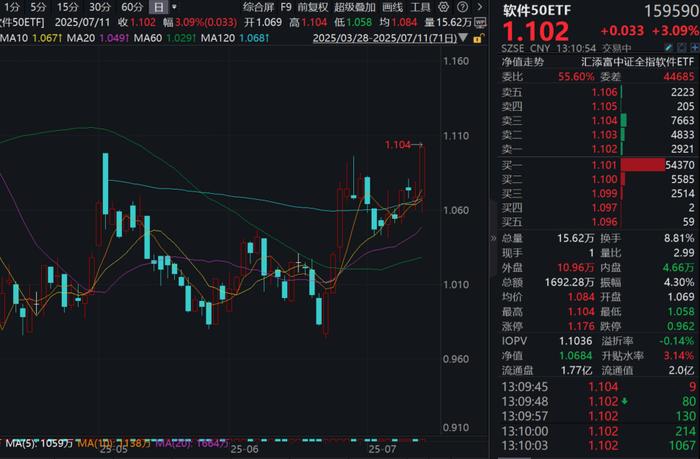
互联网券商、稳定币爆发,指南针涨超15%!软件50ETF(159590)强势涨超3%!金融软件有何催化?机构解读
Xin Lang Cai Jing· 2025-07-11 05:45
Group 1: Market Trends - The internet finance sector is experiencing a strong rally, with stablecoin concepts seeing significant gains, exemplified by the Software 50 ETF (159590) rising over 3% [1] - A meeting in Shanghai focused on the development trends and strategies for cryptocurrencies and stablecoins, emphasizing the need for innovation and research in digital currencies [1] Group 2: Regulatory Developments - The People's Bank of China released a draft for the "Rules for Cross-Border Payment System Business," aimed at managing the expansion of CIPS and enhancing participant management [3] - The new regulations are expected to facilitate the continuous expansion of CIPS and accelerate the internationalization of the Renminbi, indicating a shift towards more flexible regulatory frameworks [3] Group 3: Software Industry Insights - A training program for talent in enterprise basic software and industrial software was launched, highlighting the importance of software development in implementing a strong manufacturing strategy [4] - The Software 50 ETF tracks the CSI Software Index, which includes a diverse range of software companies, with approximately 67% of its weight in application software and over 15% in AI-related fields [5] Group 4: Cloud Infrastructure Spending - Canalys reported that spending on cloud infrastructure services in mainland China reached $11.6 billion in Q1 2025, marking a 16% year-over-year increase [5] - Alibaba Cloud holds a 33% market share in the cloud services market in mainland China, followed by Huawei Cloud at 18% and Tencent Cloud at 10% [5]


理性看待行情发展
猛兽派选股· 2025-06-26 01:00
Group 1 - The current market is assumed to be breaking out of a consolidation phase, indicating the start of a major upward trend, with sentiment indicators returning from a low to a warmer zone [1] - The Shanghai Composite Index has already achieved a breakout and is in an attacking posture [1] - The Shenzhen Composite Index has also achieved a breakout and is in an attacking posture [2] Group 2 - The Sci-Tech Innovation Board Index has just reached the upper boundary of its consolidation structure, indicating an attacking posture [3] - However, a divergence in momentum has been observed on a 5-minute scale, suggesting that short-term gains may be limited [4] Group 3 - The overall market situation aligns with previous analyses, indicating that the pullback will not be too deep and that the market is at the end of the first phase of a bull market, which typically lasts 8 to 10 months [6] - It is noted that before entering a major upward phase, the sentiment indicators may drop into a cold zone but not necessarily to freezing levels, as seen in previous bull markets in 2014 and 2019 [6][7] Group 4 - A common characteristic before a major upward trend is a narrow, rhythmic, and self-disciplined fluctuation or consolidation structure, typically requiring at least three touches (3T) [8] - Currently, the market is only at 2T in its consolidation structure, suggesting a potential short-term pullback for confirmation before a breakout [8] Group 5 - There is caution against excessive excitement in the media regarding the market, as recent gains in brokerage stocks are limited to a few mid-cap firms, indicating a possible high-level distribution rather than a broad-based rally [8] - The real surge is observed in financial software stocks, driven by policy announcements, which typically attract speculative trading [8] - The proportion of stocks with gains exceeding 5% is not high, indicating a long-tail effect where only a small number of stocks are performing exceptionally well [8]

6/16财经夜宵:得知基金净值排名及选基策略,赶紧告知大家
Sou Hu Cai Jing· 2025-06-16 16:21
Core Insights - The article provides a ranking of open-end funds based on their net asset value growth as of June 16, 2025, highlighting the top and bottom performers in the market [2][4][6]. Fund Performance Summary - The top 10 funds with the highest net value growth include: 1. Huabao Zhongzheng Financial Technology Theme ETF: 1.5122 2. Guotai Zhongzheng Animation Game ETF: 1.2366 3. Huaxia Zhongzheng Financial Technology Theme ETF: 1.2376 4. Boshi Financial Technology ETF: 1.2914 5. Huaxia Zhongzheng Animation Game ETF: 1.2451 6. Huatai Baichuan Zhongzheng Animation Game ETF: 1.2851 7. Huabao Zhongzheng Financial Technology Theme ETF Initiated A: 1.0060 8. Huabao Zhongzheng Financial Technology Theme ETF Initiated C: 0.9955 9. Huaxia Zhongzheng Animation Game ETF Initiated Link: 1.3099 10. Huaxia Zhongzheng Animation Game ETF Initiated Link A: 1.3248 [2][4]. - The bottom 10 funds with the lowest net value growth include: 1. Shenwan Lingxin New Power Mixed C: 0.4880 2. Shenwan Saixin New Power Mixed A: 0.4889 3. Taiping Hengtai Three-Month Open Debt C: 1.0317 4. Guotai Zhongzheng Hu-Shen-Hong Gold Industry Stock ETF: 1.1907 5. Gold Stock ETF Fund: 1.2346 6. Huaxia Zhongzheng Hu-Shen-Hong Gold Industry Stock ETF: 1.6381 7. Guotai Zhongzheng Hu-Shen-Hong Gold Industry Stock ETF: 1.4999 8. Hu'an Zhongzheng Hu-Shen-Hong Gold Industry Stock ETF: 1.1609 9. Ping An Zhongzheng Hu-Shen-Hong Gold Industry ETF: 1.2217 10. Southern Zhongzheng Hu-Shen-Hong Gold Industry Stock Index Initiated A: 1.3031 [4][6]. Market Trends - The Shanghai Composite Index opened lower but showed a steady increase throughout the day, closing with a small gain, while the ChiNext Index also opened lower but experienced a rise before stabilizing [6]. - The total trading volume reached 1.24 trillion, with a market breadth of 3,559 gainers to 1,641 losers [6]. - Leading sectors included media and entertainment, internet, and software services, all showing gains of over 2%, while the agriculture sector lagged [6]. Fund Strategy Analysis - The Huabao Zhongzheng Financial Technology Theme ETF has shown significant net value growth, indicating strong performance in the financial software sector [6]. - The fund's top holdings include stocks like Tonghuashun and Dongfang Caifu, with a concentration of 54.15% in its top ten holdings [7]. - Conversely, the Shenwan Lingxin New Power Mixed C fund has underperformed, with a concentration of 67.29% in its top ten holdings, indicating a diverse but less effective investment strategy [7].

神州信息:打造金融软件领域黑灯工厂
Zheng Quan Ri Bao· 2025-06-04 16:49
Core Insights - Digital transformation is crucial for companies to reshape their competitiveness, with AI technology accelerating changes in the financial software industry [1] - Shenzhou Information is developing a "black factory" in the financial software sector, driven by AI agents to automate the entire process from demand design to operation [1] Group 1: Technological Advancements - Shenzhou Information has been responding to the digital needs of the financial sector through technological innovation, having anticipated the potential of distributed technology a decade ago [2] - The company has successfully captured market share with its distributed architecture core system solutions since 2019, following the industry's increasing technological demands [2] - The application of AI coding technology has significantly reduced the average development cycle and improved code accuracy, with the company starting large-scale applications in 2022 [2][3] Group 2: Model-Driven Transformation - The concept of a "black factory" in financial software involves automating the generation of business models from natural language descriptions, which are then converted into executable code [4] - The transition from "code development" to "model-driven" is essential for achieving full automation in processes from demand to operation [5] - Shenzhou Information aims to create a smart ecosystem where systems can generate personalized solutions quickly, enhancing operational efficiency [6] Group 3: Industry Focus and Ecosystem Building - The company emphasizes vertical specialization, training its industry models with real-world banking scenarios, which distinguishes it from general-purpose models [7] - Shenzhou Information is focused on building an ecosystem that enhances efficiency, with a vision that the ultimate competition in fintech is about ecological efficiency [8] Group 4: Global Expansion and Strategic Initiatives - The company is adopting a global perspective, starting its international strategy in Southeast Asia, and has established an overseas headquarters in Singapore [9] - Shenzhou Information has secured contracts for digital banking solutions in Singapore and digital transformation projects in Malaysia, showcasing its capability to deliver comprehensive financial solutions [10] - The company is moving towards a systematic output of solutions, differentiating itself from traditional IT vendors by creating a "technology + business" ecosystem [10]

Buy Or Sell INTU Stock Ahead Of Its Upcoming Earnings?
Forbes· 2025-05-20 11:20
Core Insights - Intuit is expected to announce earnings on May 22, 2025, with historical data indicating a 69% chance of a positive one-day return following earnings announcements [1][7] - Consensus forecasts predict earnings per share of $10.91 and revenues of $7.56 billion for the upcoming quarter, compared to $9.88 EPS and $6.74 billion in revenues for the same quarter last year [2] - Intuit's current market capitalization stands at $188 billion, with $17 billion in revenue, $4.1 billion in operating profit, and $3.0 billion in net income over the past twelve months [3] Historical Performance - Over the past five years, Intuit has recorded 16 earnings data points, with 11 positive and 5 negative one-day returns, resulting in a median positive return of 2.2% and a median negative return of -3.8% [7] - The likelihood of a positive one-day return drops to 67% when analyzing data from the last three years instead of five [7] Trading Strategies - Traders can utilize historical trends to establish positions before earnings announcements and adjust trades based on immediate market reactions and subsequent medium-term performance [6] - A strategy involving the correlation between short-term and medium-term returns can be employed, particularly if a strong correlation exists between 1D and 5D returns [5][6]


超过霉霉,她拿下全球最年轻女富豪
创业家· 2025-05-16 09:55
Core Viewpoint - Lucy Guo has become the youngest self-made female billionaire globally, surpassing Taylor Swift, with a net worth of approximately $1.25 billion, primarily due to her stake in Scale AI and her entrepreneurial ventures [3][4][10]. Group 1: Lucy Guo's Background and Achievements - Lucy Guo, born on October 14, 1994, in Fremont, California, is the daughter of Chinese immigrant electrical engineers and showed an early interest in technology and entrepreneurship [8][9]. - She dropped out of Carnegie Mellon University after receiving the Thiel Fellowship, which encouraged her to pursue entrepreneurship [9]. - Guo co-founded Scale AI at the age of 21, where she played a significant role in operations and product design [10]. Group 2: Scale AI's Growth and Valuation - Scale AI has achieved a valuation of $25 billion, an 80% increase from the previous year, driven by its data labeling services for AI training [13][16]. - The company has expanded its services from basic data labeling to a comprehensive AI-as-a-Service (AIaaS) model, catering to major clients like Cruise and Tesla [14][15]. - In 2023, Scale AI reported an annual revenue of $750 million, a threefold increase, and is projected to exceed $2 billion in revenue this year [16]. Group 3: Investment and Future Prospects - Lucy Guo retains approximately 5% of Scale AI's shares, valued at nearly $1.2 billion, contributing significantly to her billionaire status [13][16]. - Scale AI's successful funding rounds and strategic partnerships with major tech firms have positioned it as a leading player in the AI industry, benefiting from the growing demand for large-scale data labeling [15][16].

区块链ETF的功能及开发
Sou Hu Cai Jing· 2025-05-02 12:52
Core Insights - The article discusses blockchain ETF software, which is designed to display, analyze, and manage investments in blockchain-related ETFs, emphasizing that it is traditional financial software rather than decentralized applications built on blockchain technology [1] Functionality Overview - **Real-time or Near Real-time Price Display**: The software shows current market trading prices, daily price changes, and trading volumes by connecting to data providers like Bloomberg or Refinitiv [3] - **Historical Price and Chart Analysis**: It provides historical price data visualized through various chart types, supporting technical analysis tools [4] - **Fund Overview and Strategy Introduction**: The software displays essential information about the ETF, including its name, code, management fees, and investment strategy [5][6] - **Holdings Information View**: It lists the current stocks held by the ETF along with their weight in total assets, including company names and industry classifications [7][8] - **Fund Performance Display**: The software showcases the ETF's returns over different periods and compares them with benchmark indices or similar funds [9][10] - **Latest Net Asset Value (NAV)**: It shows the ETF's NAV calculated after market close, which is crucial for assessing the fund's intrinsic value [11] - **News and Research Reports**: The software integrates news and research reports related to the ETF and its holdings, requiring connections to news APIs [12] - **Risk Alerts and Document Access**: It provides risk warnings and access to official documents like prospectuses and periodic reports [13][14] - **Buy/Sell Entry (Optional)**: While actual trading occurs on brokerage platforms, the software can link to these platforms for user convenience [15][16] Management Features - **Portfolio Management**: The software manages the actual stock holdings, quantities, and costs, often integrating with internal systems of fund managers [19] - **Creation/Redemption Processing**: It handles the creation and redemption of ETF shares, involving complex settlement processes [19] - **Fee Calculation and Distribution**: The software calculates various fees and deducts them from fund assets [19] - **Compliance and Reporting**: It generates reports to meet regulatory requirements and monitors investment restrictions [19] Technical Considerations - **Data Source Integration**: A key challenge is efficiently obtaining data from multiple financial data providers and exchanges [19] - **Backend Architecture**: A robust backend system is necessary for processing real-time data, storing historical data, and managing user data [19] - **Database Design**: High-performance database schemas are required for storing and querying time-series trading data [19] - **Real-time Data Processing**: Technologies like message queues and stream processing are essential for low-latency data transmission [19] - **Frontend Development**: Modern frameworks and high-performance chart libraries are used to build user interfaces [19] - **Security**: Data security, user authentication, and protection against cyber threats are critical for financial software [19] - **Compliance**: The software must adhere to financial regulations in its operating regions [19] - **Blockchain Representation**: The software's uniqueness lies in its focus on investments in blockchain-related companies, providing relevant data and analysis without operating directly on a blockchain [19]

区块链ETF软件的测试
Sou Hu Cai Jing· 2025-05-02 12:10
Group 1 - The testing of blockchain ETF software is a complex and multi-faceted process that requires traditional financial software testing methods while also considering the characteristics of blockchain technology, cryptocurrency markets, and strict regulatory requirements [1] - Key technical challenges include data accuracy and completeness testing, integration testing, performance and stability testing, and security testing [3][4] Group 2 - Market data source validation is essential to ensure the software can accurately and in real-time retrieve prices and trading volumes from major cryptocurrency exchanges and data providers [5] - NAV (Net Asset Value) calculation verification is a core function of ETF software, requiring rigorous testing to ensure accurate daily or real-time NAV calculations based on holdings, market prices, fees, and dividends [5] - Consistency of holding data must be tested to ensure the ETF's displayed holdings align with actual assets managed by custodians [5] Group 3 - Compliance and regulatory requirements testing is crucial, including the generation of regulatory reports and monitoring of investment restrictions [8] - Error handling and recovery testing are necessary to ensure the software can manage external system failures and recover from crashes while maintaining data consistency [8] Group 4 - The testing process must incorporate various methods such as automated testing, manual testing, penetration testing, and performance testing, requiring close collaboration with fund operations, compliance, and security teams [7] - The rapid changes in the cryptocurrency market and related technologies necessitate continuous updates to testing strategies and use cases [8]