Semiconductor Foundry

Search documents
华虹半导体:对 2026 年晶圆平均销售价格回升前景更为谨慎,评级下调至中性;新目标价 59 港元
2025-10-19 15:58
Summary of Hua Hong Semiconductor Conference Call Company Overview - **Company**: Hua Hong Semiconductor - **Sector**: Semiconductors - **Focus**: Pure foundry primarily engaged in 200mm and 300mm wafer processing, specializing in semiconductors for specialty applications such as embedded non-volatile memory (eNVM) and power discrete [12][13] Key Points and Arguments Downgrade and Price Objective - **Rating Change**: Downgraded from Buy to Underperform due to cautious outlook on wafer ASP and margin recovery in 2026 [1][3] - **New Price Objective**: HK$59, based on a 2x P/B (2026E), reflecting a more conservative valuation compared to the previous HK$44.5 [3][44] Inventory and Demand Dynamics - **Inventory Pressure**: Rising inventory levels among China's semiconductor chipmakers are expected to limit ASP increases in 2026, with a revised assumption of 5% ASP growth (down from 10%) [2][16] - **Demand Growth**: Chip shipment growth in China has slowed significantly, with 0%/11%/6% YoY growth in June/July/August 2025, compared to 16-40% YoY in the previous periods [2][15] Financial Forecasts - **Profitability Outlook**: Estimated operating profit margin (OPM) of 4% in 2026, improving from -4% in 2025 but below the 10-year average of 10% [2][31] - **Net Income Projections**: Adjusted net income forecast for 2026 is US$216 million, with a gradual recovery expected in subsequent years [4][42] Capacity Expansion and Acquisitions - **Acquisition of Huali Micro**: Plans to acquire Huali Micro (Fab5) announced, but details are pending. This acquisition is expected to enhance long-term competitiveness by increasing revenue and capacity [1][3] - **Capacity Growth**: Completion of Fab9 in 2026 could increase total 12" wafer capacity by 38%, with total wafer shipment expected to grow by 26% in 2026 [31][37] Market Position and Valuation - **Market Share Risks**: Aggressive capacity expansion by competitors like SMIC poses downside risks to Hua Hong's market share and profitability [3][13] - **Valuation Comparison**: Hua Hong's current P/B of 2.6x (2026E) is higher than the average of 3.2x for China foundry/OSATs, indicating a rich valuation [60] Cash Flow and Capital Expenditure - **Free Cash Flow**: Negative free cash flow expected due to high capital expenditures for Fab9 construction, projected at US$2-3 billion per year [45][46] - **Operating Cash Flow**: Operating cash inflow is expected to remain below US$1.5 billion, leading to negative free cash flow in the near term [45][46] Additional Important Insights - **Sales Mix**: Sales exposure to overseas markets has decreased from over 40% in 2017-2019 to less than 20% by 2024, indicating a shift towards domestic markets [42] - **ASP and Margin Trends**: Wafer ASP stabilization is anticipated in 1H25, but overall margins are expected to remain below 20% by the end of 2026 due to inventory pressures [39][40] This summary encapsulates the critical insights from the conference call regarding Hua Hong Semiconductor's current position, challenges, and future outlook in the semiconductor industry.
台积电:云人工智能的关键赋能者,2026 年销售额与资本支出有望大幅增长
2025-10-19 15:58
Summary of TSMC Conference Call Company Overview - **Company**: Taiwan Semiconductor Manufacturing Company (TSMC) - **Industry**: Semiconductor Foundry - **Market Cap**: NT$38,512 billion / US$1,257 billion [7] Key Points Financial Performance and Guidance - TSMC raised full-year sales growth guidance to mid-30% and capex to US$40-42 billion for 2026 [2][3] - Q4 sales guidance indicates a 1% QoQ decline, aligning with expectations of flat QoQ [2] - Q3 gross margin (GM) was reported at 59.5%, exceeding expectations of 57.5%, attributed to cost reductions and improved utilization [2] - Q4 GM is expected to remain resilient at 60.0% [2] - 2025E EPS was raised by 5% to NT$64.39, and 2026-27E EPS increased by 8-10% due to a stronger outlook for Cloud AI and non-AI segments [5][8] Capital Expenditure and Growth Drivers - Capex for 2025E is projected to reach US$42 billion, with 2026/27E capex raised to US$46 billion/50 billion [3] - Key growth drivers include: 1. Expansion of N3 capacity to support AI accelerator migration [3] 2. Accelerated N2 ramp for smartphones and PCs [3] 3. Faster expansion in the US, with plans for earlier mass production in Arizona [3] Gross Margin and Overseas Expansion - Management revised overseas expansion GM dilution expectations from 2-3% to 1-2% for 2025, indicating a more favorable product mix and price adjustments [4] - Forecast for 2026 GM is 58.1%, slightly below the 59.4% estimate for 2025 due to N2 dilution and overseas expansion impacts [4] Revenue and Profitability Projections - Revenue projections for 2025E, 2026E, and 2027E are NT$3,781.8 billion, NT$4,537.8 billion, and NT$5,604.6 billion respectively, reflecting YoY growth rates of 31%, 20%, and 24% [14] - Net profit for 2025E is projected at NT$1,669.5 billion, with a net margin of 44.1% [14] Revenue Mix and Technology Adoption - Revenue mix by platform for Q325 shows: - HPC: 57% - Smartphone: 30% - IoT: 5% - Auto: 5% [12][29] - Wafer revenue by technology indicates a strong focus on advanced nodes: - 3nm: 23% - 5nm: 37% [13][31] Valuation and Market Position - Price target raised to NT$1,700 from NT$1,570, maintaining a Buy rating [5][7] - TSMC's valuation metrics include a P/E ratio of 23x for 2026E, with a long-term earnings CAGR of 20% [5] Industry Outlook - The semiconductor foundry industry is expected to continue outperforming the broader semiconductor market, driven by growth in HPC-related applications, including CPUs, networking, and AI accelerators [27] Additional Insights - TSMC's overseas expansion is expected to have a manageable impact on gross margins, with a focus on maintaining competitive pricing and product mix [4] - The company is optimistic about the demand for Cloud AI, anticipating further upside in sales, margins, and capex outlook from 2026E [2][3] This summary encapsulates the key insights from TSMC's conference call, highlighting the company's robust financial performance, strategic growth initiatives, and positive industry outlook.
Should Investors Buy Taiwan Semiconductor Stock Before Earnings?
Yahoo Finance· 2025-10-04 14:00
Group 1 - TSMC will release its Q3 2025 earnings on Oct. 16, and it is a leading producer of advanced semiconductors crucial for AI advancements, suggesting long-term stock performance potential [1] - TSMC's market share has increased to over 70% as of Q2 2025, up from 67% in the previous quarter, reinforcing its position as the world's largest semiconductor foundry [2] - The company has experienced a 40% revenue increase in the first half of 2025, reaching $56 billion, and expects Q3 revenue between $31.8 billion and $33 billion, indicating a 38% rise at the midpoint [4] Group 2 - Grand View Research projects a 32% CAGR for AI through 2033, which aligns with TSMC's growth trajectory [3] - TSMC has consistently beaten revenue estimates in the past four quarters, suggesting the potential for continued strong performance in Q3 [5] - The company is focusing on advanced chip sales in the 2nm to 5nm range, where it competes primarily with Samsung [6] Group 3 - TSMC allocated nearly $20 billion to capital expenditures in the first half of the year, with plans for $165 billion investment in advanced manufacturing facilities in Arizona to meet demand [7] - Despite a 40% revenue growth in the first half of the year, TSMC's P/E ratio stands at 33, which may not deter investors [8]

Final Trade: GDX, PFE, GFS, BMY
Youtube· 2025-10-01 22:32
Group 1 - Gold miners are currently viewed as an offensive investment due to strong free cash yields, contrasting with their previous defensive perception [1] - There is a discussion about pharmaceuticals, specifically mentioning a shared custody situation with Pfizer, indicating potential volatility or issues with the company [2] - The mention of Global Foundries suggests a positive outlook for companies involved in foundry services, particularly in relation to Intel's foundry initiatives [2]



晶合集成9月23日获融资买入9056.72万元,融资余额10.24亿元
Xin Lang Cai Jing· 2025-09-24 01:37
Core Viewpoint - The company, Jinghe Integrated Circuit Co., Ltd., has shown significant growth in revenue and net profit, indicating a strong performance in the semiconductor industry, particularly in the 12-inch wafer foundry business [2][3]. Financial Performance - As of June 30, 2025, Jinghe Integrated Circuit achieved a revenue of 5.198 billion yuan, representing a year-on-year growth of 18.21% [2]. - The net profit attributable to shareholders for the same period was 332 million yuan, reflecting a substantial increase of 77.61% year-on-year [2]. Shareholder and Market Activity - As of September 23, 2023, the company had a total financing balance of 1.030 billion yuan, which accounts for 3.61% of its market capitalization, indicating a high level of financing activity [1]. - The number of shareholders decreased by 3.90% to 62,800, while the average number of circulating shares per person increased by 4.95% to 18,907 shares [2]. Institutional Holdings - As of June 30, 2025, major institutional shareholders include: - Huaxia SSE Sci-Tech Innovation Board 50 ETF, holding 44.4063 million shares, decreased by 739,200 shares [3]. - E Fund SSE Sci-Tech Innovation Board 50 ETF, holding 33.2288 million shares, increased by 697,000 shares [3]. - Other notable shareholders include the Hong Kong Central Clearing Limited and Huaxia National Index Semiconductor Chip ETF, with significant changes in their holdings [3]. Dividend Distribution - Since its A-share listing, Jinghe Integrated Circuit has distributed a total of 194 million yuan in dividends [3].

Taiwan Semiconductor Manufacturing Company Limited (TSM)’s Foundry Market Share Surged in Q2: Report
Yahoo Finance· 2025-09-18 15:20
Group 1 - Taiwan Semiconductor Manufacturing Company Limited (TSM) has increased its share of the semiconductor foundry market to 38% in Q2 2025, up from 31% in the same period last year [1][2] - The foundry sector experienced a 19% year-over-year growth in revenue, driven by demand for AI and advanced processes, along with support from China's subsidy program [2][3] - TSMC is expected to see further market share growth in Q3, supported by the peak season for consumer electronics, existing subsidy policies in China, and increasing AI orders [3] Group 2 - Advanced packaging technologies are becoming increasingly important, and TSMC is well-positioned to lead in both advanced process nodes and advanced packaging due to its technological capabilities and strong customer relationships [3] - While TSMC has significantly expanded its market share, most other players in the semiconductor sector have either remained stagnant or reported slight losses [3]
SkyWater Technology: More Than A Foundry, A Grounded Bet On The Quantum Revolution
Seeking Alpha· 2025-08-25 20:44
Group 1 - SkyWater Technology (NASDAQ: SKYT) is viewed as a strong investment opportunity, with the current market pricing it similarly to a typical chip foundry, indicating a potential mispricing [1] - The analysis emphasizes a focus on identifying asymmetric risk-reward opportunities through quantitative analysis and market intuition, particularly in technology disruptors and undervalued small-cap companies [1] - The investment philosophy includes exploiting market anomalies and long-term structural trends, with a preference for companies that have strong competitive advantages and innovative technologies [1]



中芯国际- 产能因充足订单满负荷;第三季度营收重拾环比升势;评级买入-SMIC (0981.HK)_ Capacities fully loaded with solid orders ahead; 3Q Rev regaining QoQ uptrend; Buy
2025-08-11 01:21
Summary of SMIC (0981.HK) Conference Call Company Overview - **Company**: SMIC (Semiconductor Manufacturing International Corporation) - **Ticker**: 0981.HK - **Industry**: Semiconductor Foundry Key Points Financial Performance - **2Q25 Results**: Slightly beat estimates; net profit lower than consensus due to higher operating expenses and lower non-operating income [1][4] - **3Q25 Guidance**: Revenue expected to increase by 5% to 7% QoQ, indicating a recovery in growth [1][2] - **Gross Margin Guidance**: Expected to be between 18% and 20% for 3Q25, slightly lower than previous estimates [1][2] Capacity and Demand - **Utilization Rates**: High utilization rates supported by solid orders in analog products, CIS, and automotive sectors [2][3] - **Order Trends**: Management expects solid orders to continue, driving shipment expansions [2] - **8-inch Fabs**: Improvements in utilization rates driven by local Chinese customers, with a growing trend of providing manufacturing for overseas clients [3] Revenue and Earnings Revisions - **Earnings Revisions**: Adjustments made to 2025-2029 earnings estimates, primarily lowering gross margin and operating profit margin due to ongoing depreciation and amortization (D&A) [4][8] - **Revenue Projections**: Revenue for 2025 is projected at $9.24 billion, with a slight increase from previous estimates [8][24] Valuation and Price Target - **12-Month Price Target**: Maintained at HK$63.7 based on a 36x P/E ratio for 2028E earnings, discounted back to 2026E [9][20] - **A-Shares Price Target**: Unchanged at Rmb160.0, reflecting a 273% premium over H-shares [10][20] Risks and Challenges - **Key Risks**: 1. Weaker-than-expected demand in smartphones and consumer electronics [21] 2. Slower product diversification and capacity expansions [21] 3. Potential restrictions on access to equipment/materials due to U.S. regulations [21][22] Investment Thesis - **Long-Term Growth**: Positive outlook driven by local fabless customers' demand and gradual recovery in margins [23] - **Valuation**: Shares are considered attractively valued as they trade below historical average P/E ratios [23] Additional Insights - **Geopolitical Factors**: The company is adapting to geopolitical uncertainties by increasing local production capabilities [3] - **Market Position**: SMIC is the largest foundry in China, covering a wide range of technology nodes from 0.35um to 14nm [23] This summary encapsulates the essential insights from the conference call, highlighting SMIC's financial performance, capacity utilization, revenue projections, valuation, risks, and long-term growth potential.

华虹_2025 年第三季度收入预计环比增长 10% - 13%,毛利率指引超预期;2025 年第二季度毛利率、营业利润超预期;评级中性-Hua Hong (1347.HK)_ 3Q25 revenues to grow at +10 ~ +13% QoQ with GM guidance beat; 2Q25 GM_ OP beat; Neutral
2025-08-08 05:02
Summary of Hua Hong's Earnings Call Company Overview - **Company**: Hua Hong (1347.HK) - **Industry**: Semiconductor foundry focusing on specialty technologies Key Financial Highlights - **3Q25 Revenue Guidance**: Expected to grow by +10% to +13% QoQ, with gross margin (GM) guidance of 10% to 12% [1][2] - **2Q25 Results**: Revenue of US$566 million, representing an 18% YoY increase and a 5% QoQ increase. Gross margin was 10.9%, exceeding company guidance of 7% to 9% [1][10] - **Operating Loss**: Reported at US$36 million, which was better than expected, but net profit was lower than consensus at US$8 million [1][10] Demand and Pricing Outlook - **Demand Expectations**: Management anticipates solid demand from 1H25 to continue into the second half of the year [2] - **Pricing Adjustments**: The company is working on upward pricing adjustments, expected to reflect in 3Q and 4Q financials, with increases projected to be in the single-digit range [2][4] Capacity Expansion Plans - **Second 12'' Fab**: The ramp-up of the second 12'' fab is on track, increasing total capacity to 447k wpm by 2Q25, compared to 391k wpm in 4Q24. Management aims to bring 80%-90% of planned capacity online by 2H26 [3][4] - **Future Expansion**: A new fab is planned after the second 12'' fab to support continuous growth [3] Gross Margin and Operating Income - **3Q25 GM Guidance**: Expected to improve to 10% to 12%, supported by better utilization rates and cost efficiencies [4][8] - **4Q GM Visibility**: Management expressed low visibility for 4Q GM due to the introduction of new capacities [8] Earnings Revisions - **2025E Earnings Revision**: Net income estimates revised down by 23% due to potential dilution from non-controlling interests. Revenue estimates slightly reduced by 2%, while gross profit estimates increased by 3% [10][11] Valuation and Price Target - **Target Price**: Raised by 14.7% to HK$46.9, based on a target P/E of 35.3x for 2026E [11][21] - **Investment Rating**: Maintained at Neutral due to moderate upside potential [11][21] Risks and Considerations - **Key Risks**: Include stronger or weaker-than-expected end-market demand, ramp-up speed of the 12" fab, and uncertainties surrounding US-China trade relations [22][24] Conclusion - **Investment Thesis**: Hua Hong is positioned for long-term growth through capacity expansions and product optimization, despite facing near-term margin pressures from ASP competition and increasing depreciation and amortization burdens [24]
全球芯片代工增长17%!
国芯网· 2025-07-28 14:03
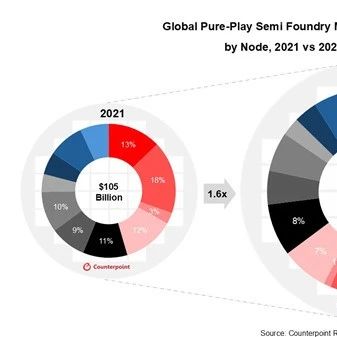
Core Insights - The global pure semiconductor foundry industry revenue is projected to reach $165 billion by 2025, representing a 17% year-on-year growth, with a compound annual growth rate (CAGR) of 12% from 2021 to 2025, driven primarily by advanced process nodes [2] - Revenue from the 3nm node is expected to grow over 600% year-on-year, reaching $30 billion, while the 5/4nm nodes are anticipated to exceed $40 billion, contributing more than half of the total revenue from pure foundries by 2025 [2] - The demand for high-end smartphones, AI PC solutions, AI ASICs, GPUs, and high-performance computing (HPC) solutions is the main driver behind the revenue growth of advanced processes [2] Industry Competition Landscape - TSMC holds a leading position in advanced nodes, followed by Samsung and Intel, while UMC, GlobalFoundries, and SMIC continue to see strong demand in other nodes, although their revenue growth may not match that of advanced nodes [3] - Innovations in backend packaging processes, such as HBM memory integration and the shift towards chip-scale packaging, are creating new growth opportunities for the industry [3][4] - These innovations not only enhance product performance and reliability but also open up new revenue streams for semiconductor foundries [4]