Manufacturing

Search documents
Siemens unveils lineup for CES 2026 keynote
Businesswire· 2025-12-17 18:34
Core Insights - Siemens announced a keynote at CES 2026 featuring industry and technology leaders [1] - The keynote will include discussions on how AI is transforming manufacturing, infrastructure, and transportation [1] - Executives from NVIDIA, Microsoft, PepsiCo, and Commonwealth Fusion Systems will participate in the event [1] Company and Industry Summary - Siemens' President and CEO Roland Busch will lead the keynote session [1] - The focus of the conversations will be on the impact of AI on the physical world [1] - The event aims to highlight the collaboration between major companies in advancing technology [1]


The Toro pany(TTC) - 2025 Q4 - Earnings Call Transcript
2025-12-17 17:02
Financial Data and Key Metrics Changes - The company reported consolidated net sales of $1.07 billion for Q4, a decrease of 0.9% from the previous year, primarily due to lower shipments and prior-year divestitures, partially offset by net price realization [21] - For the full year, total consolidated net sales were $4.5 billion, down 1.6% from fiscal 2024, largely due to strategic divestitures [7] - Adjusted diluted earnings per share for Q4 were $0.91, compared to $0.95 in the prior year, reflecting higher expenses related to employee incentive compensation [23] - Full-year adjusted earnings per diluted share were $4.20, slightly up from $4.17 in fiscal 2024 [24] Business Line Data and Key Metrics Changes - Professional segment net sales for Q4 were $910 million, virtually unchanged from the previous year, with earnings margin at 19.2%, up 60 basis points year-over-year [17] - Residential segment net sales for Q4 were $147 million, down 5.1% from the prior year, but exceeded expectations due to net price realization [20] - Full-year professional segment net sales rose 1.9% to $3.62 billion, with earnings margin improving to 19.4% from 18% in fiscal 2024 [19] Market Data and Key Metrics Changes - The company is focusing on key growth markets, particularly in golf, grounds, and underground specialty construction, anticipating a multi-year growth trajectory [8] - The acquisition of Tornado Infrastructure Equipment is expected to enhance the company's position in the underground construction market [9] Company Strategy and Development Direction - The company aims to enhance customer productivity through investments in technology and innovation, with a focus on operational excellence and cost savings [5][10] - The AMP program has been expanded, with a new savings target of $125 million by the end of 2026, up from the previous target of $100 million [11] - The company is committed to maintaining strong profit margins and market competitiveness through productivity improvements and selective price increases [10] Management's Comments on Operating Environment and Future Outlook - Management expressed cautious optimism about the macroeconomic environment, noting potential pressures from inflation and interest rates on consumer confidence [29] - For fiscal 2026, the company expects total net sales to rise by 2%-5%, with professional segment sales anticipated to grow mid-single digits and residential segment sales expected to decline low to mid-single digits [30] - The company is confident in its ability to navigate cost pressures while continuing to invest in innovation [31] Other Important Information - The company achieved record free cash flow of $578 million for the year, with a conversion rate of 146% [12] - A quarterly dividend increase from $0.38 to $0.39 was announced, along with a share repurchase authorization of up to six million shares [34] Q&A Session Summary Question: Guidance on sales growth and volume expectations - Management acknowledged that a portion of the sales growth is attributed to the Tornado acquisition and indicated continued strength in the professional segment, particularly in underground construction [52][54] Question: Improvement expectations in residential segment - Management expects some recovery in the residential segment, influenced by macroeconomic factors and potential restocking in the channel [57][60] Question: Details on the AMP program and additional savings - Management confirmed that the additional $25 million in savings is achievable through ongoing operational efficiency initiatives without needing volume growth [61][62] Question: Raw material cost expectations for 2026 - Management anticipates some inflation in raw material costs early in the year, with expectations of stabilization by mid-year [66] Question: Channel inventory status - Management reported that channel inventories are in good shape, with improved lead times contributing to customer confidence [73][80] Question: Margin guidance for professional segment - Management indicated that while some benefits from the AMP program will continue, the addition of Tornado may not be fully accretive to operating margin in the first year [81][82]

ABM Industries(ABM) - 2025 Q4 - Earnings Call Transcript
2025-12-17 14:30
Financial Data and Key Metrics Changes - The company reported record quarterly revenue of $2.3 billion, a 5.4% year-over-year increase, driven by 4.8% organic growth and contributions from a recent acquisition in Ireland [15][16] - Adjusted EPS was $0.88, reflecting a $0.26 headwind from prior-year self-insurance adjustments, indicating strong underlying performance when adjusted [17][24] - Adjusted EBITDA was $124.2 million with a margin of 5.6%, compared to $125.6 million and 6% in the prior year, impacted by prior-year self-insurance adjustments [17][18] Business Line Data and Key Metrics Changes - Business and Industry (B&I) revenue surpassed $1 billion, up 2% year-over-year, with operating profit of $80.6 million and a margin of 7.7% [18] - Aviation revenue grew 7% to $296.7 million, with operating profit of $16.8 million and a margin of 5.7% [18][19] - Manufacturing and Distribution (M&D) revenue increased 8% to $417.4 million, with operating profit of $35.8 million and a margin of 8.6% [19][20] - Education revenue rose 2% to $233.7 million, with operating profit increasing 44% to $18.8 million and margins expanding to 8% [20][21] - Technical Solutions revenue increased 16% to $298.7 million, with operating profit rising 32% to $37.1 million and a margin of 12.4% [21] Market Data and Key Metrics Changes - The company noted strong demand across key end markets, particularly in technical solutions, aviation, and manufacturing and distribution, indicating a healthy market environment heading into fiscal 2026 [10][11] - The acquisition of WGNSTAR is expected to strengthen the company's position in the semiconductor market, which is experiencing multi-year growth due to U.S. semiconductor onshoring [8][10] Company Strategy and Development Direction - The company is focused on enhancing its portfolio and expanding technical and data-enabled capabilities, aiming for long-term growth [29][30] - The acquisition of WGNSTAR is seen as a strategic move to penetrate the semiconductor sector, which has a low current outsourcing rate, providing significant growth opportunities [8][54] - The company plans to continue investing in AI capabilities and ERP implementation to improve operational efficiency and unlock new revenue streams [7][10] Management's Comments on Operating Environment and Future Outlook - Management expressed confidence in the company's momentum heading into fiscal 2026, expecting organic revenue growth of 3%-4% and adjusted EPS in the range of $3.85-$4.15 [11][24] - The restructuring program is expected to yield annual savings of $35 million, with most benefits realized in fiscal 2026 [9][11] - Management highlighted the importance of maintaining operational excellence and adaptability in a complex operating environment [10][29] Other Important Information - The company ended the year with total indebtedness of $1.6 billion and available liquidity of $681.6 million [22][23] - Free cash flow for the fourth quarter was $112.7 million, significantly improved from the prior year [23] Q&A Session Summary Question: What are the drivers behind the relatively flat margin outlook for 2026 despite restructuring savings? - Management explained that the new Segment Operating Margin metric reflects the operating health of the business and incorporates some mix and pricing decisions affecting margins [32] Question: Can you discuss the strategic attraction of the WGNSTAR acquisition? - The acquisition is compelling due to the growth potential in the semiconductor space, allowing the company to penetrate fabrication centers where it previously could not operate [33][35] Question: What is the outlook for pricing concessions in the B&I business? - Management indicated that pricing discussions have stabilized and are not as dramatic as in previous quarters, reflecting a normalization in the market [38] Question: Can you provide details on the remaining pieces of the ERP roadmap for 2026? - The majority of transactions are now on the new ERP system, with a few less complex groups remaining to be integrated, which is expected to enhance cash flow [40] Question: What is the expected free cash flow for 2026, considering one-time items? - The normalized free cash flow target is around $250 million, with several one-time costs expected to reduce this figure to approximately $185 million [42] Question: What is the expected EBITDA margin for WGNSTAR and the anticipated synergies? - WGNSTAR has mid-teen EBITDA margins, and the company expects significant revenue synergies from cross-selling opportunities in the semiconductor space [56]

Brady Has Raised Its Dividend for 40 Years and the 23.5% Payout Ratio Says It Will Continue
247Wallst· 2025-12-17 13:21
Core Insights - Brady Corporation (NYSE:BRC) specializes in manufacturing identification solutions and workplace safety products for industrial customers globally [1] Company Overview - The company serves a diverse range of industrial customers worldwide, indicating a broad market reach and potential for growth in various sectors [1]


Exchange Income Corporation Announces December 2025 Dividend
Businesswire· 2025-12-17 12:01
Core Viewpoint - Exchange Income Corporation has declared eligible dividends of $0.23 per share for the month ending December 31, 2025, payable on January 15, 2026, to shareholders of record on December 31, 2025 [1] Group 1: Dividend Information - The declared dividend is designated as an "eligible dividend" under the Income Tax Act (Canada), allowing Canadian residents to potentially benefit from enhanced dividend tax credits [3] - Eligible shareholders can reinvest their dividends through the Corporation's dividend reinvestment and share purchase plan [2] Group 2: Company Overview - Exchange Income Corporation is a diversified, acquisition-oriented company focused on the Aerospace & Aviation and Manufacturing segments [4] - The Corporation employs a disciplined acquisition strategy to identify profitable, well-established companies with strong management teams, steady cash flow, and opportunities for organic growth [4]

东海证券晨会纪要-20251217
Donghai Securities· 2025-12-17 03:38
Group 1 - The report emphasizes the growth opportunities in AI infrastructure-related equipment, projecting a significant increase in global investment in generative AI, expected to rise from $315.9 billion in 2024 to $1,261.9 billion by 2029, with a compound annual growth rate (CAGR) of 31.9% [5][6] - North American internet giants are significantly increasing capital expenditures, with a total of $258.56 billion in 2024, marking a 58.05% year-on-year increase, focusing on AI infrastructure [6] - The demand for PCB (Printed Circuit Board) is expected to rise due to the growth in computing power, with manufacturers expanding production capacity and transitioning to high-end production [6] Group 2 - Domestic demand remains under pressure, with November retail sales growth at 1.3%, down from 2.9% in the previous month, and fixed asset investment showing a cumulative year-on-year decline of 2.6% [8][10] - The report highlights the need for policy measures to stabilize investment and support the real estate market, with a focus on increasing residents' income and expanding quality consumption supply [10][12] - The manufacturing investment decline has narrowed to 4.5% year-on-year, with certain sectors like transportation equipment and automobiles showing strong growth [14] Group 3 - Short-term loans and bond financing for enterprises are performing well, with a notable increase in short-term loans by 1,000 billion yuan year-on-year, reflecting strong liquidity support for small and medium-sized enterprises [18][21] - The report indicates that the overall credit growth is expected to focus on structural optimization, with a shift towards supporting technology innovation and consumer infrastructure [19][21] - The monetary policy is anticipated to remain stable, with potential for further easing if necessary, while the banking sector is expected to maintain asset quality stability [20][21]
XAIR大会发布多项“AI+制造”成果
Zhong Guo Hua Gong Bao· 2025-12-17 02:52
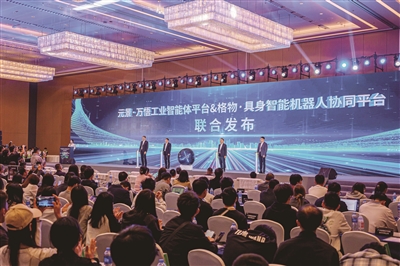
Group 1 - The 2025 Guangdong-Hong Kong-Macao Greater Bay Area Artificial Intelligence and Robotics Industry Conference was held from December 12 to 14, showcasing the latest achievements in the integration of AI and manufacturing [1] - The conference highlighted the construction achievements of the "National Artificial Intelligence Pilot Base," which is the only national-level pilot platform focusing on mobile terminals, co-built by Shenzhen and Dongguan, and constructed by China Unicom [1] - The base aims to enhance "terminal innovation" and "manufacturing efficiency" by establishing five foundational capabilities: computing power, data, models, applications, and security [1] Group 2 - Guangdong Unicom, in collaboration with various organizations, launched the "Guangdong Artificial Intelligence + Manufacturing Industry Alliance" to tackle common technical challenges and promote resource collaboration and achievement transformation [2] - The alliance includes partnerships with major companies such as Huawei, TCL, Midea, and others to accelerate the transformation of technological achievements into industrial practices [2] - Two platforms were officially launched: the "Yuanjing·Wanwuh Industrial Intelligence Platform" and the "Ge Wu·Embodied Intelligent Robot Collaborative Platform," aimed at empowering the entire production process with intelligent capabilities [1][2]





Is IDEX Corp Stock Underperforming the Dow?
Yahoo Finance· 2025-12-16 17:25
Core Insights - IDEX Corporation (IEX) specializes in technologies that enhance safety, cleanliness, and connectivity in daily life, with applications in microchip production, water treatment, and satellite communications [1] - The company is currently valued at approximately $13.4 billion, categorizing it as a large-cap entity, and has expanded from three small manufacturing businesses in 1988 to over 50 global operations [2] Financial Performance - IDEX's stock has recently increased by 8.8%, outperforming the Dow Jones Industrial Average's 5.5% return, although it is currently 21.1% below its 52-week high of $226.04 [3] - Over the past 52 weeks, the stock has declined by about 20%, with an additional projected decline of 14.8% in 2025, contrasting with a broader market gain of 10.4% over the past year and 13.5% in 2025 [4] - A positive technical trend is noted, with the stock trading above its 50-day and 200-day moving averages since late November, indicating improved momentum [5] Recent Developments - On October 29, IDEX reported strong Q3 2025 earnings, with adjusted EPS of $2.03, surpassing estimates of $1.93 and reflecting a 7% year-over-year increase, while revenue rose by 10% to $879 million, exceeding the consensus of $861.1 million [6]

AI Agents for Visual Inspection in Manufacturing
NVIDIA· 2025-12-16 17:22
Vision AI agents are transforming semiconductor manufacturing operations, driving new levels of quality and productivity. At the DAI level, visual inspection agents identify defects more accurately by fine-tuning Vision Foundation models with labeled images and now millions of unlabeled images through self-supervised learning and NVIDIA TAU. At the wafer level, AI agents powered by NVIDIA Metropolis and Cosmos Reason identify defects and reason potential root causes.As manufacturing processes deviate over t ...

November unemployment rate rose to 4.6%, highest level since September 2021
CNBC Television· 2025-12-16 14:29
Market Trends & Analysis - The market's reaction to delayed jobs data indicates that education and health services are the primary drivers of employment [1] - There is a mismatch between available jobs and the skills of the workforce, specifically in sectors like construction [2] - The current job creation rate of 64,000 jobs for 340 million people is considered insufficient [3] Economic Policy & Outlook - A 1% interest rate is suggested as a potential solution to improve job growth [4] - The need for more creative solutions beyond simply lowering interest rates is emphasized [5]