Real Estate Development

Search documents
观楼|俊发·俊云峰降价持续热销,招商建管接手天宇澜山后续开发
Xin Lang Cai Jing· 2025-12-16 04:55
Market Overview - In the week of December 8-14, 2025, the Kunming real estate market experienced an increase in both volume and price, driven by the sales of discounted old projects and the concentrated registration of engineering compensation housing [1] - A total of approximately 33,900 square meters were supplied to the market, representing a 7% week-on-week increase, with around 219 units available [1] - The total transaction volume reached approximately 66,100 square meters, marking a 21% week-on-week increase, with an average transaction price of approximately 12,640 yuan per square meter, a slight increase of 1% [1] Project Performance - Poly Tianjun Phase II continued to perform well after its launch, maintaining a position in the top three sales rankings with weekly sales of approximately 45 million yuan, selling 19 units at an average price of about 17,389 yuan per square meter [3] - Junfa Junyunfeng led the sales in the top five residential projects, achieving weekly sales of about 30 million yuan, selling 25 units at an average price of approximately 10,132 yuan per square meter [3] - Longfor's three projects also ranked well, with Longfor Tianpu and Longfor Xuechenfu achieving sales of approximately 40 million yuan and 39 million yuan, respectively, with average prices of about 21,096 yuan and 12,403 yuan per square meter [3] New Projects and Land Supply - The new residential project in Chenggong New City, Zhongtong Lian Dashushan, continued to perform well, selling 18 units at an average price of approximately 10,832 yuan per square meter [4] - Last week, a total of 10 land parcels were supplied in Kunming's main urban area, all sold at base prices, with companies like Longfor, Yunnan Urban Investment, and New Hope acquiring land [4] - The Huayun Runfu project launched 99 high-rise units with a construction area of approximately 145-189 square meters, achieving a sales rate of about 8% with an average price of approximately 18,000-19,000 yuan per square meter [4] Project Management and Financials - On December 8, the bidding results for the Tianyu Lanshan project were announced, with Shenzhen招商建设管理有限公司 winning the bid with a total fee rate of 2.5% [6] - The Tianyu Lanshan project currently has total liabilities of approximately 3.2 billion yuan, including priority debts of 400 million yuan and ordinary debts of 1.27 billion yuan [6] - The project management will utilize the brand influence of 招商建管 to enhance sales, covering all aspects from planning to delivery [6]

中国房地产月度追踪 - 又一个月的下滑,12 月或延续颓势-China Property Monthly Tracker_ Another month of slippage, and likely carry forward in Dec
2025-12-16 03:30
Summary of China Property Monthly Tracker Industry Overview - The report focuses on the **Chinese property market**, highlighting significant declines in various metrics such as average selling prices (ASP), primary sales, new starts, and completions in November 2025 compared to previous years. Key Market Indicators - **Primary Sales**: - Volume declined by **17%** year-over-year (yoy) - Value declined by **25%** yoy, which was largely in line with expectations [2][11] - **New Starts**: - Fell sharply by **28%** yoy, marking the second consecutive month of decline [11] - **Completions**: - Declined by **25%** yoy, undershooting estimates [11] - **Fixed Asset Investment (FAI)**: - Reached its lowest level since 2012, declining by **30%** yoy [2][11] - **Secondary Transaction Volumes**: - Decreased by **24%** yoy [2][11] Price Trends - **Average Selling Prices (ASP)**: - Nationwide ASP declined by **9.5%** yoy in November [21] - Primary market ASP showed a slight decline of **0.4%** month-over-month (mom), while secondary market ASP declined by **0.7%** mom [11][28] Developer Activity - Developers' land acquisition spending moderated to **21%** of contract sales in November, with an average project-level gross profit margin (GPM) of **25%** [12][71] - The land market showed signs of weakness, with land sales volume and value declining by **27%** and **37%** yoy, respectively [35] Future Expectations - For December 2025, expectations include: - Continued price weakness and a **low-teens to low-twenties %** yoy decline in sales volume and value [3][13] - A potential positive yoy for completions, but a steeper decline in new starts [3][13] - Secondary transaction volumes expected to decline by **high-twenties %** yoy [3][13] Policy and Market Sentiment - Key areas to watch include: - Potential large-scale mortgage interest subsidies and commercial mortgage rate cuts [4][8] - Removal of housing purchase restrictions in core districts of Tier-1 cities [4][8] - Signs of rent stabilization in high-tier cities [4][8] - The overall demand score for the property market was **37 out of 100**, indicating a challenging environment for developers and homebuyers [53][55] Developer Liquidity - Developers are facing a funding gap estimated at **Rmb3.2 trillion** for 2025, with liquidity remaining tight [54][57] - New funding sources for developers increased by **21%** mom and **29%** yoy in November, indicating some recovery in financing [63] Conclusion - The Chinese property market is experiencing significant challenges, with declining sales, prices, and construction activity. Developers are under pressure due to liquidity issues and a challenging market environment. Future policy measures and market sentiment will be crucial in determining the trajectory of the market moving forward.
中国房地产 - 11 月地产数据恶化速度超预期-China Property-November Property Data Worsened Faster Than Expected
2025-12-16 03:30
Summary of China Property Industry Conference Call Industry Overview - **Industry**: China Property - **Date**: December 15, 2025 - **Key Findings**: The property market in China is experiencing significant challenges, with home sales and construction activity declining faster than anticipated. The outlook for 2026 remains bleak, with expectations of prolonged downtrends in the physical market. Key Points Home Sales and Market Sentiment - Home sales in November saw a year-on-year decline of **-25%** in value and **-17%** in volume, worsening from October's declines of **-24%** and **-19%** respectively, leading to an **11M25** decline of **-11.1%** in value and **-7.8%** in volume [2][3] - The National Bureau of Statistics (NBS) reported a further drop in home prices, with primary markets down **0.4%** month-on-month and secondary markets down **0.7%** in November [2] Construction Activity - Construction completions fell by **26%** year-on-year in November, slightly improving from a **28%** decline in October, with an **11M25** decline of **-18.0%** [3] - New construction starts decreased by **28%** year-on-year in November, compared to a **30%** decline in October, leading to an **11M25** decline of **-21%** [3] - Real estate investment (REI) saw a significant decline of **-30%** year-on-year in November, worsening from **-23%** in October, with an **11M25** decline of **-15.9%** [3] Market Outlook - The physical market is expected to take longer to stabilize, with predictions of a high single-digit percentage decline in primary sales volume and mid-teens percentage declines in new starts, completions, and REI in 2026 [4] - Inventory levels remain high, and the analysis suggests that home prices in tier-1 and major tier-2 cities may stabilize in the second half of 2027 if the macroeconomic environment remains stable [4] Investment Opportunities - The report suggests focusing on quality companies with credible self-help stories, such as **CR Land** and **Seazen A**, which are expected to generate positive alpha despite the negative industry beta in 2026 [5] - **C&D** and **COLI** are highlighted as consolidators in the residential market, with optimized land banks supporting margin and earnings recovery [5] Data Summary - **Total sales value** in November was **Rmb 611 billion**, down **25.1%** year-on-year [6] - **Residential sales value** was **Rmb 532 billion**, down **17.3%** year-on-year [6] - **Total RE investment** was **Rmb 503 billion**, down **30.3%** year-on-year [6] - **Total GFA started** was **44 million sqm**, down **27.6%** year-on-year [6] - **Total GFA completion** was **46 million sqm**, down **25.5%** year-on-year [6] Conclusion The China property market is facing significant headwinds, with declining sales, construction activity, and investment. The outlook for 2026 remains challenging, but there are potential investment opportunities in quality companies that can navigate the current environment effectively.
中国地产:实体市场-行之有效的举措:价格稳定是关键-China Property_ Physical Market - Doing the Right Things; Price Stabilization Pivotal
2025-12-16 03:27
Summary of Conference Call on China Property Market Industry Overview - The conference call focuses on the **China Property** market, highlighting the ongoing challenges and potential recovery strategies within the sector. Key Points and Arguments Market Conditions - **Price Stabilization**: Coordinated policies in both property and financial sectors are seen as essential to break the downward price spiral, with a projected timeline of **2 years** for stabilization [1][2] - **Home Price Expectations**: A survey by PBoC indicates only **9%** of depositors expect housing prices to rise in **2026E**, reflecting a significant lack of confidence [1] - **Secondary Listings**: The market is experiencing a surge in secondary listings, with **4.7 million units** expected in **2025**, leading to a **9% year-over-year** decline in secondary prices [1][11] Sales and Inventory Trends - **Sales Decline**: National sales are projected to drop by **11% year-over-year** to **Rmb 7.6 trillion**, with residential sales at **Rmb 6.8 trillion** [4] - **Inventory Levels**: Record-high inventory levels are noted, with **36 months** of new home inventory, necessitating approximately **2 years** to return to historical averages [1][11] - **Foreclosure Sales**: Foreclosure sales have been minimal, accounting for only **0.3%** of the secondary market, with **92,000 units** sold at an average discount of **24%** [1][11] Economic Impact - **Household Wealth**: Real estate constitutes **66%** of household wealth, indicating that home price fluctuations significantly impact consumer spending and GDP [1][2] - **Local Government Revenue**: Land sales have decreased to **25%** of local government revenue, down from a peak of **44%** in 2020, indicating a shift in financial reliance [1][2] Future Projections - **Price Decline**: Home prices are expected to decline by **3-5%** in **2026E**, with top cities stabilizing first by the end of that year [9][11] - **New Home Supply**: New home supply is anticipated to contract further, with land acquisition and starts expected to drop by **10%** and **15%** year-over-year, respectively [4][9] - **Demand-Side Stimulus**: A new round of local stimulus is anticipated in **4Q25**, although its effectiveness in altering price expectations remains uncertain [2][4] Regulatory Environment - **Resale Restrictions**: Many cities have removed resale restrictions, leading to increased secondary supply and impacting price expectations [1][40] - **Market Regulation**: There is a focus on regulating online property information and media to stabilize market expectations [2] Additional Important Insights - **Investment Units**: An estimated **6.7 million investment units** are expected to enter the market, exacerbating supply pressures due to eased resale restrictions [1][42] - **Vacancy Rates**: A **12%** vacancy rate translates to approximately **36 million vacant units**, indicating significant overcapacity in the market [1][11] - **Long-Term Structural Changes**: The shift towards higher-quality GDP growth is seen as a long-term structural change, with property contributing around **10%** to GDP in **2026E** [1][2] This summary encapsulates the critical insights from the conference call regarding the current state and future outlook of the China property market, emphasizing the challenges and potential recovery strategies.

X @Bloomberg
Bloomberg· 2025-12-16 02:12
Even more evidence is piling up that China Vanke can no longer rely on state support, underscoring a dramatic reversal for the developer whose local government backing had until recently made the risk of default seem distant https://t.co/fAa2n2A4QZ ...

Middleburg, Landmark announce land buys
Yahoo Finance· 2025-12-15 15:04
Core Insights - Despite sluggish apartment sales, the land market remains liquid, as evidenced by two recent deals involving Landmark Properties and Middleburg Communities [1][5] Group 1: Landmark Properties - Landmark Properties, in partnership with Manulife Investment Management, acquired a 3.29-acre site in Auburn, Alabama, to develop The Mark Auburn, an 825-bed student housing property [1][2] - The project will consist of 329 units, ranging from studios to five-bedroom apartments, and is expected to open by the fall 2028 academic year [3] - The acquisition involved negotiating a four-parcel site across two zoning areas, allowing for increased density and differentiation from similar properties in the area [4] Group 2: Middleburg Communities - Middleburg Communities closed on land and construction financing for Mosby Deerbrook, a 330-unit luxury apartment community in Spring Hill, Florida [5] - The property will include 113 one-bedroom, 182 two-bedroom, and 35 three-bedroom apartments, with construction expected to commence imminently and first units delivering in early 2027 [5] - The chosen location offers wetland views and proximity to a cancer research park, which was deemed more valuable than marginally cheaper alternatives [6][7]
Earth Science Tech, Inc. Receives FINRA Clearance on Form 211 to Initiate Quotations
Globenewswire· 2025-12-15 13:00
Core Insights - Earth Science Tech, Inc. (ETST) has received clearance from the Financial Industry Regulatory Authority (FINRA) for its Form 211 application, allowing for the initiation of priced quotations for its securities [1][2][3] Company Overview - ETST operates as a strategic holding company focused on acquiring and scaling high-potential operating businesses, with current operations in compounding pharmaceuticals, telemedicine, and real estate development through various subsidiaries [3] - The company's subsidiaries include RxCompoundStore.com, Peaks Curative, Avenvi, Mister Meds, Earth Science Foundation, Las Villas Health Care, and an 80% interest in MagneChef [3] Subsidiary Highlights - **RxCompoundStore.com, LLC**: A fully licensed compounding pharmacy operating in multiple states, actively pursuing licensure in remaining U.S. states [4] - **Mister Meds, LLC**: A compounding pharmacy in Texas with advanced sterile compounding capabilities, applying for licensure in additional states [5] - **Peaks Curative, LLC**: A telemedicine platform offering consultations for compounded medications, expanding into the veterinary market through the acquisition of Zoolzy.com [6] - **Las Villas Health Care, Inc.**: A healthcare facility focused on the Spanish-speaking community, providing advanced health treatments [8] - **Avenvi, LLC**: A diversified real estate company managing a $10 million share repurchase program and overseeing investment activities for ETST [9] - **MagneChef**: A direct-to-consumer retail brand developing new cooking products and expanding into the BBQ tool market through the acquisition of BBQraft [9] - **Earth Science Foundation, Inc.**: A nonprofit organization providing financial support for prescription costs at ETST's pharmacies [10] Strategic Importance - The clearance of Form 211 is viewed as a critical milestone for ETST, expected to enhance shareholder value, improve liquidity, and provide greater visibility for executing its business plan [3]

*ST金科:公司及控股子公司重整计划执行完毕
Xin Lang Cai Jing· 2025-12-15 12:33
Core Viewpoint - The restructuring plan of *ST Jinke and its subsidiary Chongqing Jinke Real Estate Development Co., Ltd. has been successfully completed, significantly improving the company's financial stability and competitive position [1] Group 1: Restructuring Plan - The restructuring plan was executed on November 21, 2025, and involved increasing the total share capital from 5.34 billion shares to 10.634 billion shares [1] - The plan introduced new investors and adjusted the rights of existing investors, effectively mitigating debt risks [1] Group 2: Financial Improvement - The completion of the restructuring plan is expected to greatly enhance the company's asset-liability structure [1] - The company aims to integrate high-quality resources and develop a new model for real estate development, which will improve its core competitiveness and profitability [1] Group 3: Future Outlook - The company is focused on returning to a positive development track and achieving high-quality, sustainable, and healthy growth [1]

宁波温州金华四宗地底价成交,总金额超24亿元
Sou Hu Cai Jing· 2025-12-15 10:43
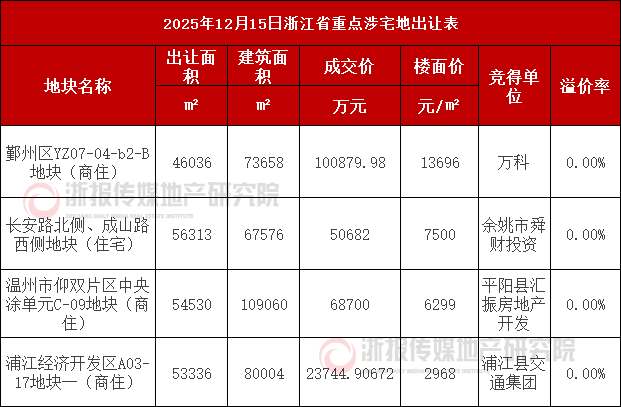
Group 1 - The core point of the article is that several residential land parcels in Ningbo, Wenzhou, and Jinhua were sold at the base price, indicating a stable but cautious real estate market in these regions [1][3][4][7][9]. Group 2 - In Ningbo, the commercial and residential land in Yinzhou was acquired by Vanke for a total price of 100,879.98 million yuan, with a floor price of 13,696 yuan per square meter [1][3]. - The residential land in Yuyao was won by Yuyao Shuncai Investment for 50,682 million yuan, resulting in a floor price of 7,500 yuan per square meter [1][4]. - The commercial and residential land in Wenzhou was secured by Pingyang Huizhen Real Estate Development for 68,700 million yuan, with a floor price of 6,299 yuan per square meter, which is lower than the previous sale price of 7,280 yuan per square meter [1][7]. - The commercial and residential land in Jinhua was obtained by the Pujiang Transportation Group for 23,744.906724 million yuan, with a floor price of 2,968 yuan per square meter [1][9].
Day7 | 2025年十大作品全国20强展示
克而瑞地产研究· 2025-12-15 09:50
Core Viewpoint - The "2025 China Real Estate Product Evaluation" has entered the project display phase, with the initial shortlisted projects announced on December 3rd, following a vigorous selection process involving industry experts and enterprises [2]. Group 1: Evaluation Process - The evaluation will combine expert reviews and online voting to determine the final awards, including "Top Ten High-end/Light Luxury/Quality Works" and "National Good Houses" [3]. - The evaluation work is currently progressing in an orderly manner, with details of shortlisted projects to be released via the WeChat account "克而瑞产品测评" from December 9 to December 16 [12]. Group 2: Shortlisted Projects - High-end shortlisted projects include Beijing Runyuan, featuring a classic international architectural style [4]. - Light luxury shortlisted projects include Huazhu Sanya Haitang Yufu Phase II, characterized by a modern architectural style [6]. - Quality shortlisted projects include Jinan Wangyun, which exemplifies urban vacation and quality living [10]. Group 3: Industry Focus - Since 2018, the company has focused on changes in industry product strength, evolving from "product strength" to "product series" and "product," emphasizing delivery and value retention [12]. - The Product Strength 100 Working Group aims to promote valuable and replicable products and concepts within the industry, driving continuous upgrades in product strength [12].