Glass

Search documents
中国区原材料周度监测:反内卷进程持续推进-Greater China Materials Weekly Monitor Continued Progress of Anti-Involution
2025-08-05 03:19
Summary of Key Points from the Conference Call Industry Overview - **Industry Focus**: Greater China Materials, specifically in the Asia Pacific region [1] - **Market Sentiment**: The industry view is considered attractive by Morgan Stanley [6] Price Movements and Inventory Changes Base Metals - **Copper**: Prices decreased by 1.5% week-over-week (WoW), with inventories down by 1.2% WoW [2] - **Aluminum**: Prices fell by 1.3% WoW, while inventories increased by 1.5% WoW [2] - **Gold**: Price decreased by 1.4% WoW, settling at US$3,290 per ounce [2] Battery Metals - **Lithium Hydroxide**: Prices for industrial-grade and battery-grade lithium hydroxide rose by 9.4% and 8.5% WoW, respectively [2] - **Lithium Carbonate**: Prices for industrial-grade and battery-grade lithium carbonate increased by 1.5% and 2.1% WoW, respectively [2] Steel - **HRC and CRC Prices**: Shanghai HRC prices increased by 0.9% WoW, while CRC prices decreased by 0.2% WoW [3] - **Rebar**: Prices rose by 2.3% WoW [3] - **Long Steel Inventories**: Increased by 3.3% WoW [3] Cement and Coal - **Cement Prices**: Decreased by 0.6% WoW to Rmb323 per ton [3] - **Coal Prices**: QHD5500 coal prices increased by 0.5% WoW to Rmb665 per ton, with inventories dropping by 10.8% WoW [3] Glass - **Glass Fiber Prices**: Average prices declined by 1.3% WoW to Rmb3,850 per ton [4] - **Float Glass Prices**: Increased by 2.8% WoW to Rmb1,317 per ton [4] Regulatory Environment - **NDRC Initiatives**: The National Development and Reform Commission (NDRC) is promoting a unified national market and aims to eliminate 'involution-style' competition [8] - **CISA Recommendations**: The China Iron and Steel Association (CISA) emphasized the need for regional and product self-discipline, urging enterprises to control production and stabilize prices [8] Analyst Insights - **Analyst Team**: The report includes insights from multiple equity analysts at Morgan Stanley, indicating a collaborative approach to research [5] - **Investment Banking Relationships**: Morgan Stanley has disclosed its investment banking relationships with several companies in the materials sector, which may influence research objectivity [6][18] Stock Ratings - **Coverage Universe**: The report lists various companies within the Greater China Materials sector, with ratings ranging from Overweight to Underweight [62][64] - **Notable Companies**: Companies such as Aluminum Corp. of China Ltd. and Ganfeng Lithium Co. Ltd. are highlighted with their respective ratings [62][64] Conclusion - The Greater China Materials sector is experiencing mixed price movements across various commodities, with regulatory efforts aimed at stabilizing the market. Analysts maintain an attractive outlook for the industry, supported by ongoing price adjustments and inventory management strategies.
XINYI GLASS(00868.HK):DEEP PROCESSING BUSINESS UNDERPINS EARNINGS; WATCH FOR MARGINAL RECOVERY IN FLOAT GLASS
Ge Long Hui· 2025-08-03 18:24
Core Viewpoint - Xinyi Glass reported a decline in revenue and net profit for 1H25, primarily due to weak demand in the float glass and architectural glass sectors, although automotive glass earnings showed resilience [1][2]. Financial Performance - Revenue for 1H25 decreased by 9.7% YoY to Rmb9.8 billion, with net profit attributable to shareholders falling 59.6% YoY to Rmb1 billion [1]. - Automotive glass revenue increased by 10.6% YoY to Rmb3.3 billion, with gross margin rising by 5.0 percentage points YoY to 54.5% [2]. - Float glass revenue dropped by 16.4% YoY to Rmb5.4 billion, with the industry average selling price (ASP) declining by 28% YoY to Rmb1,329 per ton [3]. Cost and Expenses - The firm's expense ratio increased by 2.4 percentage points YoY to 18.6%, with selling expenses rising by 1.6 percentage points YoY to 6.7%, attributed to higher US import tariffs [4]. - The effective tax rate rose by 5-6 percentage points YoY, linked to a decrease in earnings from associates [4]. Capital Expenditure and Dividends - Capital expenditure fell by 81% YoY to Rmb1 billion, primarily for investments in new industrial parks in China and Indonesia [5]. - An interim dividend of HK$0.125 per share was proposed, with a payout ratio of approximately 49% and a dividend yield of 3.3% [5]. Industry Outlook - The float glass industry is expected to adjust supply through cold repairs, with potential cost increases for highly polluting fuels possibly improving earnings [5]. - The company's focus on deep engagement in the automotive glass aftermarket and expansion into the OEM segment may provide stability to overall earnings [5]. Financial Forecasts - The 2025 EPS forecast was cut by 21% to Rmb0.52, while the 2026 EPS forecast remains at Rmb0.68, reflecting pressures on the float glass business [5]. - The target price is maintained at HK$8.5, implying a 15x 2025e and 11x 2026e P/E ratio, with a 5% upside potential [5].

How Will Corning Stock React To Its Upcoming Earnings?
Forbes· 2025-07-28 11:40
Core Insights - Corning Incorporated (NYSE: GLW) is scheduled to report its earnings on July 29, 2025, with historical data indicating a tendency for negative one-day returns post-earnings announcements, occurring in 60% of cases [2][3] Financial Performance - Analysts project earnings of $0.57 per share on revenues of $3.84 billion for the upcoming quarter, showing an improvement from the previous year's earnings of $0.47 per share on revenues of $3.60 billion [3] - Corning has an estimated market capitalization of around $48 billion, with $14 billion in revenue generated over the past twelve months, operational profits of $1.3 billion, and a net income of $454 million [4] Historical Earnings Reaction - Over the past five years, Corning has recorded 20 earnings data points, with 8 positive and 12 negative one-day returns, resulting in positive returns approximately 40% of the time [6] - The median of the 8 positive returns is 3.9%, while the median of the 12 negative returns is -3.1% [6] Post-Earnings Return Analysis - The correlation between short-term (1D) and medium-term (5D, 21D) returns can guide trading strategies, with a focus on pairs that show the strongest correlation [7] - Historical data indicates that the correlation between 1D and 5D returns can be utilized for positioning trades following earnings announcements [7] Competitor Influence - The performance of competitors can impact Corning's post-earnings stock response, with pricing effects potentially starting before the earnings announcement [8]



浮法玻璃价格因情绪面上涨;基本面压力仍存-Greater China Materials_ Float glass price up on sentiment; fundamental pressure remains
2025-07-28 01:42
Summary of Conference Call on Float Glass Industry Industry Overview - **Industry**: Float Glass - **Region**: Greater China Materials, Asia Pacific Key Takeaways 1. **Price Movement**: Float glass prices have increased due to improved market sentiment, with future prices rising from Rmb980/ton in early July to Rmb1307/ton as of July 24, 2025, driven by expectations of anti-involution actions [11][1][2] 2. **Inventory Changes**: Total inventory at future-spot traders rose from 0.7 million weight cases in late May to 2.16 million weight cases currently, while traditional float glass inventory decreased from 60.6 million weight cases in mid-June to 53 million weight cases [11][1][2] 3. **Market Dynamics**: Despite the price increase, demand remains muted, with order days from processing plants at a multi-year low of 9.3 days, indicating a mismatch between supply and demand [2][3][1] 4. **Profit Margins**: The slight recovery in spot glass prices has led to a marginal improvement in margins for glass producers, although fundamental pressures persist due to high supply levels [1][2][3] Company-Specific Insights 1. **Major Players**: Companies such as Xinyi Glass and Zhuzhou Kibing Group are expected to face earnings pressure due to the ongoing supply-demand mismatch and potential downside in float glass prices [2][1] 2. **Maintenance Impact**: Improved profits have led to the postponement of maintenance plans for some production lines, which could further exacerbate supply issues [2][1] Risks and Considerations 1. **Downside Risks**: The industry faces risks from weaker-than-expected demand in the property segment, potential sharp decreases in float glass prices, and margin squeezes from rising costs of natural gas and soda [19][1] 2. **Upside Risks**: Potential improvements in downstream demand, particularly from the property and automotive markets, could positively impact the industry [16][1] Conclusion - The float glass industry is currently experiencing a complex interplay of rising prices driven by sentiment and inventory dynamics, against a backdrop of muted demand and fundamental pressures. Major producers are likely to face challenges in maintaining profitability amidst these conditions.
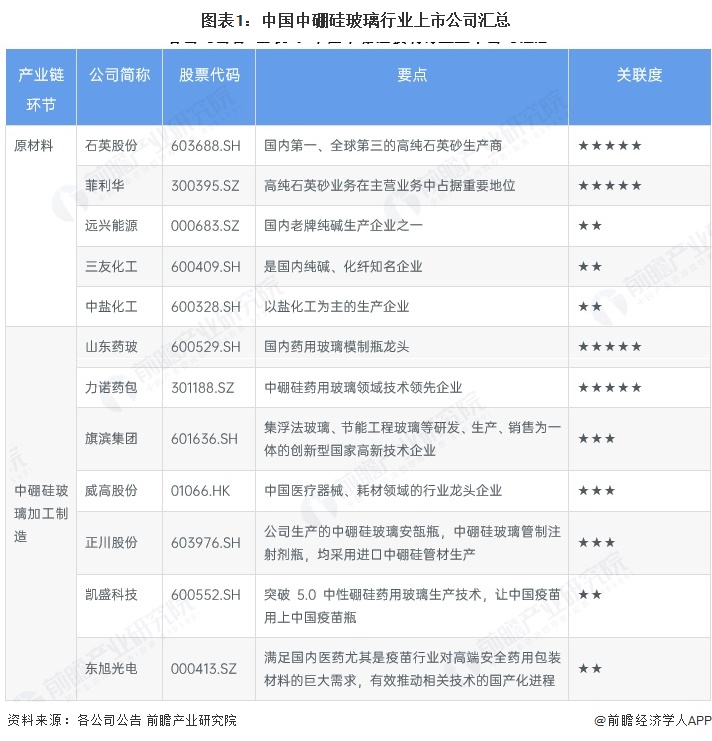
【最全】2025年中硼硅玻璃行业上市公司全方位对比(附业务布局汇总、业绩对比、业务规划等)
Qian Zhan Wang· 2025-07-27 03:58
Group 1: Industry Overview - The main listed companies in the borosilicate glass industry include Shandong Pharmaceutical Glass, Linuo Pharmaceutical Packaging, Qibin Group, Weigao Group, and Zhengchuan Co., Ltd. [1] - The number of A-share listed companies in the borosilicate glass sector is relatively small, with key players being Shandong Pharmaceutical Glass, Linuo Pharmaceutical Packaging, Qibin Group, and Zhengchuan Co., Ltd. [1] Group 2: Financial Performance - In 2024, the projected revenue for Shandong Pharmaceutical Glass from borosilicate glass-related businesses is 51.30 billion yuan, Linuo Pharmaceutical Packaging is 10.81 billion yuan, and Qibin Group is 156.49 billion yuan [2]. - The revenue contribution of borosilicate glass-related businesses to total revenue is significant, with Shandong Pharmaceutical Glass at 51.38%, Linuo Pharmaceutical Packaging at 43.24%, and Zhengchuan Co., Ltd. at 52.85% [5]. Group 3: Production and Sales Metrics - In 2024, Shandong Pharmaceutical Glass and Zhengchuan Co., Ltd. have production and sales rates close to 100%, while Linuo Pharmaceutical Packaging's rate is below 90% [6]. - The gross profit margin for Shandong Pharmaceutical Glass is notably high, while Linuo Pharmaceutical Packaging and Zhengchuan Co., Ltd. have margins around 22%-23% [6]. Group 4: Business Layout and Strategy - The borosilicate glass industry is concentrated in the eastern coastal regions of China, particularly in Jiangsu Province [2]. - Leading companies like Shandong Pharmaceutical Glass and Linuo Pharmaceutical Packaging are expanding capacity and integrating the supply chain to accelerate domestic substitution in the borosilicate glass market [8]. Group 5: Future Plans - Shandong Pharmaceutical Glass aims to increase its production capacity to 5 billion units per year by 2025, with a target export ratio of 20%-25% [9]. - Linuo Pharmaceutical Packaging plans to achieve a production capacity of 63,000 tons per year by 2025, covering all specifications from 5ml to 500ml [9]. - Qibin Group is investing 780 million yuan to build two production lines for borosilicate glass, expected to be operational by 2025 with an annual capacity of 100,000 tons [9].




Vitreous Glass Announces Dividend
Thenewswire· 2025-07-15 22:10
Core Viewpoint - Vitreous Glass Inc. has declared a cash dividend of $0.07 per common share, to be paid on August 15, 2025, to shareholders of record as of August 1, 2025, indicating a commitment to return value to shareholders while anticipating continued quarterly dividends in the future [1][2]. Company Summary - The dividend is classified as an "eligible dividend" for tax purposes, which may enhance its attractiveness to investors [2]. - As of July 15, 2025, the Corporation had approximately 6,336,087 common shares issued and outstanding, providing a basis for calculating the total dividend payout [3].

Corning: Limit Upside Ahead, Now Neutral (Rating Downgrade)
Seeking Alpha· 2025-07-15 07:23
Core Viewpoint - Coverage of Corning Incorporated (NYSE: GLW) has resumed after a year-long pause, highlighting a strong share price gain of over 20% [1] Group 1 - The company is strategically positioned to benefit from market trends, particularly in developed markets [1] - The analysis is conducted by buy-side hedge professionals focusing on fundamental, income-oriented, long-term investment strategies [1]

X @The Economist
The Economist· 2025-06-29 19:09
Corning’s boss is a corporate stalwart with a passion for glass https://t.co/aIvtqswNID ...
摩根士丹利:太阳能玻璃价格跌至现金成本线以下;产能出清仍需时间
摩根· 2025-06-23 02:09
Investment Rating - The industry investment rating is Attractive [4]. Core Insights - Solar glass prices have dropped below cash cost levels, with reported prices in June for 2.0mm products at Rmb12-12.5/sqm and actual executed prices ranging from Rmb10.8-11/sqm, indicating industry-wide losses at cash levels [2][7]. - The rebound in solar glass prices in March and April led to the initiation of 11.3kt/d new capacities and the resumption of one 850/t line in the past three months, with the industry operating capacity at approximately 100kt/d, supporting around 54GW monthly production [7]. Summary by Sections Price Trends - Solar glass prices rebounded in March and April to Rmb14-14.5/sqm due to better-than-expected demand, but have since fallen to Rmb12-12.5/sqm in June, with actual prices for smaller players even lower [2][7]. Production Capacity - Approximately 97% of the operating capacity commenced production in 2021 and later, making it difficult to suspend production quickly. There are still around 10kt/d of smaller lines that may exit the market first due to higher costs [3]. Market Dynamics - The lower profit margins are expected to trigger production line blockages or suspensions, with companies like CNBM, Flat Glass, IRICO, and Almaden planning maintenance in the near term [3].

Should Value Investors Buy OI Glass (OI) Stock?
ZACKS· 2025-06-17 14:41
Core Viewpoint - OI Glass is identified as a strong value stock with favorable metrics, indicating it may be undervalued in the current market [4][9]. Valuation Metrics - OI Glass has a P/E ratio of 8.64, which is lower than the industry average of 8.94. The stock's Forward P/E has fluctuated between 5.39 and 14.36 over the past year, with a median of 7.76 [4]. - The PEG ratio for OI is 0.25, matching the industry's average PEG. Over the last year, OI's PEG has ranged from 0.18 to 1.32, with a median of 0.90 [5]. - OI's P/B ratio stands at 1.68, compared to the industry average of 1.99. The P/B ratio has varied from 0.94 to 1.74 in the past year, with a median of 1.34 [6]. - The P/S ratio for OI is 0.33, which is lower than the industry average of 0.4 [7]. - OI has a P/CF ratio of 7.07, which is attractive compared to the industry's average of 8.30. This ratio has seen a range from 4.02 to 25.52 over the past year, with a median of 7.30 [8]. Investment Outlook - The combination of these metrics suggests that OI Glass is likely undervalued, and its strong earnings outlook positions it as one of the market's strongest value stocks [9].