
Real Estate Development

Search documents
Hotel to be demolished as Kairoi spends $39M on LoHi site
BusinessDen· 2025-12-09 12:20
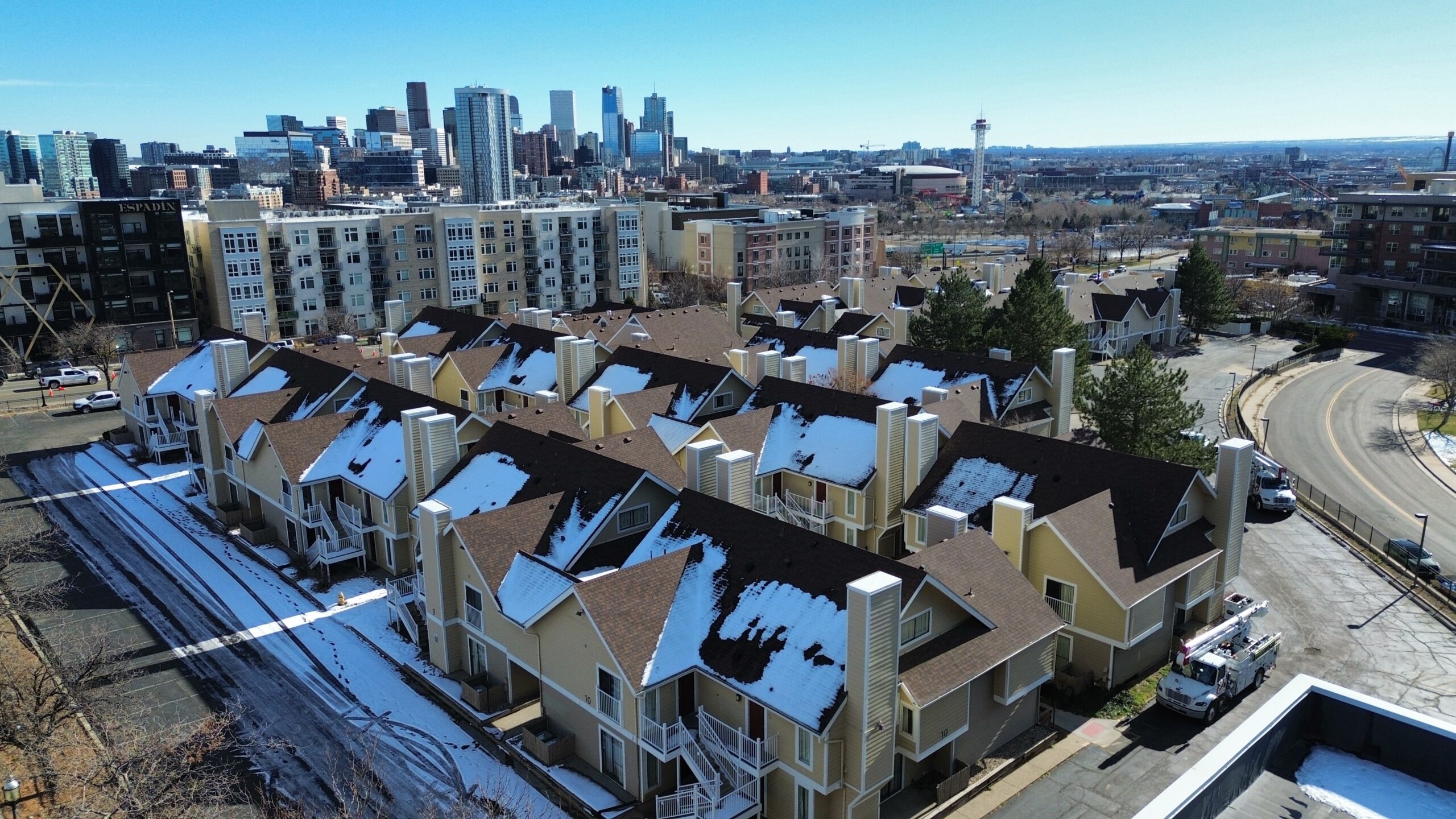
Core Insights - Kairoi Residential has acquired a prominent corner in LoHi for $39 million, planning to develop a 5-story, 429-unit apartment complex [2][3] - The purchase price was $231 per square foot for the 4 acres of land, which includes the site of the closed Residence Inn by Marriott hotel [2] - The estimated construction cost for the new apartment complex is projected at $65.6 million [2] Company Details - Kairoi Residential is based in San Antonio, Texas, and has previously developed six other projects in the local area, including Westminster and RiNo [4] - The company has recently closed on a development site in Lakewood, indicating ongoing expansion efforts [4] Market Context - The LoHi area is experiencing significant demand for apartment construction, with nearby projects including a 189-unit development by Carmel Partners and a 282-unit project by a new Aspen-based firm [5]


DarGlobal launches $4.2bn coastal destination project in Muscat
Yahoo Finance· 2025-12-09 09:55
Core Insights - DarGlobal and Art District Real Estate Development have partnered to develop the Marine, Art & Digital District (MAD) in Muscat, Oman, covering over 1.5 million square meters with a gross development value of OR1.6 billion ($4.2 billion) [1][2] - The project aims to create an integrated location combining residential, hospitality, cultural, retail, and business facilities, supporting Oman's economic diversification strategy [2][3] Group 1 - The MAD project will be developed in multiple phases over the next 12 years [1] - The district will feature international art exhibitions, digital business incubators, a financial center, and a year-round program of cultural events [4] - The initiative is designed to attract foreign investors and entrepreneurs, fostering new business models related to property ownership and digital enterprises [5] Group 2 - DarGlobal's portfolio includes developments in 14 cities across nine countries, with an international development pipeline exceeding $19 billion [6] - The company recently acquired 28,800 square meters of land for a mixed-use project in Jeddah, Saudi Arabia [6] - The CEO of DarGlobal emphasized that MAD will empower enterprise, attract global talent, and unlock new economic value for Oman [3][5]
X @Bloomberg
Bloomberg· 2025-12-09 07:40
IPO Plans - RMZ, one of India's biggest developers, is considering an IPO [1] - The IPO may raise as much as $1 billion [1]
国企整体回购,用于城中村改造!惠州仲恺挂牌3宗地
Nan Fang Du Shi Bao· 2025-12-09 06:24
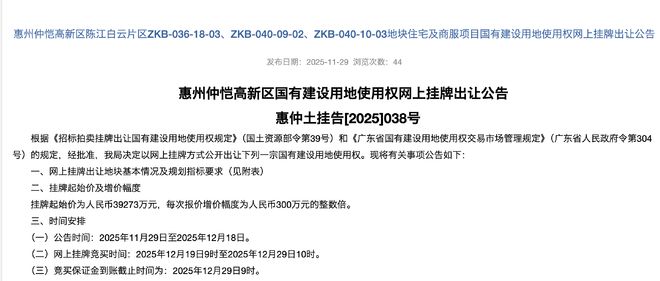
Core Points - The Huizhou Zhongkai High-tech Zone Public Resource Trading Center has listed three commercial and residential land parcels in the Chenjiang Baiyun area, with a total starting price of approximately 393 million yuan and a starting floor price of about 3,059 yuan per square meter [1][4] - The listed land parcels are designated for the construction of resettlement housing as part of a village renovation project, with the overall repurchase to be conducted by a state-owned enterprise [1][4] Group 1 - The three land parcels, identified as ZKB-036-18-03, ZKB-040-09-02, and ZKB-040-10-03, are located in the northern area of Chenjiang Light Rail Station and are part of the urban village renovation project [4] - The total land area for the three parcels is approximately 41,000 square meters, with a total planned construction area of about 128,000 square meters and a minimum of 1,088 residential units [4] - The project includes specific housing type ratios, with 22.5% for units of 85-89 square meters, 22.5% for units of 100-105 square meters, 35% for units of 118-123 square meters, and 20% for units larger than 140 square meters [4] Group 2 - The project is required to include a certain proportion of commercial building area and must not include service-type apartments, while also providing public service facilities such as property service rooms, elderly care facilities, and community sports activity areas [4] - The total repurchase price for the project is capped at 1.15 billion yuan, with a repurchase price of 8,650 yuan per square meter for residential and commercial properties, and 30,000 yuan per parking space [7] - This land supply is a key initiative for promoting urban renewal in the Zhongkai central area, aiming to efficiently and steadily ensure the resettlement of villagers while enhancing the urban landscape and functionality [9]
中国地产周评 - 第 49 周总结:市场活跃度放缓,降价幅度收窄-China Property Weekly Wrap_ Week 49 Wrap - Market activities moderated, while price cuts decelerated
2025-12-09 01:39
Summary of Key Points from the Conference Call Industry Overview - The report focuses on the **Chinese real estate market**, highlighting recent trends in property sales and market activities during week 49 of 2025. Core Insights and Arguments 1. **Policy Support**: The State Council continues to support urban renewal initiatives, aiming to stabilize the property market and promote high-quality housing construction and development [1][2] 2. **Market Activity Decline**: Overall market activities have slowed, with primary sales volume down **16% week-over-week (wow)** and secondary sales down **5% wow**. Subscription-based secondary sales also fell by **5% wow** [2][5] 3. **Price Adjustments**: The pressure on secondary prices has eased slightly, with listings that experienced price cuts decreasing by **18% wow**, resulting in a ratio of listings with price cuts to those with price increases at **15.5X** compared to **17.3X** in November [2][5] 4. **Sales Performance**: New home sales volume averaged **-16% wow** and **-44% year-over-year (yoy)**, with tier-3 cities and the Yangtze River Delta (YRD) outperforming other tiers. Secondary transactions were down **5% wow** and **-49% yoy** [5][27] 5. **Year-to-Date (YTD) Performance**: Primary Gross Floor Area (GFA) sold was down **14% yoy**, with tier-3 cities and Central & Western regions outperforming. Secondary GFA sold was up **2% yoy** [5][23] 6. **Inventory Levels**: Inventory increased by **0.1% wow** but decreased by **3.6% from the end of 2024**, with inventory months at **27.5** compared to an average of **26.7** in November [37][39] 7. **Valuation Trends**: Offshore developers saw an average share price decline of **2% wow**, while onshore developers averaged **-3% wow**. Offshore coverage trades at a **41% discount** to end-2025 estimated net asset value (NAV) [49][50] Additional Important Insights 1. **Completion Rates**: The GSPC tracker indicates a high single-digit percentage decline in completions for November 2025, with expectations of a **30%-40% yoy decline** in new starts [15][42] 2. **Home Appliance Sales**: Anticipated to decline yoy in November 2025 based on secondary sales trends in approximately 20 cities [15] 3. **Market Sentiment**: The average Centraline Salesman Index (CSI) was down **2.7 percentage points (pp) wow** and **8.2 pp yoy**, indicating a negative sentiment among agents regarding property prices [31][33] 4. **Seller Expectations**: The average Centraline Seller Asking Index (CAI) increased by **0.3 pp wow** but decreased by **10.9 pp yoy**, reflecting mixed expectations among sellers [34][36] This summary encapsulates the key points from the conference call, providing insights into the current state of the Chinese real estate market, including sales performance, inventory levels, and market sentiment.
The Kansai Electric Power Company (OTCPK:KAEP.Y) 2025 Investor Day Transcript
2025-12-08 13:02
Summary of Kansai Electric Power Company Investor Day Company Overview - **Company**: Kansai Electric Power Company (KEPCO) - **Date**: December 08, 2025 - **Focus**: Discussion on subsidiaries Optage and Kanden Realty and Development, including financial performance, future outlook, and competitive positioning Key Points Financial Performance - **Free Cash Flow**: - Optage's free cash flow was positive until last year, with expected investments increasing from JPY 40 billion, which may lead to negative cash flow in the short term but positive in 5-10 years [6][10] - **Return on Assets (ROA)**: - Optage achieved a significant ROA of 15%, which may be challenging to maintain in the future due to new growth investments [4][7] - Kanden Realty and Development's ROA is expected to reach 5% by 2025, with current figures lower than that [11][14] Competitive Positioning - **Industry Comparison**: - Optage's ROA is reportedly higher than peers such as NTT East, NTT West, and J:COM, although specific competitor comparisons were not disclosed [9][10] - Kanden Realty and Development's ROA is compared to other real estate firms, with figures like Mitsui Fudosan at 4.2% and Mitsubishi Estate at 4% [13] Strategic Initiatives - **Investment Plans**: - KEPCO plans to invest JPY 1.1 trillion over five years, with JPY 900 billion allocated for capital recycling [30][31] - **Real Estate Development**: - Focus on long-term capital gain through residential housing, with plans to develop properties in the Tokyo Metropolitan Area and Yumeshima [22][33] - Collaboration with local companies for large-scale developments, including a new subway station in Nakanoshima [24] Nuclear Power Insights - **Capacity Utilization**: - Current capacity utilization is around 90%, with aspirations to match U.S. standards, but regulatory and community acceptance remain challenges [25][26] - **Future Developments**: - Plans for new nuclear plants are cautious, with a focus on thorough community engagement and safety assessments [41][43] Data Center Demand - **Market Trends**: - High demand for data centers, particularly for GPU-related services, although uncertainty exists regarding the sustainability of this demand in Japan [18][20] - **Business Model**: - Optage's data center strategy includes connectivity services, targeting telecom carriers and cloud service providers [48][54] Miscellaneous - **Real Estate Strategy**: - Kanden Realty and Development aims to increase capital gain from 50% to 60% of revenue, with a focus on residential housing due to rising architecture costs [47][55] - **M&A Considerations**: - No immediate plans for M&A in the real estate sector, but partnerships with strong local firms are being considered [39][40] Conclusion Kansai Electric Power Company is strategically positioning itself for future growth through significant investments in its subsidiaries, focusing on maintaining competitive ROA, and navigating the complexities of nuclear power and real estate development. The company is also adapting to market demands in the data center space while ensuring community engagement and regulatory compliance in its nuclear initiatives.
“过江龙”搅局,龙湖摘得深圳一块宅地
Sou Hu Cai Jing· 2025-12-08 12:44
12月8日,龙湖摘得深圳市光明区A627-0268宗地,进一步拓展在粤港澳大湾区版图。 南方+记者 周中雨 该地块位于光明核心区域公明中心区,距离6号线红花山站约300米,距离13号线新庄站约900米。其所属板块整体居住氛围较好,地块周边教育资源丰富, 涵盖公明中学、公明中英文学校、光明高级中学、光明区第二中学、深圳理工大学明珠校区等各级学校。地块周边还有红花山体育中心、光明区少年儿童图 书馆、公明广场、红花山公园、楼村湿地公园等众多市政休闲配套。大仟里购物中心、光明人民医院西院区等商业、医疗配套亦离地块较近。 据了解,自2014年正式进入粤港澳大湾区以来,龙湖在大湾区已经成功开发包括深圳御湖境、广州天奕、佛山江与城、珠海天澜等36个项目。 据悉,龙湖此次摘得的地块总用地面积20523.78㎡,建筑面积63623㎡,容积率3.1。 ...


The Kansai Electric Power Company (OTCPK:KAEP.Y) 2025 Earnings Call Presentation
2025-12-08 12:00
OPTAGE Inc Summary - OPTAGE's consumer business generated ¥258.3 billion in revenue in FY2024, with 54% from FTTH services, 35% from mobile business, and 11% from business solutions[12] - OPTAGE has 1.7 million FTTH subscribers and 1.37 million mobile subscribers as of end-October 2025[7] - OPTAGE aims to transition to a business portfolio where Business Solutions exceed 50% of revenue by FY2035, targeting approximately ¥430 billion in revenue and ¥75 billion in ordinary profit[68, 69] - OPTAGE plans to invest approximately ¥300 billion in growth areas by 2035 to enhance competitiveness and grow as a core non-energy company[59] Kanden Realty & Development Co,Ltd Summary - Kanden Realty & Development's revenue nearly doubled and profit before taxes increased by 2.8 times from 2016 to 2024[82, 83] - Kanden Realty & Development aims for FY2030 targets of ¥310 billion in revenue, ¥40 billion in profit before taxes, and an ROA of 4.5% or higher[103, 104] - Kanden Realty & Development has established a capital recycling business model, with 50% of on-balance sheet assets allocated to capital recycling as of FY2024[73, 93, 94] - Kanden Realty & Development targets an annual increase of ¥180 billion from FY2026 to FY2030 by strengthening the capital recycling business[99] Nuclear Power Generation Summary - The company supplies approximately 50% of Japan's operating nuclear capacity, with a total of 6,578 MW[113, 114] - The company has invested approximately ¥1.19 trillion in safety measures for all seven plants under the new regulatory standards[115] - The company aims to maximize the utilization of existing reactors and steadily advance the development of next-generation advanced reactors[140]
31.86亿!中海再次拿下深超总宅地,创片区溢价新高
Nan Fang Du Shi Bao· 2025-12-08 11:56
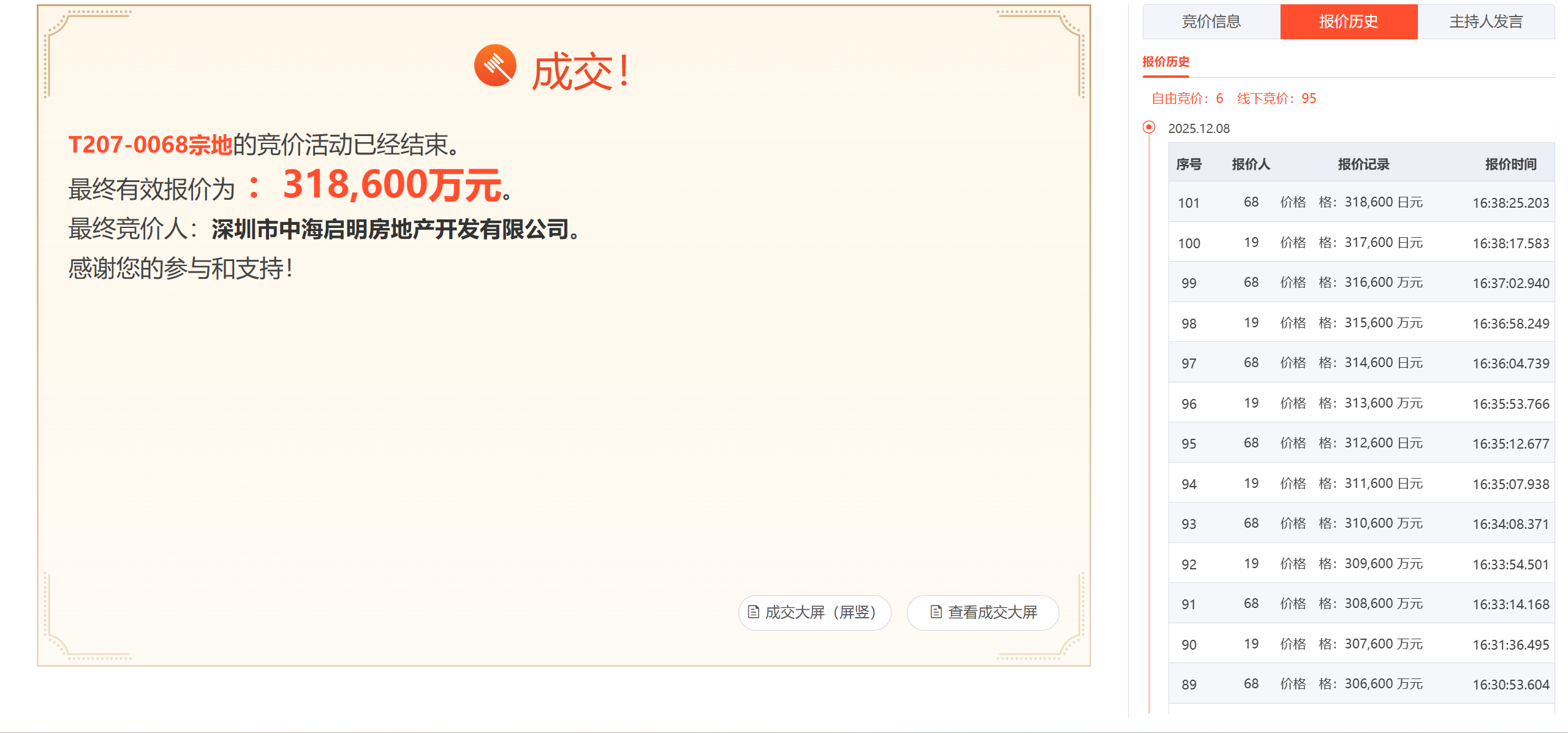
Core Viewpoint - The recent land auction in Shenzhen demonstrates intense competition for residential land, with significant price increases and high premium rates, indicating strong confidence from leading real estate companies in core urban assets despite market adjustments [1][4]. Group 1: Land Auction Details - On December 8, two residential plots were successfully auctioned in Shenzhen, with a total revenue of 39.52 billion yuan, including a competitive bid of 31.86 billion yuan for the Shenzhen Bay Super Headquarters Base plot [1][2]. - The Shenzhen Bay Super Headquarters Base T207-0068 plot saw a total of 101 rounds of bidding, resulting in a floor price of approximately 77,360 yuan/m² and a premium rate of 42.49%, setting a new high for premium rates in the area [1][3]. - The total area of the T207-0068 plot is about 11,833.61 m², with a total construction area of approximately 41,184 m², including residential and commercial spaces [2]. Group 2: Market Trends and Company Strategies - China Overseas Land & Investment has acquired three residential plots in Shenzhen this year, totaling 8.62 billion yuan, with an average premium rate of 51.87%, reinforcing its leading position in the high-end market [4][6]. - The competitive bidding for the Shenzhen Bay plot reflects the resilience of the luxury housing market, as top-tier assets continue to attract strong interest from major developers [4][8]. - The overall land supply in Shenzhen has been optimized, with 11 residential plots successfully auctioned this year, generating over 28 billion yuan in total revenue [6][8].

KEC and Archipelago to establish Madinah-based hotel management company
Yahoo Finance· 2025-12-08 11:21
Core Insights - Knowledge Economic City (KEC) has formed a strategic joint venture with Archipelago International to create a hospitality management company in Madinah, Saudi Arabia, with both parties holding equal shares [1][2] - The new company will focus on developing a Saudi hotel brand and managing the construction of a hotel with approximately 2,500 keys, marking a significant development in the Saudi hospitality sector [1][2] Company Overview - Archipelago International is the largest privately owned hotel management group in Southeast Asia, managing over 45,000 rooms across more than 200 hotels in various regions including Southeast Asia, Latin America, the Middle East, the Caribbean, and Oceania [4] - KEC is regulated by the Economic Cities and Special Zones Authority and aims to drive urban and economic changes in Madinah through strategic partnerships [4] Industry Impact - The partnership aims to enhance the hospitality industry in Saudi Arabia, contributing to the diversification of the sector and increasing employment opportunities for national talent [3] - Future plans include franchise and management models to support broader growth across the kingdom [3]