
电子商务服务业

Search documents
今年1至10月全国新设立外资企业数同比增长14.7%
Yang Shi Xin Wen· 2025-11-22 01:30
Group 1 - The number of newly established foreign-invested enterprises in China from January to October this year reached 53,782, representing a year-on-year increase of 14.7% [1] - The actual use of foreign capital in China during the first ten months amounted to 621.93 billion RMB, with the manufacturing sector receiving 161.91 billion RMB and the service sector receiving 445.82 billion RMB [1] Group 2 - The high-tech industry attracted 192.52 billion RMB in foreign investment, with significant growth in e-commerce services (173.1%), medical instruments and equipment manufacturing (41.4%), and aerospace equipment manufacturing (40.6%) [3] Group 3 - Foreign investments from the UAE, UK, and Switzerland increased by 48.7%, 17.1%, and 13.2% respectively [5]

2025年1—10月全国吸收外资6219.3亿元人民币
Yang Shi Xin Wen· 2025-11-21 17:32
Core Insights - In the first ten months of 2025, the number of newly established foreign-invested enterprises in China reached 53,782, marking a year-on-year increase of 14.7% [1] - However, the actual utilized foreign capital amounted to 621.93 billion RMB, reflecting a year-on-year decrease of 10.3% [1] Industry Analysis - The manufacturing sector attracted 161.91 billion RMB in actual foreign investment, while the service sector received 445.82 billion RMB [1] - High-tech industries saw actual foreign investment of 192.52 billion RMB, with significant growth in specific areas: e-commerce services increased by 173.1%, medical instruments and equipment manufacturing by 41.4%, and aerospace equipment manufacturing by 40.6% [1] Source Country Insights - Investment from the UAE, UK, and Switzerland into China grew by 48.7%, 17.1%, and 13.2% respectively [1]
前10月全国新设外商投资企业增长14.7%
Zheng Quan Shi Bao· 2025-11-21 16:36
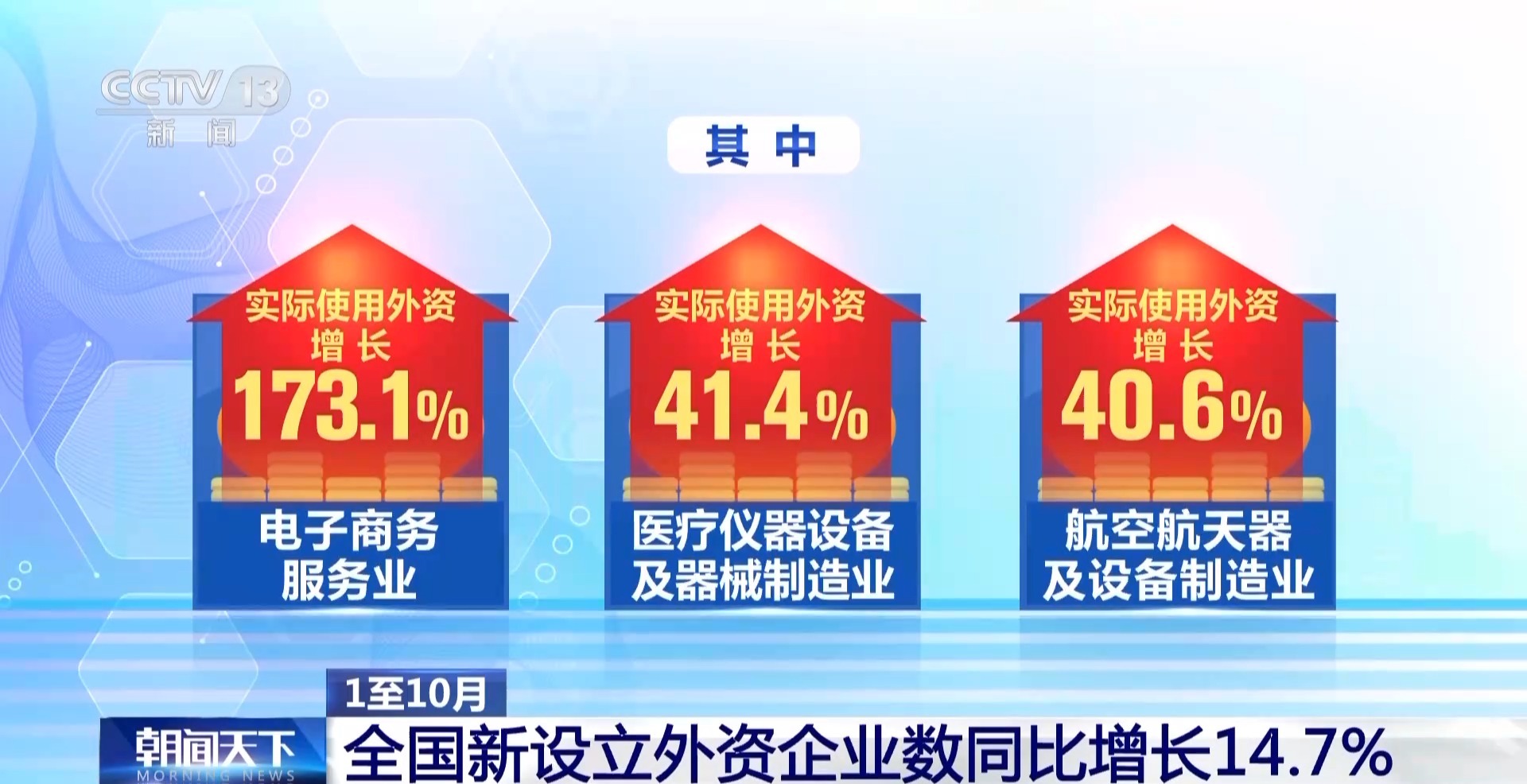
(文章来源:证券时报) 商务部指出,从行业看,前10个月制造业实际使用外资1619.1亿元人民币,服务业实际使用外资4458.2 亿元人民币。高技术产业实际使用外资1925.2亿元人民币,其中,电子商务服务业、医疗仪器设备及器 械制造业、航空航天器及设备制造业实际使用外资分别增长173.1%、41.4%、40.6%。 来源地方面,今年阿联酋、英国、瑞士等实际对华投资分别增长48.7%、17.1%、13.2%(含通过自由港 投资数据)。 11月21日,商务部数据显示,今年前10个月,全国新设立外商投资企业53782家,同比增长14.7%;实 际使用外资金额6219.3亿元人民币,同比下降10.3%。 ...
前10月全国新设 外商投资企业增长14.7%
Zheng Quan Shi Bao· 2025-11-21 16:29
来源地方面,今年阿联酋、英国、瑞士等实际对华投资分别增长48.7%、17.1%、13.2%(含通过自由港 投资数据)。(秦燕玲) 商务部指出,从行业看,前10个月制造业实际使用外资1619.1亿元人民币,服务业实际使用外资4458.2 亿元人民币。高技术产业实际使用外资1925.2亿元人民币,其中,电子商务服务业、医疗仪器设备及器 械制造业、航空航天器及设备制造业实际使用外资分别增长173.1%、41.4%、40.6%。 11月21日,商务部数据显示,今年前10个月,全国新设立外商投资企业53782家,同比增长14.7%;实 际使用外资金额6219.3亿元人民币,同比下降10.3%。 ...
全国新设立外商投资企业前10个月同比增长14.7%
Zheng Quan Ri Bao· 2025-11-21 16:24
Group 1 - The number of newly established foreign-invested enterprises in China reached 53,782 from January to October 2025, representing a year-on-year increase of 14.7%, indicating strong market attraction for foreign investment [1] - The actual foreign capital utilized amounted to 621.93 billion RMB, showing a year-on-year decrease of 10.3% [1] - In the manufacturing sector, actual foreign capital utilization was 161.91 billion RMB, while the service sector saw 445.82 billion RMB, and high-tech industries attracted 192.52 billion RMB, with significant growth in e-commerce services, medical equipment manufacturing, and aerospace manufacturing [1] Group 2 - Recent policies aimed at attracting foreign investment have intensified, including the "2025 Action Plan for Stabilizing Foreign Investment" and measures to encourage reinvestment by foreign enterprises [2] - Recommendations for enhancing foreign investment include improving the foreign investment policy system, optimizing the business environment, and promoting the "Invest in China" brand through various overseas investment promotion activities [2] - The establishment of free trade pilot zones is suggested to enhance strategic openness and attract more foreign capital by implementing more pilot policies [2]
财政部:1-10月全国吸收外资6219.3亿元人民币
Xin Hua Cai Jing· 2025-11-21 11:33
Core Insights - The Ministry of Finance reported that from January to October 2025, there were 53,782 newly established foreign-invested enterprises in China, representing a year-on-year increase of 14.7%. However, the actual utilized foreign capital amounted to 621.93 billion RMB, showing a decline of 10.3% compared to the previous year [1]. Industry Analysis - In terms of industry, the actual utilized foreign capital in the manufacturing sector was 161.91 billion RMB, while the service sector attracted 445.82 billion RMB [1]. - High-tech industries saw an actual utilization of foreign capital totaling 192.52 billion RMB, with significant growth in specific areas: e-commerce services increased by 173.1%, medical instruments and equipment manufacturing by 41.4%, and aerospace equipment manufacturing by 40.6% [1]. Source Country Insights - Foreign investments from the UAE, UK, and Switzerland increased by 48.7%, 17.1%, and 13.2% respectively, including data from free port investments [1].
商务部:2025年1—10月全国吸收外资6219.3亿元人民币
Zheng Quan Shi Bao Wang· 2025-11-21 10:18
Core Insights - The number of newly established foreign-invested enterprises in China reached 53,782 from January to October 2025, representing a year-on-year increase of 14.7% [1] - The actual utilized foreign capital amounted to 621.93 billion RMB, showing a year-on-year decrease of 10.3% [1] Industry Analysis - In the manufacturing sector, the actual utilized foreign capital was 161.91 billion RMB, while the service sector saw 445.82 billion RMB in actual utilized foreign capital [1] - High-tech industries attracted 192.52 billion RMB in actual utilized foreign capital, with significant growth in e-commerce services (173.1%), medical instruments and equipment manufacturing (41.4%), and aerospace equipment manufacturing (40.6%) [1] Source Country Insights - Investments from the UAE, UK, and Switzerland increased by 48.7%, 17.1%, and 13.2% respectively, including data from free port investments [1]
商务部:今年1-10月全国吸收外资6219.3亿元人民币
Xin Lang Cai Jing· 2025-11-21 10:17
Group 1 - In the first ten months of 2025, a total of 53,782 new foreign-invested enterprises were established in China, representing a year-on-year increase of 14.7% [1] - The actual utilized foreign capital amounted to 621.93 billion RMB, showing a year-on-year decrease of 10.3% [1] - In terms of industry, the manufacturing sector attracted 161.91 billion RMB in foreign investment, while the service sector received 445.82 billion RMB [1] Group 2 - High-tech industries saw actual foreign investment of 192.52 billion RMB, with significant growth in e-commerce services (173.1%), medical instruments and equipment manufacturing (41.4%), and aerospace manufacturing (40.6%) [1] - From the perspective of investment sources, foreign investments from the UAE, the UK, and Switzerland increased by 48.7%, 17.1%, and 13.2% respectively [1]
2025年1-10月全国吸收外资6219.3亿元人民币
Yang Shi Wang· 2025-11-21 10:13
Group 1 - The number of newly established foreign-invested enterprises in China from January to October 2025 reached 53,782, representing a year-on-year increase of 14.7% [1] - The actual utilized foreign capital amounted to 621.93 billion RMB, showing a year-on-year decrease of 10.3% [1] - In terms of industry, the actual utilized foreign capital in the manufacturing sector was 161.91 billion RMB, while the service sector saw 445.82 billion RMB [1] Group 2 - High-tech industries attracted 192.52 billion RMB in actual utilized foreign capital, with significant growth in e-commerce services (173.1%), medical instruments and equipment manufacturing (41.4%), and aerospace manufacturing (40.6%) [1] - From the perspective of investment sources, foreign investments from the UAE, UK, and Switzerland increased by 48.7%, 17.1%, and 13.2% respectively [1]
前三季度新设立外商投资企业同比增16.2%
Ren Min Ri Bao· 2025-11-02 22:21
Group 1 - The number of newly established foreign-invested enterprises in China reached 48,921 in the first three quarters, representing a year-on-year increase of 16.2% [1] - The actual utilized foreign capital amounted to 573.75 billion yuan, showing a year-on-year decrease of 10.4% [1] - In September alone, the actual utilized foreign capital increased by 11.2% year-on-year [1] Group 2 - In terms of industry, the manufacturing sector attracted 150.09 billion yuan in foreign investment, while the service sector attracted 410.93 billion yuan [1] - High-tech industries received 170.84 billion yuan in foreign investment, with significant growth in e-commerce services (155.2%), aerospace equipment manufacturing (38.7%), and medical instruments manufacturing (17%) [1] Group 3 - From the perspective of investment sources, foreign investments from Japan, UAE, the UK, and Switzerland increased by 55.5%, 48.7%, 21.1%, and 19.7% respectively [1]