Pharmaceuticals

Search documents
Bayer Wins EC Approval to Expand Kerendia in Heart Failure Treatment
ZACKS· 2026-03-31 18:46
Core Insights - Bayer has received approval from the European Commission for the label expansion of Kerendia (finerenone) to treat adults with heart failure with left ventricular ejection fraction (LVEF) ≥40% [1][8] Group 1: Drug Approval and Efficacy - The approval is based on the phase III FINEARTS-HF study, which showed that finerenone significantly reduced cardiovascular death and heart failure events compared to placebo [3][8] - Heart failure affects over 64 million people globally, with at least 15 million in Europe, and approximately half of these patients have LVEF ≥40% [4] Group 2: Market Presence and Sales Performance - Finerenone is already marketed as Kerendia in over 100 countries, including major markets like China, Europe, Japan, and the United States, primarily for chronic kidney disease associated with type II diabetes [2] - Kerendia generated sales of €829 million in 2025, reflecting a 79% increase from 2024, contributing to the growth of Bayer's pharmaceutical unit [6][8] Group 3: Ongoing Research Programs - The FINEARTS-HF study is part of the larger MOONRAKER program, which is one of the largest phase III initiatives in heart failure, enrolling over 15,000 patients [5] - The THUNDERBALL program focuses on chronic kidney disease and includes several completed and ongoing studies aimed at expanding the use of finerenone [6] Group 4: Company Performance and Strategy - Bayer's stock has surged 84.4% over the past year, significantly outperforming the industry average gain of 8.6% [7] - The company is focusing on expanding its portfolio with new products like prostate cancer drugs Nubeqa and Kerendia, which are performing well despite declines in other areas [9]

Lilly and Novo Show How AI Is Rewiring Big Pharma
PYMNTS.com· 2026-03-31 18:45
Core Insights - Eli Lilly and Novo Nordisk are leveraging artificial intelligence (AI) to transform drug development processes, significantly impacting the speed at which new medicines are delivered to patients [1][4]. Eli Lilly - Eli Lilly has entered a $2.75 billion partnership with Insilico Medicine, gaining exclusive rights to develop drugs using Insilico's Pharma.ai platform, which has already produced 28 drug candidates, with nearly half in clinical testing [3][7]. - The company has implemented AI technologies in its manufacturing processes, including digital twin technology and computer vision, to enhance production efficiency and quality control [5]. - Eli Lilly's revenue from GLP-1 drugs has seen substantial growth, with Mounjaro sales doubling to $23 billion and Zepbound revenue increasing from $4.9 billion to $13.5 billion, contributing to over half of the company's total revenue of $65 billion [6]. Novo Nordisk - Novo Nordisk has generated nearly $100 billion in cumulative sales from its drugs Ozempic and Wegovy, focusing on reducing clinical trial durations through AI agents trained on internal and competitor data [12]. - The AI agents are actively used in clinical trials to identify protocol gaps and manage data, which has reduced reliance on external contractors for analytical tasks [13]. - Novo Nordisk has partnered with Nvidia to utilize the Gefion sovereign AI supercomputer for large-scale drug discovery, emphasizing the financial impact of reducing time-to-market for new drugs [14]. - The company has been selective in rolling out AI tools, learning from experiences where costs outweighed benefits, indicating a strategic approach to AI implementation [15]. Industry Implications - The integration of AI across various stages of drug development, from discovery to manufacturing and clinical execution, is creating a competitive advantage that traditional productivity enhancements cannot achieve [16].


SLNO Stockholders Have Rights – If You Lost Money Investing in Soleno Therapeutics, Inc. Contact Robbins LLP for Information About Recovering Your Losses
Globenewswire· 2026-03-31 18:43
Core Viewpoint - A class action lawsuit has been filed against Soleno Therapeutics for allegedly misleading investors regarding the safety and efficacy of its drug DCCR during its Phase 3 clinical trial [1][2]. Group 1: Company Overview - Soleno Therapeutics is a pharmaceutical company focused on developing therapies for rare diseases, with its only commercial product being diazoxide choline extended-release tablets (DCCR) for treating hyperphagia in individuals with Prader-Willi syndrome (PWS) [1]. Group 2: Allegations and Legal Proceedings - The class action covers investors who purchased Soleno stock between March 26, 2025, and November 4, 2025, alleging that the company failed to disclose significant safety concerns related to DCCR, including issues of excess fluid retention [2]. - The complaint states that the administration of DCCR posed materially greater safety risks than disclosed, leading to lower commercial viability and undisclosed risks of adverse events post-launch [2]. - On August 15, 2025, Scorpion Capital released a report detailing issues with Soleno's clinical trial conduct, which led to a nearly 12% decline in stock price over two trading days [3]. - Following a report of a patient death related to DCCR on September 10, 2025, Soleno's stock price fell nearly 19% over two trading days [4]. - On November 4, 2025, Soleno reported financial results indicating a disruption in DCCR's launch trajectory due to the Scorpion Capital report, resulting in a 27% decline in stock price from approximately $64 to $47 per share [5]. Group 3: Shareholder Actions - Shareholders may be eligible to participate in the class action and must submit their papers to the court by May 5, 2026, to serve as lead plaintiff [6].


Idorsia Ltd (IDRSF) Discusses Positive Phase II Results for Daridorexant in Pediatric Insomnia and Neurodevelopmental Disorders Transcript
Seeking Alpha· 2026-03-31 18:32
Core Viewpoint - The conference call discusses the positive results of the Phase II study of daridorexant for children with insomnia disorder, indicating potential advancements in pediatric insomnia treatment [2]. Group 1: Company Overview - Idorsia Pharmaceuticals is presenting the results of its daridorexant program, specifically focusing on its application for pediatric insomnia [2]. - Key personnel involved in the presentation include Jean-Paul Clozel, Chairman and Interim CEO, Martine Clozel, Chief Scientific Officer, and Alberto Gimona, Head of Global Clinical Development [2]. Group 2: Study Results - The Phase II study results for daridorexant in children with insomnia disorder were announced positively, suggesting effective treatment options for this demographic [2]. - The drug is currently investigational and has not yet received approval or marketing authorization in any country [3].

Johnson & Johnson: Is The Stock Still Undervalued After The Rally? A Quantitative Approach
Seeking Alpha· 2026-03-31 18:11
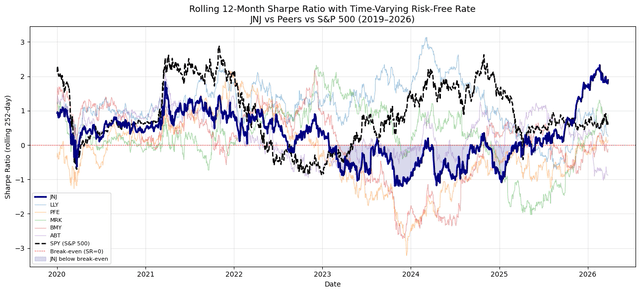
Investment Thesis - Johnson & Johnson (NYSE: JNJ) is valued with a Hold judgment, recognized for being one of the largest and most diversified players in the pharmaceutical industry, and has a long history of dividend increases spanning 62 years [1] Valuation Analysis - A quantitative evaluation using a Monte Carlo DCF model indicates that the stock is overvalued in slightly more than 1 out of 2 possible future scenarios [2] Performance Comparison - In terms of risk-adjusted performance, Johnson & Johnson ranks second among its peers, with only Eli Lilly (LLY) performing better. A structural break was identified in the Fama-French regression analysis after mid-2024, and the rolling Jensen's alpha has shown recovery following litigation events [3] Dividend Performance - Johnson & Johnson has a payout ratio of 64%, one of the lowest in its peer group, indicating potential for dividend increases in the coming year. However, the current dividend return is insufficient to compensate for the risk taken by investors, highlighting the need for capital increases to address the 1.13% gap between equity return and cost of equity [4] Company Overview - Johnson & Johnson is one of the largest and most recognized companies in the pharmaceutical industry, with a diverse range of specializations including pharmaceuticals [5]

Are Pharmaceuticals Poised for a Rebound? The Key Metric to Keep in Mind
Etftrends· 2026-03-31 17:41
Core Viewpoint - The pharmaceutical sector is experiencing increased merger and acquisition activity, alongside strong product pipelines, which may present renewed investment opportunities, particularly for those focusing on free cash flow metrics [1]. Group 1: Pharmaceutical Industry Outlook - The pharmaceutical industry is seeing a ramp-up in M&A activity and has robust pipelines with significant product launches anticipated [1]. - Factors such as interest rate cuts and potential deregulation may improve sentiment towards pharmaceutical companies [4]. - Merck & Co Inc. (MRK) is highlighted as a top holding in the VictoryShares Free Cash Flow ETF (VFLO), indicating its potential for upside [2]. Group 2: Free Cash Flow (FCF) Importance - Free cash flow is a critical metric for assessing a company's financial strength, revealing cash remaining after operating expenses [3]. - As of the end of 2025, MRK demonstrated strong FCF generation, contributing to its status as the largest holding in VFLO [4]. - The Victory U.S. Large Cap Free Cash Flow Index screens companies based on expected FCF, focusing on both trailing and forward-looking measures [5]. Group 3: Merck's Performance - Merck's Q4 results exceeded estimates, with the CEO expressing a positive outlook for 2026, driven by demand for innovative products like KEYTRUDA and contributions from new launches [2][3]. - The company's performance in various segments, including cardiometabolic, respiratory, and vaccines, has bolstered its financial results [3].


ANI Pharmaceuticals 2026 Watchlist: Gout Sales Force and Rare Disease
ZACKS· 2026-03-31 17:20
Core Insights - ANI Pharmaceuticals (ANIP) is focusing on rare diseases, expecting this segment to contribute approximately 60% of 2026 sales, primarily driven by Cortrophin Gel [2][10] - The company aims to re-accelerate its retina franchise after a challenging 2025, with a target for Iluvien sales between $78 million and $83 million in 2026 [9][11] Rare Disease Focus - The management anticipates that the rare disease segment will be the main growth driver, with Cortrophin Gel at the center of this strategy [2][10] - The growth potential is supported by under-penetration in addressable markets and expanding applications in rheumatology, nephrology, and pulmonology [3][6] Gout Sales Force Initiative - A significant catalyst for 2026 is the establishment of a 90-person sales force dedicated to acute gouty arthritis, targeting a large and relatively untapped patient population [4][10] - Initial revenue from Cortrophin in Q1 2026 is expected to be around 13% to 14% of total 2026 sales, with anticipated acceleration as the new sales team is deployed [5][10] Retina Franchise Recovery - The retina franchise is set for a rebound after a "reset year" in 2025, with a unified Iluvien brand aimed at broader promotion across diabetic macular edema and chronic non-infectious uveitis [9][11] - Competitive pressures exist in the retina market, with major players like AbbVie and Regeneron Pharmaceuticals posing challenges [12][15] Generics Segment Stability - Although generics are not the primary growth engine, they continue to provide stability, generating $384 million in revenue in 2025 [13] - The generics segment supports a steady cadence of 10 to 15 product launches annually, which can help fund specialty initiatives [14] Competitive Landscape - The competitive environment is intensifying, particularly in the rare disease and retina markets, with significant players impacting ANIP's market position [15] - Customer concentration poses a structural risk, as three wholesale customers accounted for 53% of total net revenues in 2025 [16]


Is ANIP Undervalued? How to Read Its 9.3x Forward P/E
ZACKS· 2026-03-31 17:20
Core Viewpoint - ANI Pharmaceuticals (ANIP) has transitioned into a specialty-led growth narrative, with Cortrophin Gel as the primary growth driver and the retina franchise poised for recovery [1] Stock Performance and Valuation Context - ANIP shares have decreased by 6.6% year to date but have increased by 8.4% over the past 12 months, while the Zacks sub-industry has risen by 0.8% and the sector has declined by 7% during the same period [2] - The S&P 500 has decreased by 7.7% year to date but has increased by 15.9% over the past year, indicating that ANIP has underperformed compared to stronger peers while faring better than the broader sector [4] - ANIP is trading at a forward P/E of 9.34x, significantly lower than the Zacks sub-industry at 34.66x, the sector at 19.21x, and the S&P 500 at 19.86x [5][6] Competitive Landscape - The discount in ANIP's valuation is attributed to concerns regarding execution, competition, and reimbursement pressures in ophthalmology, particularly from competitors like AbbVie and Regeneron [6][9] Historical Valuation Analysis - Over the past five years, ANIP's forward earnings multiple has ranged from 7.40x to 61.11x, with a median of 15.69x, indicating that the current valuation of 9.34x is closer to the lower end of this range [10] - The market skepticism surrounding ANIP's valuation is likely linked to execution risks rather than demand for specialty medicines [11] Additional Valuation Metrics - ANIP's forward price-to-sales ratio is 1.51x, with a five-year range from 1.24x to 3.73x and a median of 1.94x, suggesting that the stock is undervalued based on sales metrics [12][14] - The price-to-book ratio stands at 3.07x, with a five-year range from 1.24x to 4.92x, indicating that the market is cautious about revenue until execution improves [17] Future Growth Drivers - The price target for ANIP is set at $77.00, reflecting a forward P/E of 9.76x, contingent on the company's ability to defend and grow earnings as it shifts towards specialty [15] - Key watch items include Cortrophin's revenue trajectory, with guidance of $540 million to $575 million for 2026, and expected improvements in Iluvien sales for the retina franchise [16][18] Financial Position - ANIP ended 2025 with approximately $286 million in cash, $17 million in short-term debt, and $600 million in long-term debt, which influences how investors perceive valuation discounts [19] - The liquidity position reduces refinancing pressure while emphasizing the need for consistent operational performance to support growth initiatives [20]

ANIP Stock Outlook: Cortrophin Growth vs. Retina Reset
ZACKS· 2026-03-31 17:20
Core Insights - ANI Pharmaceuticals is shifting its growth profile towards specialty therapies, particularly in the Rare Disease segment, with significant contributions from Purified Cortrophin Gel, while the Generics business continues to provide stable cash flow [1][3]. Revenue Performance - Fiscal 2025 total revenue reached $883.4 million, marking a 43.8% increase year over year. The Rare Disease and Brands segment contributed $484.0 million (54.8% of total revenue), while Generics and Other contributed $399.4 million (45.2%) [4][8]. - The majority of revenue, $852.4 million, was generated in the U.S., with $30.9 million coming from international operations [4]. Specialty Growth Drivers - Cortrophin Gel was the main revenue driver, generating $347.8 million in 2025, reflecting a growth rate of approximately 76% year over year. This product is central to the company's specialty strategy [5][8]. - The prefilled syringe formulation has improved usability and gained traction, leading to a majority of new patient starts. A dedicated sales force of around 90 personnel is being established to target acute gouty arthritis flares [6]. Ophthalmology Segment Challenges - The ophthalmology franchise faced headwinds in 2025, generating $74.9 million in revenue from Iluvien/Yutiq, impacted by reimbursement issues and inventory dynamics. Management described 2025 as a "reset year" for this segment [7][8]. - A unified Iluvien brand is being promoted to streamline marketing efforts across related conditions, with expectations for recovery in 2026 [9]. Future Guidance - For fiscal 2026, management has reaffirmed guidance for total net revenue between $1.06 billion and $1.10 billion, with Cortrophin revenue projected at $540 million to $575 million. Adjusted non-GAAP EBITDA is expected to be between $275 million and $290 million [10]. - Cortrophin revenue in the first quarter of 2026 is anticipated to be about 13%-14% of full-year sales, slightly below the previous year's contribution, with expectations for sequential growth as the year progresses [11]. Competitive Landscape - Competitive intensity poses a risk to ANI's specialty portfolio, particularly for Cortrophin Gel, which competes with Acthar Gel from Keenova Therapeutics. In ophthalmology, Iluvien faces competition from AbbVie and Regeneron Pharmaceuticals [12]. - Customer concentration is another risk factor, with three wholesale customers accounting for 53% of total net revenue in 2025, which could lead to pricing and working-capital volatility [13].

TEVA's Prolia Biosimilar Gets FDA Nod, Xolair Filing Accepted
ZACKS· 2026-03-31 17:16
Core Insights - Teva Pharmaceutical Industries Ltd. has received FDA approval for its biosimilar Ponlimsi, which is a competitor to Amgen's Prolia, aimed at treating various bone conditions [1][8] - The approval is based on evidence demonstrating that Ponlimsi has similar efficacy, safety, and immune response as Prolia [1] - Teva anticipates that the approval will significantly enhance its biosimilar portfolio [3] Product Details - Ponlimsi is approved for all indications of Prolia, including treatment for osteoporosis in high-risk men and postmenopausal women, glucocorticoid-induced osteoporosis, and improving bone mass in certain cancer patients [2] - The biosimilar versions of Prolia and Xgeva were previously approved in the European Union in November 2025, with Prolia generating sales of $4.4 billion in the same year, accounting for 13% of Amgen's total product sales [3][11] Financial Outlook - Teva aims to grow its biosimilars business by $400 million by 2027, with expectations for improvement in its generics business as well [8][13] - The company's global generics business was flat in 2025 compared to 2024, but it is projected to rise in a low single-digit range in 2026 [12][13] Market Performance - Year-to-date, Teva's shares have decreased by 9.2%, while the industry has seen a decline of 8.7% [5]