Servers

Search documents
[热闻寻踪] 液冷服务器概念上涨 争抢162亿美元蛋糕 谁才是液冷真龙头?
Quan Jing Wang· 2025-12-21 04:22
Core Insights - The rise in AI chip power consumption has made high-efficiency liquid cooling an essential part of the computing power industry, with liquid cooling solutions offering a heat transfer coefficient 20 times greater than air cooling, stabilizing chip temperatures below 65°C, which is critical for GPU performance and data center expansion [1] - IDC forecasts that from 2024 to 2029, the liquid cooling server market in China will grow at a compound annual growth rate (CAGR) of 46.8%, reaching a market size of $16.2 billion by 2029 [1] - Recent trends show a significant increase in A-share liquid cooling server-related stocks, with heightened investor inquiries about company operations [1] Company Responses - **川环科技** focuses on expanding applications for liquid cooling pipeline products, particularly in automotive fluid pipelines, data server liquid cooling, and energy storage liquid cooling, while maintaining confidentiality regarding specific collaborations with clients [2] - **硕贝德** confirms that its cooling products and modules can be applied in liquid cooling servers [4] - **川润股份** highlights its competitive advantages in high-end equipment manufacturing and energy management, emphasizing its capabilities in providing stable and reliable liquid cooling systems [6] - **飞龙股份** reports that its revenue from liquid cooling components was approximately 4.115 million, accounting for less than 2% of total revenue, but anticipates increased sales in the second half of the year based on current orders [8] - **首都在线** is actively preparing high-power and liquid cooling systems for data center operations, aiming to optimize server cooling efficiency and reduce energy consumption [10] - **飞荣达** has not yet supplied directly to clients like NVIDIA but has made significant progress in developing various cooling products, including liquid cooling modules [11] - **澄天伟业** emphasizes its self-developed high-performance manufacturing processes for liquid cooling products, which are crucial for meeting the demands of high-power computing devices [13] - **银轮股份** is committed to high investment in digital energy thermal management and anticipates accelerated order acquisition [15] - **科创新源** collaborates with Honeywell and is involved in the development of liquid cooling solutions for high-performance computing scenarios [17] - **捷邦科技** is progressing with its liquid cooling business as planned, while also focusing on market value management [18] - **思泉新材** has developed a range of cooling products and is actively working on customer product introductions in the liquid cooling sector [20] - **冰轮环境** has introduced new technologies to adapt to the latest high-efficiency servers, including low-carbon energy-saving technologies [22] - **科华数据** is expanding its partnerships with leading internet companies to meet the growing demand for intelligent computing centers [24] - **鼎通科技** produces various connectors and cooling solutions for servers and data centers [26]


中信证券:看好超节点服务器整机环节 建议关注产业链相关公司
智通财经网· 2025-12-19 00:55
Core Insights - The report from CITIC Securities indicates that the supernode solution is expected to scale rapidly, serving as a fundamental computing unit for future AI infrastructure, with advantages such as efficient communication bandwidth and native memory semantics [1][2] Group 1: Supernode Development - The MoE (Mixture of Experts) architecture imposes new hardware requirements, leading to the emergence of scale-up supernodes [2] - Supernodes face complex systemic challenges compared to traditional eight-card servers, including heat dissipation, stability issues from mixed optical and copper interconnects, and long-term reliability concerns [2][3] - The current phase of supernode solutions is characterized by a variety of competing technologies, with domestic solutions like Huawei's CloudMatrix384 and Alibaba's Panjiu emerging [3] Group 2: Technical Challenges and Solutions - As computing density increases, liquid cooling solutions with a PUE closer to 1, such as phase change immersion cooling, may see greater development opportunities if stability issues can be resolved [4] - The complexity of supernode servers has significantly increased, requiring deep consideration of chip integration, heat dissipation, and interconnects, transforming server manufacturers into core system integrators [5] Group 3: Investment Strategy - The supernode technology is in its early stages, with the MoE architecture likely to become mainstream, presenting new adaptive requirements for hardware development [7] - The report suggests that companies with customization capabilities and supply chain management skills in the server manufacturing sector are likely to see significant growth opportunities [7]

A股开盘速递 | 指数红盘震荡!液冷服务器概念走强 贵金属板块反复活跃
智通财经网· 2025-12-17 01:55
Core Viewpoint - The market is experiencing fluctuations as the year-end approaches, with a focus on policy dividends and economic trends for the upcoming year [3]. Group 1: Market Performance - As of December 17, the Shanghai Composite Index rose by 0.06%, the Shenzhen Component Index increased by 0.62%, and the ChiNext Index gained 0.92% [1]. - The liquid cooling server concept continues to show strength, with stocks like Feilong Co. and Yingweike hitting the daily limit, while Yidong Electronics leads the gains [1][2]. - Lithium mining stocks are also on the rise, with Jinyuan Co. reaching the daily limit and other companies like Guocheng Mining and Dazhong Mining following suit [1]. Group 2: Sector Insights - The liquid cooling server sector is gaining traction, driven by the upcoming International AIDC Liquid Cooling Supply Chain Conference, highlighting the shift from air cooling to liquid cooling among major AI companies [2]. - Investment strategies are shifting towards low-value sectors, with a focus on non-bank financials, electric equipment, and AI applications [2]. Group 3: Future Outlook - Galaxy Securities anticipates that the market's fluctuating structure will continue, with a focus on policy dividends and economic trends for the next year [3]. - Key investment themes include the acceleration of global changes, the shift towards new productive forces, and the recovery of manufacturing and resource sectors [3]. - According to招商证券, investment opportunities will revolve around domestic demand recovery and technological self-reliance, with a balanced focus on cyclical stocks [4].


全球光模块:总体潜在市场解析;AI 服务器基础设施扩张推动 800G1.6T 需求增长Global Optical transceivers_ TAM introduced; rising 800G _ 1.6T driven by growing AI servers infrastructure
2025-12-15 01:55
Summary of Global Optical Transceivers Conference Call Industry Overview - The global optical transceiver market is projected to grow significantly, driven by the increasing demand for AI server infrastructure and the transition from copper to fiber optics [1][2] - The market is expected to reach US$24 billion in 2025, US$30 billion in 2026, and US$37 billion in 2027, with the 800G+ segment growing at an impressive 87% CAGR [2] Key Insights - **Adoption Trends**: - 1.6T optical transceivers are expected to ramp up adoption in 2026-2027, while 3.2T will start adoption in 2027 [1] - The penetration of silicon photonics (SiPh) solutions is anticipated to increase, reaching 60% for 800G, 80% for 1.6T, and 100% for 3.2T optical transceivers by 2028 [2] - **Market Demand**: - The demand for optical transceivers is expected to be driven by the AI server infrastructure cycle, with ASIC chips projected to account for 40% of total AI chips by 2025 and 45% by 2026 [1] - Shipment volumes for 800G and 1.6T are expected to grow from 36 million and 5 million units in 2026 to 56 million and 12 million units in 2027, respectively [2][17] - **Supply Chain Insights**: - Companies rated as "Buy" include optical transceiver module leaders Innolight and Eoptolink, CW laser manufacturers Landmark and VPEC, and data center switch provider Ruijie [3] Financial Projections - The global optical module total addressable market (TAM) is projected to grow from US$24.1 billion in 2025 to US$36.8 billion in 2027, with significant contributions from the 800G+ segment [2][8] - The average selling price (ASP) for optical transceivers is expected to decline year-over-year, with a notable drop for 800G and 1.6T products [14][15] Additional Considerations - The transition to high-speed connections is expected to accelerate the adoption of SiPh solutions due to their cost advantages over traditional EML modules [18] - The overall demand for optical transceivers is projected to reach 392 million units in 2025, increasing to 437 million units by 2028, with traditional applications declining from 89% to 66% of total shipments [16] - The market is witnessing a shift towards higher-speed products, with 800G becoming the mainstream specification for large-scale data centers [17] Conclusion - The optical transceiver market is poised for rapid growth, driven by advancements in AI infrastructure and the increasing adoption of high-speed optical solutions. Key players in the supply chain are well-positioned to benefit from these trends, making it a promising area for investment.
研判2025!中国刀片式服务器行业分类、市场规模及重点企业分析:规模扩张与国产化共塑关键窗口期,高端竞争蓄势待发[图]
Chan Ye Xin Xi Wang· 2025-12-15 01:42
Core Viewpoint - The Chinese blade server industry is experiencing a critical development phase driven by technological upgrades, deepening market applications, and supply chain localization, characterized by simultaneous expansion of market size and acceleration of domestic production processes [1] Industry Overview - Blade servers are a high-density server platform designed for specific application industries and high-density computing environments, allowing multiple "blade" modules to be inserted into a unified chassis, providing optimal space efficiency and energy efficiency for large data centers [4][6] - The evolution of the blade server industry in China has transitioned from early architectural exploration to market maturity, showcasing a trajectory from single functionality to multi-fusion [6] Market Size - The market size of the Chinese blade server industry is projected to reach approximately 15.07 billion yuan in 2024, reflecting a year-on-year growth of 2.8%, driven by strong demand from cloud computing and artificial intelligence [1][8] Key Enterprises - Unisplendour Corporation, through its subsidiary H3C, leads the blade server market, leveraging its unique position as the exclusive provider of HPE servers in China and its "plastic architecture" for resource pooling [10] - Inspur Information maintains a strong market share through continuous innovation in liquid cooling technology, while Huawei excels in AI computing scenarios with its self-developed Kunpeng chips [10] - Sugon focuses on high-performance computing and liquid cooling technology, establishing a competitive edge in the research and supercomputing sectors [10] Industry Development Trends 1. **Liquid Cooling Technology and AI Integration** - The industry is accelerating towards green and intelligent infrastructure, with liquid cooling technology expected to penetrate over 30% of the market by 2025, significantly improving energy efficiency [13] 2. **Market Concentration and Localization** - The competition is becoming increasingly oligopolistic, with domestic CPUs gaining traction in government and military sectors, while the supply chain is reducing reliance on imports [14] 3. **Edge Computing Expansion** - The blade server architecture is evolving towards a dual-mode of "centralized large clusters + distributed micro-clusters," adapting to the demands of edge computing driven by 5G and IoT applications [16]




2026年,AI服务器贵贵贵
3 6 Ke· 2025-12-11 11:51
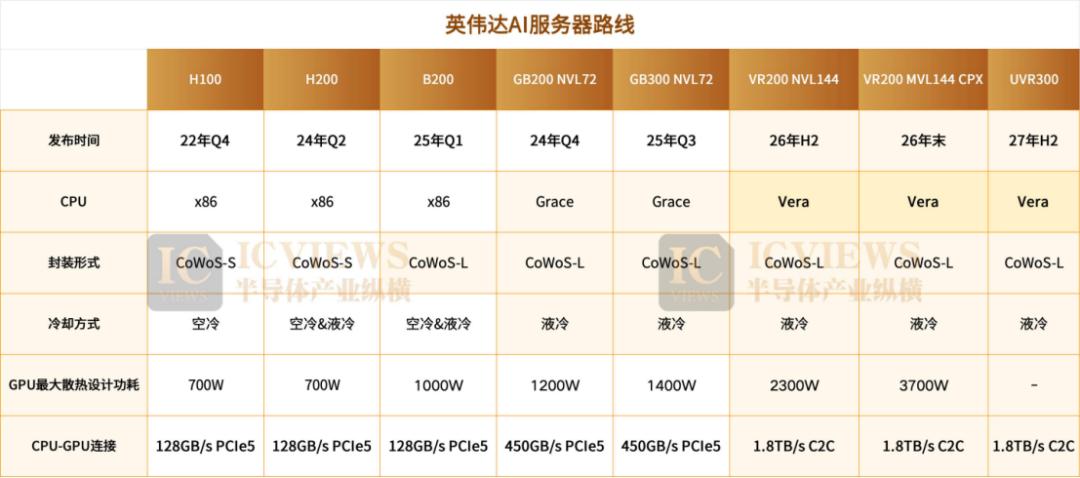
Core Insights - The AI server hardware is undergoing a significant design upgrade driven by GPUs and ASICs, with new platforms from NVIDIA and AMD expected to enhance computing power and cabinet density by 2026 [1][4] - The demand for AI servers is surging, with NVIDIA's platform projected to see cabinet demand more than double from approximately 28,000 units in 2025 to at least 60,000 units in 2026 [2] - The transition to advanced cooling and power solutions is essential as GPU power consumption increases, leading to a complex engineering system for future AI data centers [4][5] AI Server Demand - The demand for AI servers continues to rise, with NVIDIA's platform expected to see cabinet demand increase significantly [2] - AMD's Helios server rack project is also making progress, further intensifying the market demand for advanced AI hardware [2] NVIDIA AI Server Roadmap - NVIDIA's upcoming AI server platforms include the GB300 and Vera Rubin series, with increasing power consumption from 700W for H100 to 3700W for the upcoming VR200 platform [4][22] - The GB200 platform is currently the core driver of the AI server market [3] Supply Chain and Production - Major ODM manufacturers like Hon Hai, Quanta, Wistron, and Wiwynn are key suppliers for NVIDIA's AI server cabinets, with Hon Hai leading in production [10] - Hon Hai's AI server cabinet shipments increased by 300% quarter-over-quarter, with expectations to exceed NT$1 trillion in revenue by 2025 [10] Revenue and Market Share - In November, Quanta, Wistron, and Wiwynn reported record monthly revenues, with significant year-over-year growth [12] - By 2025, Hon Hai is expected to capture over 40% of the AI server market share, with GB200 and GB300 platforms dominating shipments [12] Industry Upgrades - The shift to NVIDIA's GB300 and Vera Rubin platforms represents a new cycle in AI hardware, prompting a reevaluation of supply chain components [13] - The power supply and cooling systems are undergoing significant changes to accommodate the increasing power demands of AI workloads [14][16] Power Supply Innovations - NVIDIA's Kyber power supply strategy aims to redefine data center power architecture, with projected values for Rubin Ultra cabinets expected to exceed ten times that of current GB200 cabinets by 2027 [16] - The transition to 800V DC power solutions is critical for meeting the demands of modern AI data centers [14][16] Cooling Solutions - NVIDIA's cooling technology is evolving from air cooling to liquid cooling solutions to manage the rising thermal demands of high-performance GPUs [17][22] - The value of cooling components for AI servers is expected to increase significantly, with projections indicating a 17% rise for the next generation of cooling modules [22] PCB Demand Surge - The upgrade of AI servers is driving a surge in demand for high-end PCBs, with manufacturers increasing production capacity for advanced multi-layer boards [23][24] - The market for high-end PCBs is expected to grow significantly, with prices for advanced boards potentially doubling due to increased complexity [23] CSP Capital Expenditure - Major cloud service providers (CSPs) are ramping up capital expenditures to support the growing demand for AI infrastructure, with projected increases in spending for 2025 and 2026 [26][29] - The total capital expenditure for the eight major CSPs is expected to exceed $600 billion in 2026, reflecting strong long-term growth potential in AI infrastructure [26][29]

This underdog stock may deliver Nvidia-level performance in 2026
Invezz· 2025-12-10 13:35
Supermicro stock (NASDAQ: SMCI) has been an underdog in the server market for a long time. But, with the recent boom in the artificial intelligence space, SMCI has shifted into the heart of the AI sup... ...


烽火通信旗下长江计算中标头部互联网企业通算服务器采购项目
Zheng Quan Shi Bao Wang· 2025-12-10 03:56
Core Viewpoint - The company, Yonghua Communication, has made significant progress in market expansion by winning a major procurement project for servers from a leading internet enterprise for Q1 2026 [1] Group 1 - Yonghua Communication's subsidiary, Changjiang Computing, has successfully secured an exclusive bid for the server procurement project [1]

“H200或放开”下投资思路
2025-12-10 01:57
Summary of Conference Call Notes Industry Overview - The conference call discusses the **domestic AI computing power industry** and the anticipated growth driven by the large-scale release of domestic chips, recovery in bidding, and the potential approval of the **H200 chip** [1][3][5]. Key Points and Arguments H200 Chip Approval - The approval of the H200 chip is expected to significantly benefit the **computing end** and **AIDC (AI Data Center)** sectors directly, while indirectly benefiting the **network end** and **domestic chip** sectors [1][5]. - If the H200 chip is approved for sale in China, it will greatly enhance the development of the domestic AI and computing power industry chain [3][7]. Market Demand and Growth - The demand for AIDC is projected to reach at least **6-7 GW** in the coming year, with a potential shortage of quality data center resources [5]. - The AIDC sector has seen a decline in stock prices since Q2 but is expected to recover due to increased demand for AIGC (AI Generated Content) in Q3 and Q4 [1][5]. Key Players and Beneficiaries - Major beneficiaries of the H200 chip approval include: - **Computing End**: Companies like **Inspur**, **Unisoc**, and **ZTE** are expected to benefit from increased demand for AI servers and power supplies [5][8]. - **AIDC Sector**: Companies such as **Huaneng New Network**, **Aofei Data**, and **David Technology** are highlighted as potential beneficiaries due to the anticipated recovery in demand [5]. - **Network Side**: Companies like **Ruijie Networks** and **ZTE** are noted for their significant market share and advancements in high-speed switching chips [6][10]. Technological Trends - The conference emphasizes the importance of **Scale-up technology** in driving demand for ultra-high-speed switching chips, particularly the **51.6T switching chip** [6][11]. - The shift towards **liquid cooling** technology is also highlighted, with companies like **Inveke** positioned to benefit from this trend [5][9]. Policy and Market Dynamics - The development of domestic chips is supported by strong government policies, which are expected to accelerate the growth of the domestic AI ecosystem [7]. - The approval of the H200 series is seen as a catalyst for upgrading domestic large models and narrowing the gap with international competitors [7]. Additional Important Insights - The conference notes that the **ITC sector** will benefit from the resolution of supply shortages in computing cards, leading to an acceleration in IDC bidding [9]. - The **light module and related components market** is expected to flourish as supply issues are resolved, with key players like **Hua Gong Technology** and **Xin Yi Sheng** poised to gain from increased domestic demand [12]. This summary encapsulates the critical insights from the conference call, focusing on the anticipated growth in the domestic AI computing power industry, the implications of the H200 chip approval, and the key players and technologies involved.

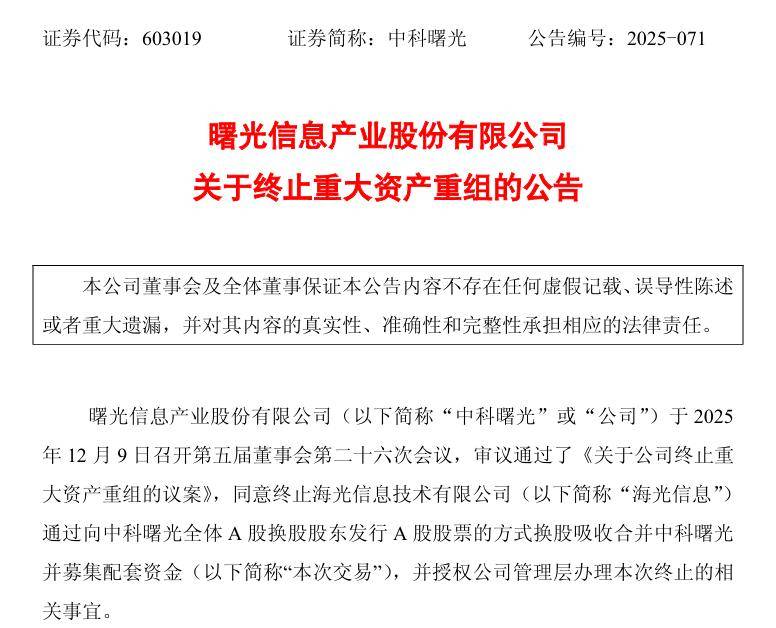
国产芯片+服务器+算力巨头计划告吹:海光信息终止合并中科曙光
Sou Hu Cai Jing· 2025-12-09 14:01
Core Viewpoint - Zhongke Shuguang announced the termination of a major asset restructuring plan involving the merger with Haiguang Information Technology due to unfavorable market conditions and the complexity of the transaction [1][3]. Group 1: Company Overview - Zhongke Shuguang, listed on the Shanghai Stock Exchange in 2014, has developed a significant market presence in computing, storage, security, and data center sectors, with a focus on intelligent computing, cloud computing, and big data technology [5]. - As of May this year, Zhongke Shuguang's total market capitalization exceeded 90.5 billion, which has increased to 146.5 billion [5]. Group 2: Haiguang Information Technology - Haiguang Information Technology, established in 2014, specializes in the research and development of processing chips and systems, including processors and accelerators [3]. - The company’s total market capitalization reached 509.7 billion, up from 316.4 billion at the time of the initial announcement in May [3]. Group 3: Transaction Details - The proposed merger was described as the largest consolidation in the domestic computing power industry, aimed at seizing new opportunities in the information technology sector [3]. - The decision to terminate the merger was made after thorough discussions and evaluations with all parties involved, citing that the conditions for implementation were not mature enough [1].