
电子材料

Search documents
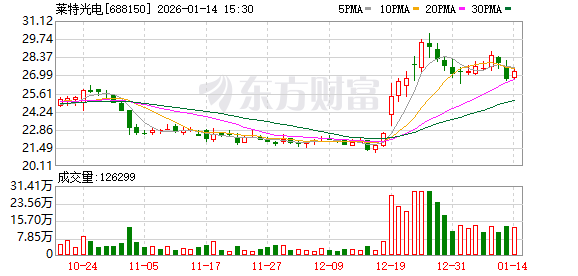
莱特光电股价涨5.31%,国寿安保基金旗下1只基金重仓,持有27.5万股浮盈赚取39.87万元
Xin Lang Cai Jing· 2026-01-15 06:27
Group 1 - The core point of the news is that LaiTe Optoelectronics has seen a stock price increase of 5.31%, reaching 28.75 CNY per share, with a total market capitalization of 11.57 billion CNY [1] - LaiTe Optoelectronics, established on February 21, 2010, primarily engages in the research, production, and sales of OLED organic materials, which account for 94.48% of its main business revenue [1] - The company is located in Xi'an High-tech Zone, Shaanxi Province, and was listed on March 18, 2022 [1] Group 2 - According to data, Guoshou Anbao Fund holds a significant position in LaiTe Optoelectronics, with the Guoshou Anbao New Blue Chip Mixed Fund (007074) owning 275,000 shares, representing 5.02% of the fund's net value [2] - The Guoshou Anbao New Blue Chip Mixed Fund has achieved a year-to-date return of 7.55%, ranking 1698 out of 8840 in its category, and a one-year return of 74.7%, ranking 566 out of 8094 [2] - The fund manager, Li Bowen, has been in charge for 3 years and 160 days, with the best fund return during his tenure being 84.25% [3]

一块布,卡了英伟达的脖子?
芯世相· 2026-01-15 04:23
Core Viewpoint - The article emphasizes the critical role of high-end electronic fabric in the AI computing power revolution, highlighting the dominance of Japanese companies in this sector and the emerging competition from Chinese firms [5][21]. Group 1: Japanese Dominance in High-End Electronic Fabric - Japanese companies like Nitto Denko, Asahi Kasei, and AGC dominate nearly 70% of the global high-end electronic fabric market, creating a near monopoly [7][12]. - These companies do not manufacture AI chips but control a crucial component that supports AI computing power [8]. - The unique chemical formulations of NE-glass and T-glass developed by Japanese firms provide superior dielectric properties, making them difficult to compete against [12][16]. Group 2: Challenges and Innovations from Chinese Companies - Chinese companies have been primarily active in the mid to low-end electronic fabric market, but recent innovations are challenging the Japanese monopoly [10][21]. - Companies like Honghe Technology and Linzhou Guangyuan have made significant breakthroughs in producing ultra-thin and low-dielectric electronic fabrics, breaking the long-standing foreign dominance [27][31]. - The successful production of 9-micron ultra-thin electronic fabric by Honghe in 2021 marked a significant milestone in the industry [27]. Group 3: The Material Revolution - The article discusses the importance of material science in technological advancements, asserting that breakthroughs in materials are essential for the progress of industries like AI and aerospace [39][41]. - The development of M9-level quartz fabric by companies like Feilihua represents a new frontier in high-end electronic materials, providing alternatives to Japanese products [35][36]. - The ongoing material revolution is seen as a critical step for China to achieve self-sufficiency and reduce reliance on foreign technology [49].



电子布概念震荡拉升 国际复材涨超10%
Xin Lang Cai Jing· 2026-01-15 01:45
Group 1 - The electronic fabric concept experienced a volatile rise in early trading, with international composite materials increasing by over 10% [1] - Dongcai Technology and Honghe Technology hit the daily limit, indicating strong investor interest and demand [1] - Changhai Co., Nanya New Materials, Feilihua, and Zhongyi Technology also showed significant gains, contributing to the overall positive trend in the sector [1]


一块布,硬卡英伟达的脖子
是说芯语· 2026-01-15 00:06
Core Viewpoint - The article emphasizes the critical role of high-end electronic fabric in the AI computing power revolution, highlighting the dominance of Japanese manufacturers in this niche market and the emerging competition from Chinese companies [4][5][7]. Group 1: High-End Electronic Fabric Market - High-end electronic fabric, essential for AI servers, is primarily produced by Japanese companies like Nitto Denko, Asahi Kasei, and AGC, which control nearly 70% of the global market [5][7]. - These companies have established a significant competitive advantage through decades of research and development, creating a robust patent network that covers the entire production process [7][10]. - The production of high-end electronic fabric requires substantial investment, with costs for advanced production lines exceeding 500 million yuan (approximately 75 million USD), making it difficult for new entrants to compete [7][10]. Group 2: Chinese Companies' Response - Chinese companies, such as Honghe Technology and Linzhou Guangyuan, have begun to break the Japanese monopoly by developing their own high-end electronic fabrics, achieving significant milestones in ultra-thin and low-dielectric materials [9][10][14]. - Honghe Technology successfully mass-produced 9-micron ultra-thin electronic fabric in 2021, marking a significant breakthrough against foreign dominance [9][10]. - Linzhou Guangyuan became the first domestic company to achieve mass production of low-dielectric fabric in 2021, showcasing the potential for innovation within the Chinese market [10][14]. Group 3: Material Science and Innovation - The development of high-end electronic fabric is a complex process that requires extensive experimentation and innovation in material science, often surpassing the challenges faced in chip and algorithm development [15][17]. - The article argues that breakthroughs in material science are crucial for the advancement of technology sectors, including AI, aerospace, and renewable energy, indicating a broader trend of material innovation in China [15][17]. - The successful production of M9-grade quartz fabric by companies like Feilihua represents a significant step in reducing reliance on Japanese materials and enhancing China's technological independence [11][13][14].

嘉德利主板IPO披露首轮审核问询函回复
Bei Jing Shang Bao· 2026-01-14 13:48
Group 1 - The core viewpoint of the article is that Quanzhou Jiade Li Electronic Materials Co., Ltd. (referred to as "Jiade Li") has disclosed its first-round inquiry response for its IPO application on the Shanghai Stock Exchange, indicating progress in its listing process [1] - Jiade Li is recognized as a national-level specialized and innovative "little giant" enterprise and a high-tech enterprise, focusing on the research, production, and sales of BOPP electrical films [1] - The company aims to raise approximately 725 million yuan through its IPO, which will be used for the construction of a new materials production base in Xiamen and to supplement working capital [1] Group 2 - The IPO application was accepted on November 6, 2025, and entered the inquiry stage on November 27 of the same year [1] - The first-round inquiry raised questions regarding Jiade Li's main products, market positioning, customer base, and revenue [1]
莱特光电:公司OLED终端材料产品覆盖红、绿、蓝三色发光层材料
Zheng Quan Ri Bao· 2026-01-14 12:12
Company Overview - The company, Lite-On Optoelectronics, has developed a comprehensive product matrix for OLED terminal materials, covering red, green, and blue emitting layer materials, as well as core functional layer materials such as hole transport layers, hole blocking layers, and electron transport layers [2] Product Development - The emitting layer materials RedPrime, GreenHost, and RedHost have achieved domestic production breakthroughs, ensuring stable supply to downstream customers and supporting revenue growth [2] - GreenPrime materials and blue light materials are currently in the validation phase with downstream customers, with expectations for domestic introduction by 2026 [2] - The company is actively advancing the research and development of next-generation narrow-spectrum dopant materials and is focusing on cutting-edge technologies such as stacked device connection layer (CGL) materials, blue phosphorescent materials, and narrow-spectrum high color gamut MRTADF materials [2] Market Outlook - By 2026, industry demand is expected to increase due to improved utilization rates of panel manufacturers, which will drive the demand for materials [2] - The production of 8.6-generation lines is anticipated to further create incremental market demand for materials [2] - The company plans to transition RedHost materials from small batch supply to large-scale supply, while GreenPrime materials are expected to be introduced and supplied at scale [2]
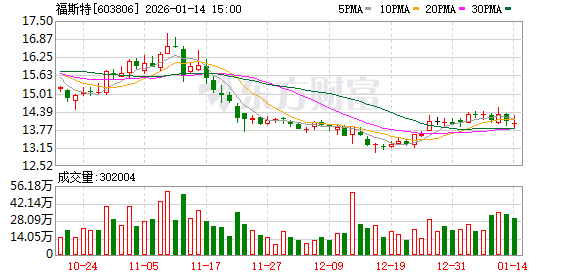
福斯特:公司目前的业务主要集中在新能源和电子赛道
Zheng Quan Ri Bao· 2026-01-14 12:09
Group 1 - The company Foster focuses its business primarily on the new energy and electronics sectors [2] - In the new energy sector, lithium battery materials are utilized for solid-state battery packaging, which can provide energy for humanoid robots [2] - In the electronics sector, electronic materials are used in the production of AI computing hardware PCBs, supporting the intelligence of humanoid robots [2]

福斯特:公司目前在电子电路领域已经有感光干膜、FCCL和感光覆盖膜等产品销售
Zheng Quan Ri Bao Wang· 2026-01-14 11:42
Group 1 - The company aims to become a platform-type materials enterprise, focusing on the electronic circuit field [1] - Current products in the electronic materials sector include photosensitive dry film, FCCL, and photosensitive cover film [1] - The company plans to increase R&D investment to expand its offerings in the electronic materials field [1]
【IPO前哨】毛利率骤降,却大笔分红!贝斯特赴港募资意欲何为?
Sou Hu Cai Jing· 2026-01-13 11:54
Core Viewpoint - The Hong Kong IPO market has been performing well since 2026, with new stocks generally seeing significant increases post-listing. Best New Materials Co., Ltd. has submitted its application for a mainboard listing on January 12, 2023, with Guotai Junan International as its sole sponsor [2]. Company Overview - Best New Materials, established in March 2017, specializes in the research, production, and sales of electronic functional enhancement materials, which are used to improve the acoustic, optical, thermal, and electrical performance of components and devices in consumer electronics and new energy sectors. The company is expanding its applications into high-growth areas such as advanced packaging and computing [3]. Market Position - According to Frost & Sullivan, Best holds a strong market position in several segments: - Ranked first in the global acoustic enhancement materials market with an 18.1% market share - Ranked second in the global LIB diaphragm coated aluminum oxide ceramic materials market with an 18.1% market share - Ranked fourth in the global acoustic adhesive market with a 3.5% market share - Ranked third in the global high-reflective glaze market with a 5.0% market share [5]. Financial Performance - Best's revenue for the first three quarters of 2023, 2024, and 2025 was RMB 320 million, RMB 355 million, and RMB 460 million, respectively, with profits of RMB 96.16 million, RMB 113 million, and RMB 118 million. The company has shown stable growth despite its relatively small scale [6]. - The acoustic enhancement materials segment remains the largest, contributing 48.4% of total revenue in the first three quarters of 2025, with a gross margin of 81.8%. However, its revenue share has decreased due to overall revenue growth [6][8]. Business Segments - The electronic ceramic materials segment accounted for 20.6% of total revenue in the first three quarters of 2025, with a gross margin of 21.7%, stemming from a strategic acquisition in 2024. The energy enhancement materials segment's revenue share has dropped to 27.7% with a gross margin of only 0.8% due to increased competition in the photovoltaic industry [8]. Customer and Supplier Dependency - Best has a high dependency on a few major customers, with sales to the top five customers accounting for 88.2%, 82.3%, and 79.0% of total revenue in 2023, 2024, and the first three quarters of 2025, respectively. The largest customer contributed 28.4%, 20.9%, and 23.1% of total revenue during the same periods. The company also relies heavily on a few suppliers, although this dependency is decreasing [9]. Dividend Policy - Best declared dividends of RMB 34.6 million in 2023, RMB 40.8 million in 2024, and RMB 40.8 million in the first three quarters of 2025, which may raise concerns among investors about potential "asset stripping" before the IPO [10]. Use of Proceeds - The company plans to use the net proceeds from the IPO for several purposes, including increasing production capacity, developing new products, building R&D centers, expanding sales and service networks, and general corporate purposes [11].

贝斯特递表港交所 国泰海通为独家保荐人
Zheng Quan Shi Bao Wang· 2026-01-13 00:04
Group 1 - Best has submitted a listing application to the Hong Kong Stock Exchange, with Cathay Securities acting as the sole sponsor [1] - Best specializes in electronic functional enhancement materials, holding a strong market position in acoustic enhancement materials, electronic ceramic materials, electronic adhesives, and energy enhancement materials [1] - The company has established three core technology platforms: inorganic powder technology platform, polymer materials technology platform, and composite materials technology platform [1] Group 2 - According to Frost & Sullivan's revenue statistics for the first half of 2025, Best ranks first in the global acoustic enhancement materials market with a market share of 18.1% [1] - Best ranks second in the global LIB separator coated aluminum oxide ceramic materials market, with a market share of approximately 18.1% [1] - The company ranks fourth in the global acoustic adhesives market, holding a market share of about 3.5%, and ranks third in the global high-reflective glaze market with a market share of 5.0% [1]
