
Real Estate

Search documents
Is the 30% Rule Unattainable in 2025? Typical U.S. Household Needs to Spend ~45% of Income to Afford the Median-priced Home
Prnewswire· 2025-06-25 10:00
Core Insights - The affordability of housing in major U.S. metros is severely constrained, with the typical household needing to spend 44.6% of their income to afford a median-priced home as of May 2025, significantly above the recommended 30% threshold [1][8] - Only three major metropolitan areas—Pittsburgh, Detroit, and St. Louis—allow median-income earners to purchase a median-priced home without exceeding 30% of their income [3][4] - High mortgage rates and home prices are the primary factors contributing to the lack of affordability in most large metros, with the average mortgage rate at 6.82% as of May 2025 [3][7] Affordability Analysis - In Pittsburgh, the median listing price is $249,900, requiring 27.4% of household income; in Detroit, it's $270,000 (29.8%); and in St. Louis, $299,900 (30.0%) [4][6] - Conversely, in Los Angeles, the median home price is $1,195,000, necessitating over 104% of the area's median income, indicating extreme unaffordability [5][6] - Other high-cost metros include San Diego, San Jose, New York, and Boston, all with affordability ratios exceeding 60% [5][6] Market Dynamics - Demand for affordable homes is increasing, particularly in the Midwest, where some markets still offer pathways to homeownership for median-income households [2][5] - The coastal markets, particularly in California, are experiencing a significant affordability crisis, with a high percentage of renters compared to homeowners [5][6] - The overall national median home price is $440,000, with a monthly payment of $2,930, reflecting the broader affordability challenges across the country [8] Potential Solutions - To improve housing affordability, strategies could include raising incomes or lowering housing costs through reduced mortgage rates or home prices [7] - Increasing the supply of affordable homes is critical, as many markets face a growing home supply gap, which has kept prices high [7]



JPMorgan's REIT Reshuffle: Ventas Stock Climbs, Cold Storage Giants Slip
Benzinga· 2025-06-23 17:24
分组1: Ventas Inc. (VTR) - JPMorgan analyst upgraded Ventas Inc. from Neutral to Overweight and raised the price target to $72 from $70, citing robust internal and external growth, including double-digit same-store net operating income gains and steady acquisitions [1] - Ventas is viewed as more attractively valued compared to peer Welltower, particularly on an implied cap rate basis, despite slightly lower growth potential [2] - The price target increase reflects improved growth visibility, based on a dividend discount model with a 5.25% long-term growth rate and a 95% AFFO payout ratio [3][7] 分组2: Americold Realty Trust Inc. (COLD) - Americold Realty Trust was downgraded from Overweight to Neutral, with a price target cut to $21 from $24 due to weaker throughput volumes and lower occupancy rates [3][4] - The downgrade reflects lower earnings estimates and a higher 11.5% discount rate in the DCF model, indicating increased uncertainty and tempered growth expectations [4] 分组3: Federal Realty Investment Trust (FRT) - Federal Realty Investment Trust was downgraded from Overweight to Neutral, with a price target set at $108, attributed to a reduced focus on development and redevelopment projects [5][6] - Investors are cautious about FRT's strategy of entering new markets by divesting high-quality assets, which may take time to show operational benefits [6][7] 分组4: Lineage Inc. (LINE) - Lineage Inc. was downgraded from Neutral to Underweight, with a price target lowered to $50 from $55, due to a broader preference for other REIT sectors despite the long-term merits of the Lineage platform [7][8] - The cold storage segment is facing lower throughput volumes, impacting occupancy and pricing, with the 2025 AFFO per share outlook falling below management guidance [8]





Walt Disney World resorts' new 'sophisticated' restaurant to require dress code
Fox Business· 2025-06-23 12:51
Core Insights - A new upscale steakhouse, Bourbon Steak by Michael Mina, is set to open at Walt Disney World Swan and Dolphin, requiring guests to adhere to a dress code that reflects the restaurant's sophisticated aesthetic [1][2][4] - The restaurant will offer premium cuts of beef, seafood, and signature desserts, although a menu with prices has not yet been released [7] - The Walt Disney World Swan and Dolphin, while not owned by Disney, provides guests with Disney benefits such as early theme park entry and complimentary transportation [10] Group 1 - Bourbon Steak by Michael Mina started accepting reservations last week, with the earliest available date being July 26 [4] - The restaurant is positioned as one of the Signature Dining experiences at the resort, emphasizing a dress code that prohibits swimwear and requires clean, neat attire [2][5] - Chef Michael Mina, a James Beard Award winner, expressed excitement about the partnership and the unique design of the restaurant tailored to its Orlando location [9] Group 2 - The Walt Disney World Swan and Dolphin features 24 dining options, including the new Bourbon Steak, enhancing its food and beverage program [4][5] - The resort is owned by Tishman Realty & Construction Corporation and MetLife, and managed by Marriott International, Inc., distinguishing it from Disney-owned properties [10] - The addition of Bourbon Steak aligns with the resort's commitment to culinary excellence and aims to elevate the dining experience for guests [5][9]


DeFi Development Corp. Partners with Kraken to Tokenize DFDV Stock on Solana, Becoming the First U.S.-Listed Crypto Treasury Strategy to Go Onchain
Globenewswire· 2025-06-23 12:00
Core Insights - DeFi Development Corp. has formed a partnership with Kraken to list its tokenized stock on the Solana blockchain, marking a significant step in integrating traditional capital markets with decentralized finance [1][2][3] Company Overview - DeFi Development Corp. is the first U.S. public company with a treasury strategy focused on accumulating and compounding Solana (SOL) [1][5] - The company operates its own validator infrastructure, generating staking rewards and fees from delegated stake, while also engaging in decentralized finance opportunities [5] Tokenization and Market Impact - The tokenized stock of DeFi Development Corp., trading under the symbol DFDVx, will be part of the inaugural cohort of tokenized stocks on Kraken's xStocks platform, alongside major companies like Apple, Tesla, and Nvidia [2][3] - The launch of DFDVx is expected to unlock new opportunities for developers and institutions to create products and integrate tokenized equity into financial systems [3][4] Strategic Vision - The company views the tokenization of its stock as a foundational element for future innovations in on-chain finance, aiming to explore new use cases that merge equity ownership with decentralized finance [4] - The demand for real-world assets (RWAs) on Solana is increasing, aligning with the company's mission to lead in capital markets innovation [4]

摩根士丹利:中国房地产_5 月数据恶化;预计疲软趋势将在第三季度延续
摩根· 2025-06-23 02:10
Investment Rating - Industry view is rated as In-Line [9] Core Insights - Property sales and home prices are expected to continue declining in the third quarter due to high secondary inventory and weakening resident sentiment [1] - Quality state-owned enterprises (SOEs) with good visibility are recommended for investment, with CR Land identified as a top pick [1][2] Monthly Property Sales - Home sales in 65 cities saw a year-on-year decrease of 11% in primary sales volume and a 5% decrease in secondary sales volume [3] - Year-to-date growth for primary sales is now at 0.1% and 13% for secondary sales as of May 2025 [3] Property Prices - Primary home prices in 70 cities dropped by 4.1% year-on-year and 0.2% month-on-month, while secondary home prices fell by 6.3% year-on-year and 0.5% month-on-month [4] - In top-10 cities, secondary prices decreased by 5.4% year-on-year, and in top-100 cities, they fell by 7.2% year-on-year [4] Secondary Market - Listing volume for secondary properties increased, with new listings up by 6% year-on-year but down 11% month-on-month [5] - Client visits to properties increased by 20% year-on-year and 3% month-on-month [5] Inventory - Primary inventory levels in tracked cities remained stable at 23.4 months, with tier 1 cities decreasing slightly to 14.2 months [6] Land Market - Land sales in 300 cities decreased by 13.8% year-on-year in gross floor area (GFA) but increased by 17.8% in value [7] - The year-to-date decline in land sales is now at 6.4% in GFA [7]
汇丰:中国宏观追踪_聚焦国内事务
汇丰· 2025-06-23 02:10
Investment Rating - The report does not explicitly provide an investment rating for the industry Core Insights - Major Chinese automakers have pledged to make payments to suppliers within 60 days amidst a severe price war, which is expected to alleviate liquidity pressures in the industrial chain [3][8] - Local governments have started to utilize special bonds to repay arrears to businesses, indicating a proactive approach to improve business liquidity [4][8] - The property sector is receiving increased policy support, focusing on urban renewals and affordable housing, as recent activity data showed declines in new home sales and property investment [9][10] Summary by Sections Automotive Industry - With US-China trade tensions stabilizing, the focus has shifted to domestic issues, particularly in the auto sector where price competition remains intense, leading to falling prices but higher volumes [2] - Automakers have faced liquidity pressures due to delayed payments and demands for price cuts exceeding 10% from suppliers [2][3] - The average accounts payable turnover days for 12 listed Chinese automakers exceeded 170 days, peaking at 248 days, with accounts payable and notes payable accounting for 46.2% of total liabilities [3] Local Government Financial Measures - By the end of 2024, the accounts payable of bond-issuing local government financing vehicles (LGFVs) stood at approximately RMB3.1 trillion, accounting for 9% of LGFV's short-term debt [4] - Hunan province issued RMB20 billion in special bonds to settle local government arrears, marking a significant step in using special local government bonds for this purpose [4] Property Sector - The property sector is under pressure, with new home sales and property investment declining by 4.6% and 12% year-on-year, respectively [9] - Premier Li Qiang announced plans to optimize policies to boost demand and stabilize the property market, with a focus on urban renewal and affordable housing [9][10] - In the first five months of the year, 16.4% of new local government special bonds were allocated to property-related projects, compared to 8.6% in 2024 [10]
The Real Brokerage: Why I Believe It's A Hidden Gem In Real Estate Tech
Seeking Alpha· 2025-06-20 18:56
Company Overview - The Real Brokerage Inc (NASDAQ: REAX) is a real estate company founded in 2014, operating across almost all of the United States and four Canadian provinces [1] Analyst Background - The author of the article is a financial journalist with over 10 years of experience in communications and has worked for various economic institutions [1] - The author also runs a podcast called Storiopolis, focusing on the history of finance [1] Market Position - The company is positioned not just as a real estate entity but also as a personal investment opportunity, indicating a broader perspective on its market role [1]


珀斯十年磨一剑!房价力压墨尔本成新贵
Sou Hu Cai Jing· 2025-06-19 23:35
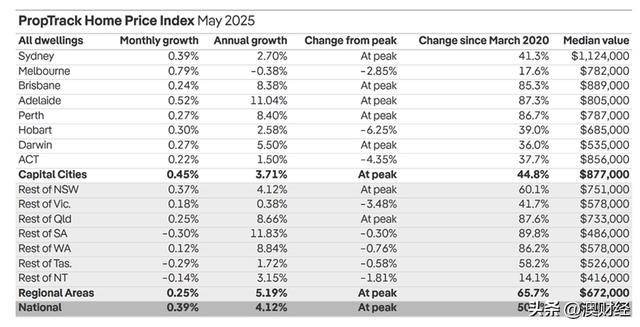
Core Insights - The Australian housing market is experiencing varied growth rates across different cities, with Perth showing significant strength in property prices, surpassing Melbourne for the first time in a decade [2][3]. Group 1: Housing Market Overview - The PropTrack Home Price Index indicates that national home prices increased by 0.39% month-on-month and 4.12% year-on-year, with a median value of AUD 2,011,530 [1]. - Sydney's median home value is AUD 1,124,000, with a monthly growth of 0.39% and an annual growth of 2.70% [1]. - Melbourne's home prices increased by 0.79% month-on-month but remain 2.85% below their peak in 2022, with a median value of AUD 782,000 [2][6]. Group 2: Perth's Market Dynamics - Perth's median home price has reached AUD 787,000, marking a significant increase driven by structural and cyclical factors, including affordability and population growth [2][3]. - The city has seen a remarkable 85.3% increase in home prices since March 2020, reflecting a strong recovery from previous lows [1]. - Perth's rental market is currently one of the tightest in Australia, with historically low vacancy rates and rapidly rising rents, attracting investors seeking capital appreciation and strong rental returns [5][9]. Group 3: Melbourne's Challenges - Melbourne faces challenges with slowing population growth and weakened price momentum, having the lowest price growth among major cities over the past five years, at less than 20% [6]. - The state of Victoria has the highest property taxes in Australia, which, combined with rising costs from new rental legislation, is leading many landlords to sell investment properties [7]. Group 4: Supply and Demand Factors - Western Australia's population growth has turned positive during the pandemic, with significant net interstate and overseas migration, putting pressure on housing supply [3]. - New housing supply is lagging behind demand due to high construction costs and labor shortages, exacerbating competition and driving up prices [3][9].
从50%到16%!澳洲单身购房地图大缩水,这些州“全军覆没”
Sou Hu Cai Jing· 2025-06-19 15:12
Group 1 - The core issue in the Australian real estate market is that single buyers are facing increasing pressure, with only 16% of regions being affordable for the average Australian to purchase a detached house [1] - In the apartment market, single buyers can only afford approximately 28% of regions, a significant drop from 66% in 2017 [2] - The affordability crisis has led to a notable decrease in the proportion of single buyers among first-time homebuyers, dropping from 45% in 2021 to 39% in 2025 [2] Group 2 - In New South Wales, the situation is particularly dire, with the percentage of regions affordable for single buyers of detached houses plummeting from 40% in 2017 to just 11% by 2025 [2] - South Australia has seen a dramatic decline in affordability, with the percentage dropping from 85% in 2017 to 19% in 2025 [2] - Finder's personal finance expert, Sarah Megginson, emphasizes that buying a home is now more challenging than ever, especially for those attempting to purchase without partner or family assistance [5][6] Group 3 - The expectation of interest rate cuts before Christmas may alleviate some pressure on current mortgage holders, but it could make entry into the market even more difficult for new buyers [8] - Increased demand in affordable markets is anticipated, which may further drive up entry-level property prices, exacerbating the challenges faced by first-time buyers [8]

摩根士丹利:中国房地产-5 月数据恶化,预计三季度弱势延续
摩根· 2025-06-19 09:47
Investment Rating - Industry view is rated as In-Line [9] Core Insights - Property sales and home prices are expected to continue declining in the third quarter due to high secondary inventory and weakening resident sentiment [1][2] - Quality state-owned enterprises (SOEs) with high visibility are recommended for investment, with CR Land identified as a top pick [1][2] Monthly Property Sales - Home sales weakened further, with primary sales volume in 65 cities down 11% year-on-year and secondary sales volume in 33 cities down 5% year-on-year [3] - Year-to-date growth for primary sales is now at +0.1% year-on-year, while secondary sales are at +13% year-on-year for the first five months of 2025 [3] Property Prices - Housing prices are declining at an accelerated rate, with primary home prices in 70 cities dropping 4.1% year-on-year and secondary home prices down 6.3% year-on-year [4] - The decline in secondary prices for the top 10 cities is 5.4% year-on-year, while for the top 100 cities, it is 7.2% year-on-year [4] Secondary Market - Listing volume continues to increase, with secondary listing prices down 8.1% year-on-year [5] - New secondary listings increased by 6% year-on-year but decreased by 11% month-on-month due to seasonality [5] Inventory - Primary inventory levels in tracked cities remained stable at 23.4 months, with tier 1 cities decreasing slightly to 14.2 months [6] Land Market - Land sales in 300 cities decreased by 13.8% year-on-year in gross floor area, while the value increased by 17.8% year-on-year [7] - The year-to-date land sales decline in gross floor area is now at -6.4% year-on-year [7]