农作物保护

Search documents
咋了?这家农化巨头正在考虑,把自己卖了!
Xin Lang Cai Jing· 2026-02-09 10:54
Core Viewpoint - FMC Corporation's board has approved the exploration of various strategic options, including the potential sale of the company, amid financial challenges and declining revenues [1][3]. Financial Performance - FMC reported a revenue of $3.47 billion for 2025, a decrease of 18% compared to 2024, primarily due to a 6% drop in product prices [1][3]. - The company experienced a net loss of $2.24 billion for the year, which is a reduction of $2.58 billion from the previous year [1][3]. - For 2026, FMC expects revenues to be between $3.6 billion and $3.8 billion, reflecting a 5% decline year-over-year [5]. Strategic Challenges - The expiration of the patent for the pesticide Rynaxypyr has posed strategic and operational challenges for FMC [1][3]. - The company is implementing a 2026 operational plan that includes asset sales and licensing agreements to repay $1 billion in debt, aiming to optimize its balance sheet [1][3]. Market Conditions - FMC faces ongoing debt issues and has seen its credit rating downgraded from BBB- to BB+ by S&P Global Ratings, indicating a non-investment grade status [2][4]. - The company is under pressure from generic competition, particularly in Latin America and Asia, which may impact pricing and profit margins [2][4]. - FMC is also contending with weak agricultural demand and competition from lower-priced products offered by rivals [2][4]. Future Outlook - FMC's CEO, Pierre Brondeau, emphasized that the focus for 2026 will be on executing operational plans to strengthen the balance sheet and enhance overall business competitiveness [2][4]. - The sales of new active ingredients are projected to be between $300 million and $400 million, with adjusted EBITDA expected to be between $670 million and $730 million, a 17% decline from the previous year [5].
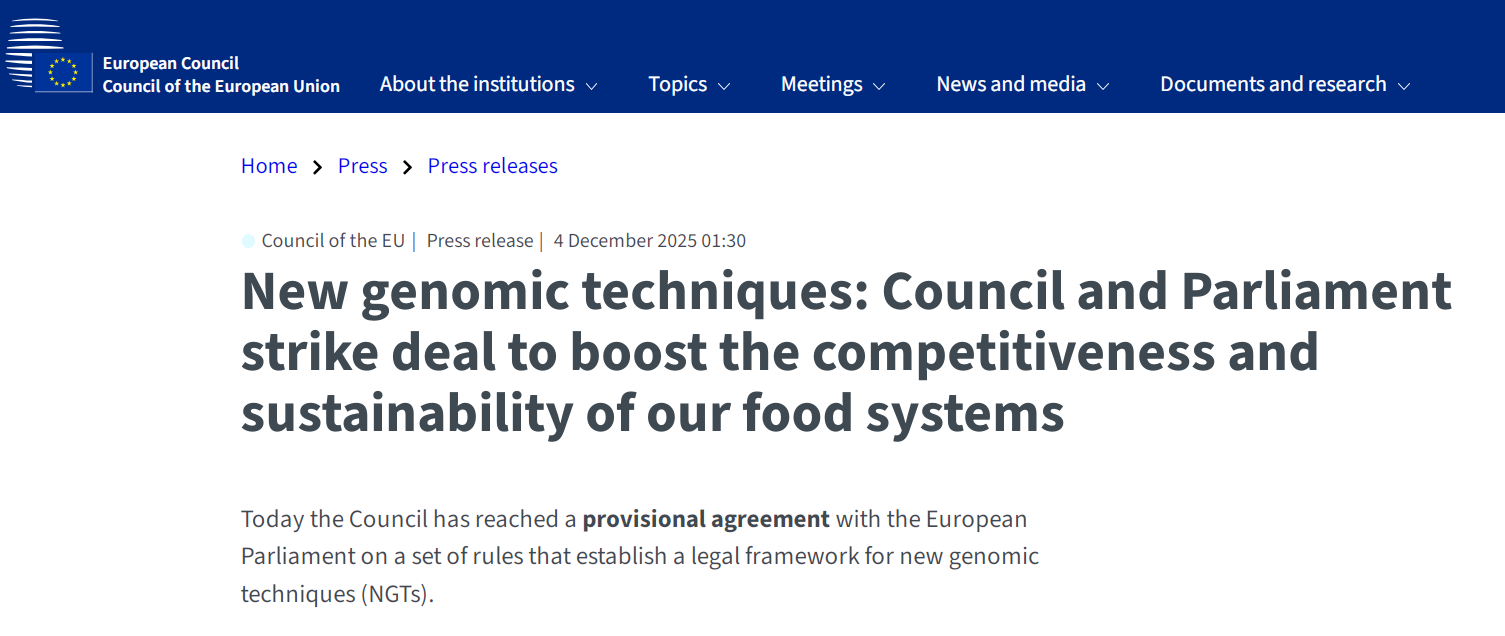
欧盟就基因编辑作物达成协议,农业领域迎来重大政策转折
Feng Huang Wang· 2025-12-04 22:21
Core Points - The EU has reached an agreement on new regulations that pave the way for the use of gene editing technology in agriculture, aimed at helping farmers cultivate healthier plant and animal varieties to address climate change challenges [1][3] - The new regulations exempt gene-edited organisms from the EU's GMO regulatory framework, distinguishing gene editing from traditional genetic modification by simulating natural breeding processes without introducing cross-species DNA [1][3] Industry Impact - The agricultural protection industry views this technology as essential for enhancing crop and livestock resilience against extreme weather, pests, and diseases, providing EU farmers a competitive edge against countries like the US that already permit gene editing [3][4] - The EU Council stated that the new regulations will make the EU food system safer and more sustainable, enabling the cultivation of crops that are more resilient to climate change and pests, with higher yields and reduced reliance on fertilizers and pesticides [3][4] Regulatory Changes - The new measures are expected to reduce administrative burdens while enhancing the competitiveness of breeding companies and farmers [4] - The regulations still require formal approval from the European Parliament and the EU Council before coming into effect [3] Stakeholder Reactions - The EU agricultural association Copa-Cogeca welcomed the agreement as a historic advancement and the only practical solution for farmers under the EU's Green Deal framework [5] - Environmental organization "Friends of the Earth" criticized the regulatory relaxation, labeling it as a deregulation of new genetically modified organisms and a "pass" for the biotechnology industry [6]

印度、巴西与美国贸易谈判仍无进展,26年春夏订单季撞上特朗普关税
Di Yi Cai Jing· 2025-08-19 11:46
Group 1: Impact of US Tariffs on India - Fitch Ratings warns that the ongoing increase in US tariffs may lower India's GDP growth forecast for FY2026 from 6.5% [1] - The US has imposed a 25% tariff on Indian goods starting August 7, with an additional 25% tariff on products imported from India due to its ties with Russia [1] - Major Indian exports such as textiles, jewelry, auto parts, and seafood will face a total of 50% tariffs, while certain electronics and pharmaceuticals will remain exempt [1][6] Group 2: Effects on Indian Companies - Indian pharmaceutical companies, like Biocon Biologics, derive nearly 40% of their revenue from the US, making them vulnerable to new tariffs [6] - UPL, a major player in crop protection chemicals, faces potential pressure as 10%-12% of its revenue comes from the US market [7] - The imposition of tariffs could lead to a significant decline in India's competitiveness in the US market, with potential export drops of 60% to 80% depending on tariff levels [10] Group 3: Business Reactions and Strategies - Companies like Farida Group, which relies heavily on the US market, have frozen expansion plans due to the tariff impact [8] - The "India+1" strategy is gaining traction among companies considering relocating from India due to the unfavorable tariff environment [9] - Exporters are experiencing a demand drop of around 20% in the short term, with some factories resorting to significant price cuts to retain customers [10]