化纤等

Search documents
【能源聚酯周报】原油表现弱势,板块震荡运行(2025.11.26)
Xin Lang Cai Jing· 2025-11-26 01:30
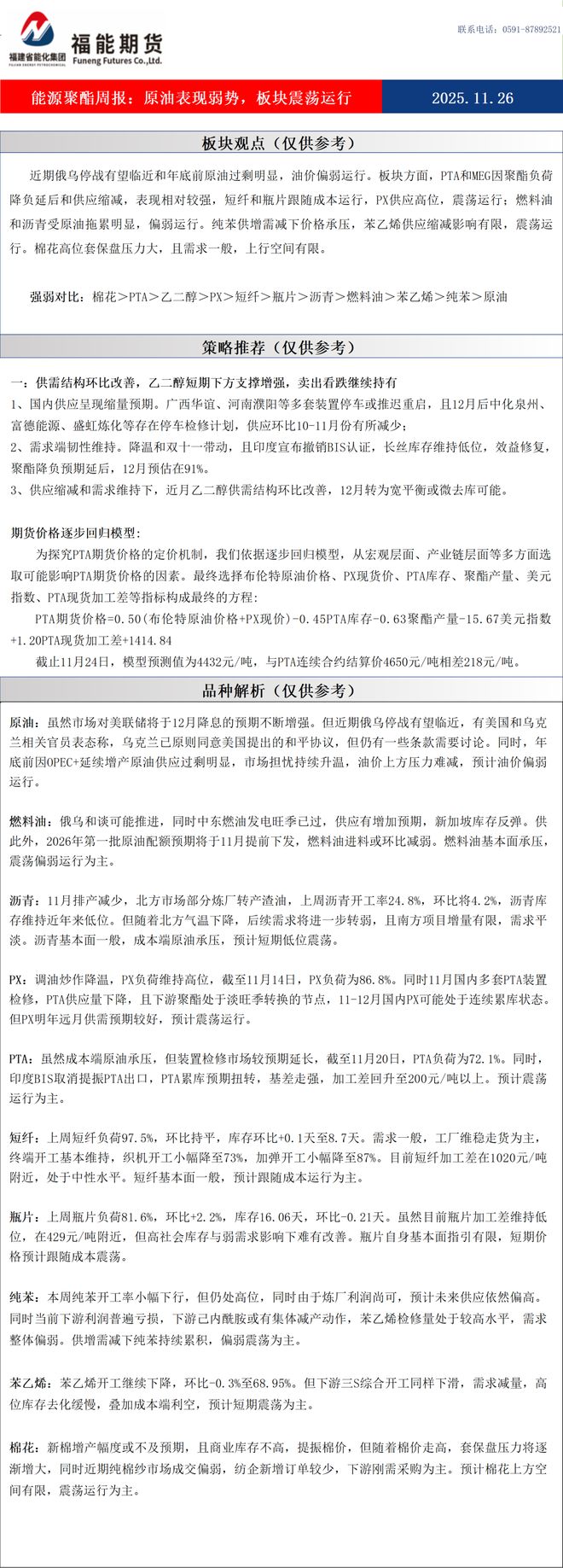
Group 1: Oil and Asphalt Industry - The production of asphalt in November decreased, with a utilization rate of 24.8%, down 4.2% month-on-month, while inventory remains at historically low levels. However, demand is expected to weaken due to falling temperatures in the northern regions and limited project increments in the south, leading to a generally weak market outlook [5]. - PX production remains high at 86.8% as of November 14, but with several PTA facilities undergoing maintenance, supply is expected to decline. The PX market may face continuous inventory accumulation in November and December, although long-term supply-demand expectations for next year appear positive [5]. - PTA production is at 72.1% as of November 20, with maintenance extending longer than anticipated. The cancellation of PTA export restrictions by India has improved market conditions, leading to a stronger basis and a recovery in processing margins above 200 CNY/ton [5]. Group 2: Short Fiber and Polyester Industry - Short fiber production remains stable at 97.5%, with inventory increasing slightly to 8.7 days. Demand is moderate, with factories maintaining steady sales, while weaving and texturing operations have slightly decreased [6]. - Bottle chip production is at 81.6% with a decrease in inventory to 16.06 days. Despite low processing margins around 429 CNY/ton, high social inventory and weak demand hinder price improvements [6]. - Pure benzene production is slightly down but remains high, with downstream profits generally in the red, leading to potential production cuts in downstream products. Overall demand is weak, resulting in continued inventory accumulation and a bearish market outlook [6]. Group 3: Cotton and Yarn Market - The increase in new cotton production may not meet expectations, and with low commercial inventory, cotton prices are supported. However, as prices rise, hedging pressures will increase, and recent transactions in the pure cotton yarn market have been weak, with downstream demand primarily driven by necessity [7].