
医学人工智能

Search documents
江苏推出医院大模型“定制神器”
Xin Hua Ri Bao· 2025-12-16 21:55
Core Insights - The integration of artificial intelligence (AI) in healthcare is advancing, with a focus on enabling grassroots hospitals to develop their own AI models for precise diagnosis, particularly for rare diseases [1][2]. Group 1: AI Model Development - The "AI-assisted diagnosis and treatment model generation and reasoning integrated system" was launched by the Suzhou Institute of Biomedical Engineering and Technology, allowing hospitals to create tailored AI models using their own data [2]. - This system serves as a one-stop platform for hospitals, integrating core algorithms, data governance, intelligent annotation, model training, and validation testing [2]. - Hospitals can quickly establish screening, diagnostic, or prognostic models for specific diseases, adapting to regional patient characteristics [2]. Group 2: Clinical Applications - The system has shown effectiveness in pediatric applications, improving diagnostic accuracy for conditions like pediatric megacolon from 77% to 87% by incorporating various parameters [3]. - In critical care scenarios, the system can rapidly identify pneumonia pathogens, aiding in timely treatment decisions [3]. - Pilot applications of the system have been implemented in several hospitals, including Huashan Hospital and Jiangsu Provincial Cancer Hospital, with ongoing optimizations based on clinical feedback [3]. Group 3: AI as a Decision Partner - AI is evolving from a mere tool to a decision-making partner in clinical workflows, with advancements in surgical robotics and multimodal perception technologies [4]. - The integration of AI into every stage of healthcare, from prevention to rehabilitation, is emphasized as essential for enhancing clinical practices [4][5]. - The development of cost-effective AI diagnostic systems for grassroots healthcare institutions is crucial for improving diagnostic capabilities and patient satisfaction [5]. Group 4: Industry and Policy Support - Jiangsu province is fostering a collaborative ecosystem for medical AI, supported by local universities and policies that promote technological implementation [5][6]. - The focus is on creating a value cycle that connects basic algorithm innovation, clinical application, and product deployment to enhance the national medical AI industry [6].
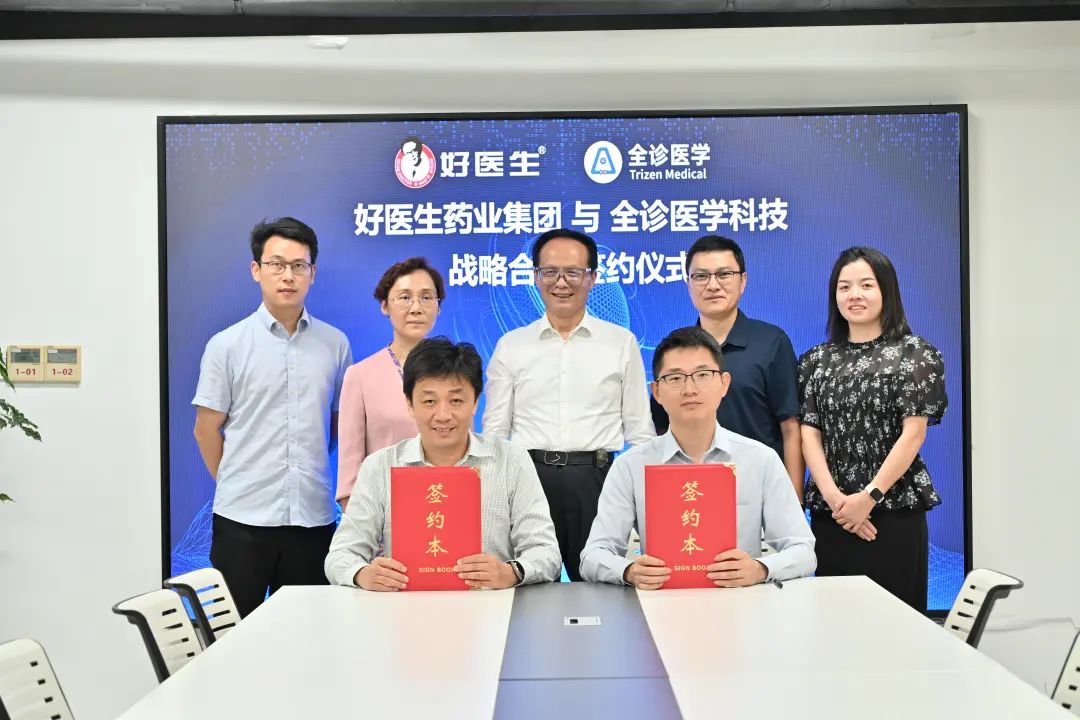
好医生集团与全诊医学达成战略合作 为中国百万基层医疗机构提供世界领先的AI解决方案
智通财经网· 2025-07-21 01:24
Core Viewpoint - The strategic partnership between China Medical Industry Top 100 Company, Good Doctor Group, and AI innovator Hangzhou Quanzhen Medical Technology aims to enhance grassroots healthcare through AI solutions and a joint venture [1][11]. Group 1: Strategic Partnership - Good Doctor Group and Quanzhen Medical will establish a joint venture to provide a comprehensive healthcare management information system (HIS), AI large models (LLM), and a series of medical intelligent agents targeting grassroots healthcare [1]. - The collaboration will leverage Good Doctor Group's extensive market network and Quanzhen Medical's advanced AI model training and application capabilities to develop and deploy leading AI solutions for nearly one million grassroots medical institutions across China [1][11]. Group 2: Leadership and Vision - Good Doctor Group's Chairman, Mr. Geng Funeng, emphasized the importance of enhancing grassroots medical service capabilities as a cornerstone of building a healthy China [7]. - The partnership is seen as a significant step in combining world-class AI technology with strong market implementation capabilities, aiming to deliver top-tier AI intelligence to every grassroots corner in need [7][11]. Group 3: AI Technology Application - Quanzhen Medical's founder, Dr. Xue Chong, highlighted the successful application of their AI product, Trizen AI, in over a hundred top-tier hospitals in China, showcasing the potential for AI to decentralize healthcare [3][11]. - The goal of the collaboration is to create AI medical solutions that are truly applicable to China's grassroots healthcare settings, significantly improving efficiency and accessibility [11]. Group 4: Collaborative Efforts - During the signing ceremony, both parties exchanged constructive opinions and suggestions regarding national research, market, and brand cooperation, indicating a strong commitment to the partnership [12].

2025中关村论坛发布多项医学人工智能领域前沿成果
Yang Guang Wang· 2025-03-31 01:18
Core Insights - The 2025 Zhongguancun Forum recently released several cutting-edge achievements in the field of medical artificial intelligence, which will promote the widespread application of advanced technologies in this sector [1] - The "White Paper on the Development of Orthopedic Joint Surgery Robots Industry" was officially released, highlighting the standardization capabilities of surgical robots that enable both large and small hospitals to achieve similar surgical outcomes [1][2] - The future of medical AI transformation extends beyond surgical robots, with AI triage tools enhancing the efficiency of initial consultations and personalized health management for chronic disease patients [2] Group 1 - The orthopedic joint surgery robot has become a standard in large hospitals, with expectations for significant increases in its adoption over the next 3 to 5 years [2] - AI systems can encapsulate top-tier medical experiences, allowing grassroots doctors to access high-quality resources, thereby improving healthcare delivery [2] - The core of the medical AI transformation is not only technological iteration but also the realization of accessible and accurate healthcare solutions [2]
