医美注射剂

Search documents
重组胶原三足鼎立成型,2025医美再生抗衰注射剂爆发式增长
Xin Lang Cai Jing· 2026-01-04 02:15
Core Insights - Jiangsu Chuangjian Medical's "cross-linked recombinant collagen implant" has been approved by the National Medical Products Administration, marking a significant milestone in the domestic regenerative collagen market [1][12] - The medical aesthetics industry is shifting from simple volume filling to advanced needs for tissue regeneration, with regenerative materials like collagen gaining popularity due to their ability to stimulate the body's own collagen production [1][6] Market Overview - The Chinese medical aesthetics injection market is projected to grow from 21.2 billion RMB in 2023 to 65.3 billion RMB by 2028, with a compound annual growth rate (CAGR) of 25.3% [5] - The regenerative anti-aging injection segment is expected to increase its market share from 3% in 2019 to 31% by 2028, indicating it is the fastest-growing sub-market [5][6] Product Categories - Medical aesthetic injectables can be categorized into hyaluronic acid, botulinum toxin, and regenerative anti-aging materials, with the latter focusing on long-term tissue regeneration rather than just physical filling [3][4] - Regenerative anti-aging injectables are further divided into microsphere regeneration, collagen-based, PDRN, and other categories, emphasizing their role in improving skin quality and addressing aging [4][5] Competitive Landscape - The domestic market for regenerative anti-aging injectables is characterized by a mix of domestic and imported products, with companies like Jinjian Biological, Juzi Biological, and Chuangjian Medical forming a competitive triad [7][12] - As of 2025, there are 15 approved collagen implant products in China, with a notable presence of both animal-derived and recombinant collagen products [10][11] Innovation and Development - Companies are focusing on R&D and regulatory compliance to enhance product quality and market acceptance, with a trend towards stricter approval processes for medical devices [13][14] - Innovations in collagen types and structures are crucial for clinical applications, with companies like Chuangjian Medical achieving significant advancements in the stability and effectiveness of their products [17] Future Trends - The integration of recombinant collagen with microsphere components is expected to create new product forms and market opportunities, positioning domestic companies to play a more significant role in the global medical aesthetics market [19]

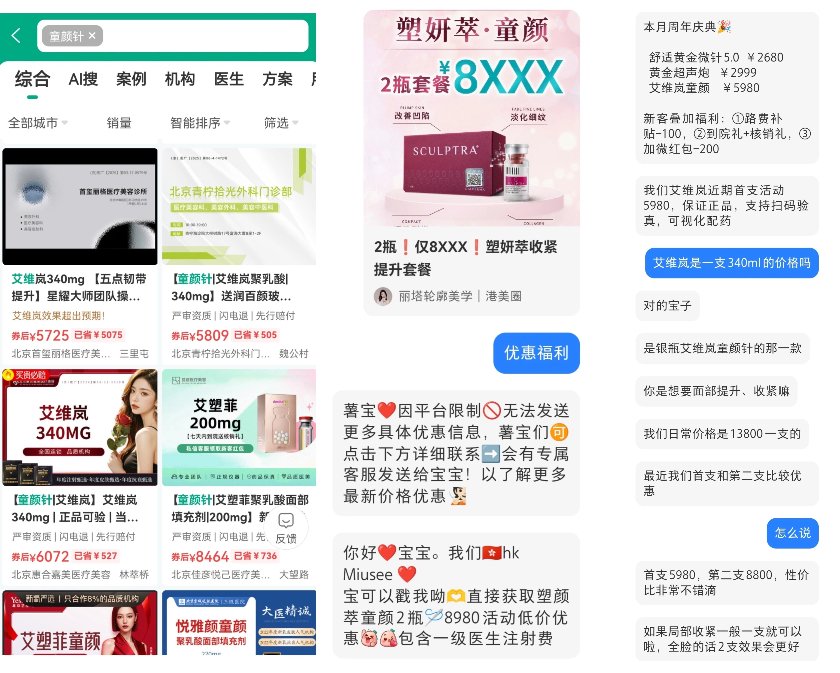
万元一支的“童颜针”开打价格战
Xin Lang Cai Jing· 2025-12-03 06:43
Core Viewpoint - The medical beauty industry in China is experiencing a price war, particularly with the "童颜针" (youthful needle) products, as prices have significantly dropped from over 10,000 yuan to around 5,000-6,000 yuan, indicating a nearly 50% reduction in price [1][3][10]. Industry Trends - The overall growth rate of the Chinese medical beauty market is expected to slow down by 2025, prompting institutions to engage in price competition to attract new customers [3][10]. - The rapid approval of various "童颜针" products has led to increased competition, with nearly 20 companies currently in the registration process for similar products [10][12]. Pricing Strategies - New players like 新氧 (Xinyang) have introduced their "童颜针" at significantly lower prices, with some products priced as low as 2,999 yuan, representing a price drop of 70-80% compared to the market average of over 12,800 yuan [6][10]. - Established brands are also adapting by launching lower-priced variants to capture a broader consumer base, as seen with 圣博玛 (Shengboma) introducing smaller packaging options [8][9]. Market Dynamics - The competition is not only based on price but also on product differentiation and marketing strategies, as companies are now focusing on specific consumer segments [12][14]. - The shift in pricing strategies reflects a broader trend in the medical beauty sector, where companies are increasingly required to justify their prices through quality and service rather than relying solely on brand prestige [12][15]. Consumer Insights - The target demographic for medical beauty services is primarily urban women aged 25-45, with a growing acceptance of mid-range pricing for services, indicating a shift in consumer behavior towards value for money [14][15]. - Consumers are becoming more discerning, considering factors such as product authenticity and the experience of the injecting physician, which adds complexity to the marketing strategies of medical beauty institutions [14][15].