地质勘察

Search documents
硬核科技守护海洋生态
Zhong Guo Zi Ran Zi Yuan Bao· 2025-09-04 02:37
Core Viewpoint - The article emphasizes the importance of sustainable utilization of marine resources, continuous environmental improvement, and ecological stability for the livelihoods of coastal communities and the long-term development of regional economies [1]. Group 1: Coastal Ecological Defense - The Geological Technology Department of Shandong Coalfield Geological Planning and Surveying Institute focuses on building an "ecological defense line" beneath the surface to support marine ecological safety and high-quality development in Shandong Province [1][2]. - The monitoring team has conducted extensive field sampling, collecting over 600 soil samples and 600 groundwater samples, covering more than 1,200 kilometers of coastline over four years [3]. - The team employs various technologies, including geophysical detection and geochemical analysis, to assess the current status and trends of seawater intrusion and salinization, providing essential data for ecological safety [3]. Group 2: Digital Protection Network - The team has developed a scientific archive for the "Phoenix Beach" in Yantai, utilizing drone technology to capture high-resolution images and create a three-dimensional model for coastal protection [7]. - The integration of drone imagery with on-site survey data has enabled precise analysis and guidance for coastal protection projects, achieving a balance between ecological preservation and economic development [7][8]. Group 3: Wetland Carbon Sink Research - The team is actively engaged in ecological protection research in the Yellow River basin, focusing on the carbon sink potential of coastal wetlands [10]. - Research projects have been initiated to study the impact of water, sediment, and climate change on the carbon sink capabilities of the Yellow River Delta wetlands, providing quantitative data for ecological restoration [10]. - As a technical support unit for the Shandong Marine Carbon Sink Industry Alliance, the team collaborates with universities to implement ecological protection and restoration projects [10]. Group 4: Commitment to Marine Ecology - The Geological Technology Department is dedicated to the core philosophy of protecting the marine ecological environment and promoting sustainable marine development through technological innovation and professional services [11].

山东省地矿局鲁南院参编的两项国家标准获批发布
Zhong Guo Fa Zhan Wang· 2025-08-15 04:02
Core Viewpoint - The approval and upcoming implementation of two national standards related to coal mining subsidence monitoring and coal gangue backfilling reclamation signify a significant advancement in the standardization process within the industry [1] Group 1: National Standards - The two national standards are titled "Technical Regulations for Satellite Remote Sensing Dynamic Monitoring of Coal Mining Subsidence Areas" (GB/T45979-2025) and "Technical Regulations for Reclamation of Backfilled Areas with Coal Gangue" (GB/T45610-2025) [1] - The implementation dates for these standards are set for February 1, 2026, and November 1, 2025, respectively [1] Group 2: Contributions and Future Plans - The company has participated in the development of multiple national and industry standards, promoting the standardization process in coal mining subsidence monitoring and coal-based solid waste disposal [1] - The company plans to leverage its technological innovation platforms and teams to enhance its industry influence and technical advantages, contributing to economic and ecological development [1]
山东省地矿局鲁南院开展汶上地热田物探项目质量与安全检查
Zhong Guo Fa Zhan Wang· 2025-08-01 06:36
Core Viewpoint - The article emphasizes the importance of safety and quality in the geothermal resource investigation project in Wenshang, Shandong Province, particularly under high-temperature conditions [1] Group 1: Safety Measures - The project leader highlighted that safety is the prerequisite for all work, especially during outdoor operations in extreme heat [1] - There is a focus on preventing heat-related issues by scheduling work to avoid high temperatures, ensuring the safety of construction personnel [1] Group 2: Quality Assurance - Quality is described as the lifeline of the project, with a thorough inspection of equipment operation status, parameter settings, installation compliance, and the completeness and accuracy of data records [1] Group 3: Technological Implementation - This project marks the first use of wide-area electromagnetic methods for geophysical exploration by the Lunan Institute, allowing for independent data collection and analysis [1] - The implementation of new technology has enhanced the autonomy and efficiency of the project, laying a solid foundation for future work [1]
建好绿色低碳美丽城市
Zhong Guo Neng Yuan Wang· 2025-07-21 01:31
Group 1 - The core viewpoint of the article emphasizes the importance of urban development in China, highlighting the shift from rapid urbanization to stable development, focusing on quality improvement and green transformation [5][6] - The meeting outlines the goal of building modern, innovative, livable, beautiful, resilient, civilized, and smart cities, promoting urban structure optimization and green transformation [5][7] - The construction of beautiful cities is identified as a key task in advancing the "Beautiful China" initiative, with a target of achieving significant results in about 50 beautiful cities by 2027 [5][8] Group 2 - Various cities in China are showcasing unique approaches to urban development, such as renewable energy buses in Beijing, zero-carbon parks in Shanghai, and green buildings in Shenzhen, contributing to a high-level urban development narrative [3][4] - The article discusses the need for tailored urban development strategies, considering the diverse urbanization levels and economic conditions across different regions [6][9] - The integration of technology and data is highlighted as a crucial factor in enhancing urban governance and environmental management, with AI and big data reshaping urban planning and resource allocation [12][13] Group 3 - The article mentions the importance of addressing air quality, water source protection, and pollution control in urban areas, aiming for a synergistic effect in reducing pollution and carbon emissions while enhancing biodiversity [7][10] - The development of charging infrastructure and green energy solutions in tourist areas, such as the Gubei Water Town, illustrates the practical steps being taken towards low-carbon tourism [8][9] - The article emphasizes the role of innovation in energy management and the transition to low-carbon economies, with cities like Ningbo leading in solar energy capacity [9][10]
2025年中国地质勘察行业发展现状、产业链、竞争格局及发展趋势研判:投资规模将进一步扩大,行业集中度将进一步提高[图]
Chan Ye Xin Xi Wang· 2025-05-19 01:20
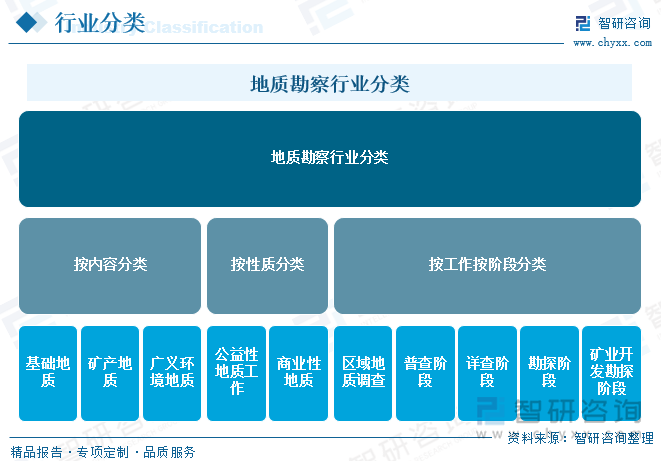
Core Insights - The geological survey industry in China is experiencing a steady growth trend, driven by the increasing demand for mineral resources due to the rapid development of strategic emerging industries such as new-generation information technology and high-end equipment manufacturing [1][4]. Industry Definition and Classification - Geological survey refers to the investigation and research of geological conditions, including rocks, stratigraphy, minerals, groundwater, and landforms, based on the needs of economic construction, national defense, and scientific and technological development [2][4]. - The geological survey can be classified into three main categories: basic geology, mineral geology, and broad environmental geology. It can also be divided into public geological work and commercial geological work based on its nature [2]. Current Development Status - The investment scale of China's geological survey industry is projected to reach 112.1 billion yuan in 2024, with a growth rate of 1.45%. Oil and gas geological surveys dominate the sector, accounting for 77.41% of the investment [4][6]. - The total revenue of the geological survey industry is expected to be approximately 412.52 billion yuan in 2024, with various revenue streams including geological survey income, engineering survey and construction income, and mineral development income [6]. Industry Chain - The geological survey industry chain consists of upstream components such as drilling equipment and geotechnical engineering survey devices, midstream geological survey services, and downstream applications in various geological contexts [8][10]. Competitive Landscape - The main players in the geological survey industry include specialized survey technology service companies, local geological survey units, and large mining companies with their own survey enterprises. Notable companies include Zhongkuang Resources Group and China Nonferrous Metal Geological Survey [17][18]. Development Trends - The geological survey industry is expected to increasingly focus on digital and intelligent technologies, driven by advancements in technology and stricter environmental impact assessments for mining development. This will lead to the growth of green survey technologies and an increase in market concentration among high-quality geological survey service providers [22].