
就业

Search documents
广发宏观:经济开年数据简析
GF SECURITIES· 2026-03-16 08:33
Economic Performance - In January-February 2026, exports increased by 21.8% year-on-year, significantly higher than December 2025's 6.6% and the annual value of 5.5%[2] - Industrial added value grew by 6.3% year-on-year, surpassing December 2025's 5.2% and the annual value of 5.9%[2] - Fixed asset investment rose by 1.8% year-on-year, compared to December 2025's -16% and the annual value of -3.8%[3] Sectoral Insights - High-tech industry added value increased by 13.1% year-on-year, up from 9.4% in the previous year[4] - Cement production turned positive with a year-on-year growth of 6.8%, compared to -6.9% last year[4] - Retail sales of consumer goods grew by 2.8% year-on-year, but were lower than the annual growth of 3.7%[5] Real Estate and Investment - Real estate sales area decreased by 13.5% year-on-year, an improvement from December 2025's -15.5%[7] - Real estate investment fell by 11.1% year-on-year, better than the previous year's -17.2%[9] - Infrastructure investment surged by 11.4% year-on-year, contrasting with last year's -1.5%[7] Employment and Consumer Behavior - Urban unemployment rate in February 2026 was 5.3%, a slight decrease of 0.1 percentage points year-on-year[9] - Consumer retail growth excluding automobiles and fuel was 4.7%, higher than last year's 3.7%[5] - Notable retail growth in categories such as tobacco and alcohol (19.1%) and communication equipment (17.8%)[6]
2026年上海市为民办实事项目公布
Xin Lang Cai Jing· 2026-02-13 03:52
Group 1 - The core viewpoint of the articles emphasizes the commitment of Shanghai to improve public services and enhance the quality of life for its citizens through various social projects [1][2][3] - In 2025, Shanghai completed 34 projects with 47 sub-items aimed at improving citizens' lives, achieving the highest overall satisfaction rating in five years [1] - For 2026, Shanghai has planned 32 projects with 38 sub-items, focusing on public service quality and modern urban governance to increase citizens' sense of gain, happiness, and security [1] Group 2 - The project selection process for 2026 involved extensive public consultation, gathering 45,000 suggestions from citizens and representatives, leading to the inclusion of new initiatives such as training for elderly caregivers and community mental health services [1][2] - The emphasis on innovation and quality in public service projects is highlighted, with a mix of long-standing successful initiatives and new projects responding to current demands, such as local elderly care service stations [2] - The government aims to address pressing social issues through collaborative efforts across various sectors, focusing on areas like health, culture, and community services to solve cross-departmental challenges [2][3]
从就业到教育 2026年地方两会释放哪些民生信号?
Xin Hua She· 2026-02-11 23:11
Employment - The government aims to create 12.67 million new urban jobs by 2025, maintaining an average urban survey unemployment rate of 5.2% [2] - Guangdong province plans to prioritize employment stability, targeting over 1.1 million new urban jobs [2] - Gansu province aims to transfer 4.8 million surplus rural laborers through an integrated service system [2] - New employment groups such as delivery workers and ride-hailing drivers will receive enhanced service guarantees [2] Elderly and Child Services - Various provinces are investing in elderly care services, with Beijing planning to build 20 regional elderly service centers and add 5,000 family care beds [4] - Tianjin is focusing on developing the silver economy and providing subsidies for elderly care services [4] - Hunan province aims to develop integrated childcare services and establish 100 provincial-level childcare service points [4] Education - The focus is on optimizing educational resource allocation and improving the quality of education [5] - Beijing plans to add 10,000 middle school places to accommodate changes in school-age population [5] - Hubei province aims to increase high school enrollment by over 30,000 and promote urban-rural educational equity [5] Healthcare - Governments are enhancing grassroots healthcare services and refining medical insurance services [7] - Shanghai is promoting the establishment of medical alliances to improve community health services [7] - Jiangxi province is optimizing basic medical insurance systems to achieve long-term care insurance coverage for employees [7] Housing - Many provinces are promoting the concept of "good houses, good communities" through urban renewal initiatives [8] - Chongqing plans to renovate old urban neighborhoods and create 100 high-quality living service circles [8] - Beijing aims to increase housing supply to alleviate difficulties faced by young people [8]


海西5.5亿元完成19项民生实事
Xin Lang Cai Jing· 2026-02-09 19:16
Core Insights - In 2025, Haixi Prefecture plans to allocate 80.7% of its fiscal revenue to the livelihood sector, with a total investment of 6.37 billion yuan for 23 livelihood projects, marking a 15.8% increase from 2025 [1][2] Group 1: Employment and Education - The region has conducted 9,000 subsidized vocational skills training sessions and established the "Just in Haixi" employment platform to enhance employment opportunities [2] - Improvements in education include renovations of kindergartens and compulsory education schools, benefiting 1,361 non-staff teachers and caregivers [2] Group 2: Housing and Health - Housing initiatives have improved living conditions for 870 households of farmers and herders [2] - Health initiatives include enhancing public hospital services and completing genetic testing projects for residents [2] Group 3: Social Welfare and Rural Revitalization - Social welfare programs provide living subsidies for disabled individuals and meal subsidies for the elderly [2] - Rural revitalization efforts include subsidies for planting and breeding, as well as support for the high-quality development of the goji berry industry [2] Group 4: Sports and Public Services - Thirteen public sports venues are now open to the public for free or at low cost [2] - Convenience services include consumer benefits and food and drug safety inspections [2] Group 5: Transportation and Infrastructure - A total of 5.28 million yuan has been allocated for subsidies on round-trip flights from Huatuo to Delingha and Xining [2] - Infrastructure improvements include the renovation of tourist restrooms and the construction of electric bicycle charging facilities [2]
东胜向暖 暖向民生
Xin Lang Cai Jing· 2026-02-06 19:58
Core Viewpoint - The focus of the news is on the development and improvement of public welfare in Dongsheng District, Inner Mongolia, with significant investments in education, healthcare, elderly care, employment, and urban living conditions to enhance the quality of life for residents by 2025 [5][10]. Public Welfare Investment - Dongsheng District plans to allocate 79.6% of its general public budget expenditure towards education, healthcare, elderly care, employment, and livability to respond to public expectations and improve basic public services [5]. Education Development - By 2025, Dongsheng District aims to establish 50 childcare institutions, enhancing the "15-minute" childcare service circle [6]. - The district has been recognized as a "Quality Balanced Development Area" for compulsory education, with plans to build or expand 4 schools, adding 2,880 new student places and attracting 195 excellent teachers [6]. - AI education will cover 47 primary and secondary schools, with a college entrance examination admission rate reaching 84%, a historical high [6]. Elderly Care and Healthcare - Dongsheng District will establish 30 elderly care restaurants and 8 community elderly service stations by 2025, enhancing social interaction and meal accessibility for seniors [7][8]. - The district has passed the national chronic disease comprehensive prevention and control demonstration area assessment, with 12 grassroots medical institutions upgraded to improve healthcare access [8]. Employment and Economic Growth - The district will host 46 recruitment events and implement "10+N" employment service initiatives, aiming for 8,868 new urban jobs in 2025, with 5,667 jobs for key groups [9]. - Skills training programs will be provided for rural laborers and unemployed individuals to enhance employment opportunities [9]. Urban Living Conditions - Dongsheng District will implement 44 old residential area renovation projects and 18 energy-saving renovations, benefiting 7,076 households and covering 773,600 square meters [9]. - The district's property management coverage has reached 81%, ensuring better maintenance of residential areas [9]. Infrastructure and Environmental Improvements - By 2025, the district will complete 4 rural water supply projects, benefiting over 6,800 residents, and enhance green spaces with a green coverage rate of 44.1% [10]. - Smart traffic management upgrades will improve traffic efficiency by 18% at major intersections [10].
河南省明确2026年重点民生实事“任务书” 以实干刻度传递民生温度
He Nan Ri Bao· 2026-02-04 23:30
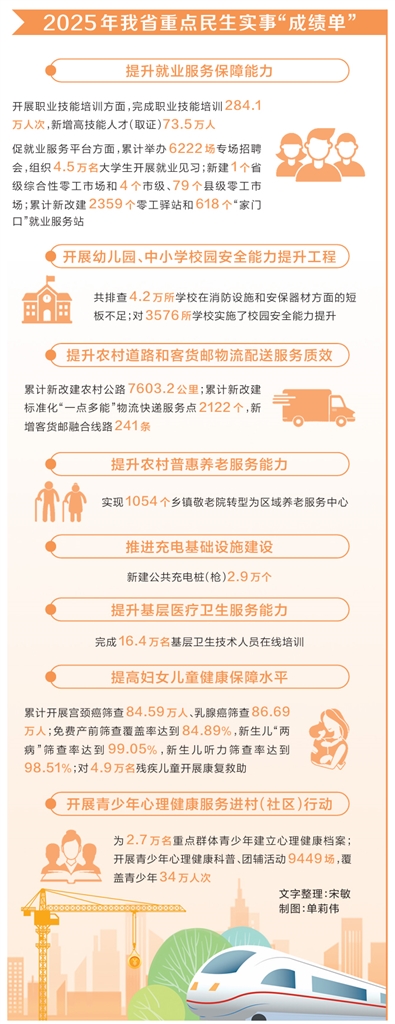
Core Viewpoint - The article highlights the achievements and future plans of the provincial government in enhancing public welfare through various initiatives in employment, education, healthcare, and elderly care, emphasizing a commitment to improving the quality of life for citizens [5]. Employment and Skills Training - A total of 284.1 million people received vocational skills training, exceeding the annual target by 142.1% [6] - 6,222 specialized job fairs were held, and 45,000 university students participated in employment internships [6] - New construction and renovation of 2,359 labor service stations and 618 "doorstep" employment service stations were completed [6] Education and Safety - 4.2 million schools were inspected for fire safety and security equipment deficiencies, with safety enhancement measures implemented in 3,576 schools [6] - The government is focused on improving educational facilities and safety standards in schools [8] Healthcare Initiatives - 16.4 million grassroots health technicians received online training [3] - Cancer screenings reached 845,900 for cervical cancer and 866,900 for breast cancer, with prenatal screening coverage at 84.89% [3] - Newborn screening rates for critical conditions were reported at 99.05% for "two diseases" and 98.51% for hearing [3] Elderly Care Services - 1,054 township nursing homes were transformed into regional elderly service centers [2] - The government is expanding elderly care services, including community meal services and support for disabled elderly individuals [8] Infrastructure Development - 7,603.2 kilometers of rural roads were newly constructed or renovated, surpassing the target by 152.1% [6] - 29,000 public charging stations were established, achieving 145.4% of the goal [6] Future Plans for 2026 - The government plans to continue focusing on education, healthcare, and elderly care, with new initiatives aimed at enhancing service delivery and addressing community needs [7] - New projects include improving parking solutions and updating old residential elevators to enhance safety and convenience for residents [8] Financial Commitment - The provincial government allocated 849.94 billion yuan for public welfare, representing 73.8% of the general public budget [6] - Specific funding was designated for various initiatives, including 8.58 billion yuan for employment services and 2.95 billion yuan for charging infrastructure [6]
北京将建设15家生育友好医院
Xin Lang Cai Jing· 2026-02-04 19:29
Core Points - Beijing's 2026 key livelihood projects have been officially announced, covering ten areas including education, elderly care, disability assistance, employment, healthcare, housing, transportation, and culture [1] - The focus of these projects is on young children and the elderly, with specific initiatives aimed at enhancing services and support for these demographics [1][2] Education - Beijing will increase educational capacity by adding 10,000 new school places, including 5,000 for junior high and 5,000 for senior high [2] - A comprehensive vision screening and myopia risk assessment will be conducted for 134,000 kindergarten children [1] Elderly Care - The city plans to establish 20 new community elderly care service centers, providing integrated services such as meal assistance, bathing, cleaning, and professional care [1] - An additional 5,000 family elderly care beds will be constructed [1] Healthcare - Five new integrated urban medical groups will be established, along with 15 new family-friendly hospitals and 15 hospitals offering multidisciplinary outpatient services [2] - Community health centers will add 45 traditional Chinese medicine symptom clinics [2] Employment - Beijing aims to create no less than 100,000 job opportunities for college graduates and assist 100,000 unemployed individuals in finding employment [2] - 2,500 new job positions for people with disabilities will be created, along with vocational training for 5,000 disabled individuals [2] Housing and Living Environment - The city will install over 800 elevators in old residential buildings and assess the safety of 6,000 old elevators [2] - Plans include the renovation of 1,000 kilometers of outdated utility pipelines and the replacement of 700,000 smart meters [2] Transportation - New subway lines and stations will be opened, including the 22nd line and several new access points on existing lines [3] - A total of 30 traffic improvement projects will be implemented to alleviate congestion [3] Parking Solutions - The initiative includes the addition of 10,000 paid shared parking spaces and the utilization of 5,000 new parking spaces from civil defense projects [4] - The city will also enhance the use of under-bridge spaces at 46 key bridges [4] Cultural Activities - Beijing plans to host 16,000 cultural events and 100 exhibitions, including activities related to the origins of Chinese civilization [4] - Community sports events will include 200 competitions, and 70 sports facilities will be newly constructed or renovated [4]
新西兰第四季失业率升至5.4% 创10年高位
Xin Lang Cai Jing· 2026-02-04 00:06
Core Insights - New Zealand's unemployment rate rose to a 10-year high of 5.4% in Q4, driven by an increase in job seekers that offset employment growth [1][2] - The report indicates that interest rates will need to remain low for some time, with the current Official Cash Rate (OCR) at 2.25% [1][2] - The rise in unemployment was above market expectations of 5.3% and slightly higher than the Reserve Bank of New Zealand's forecast, which is disappointing given recent signs of economic improvement [1][2] Employment Data - The private sector annual salary growth remains low at 2.0%, significantly below the consumer price inflation rate of 3.1% [1][2] - On a positive note, employment numbers increased by 0.5% quarter-on-quarter, surpassing the expected 0.3%, marking the first growth in 18 months [1][2] - The labor force participation rate rose to 70.5%, indicating a slight improvement in labor market engagement [1][2] Market Reactions - Following the news, the New Zealand dollar slightly declined to 0.6045 USD, and interest rate futures rebounded as the market adjusted the likelihood of rate hikes, at least until September [1][2] - Investors anticipate that the Reserve Bank of New Zealand will not adjust rates in the upcoming policy meeting on February 18, with the first potential rate hike expected in July [1][2]
服务消费领域再迎政策利好
Bank of China Securities· 2026-01-31 14:31
Investment Rating - The industry investment rating is "Outperform the Market," indicating that the industry index is expected to perform better than the benchmark index over the next 6-12 months [13]. Core Insights - The report highlights the recent policy benefits in the service consumption sector, emphasizing the importance of optimizing and expanding service supply to foster new growth points in service consumption. The government's plan includes 12 measures across key and potential areas, aiming to enhance service quality and support economic development [1][3]. - The focus on supply-side structural reforms is expected to stimulate both short-term and long-term consumer demand, promoting a virtuous cycle of employment, income, and consumption, thereby providing long-term support for economic growth [3][7]. - Key areas of focus include transportation, domestic services, cultural tourism, and sports events, with potential areas such as performance services and experiential consumption also highlighted for their growth potential [3][7]. Summary by Relevant Sections Policy Support Areas - The report outlines three main policy support areas with twelve specific measures, including: 1. Transportation services aimed at integrating tourism and enhancing service quality [7]. 2. Domestic services focusing on innovation and skill training [7]. 3. Cultural tourism services that encourage infrastructure development and enhance consumer experiences [7]. Potential Growth Areas - The report identifies potential growth areas such as performance services, sports events, and experiential consumption, which are expected to drive demand in related sectors like accommodation and dining [3][7]. Financial and Structural Support - The report emphasizes the need for a robust support system, including the establishment of standards, credit building, and financial backing to ensure the stable development of service consumption [3][7].


广东“投资于人”,每一分都流向你我更踏实的日子丨政策大白话
Sou Hu Cai Jing· 2026-01-31 06:24
Core Insights - The 2026 Guangdong Provincial Government Work Report emphasizes "investment in people" as a new trend, shifting focus from traditional infrastructure and industrial investment to areas directly impacting citizens' lives such as education, employment, healthcare, housing, and elderly care [1] Group 1: Investment in People - "Investment in people" aims to allocate more resources to essential sectors, focusing on reducing rigid living costs and enhancing individuals' ability to create wealth and withstand risks [1] - During the 14th Five-Year Plan period, Guangdong's expenditure on people's livelihoods reached 6.45 trillion yuan, accounting for over 70% of general public budget expenditures [1] - Over the past five years, the province has created more than 7 million new urban jobs and provided stable employment for 43.86 million migrant workers, alongside the construction of 1.554 million units of affordable housing [1] Group 2: Specific Initiatives - Childcare support will be expanded with subsidies for over 3 million infants and the establishment of new childcare facilities [2] - Employment initiatives include plans to absorb over 1 million college graduates for employment and entrepreneurship in Guangdong, along with subsidized vocational training for over 300,000 individuals [3] - Healthcare improvements will focus on continuous health management services for key populations and enhanced interoperability of medical examination results [4] - Education expansion includes the addition of over 200,000 regular high school places and improved support for county-level high school education [4] - Long-term care insurance systems will be accelerated to provide basic living and medical care for severely disabled individuals, with increased subsidies for vulnerable groups [5] Group 3: Strategic Importance - The ongoing investment in people's livelihoods reflects Guangdong's foresight in addressing economic transformation pressures, aiming to boost confidence and consumption while stabilizing the economy [5] - The shift towards "investment in people" signifies a deeper change in development logic, focusing on human happiness and long-term competitiveness rather than merely short-term expenditures [6]