
居住

Search documents
年末通胀加速回升,什么信号?
HUAXI Securities· 2026-01-09 12:05
Inflation Data Summary - December 2025 CPI year-on-year increased to 0.8%, matching expectations and up from 0.7% in the previous month[1] - Month-on-month CPI rose by 0.2%, a significant improvement from -0.1% in the prior month, marking the largest increase for December since 2021[1] - Core CPI, excluding food and energy, remained stable at 1.2% year-on-year, with a month-on-month increase of 0.2%[1] Core CPI Analysis - Core CPI has shown resilience, supported mainly by industrial consumer goods, maintaining a 1.2% increase for four consecutive months[2] - Prices of industrial consumer goods rose by 0.6%, contributing approximately 0.16 percentage points to the CPI increase[2] - Notable contributors include household appliances (1.4% increase), other goods and services (2.8% increase), and communication tools (3.0% increase) in December[2] Food Price Trends - Food prices increased by 0.3% month-on-month, contributing about 0.05 percentage points to the CPI, slightly above the 2021-2024 average of 0.1%[3] - Fresh vegetables and fruits saw significant increases of 0.8% and 2.6%, respectively, while pork prices continued to decline by 1.2%[3] - As of January 8, 2026, pork wholesale prices have risen by 1.9% compared to December 2025, indicating potential stabilization[3] Housing and Energy Impact - Housing prices decreased by 0.1% month-on-month, negatively impacting CPI due to its high weight of approximately 22%[4] - Fuel prices for transportation fell by 1.1%, contributing to a 0.04 percentage point decrease in CPI[4] PPI Insights - December PPI increased by 0.2% month-on-month, indicating a recovery in industrial prices after a low period[4] - The mining sector saw a 0.8% increase, while raw materials rose by 0.6%, marking a 19-month high[5] - The overall PPI remains under pressure from declining oil prices, with the oil and gas extraction sector experiencing a 1.3% drop[6] Market Implications - Current inflation levels are moderate, suggesting no immediate constraints on "loose monetary policy" but limiting the downward space for long-term interest rates[8] - Industrial price recovery is a positive signal for improving profit expectations, although a broad-based price increase has not yet materialized[8] Risk Factors - Potential unexpected adjustments in monetary policy could arise from economic slowdowns or changes in overseas monetary policies[9] - Liquidity may also experience unexpected changes if domestic economic data continues to exceed expectations[9]
民生实事绘就暖心答卷,小家大家共赴美好向荣
Xin Lang Cai Jing· 2026-01-09 09:24
Group 1 - The core viewpoint of the articles emphasizes the successful completion of 45 livelihood projects in Jiangsu Province, enhancing social security and public service systems, thereby increasing the sense of gain, happiness, and security among the people [1][2][3] - In the transportation sector, 1,400 kilometers of rural roads were newly constructed or renovated, and 330 rural bridges were upgraded, improving accessibility and safety for rural residents [1] - In housing, 771 old residential communities were renovated, and government subsidies were provided for the replacement of elevators over 15 years old, ensuring safety upgrades at minimal cost to residents [1] Group 2 - Employment support was enhanced with 349 standardized employment service stations optimized, and 25 "Suqing Stations" provided free accommodation and policy packages for job-seeking youth, facilitating closer job access [2] - In education, 30 ordinary high schools were newly built or expanded, and 224 standardized psychological counseling rooms were established in junior high schools, reflecting tangible improvements in educational quality [2] - Healthcare services saw the completion of 13 county-level maternal and child health hospitals, with HPV vaccination coverage exceeding the 2025 target, allowing residents to access quality medical services locally [2] Group 3 - The development approach in Jiangsu is characterized by a systematic work framework that ensures projects are based on community needs, with financial support increasing by 858 million yuan for university dormitory renovations and special funds for HPV vaccine supply [3] - The methodology of "asking the people for needs, advice, and effectiveness" allows for continuous optimization of livelihood projects, addressing immediate concerns while focusing on long-term development [3] - The comprehensive completion of livelihood projects reflects a harmonious relationship between individual household well-being and broader societal development, indicating a commitment to enhancing public service levels and social security systems [3]
奋楫“十五五”,资本与国策共创
Sou Hu Cai Jing· 2025-12-03 01:52
Core Insights - The focus of national development is shifting from "quantitative recovery" post-pandemic to "qualitative leap" in the "15th Five-Year Plan" [1] - The "15th Five-Year Plan" emphasizes "high-level technological self-reliance" and aims for a dual goal of "effective qualitative improvement and reasonable quantitative growth" [5][11] Group 1: Economic and Industrial Strategy - The national strategy is entering a new cycle centered on innovation efficiency, industrial structure, and regional collaboration, marking a shift from "policy following" to "system co-creation" [4] - The plan aims to build a modern industrial system with advanced manufacturing as the backbone, focusing on future industries like quantum technology, biomanufacturing, and hydrogen energy [11] - The transition from "incremental manufacturing" to "efficiency manufacturing" indicates a shift in focus from merely increasing production to optimizing resource allocation [12] Group 2: Investment Opportunities - Hard technology investment, including semiconductors and advanced materials, is positioned as a foundational logic for "systematic breakthroughs" [10] - Investment institutions are encouraged to engage in pre-financing and result transformation for national technology tasks, fostering capital co-creation [10] - The emphasis on "entrepreneurial investment + risk-sharing mechanisms" presents opportunities for investment firms to participate in national innovation initiatives [10] Group 3: Green Development - The "15th Five-Year Plan" elevates green development from a secondary goal to a structural institution, influencing all industrial allocations [17] - The integration of green issues into financial and market mechanisms signifies a shift in perspective, making green development a capital issue [17] - Sustainable investment opportunities in green infrastructure and carbon asset management are expected to grow [20] Group 4: Consumer and Market Dynamics - The plan positions consumption upgrade as a core driver of economic structural transformation, moving from recovery to quality enhancement [22] - The "silver economy" is recognized as a significant industrial opportunity, transforming aging issues into growth engines [22][25] - Investment opportunities in healthcare, elder care, and technology-assisted living are anticipated to rise due to demographic shifts [25] Group 5: Regional Development - The focus of regional policy is shifting from "development gradient" to "structural coordination," promoting a unified market and efficient resource allocation [27] - Investment institutions are encouraged to collaborate with local guiding funds to strengthen project foundations and facilitate new industry development in less developed regions [30] Group 6: Financial Market Reforms - The "15th Five-Year Plan" emphasizes structural improvements in capital markets, transitioning from a focus on financing to a comprehensive investment-funding-exit cycle [32] - Direct investment institutions are identified as key players in building a strong financial nation, with multiple exit pathways being developed [35] - The plan aims to enhance the inclusivity and adaptability of capital market systems, promoting direct financing methods [31] Strategic Summary - The "15th Five-Year Plan" outlines new engines for China's economic growth, including technological innovation and green transformation, while establishing a more inclusive capital market system [36] - Investment institutions are encouraged to align their strategies with national planning, leveraging professional judgment to identify promising sectors and companies for investment [36]


四川出台促进服务消费“十九条” 让百姓的日子更“活色生香”
Si Chuan Ri Bao· 2025-11-19 02:01
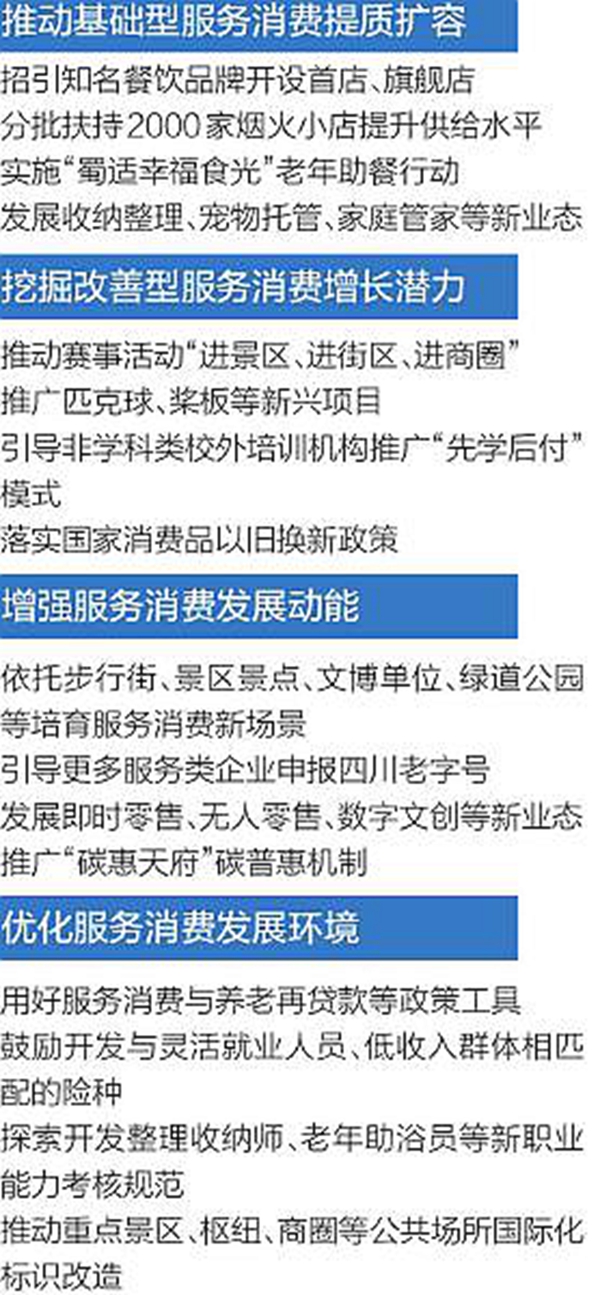
Group 1 - The core viewpoint of the news is the implementation of a comprehensive plan to enhance service consumption quality and expand its capacity in Sichuan Province, focusing on various sectors including dining, elderly care, and cultural tourism [2][3][4] - The plan includes nurturing 2,000 distinctive local shops to improve urban liveliness and convenience, alongside initiatives to enhance community elderly care services and develop new home service industries [4][5] - The strategy aims to tap into the growth potential of improved service consumption by promoting sports events and outdoor activities, as well as enhancing non-academic training services [4][6] Group 2 - The plan outlines 19 measures across four main areas: improving basic service consumption, exploring growth potential in improved service consumption, enhancing development momentum for service consumption, and optimizing the consumption environment [3][4] - New service consumption scenarios and business models will be developed, leveraging commercial complexes, pedestrian streets, and cultural sites to create unique and international service experiences [5][6] - Financial support will be strengthened for key service consumption sectors and the elderly care industry through various policy tools, aiming to meet diverse consumer needs and stimulate economic growth [6]
国家统计局:6月份食品烟酒类价格环比下降0.3%,影响CPI下降约0.09个百分点
news flash· 2025-07-09 01:34
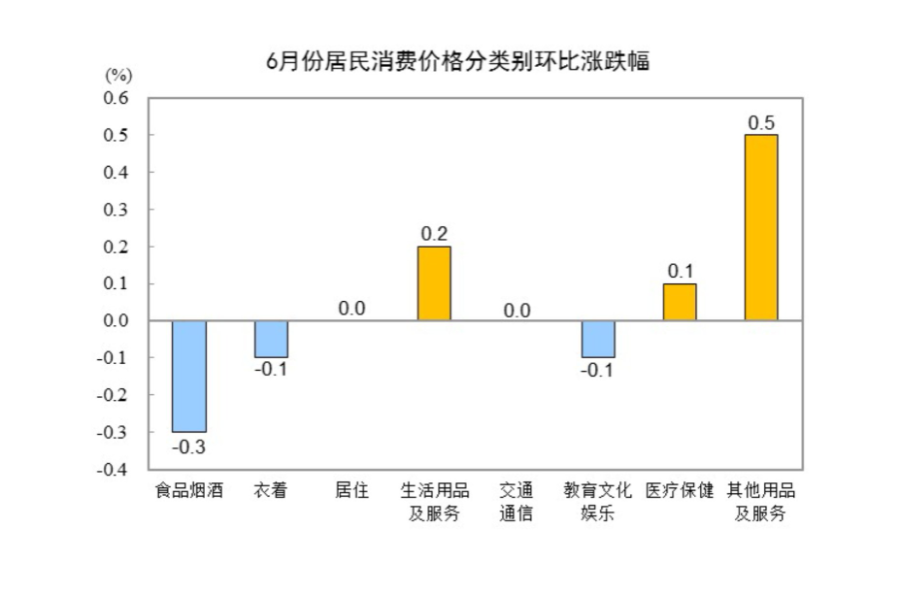
Core Insights - In June, the prices of food, tobacco, and alcohol decreased by 0.3% month-on-month, contributing to a decline in the Consumer Price Index (CPI) by approximately 0.09 percentage points [1] Price Changes in Food Categories - Fresh fruit prices fell by 3.3%, impacting the CPI by a decrease of about 0.07 percentage points [1] - Egg prices decreased by 2.9%, contributing to a CPI decline of approximately 0.02 percentage points [1] - Meat prices dropped by 0.6%, with pork prices specifically declining by 1.2%, affecting the CPI by a decrease of around 0.02 percentage points [1] - Fresh vegetable prices increased by 0.7%, leading to a CPI increase of about 0.01 percentage points [1] - Seafood prices also rose by 0.7%, contributing to a CPI increase of approximately 0.01 percentage points [1] Other Price Categories - Among the other seven major categories, three saw price increases while two remained stable and two decreased [1] - Prices for other goods and services, daily necessities, and healthcare rose by 0.5%, 0.2%, and 0.1% respectively [1] - Housing and transportation communication prices remained unchanged [1] - Clothing, education, culture, and entertainment prices decreased by 0.1% [1]
5月永州市CPI同比下跌0.6%
Sou Hu Cai Jing· 2025-06-19 02:12
Group 1 - In May, the Consumer Price Index (CPI) in Yongzhou City decreased by 0.6% year-on-year and by 0.3% month-on-month [1] - Among eight categories of goods, five experienced price increases while three saw declines year-on-year [1] - The prices of other goods and services rose by 7.5%, while transportation and communication prices fell by 3.5% year-on-year [1] Group 2 - Non-food prices decreased by 0.3% month-on-month, with service prices down by 0.1%, contributing to a CPI decline of approximately 0.04 percentage points [2] - Housing prices, both self-owned and rental, fell by 0.7% and 0.4% respectively, impacting CPI by about 0.10 percentage points [2] - International oil price declines led to domestic gasoline and diesel prices dropping by 3.8% and 4.0%, respectively, affecting CPI by approximately 0.15 percentage points [2]