
劳动力市场疲软

Search documents
美国重磅就业报告即将揭晓:91.1万就业岗位恐“蒸发”?
Jin Shi Shu Ju· 2026-02-09 12:54
Core Viewpoint - The upcoming employment report is expected to reveal significant insights into the slowdown of the U.S. labor market, with a notable downward revision of job numbers anticipated, indicating a potential shift in the perception of labor market health [1][2]. Group 1: Employment Data and Revisions - The January employment report will include a crucial revision of job numbers, with an initial estimate showing a record downward adjustment of 910,000 jobs for the year ending March 2025 [1]. - The report will also provide monthly employment revisions for the previous year, reflecting updates to the Bureau of Labor Statistics' (BLS) models that account for business openings and closures [1][4]. - Economists suggest that the revised data may indicate a more severe slowdown in hiring than previously thought, potentially altering the Federal Reserve's view on the labor market [2][3]. Group 2: Labor Market Conditions - Recent data indicates that U.S. companies announced the largest number of layoffs in January since the Great Recession, while job vacancies fell to their lowest level since 2020 [3]. - The market anticipates an increase of 70,000 in non-farm payrolls for January, with the unemployment rate expected to remain at 4.4%, slightly below the four-year high of 4.5% reached in November [3]. - The labor market appears to be at a critical juncture, with net job growth and potential job losses being closely monitored [1][2]. Group 3: Political and Economic Implications - The adjustments to employment data have become highly politicized, particularly following former President Trump's criticism of the BLS and claims of manipulated data for political purposes [4][5]. - Economists argue that revisions are necessary for accuracy and are based on more comprehensive source data, which helps balance speed and reliability [5][6]. - Transparency in revisions is essential to maintain trust in official statistics, despite the potential for confusion and conspiracy theories surrounding the data [6].
【美联储戴利指出劳动力市场存在脆弱性,仍有降息空间】美国旧金山联储主席戴利表示,她认为可能需要再降息一到两次,以应对劳动力市场疲软。当前劳动力市场中,人们“如履薄冰”——物价上涨蚕食着工资,而新的就业机会却寥寥无几。戴利表示:“我认为我们必须对利率保持开放态度,非常开放的态度。”(路透)
Sou Hu Cai Jing· 2026-02-09 01:05
Core Viewpoint - The Federal Reserve's Daly indicates that there may be a need for one to two more interest rate cuts to address the weakness in the labor market [1] Group 1: Labor Market Conditions - The current labor market is described as fragile, with rising prices eroding wages and few new job opportunities available [1] - Daly emphasizes that individuals in the labor market feel as if they are "walking on thin ice" due to these economic pressures [1] Group 2: Interest Rate Policy - Daly advocates for maintaining an open attitude towards interest rates, suggesting flexibility in monetary policy to respond to economic conditions [1]
美联储戴利认为劳动力市场存在脆弱性,有降息空间
Xin Lang Cai Jing· 2026-02-06 21:06
Core Viewpoint - The President of the San Francisco Federal Reserve, Mary Daly, suggests that there may be a need for one or two more interest rate cuts to address the weakness in the labor market, as rising prices are eroding workers' wages and new job opportunities are scarce [1][4]. Group 1: Interest Rate Outlook - Daly emphasizes the importance of maintaining an open mindset regarding interest rates, supporting the recent decision to keep the benchmark rate stable at 3.50%-3.75% [1][4]. - She believes there are valid reasons for further rate cuts, contingent on confidence that the impact of tariffs will diminish and inflation is on a downward trajectory [1][4]. Group 2: Labor Market Concerns - The unemployment rate in the U.S. was reported at 4.4% in December, with economists expecting it to remain unchanged in January [2][5]. - Daly expresses greater concern for the labor market than for inflation, noting that if businesses do not see expected demand, a "sluggish" labor market could quickly lead to layoffs [2][6]. - She highlights a troubling trend where many parents report difficulties for their children in finding jobs, with recent data indicating that the unemployment rate for recent college graduates is higher than that of the general workforce [3][7].
金荣中国:美伊谈判引发市场关注,金价扩大回落加剧震荡
Sou Hu Cai Jing· 2026-02-06 01:46
Market Overview - International gold prices experienced fluctuations and closed lower on February 5, with an opening price of $4,920.22 per ounce, a high of $5,023.74, a low of $4,789.40, and a closing price of $4,817.64 [1] Employment and Economic Indicators - In January, U.S. employers announced a significant increase in layoffs, with a total of 108,435 planned job cuts, marking a 118% year-over-year increase and the highest level for January in 17 years [3] - The transportation sector saw the largest layoffs, with 31,243 job cuts related to United Parcel Service, while the technology sector announced 22,291 layoffs, primarily from Amazon, which plans to cut 16,000 corporate jobs [3] - Initial jobless claims rose by 22,000 to 231,000, exceeding market expectations, as severe winter weather impacted business activity [4] - Job openings unexpectedly fell to the lowest level since 2020, with December vacancies dropping from a revised 6.93 million to 6.54 million, indicating weak labor demand [5] Federal Reserve and Interest Rates - According to CME's FedWatch tool, the probability of a 25 basis point rate cut by the Federal Reserve by March is 22.7%, while the probability of maintaining the current rate is 77.3% [8] Technical Analysis of Gold - Gold prices are showing signs of a downward trend, with daily moving averages indicating a bearish pattern. The price is facing resistance below the 10-day moving average, suggesting a potential top formation [11] - The trading strategy for gold suggests cautious high short and low long positions, with specific entry and exit points outlined for both aggressive and conservative traders [11]


天气因素将提振1月份就业人数,尽管ADP数据疲软
Sou Hu Cai Jing· 2026-02-04 14:51
Group 1 - The ADP report indicated that the private sector added 22,000 jobs last month, which is below the Wall Street Journal's average expectation of 45,000 jobs [1] - Pantheon forecasts that January's employment numbers will increase by 100,000, despite the ADP report being lower than expected [1] - The official employment data release has been delayed due to a partial government shutdown, which was originally scheduled for Friday [1] Group 2 - The labor market is expected to remain weak, which may exert pressure on the Federal Reserve to consider interest rate cuts [1] - The unusually mild weather in early January has boosted activity in sectors such as construction, leisure and hospitality, and transportation and logistics [1] - The trend in job growth is anticipated to remain between 50,000 to 75,000 jobs [1]
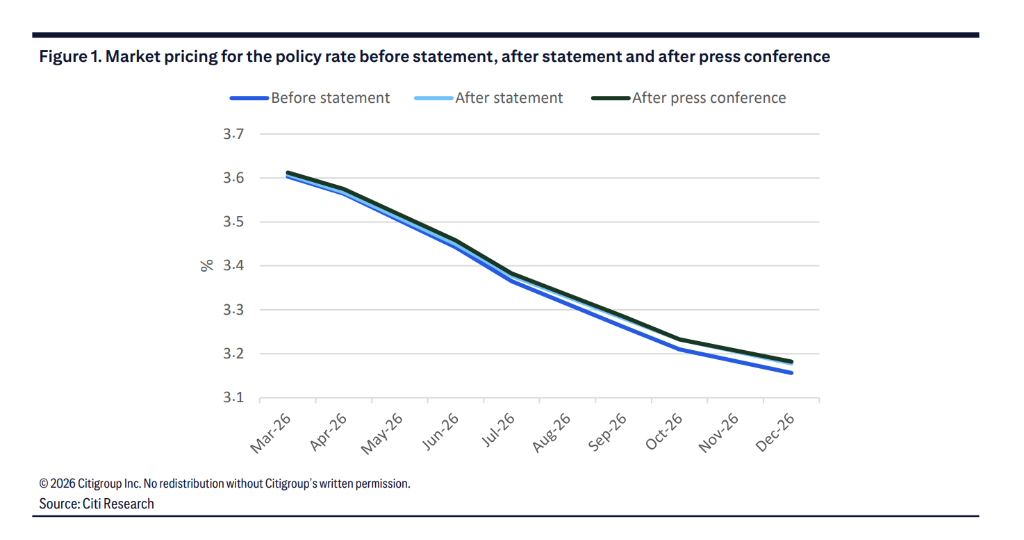
“大致中性”or“略微偏紧”?花旗解读鲍威尔讲话:降息门槛已经较低,年内有望降息三次
Hua Er Jie Jian Wen· 2026-01-29 10:07
Group 1 - The core viewpoint of the news is that despite the Federal Reserve maintaining interest rates, there are underlying signals indicating a potential shift towards rate cuts due to economic concerns [1][3] - The Federal Reserve's current policy rate is described as being in a "slightly restrictive" range, which suggests that if inflation continues to decline, it could lead to a rise in real interest rates, potentially suppressing the economy [3][4] - Citigroup predicts that the Federal Reserve will cumulatively cut rates by 75 basis points by 2026, indicating that the current pause in rate changes may be a precursor to future easing [1][4] Group 2 - The labor market is described as showing signs of stabilization, but underlying weaknesses remain, as indicated by a decline in the number of people feeling secure in their jobs [4][5] - Powell's comments on inflation suggest a belief that inflation will return to the 2% target, with current elevated core inflation primarily driven by tariff-related price increases, which are expected to subside [5][6] - Internal divisions within the Federal Reserve were highlighted, with some members voting against maintaining the current rate, indicating ongoing support for easing despite the current economic data [6][7]
英国就业人数持续下降 工资增长放缓
Xin Lang Cai Jing· 2026-01-20 15:49
Group 1 - The UK wage growth has slowed down, with private sector wage growth dropping to its lowest level in five years at 3.6% from August to November, compared to 4.5% in the previous period [1] - Employment numbers are declining, particularly in the retail and hospitality sectors, indicating a weak labor market despite the traditional hiring season approaching during Christmas [1] - The overall unemployment rate in the UK remains stable at 5.1%, which is the highest level since the lockdowns in early 2021 [1] Group 2 - The slowdown in wage growth is viewed positively by economists as it may help in controlling inflation, aligning with the Bank of England's target of 2% [1] - The Bank of England has cut interest rates six times since August 2024, with the latest reduction bringing the benchmark rate down to 3.75% in December [2] - The market anticipates that the Bank of England will maintain the current borrowing costs in the upcoming February meeting [2]
高盛观点 | 2026年中国宏观经济展望
高盛GoldmanSachs· 2026-01-16 05:05
Economic Outlook - Goldman Sachs projects China's real GDP growth to reach 4.8% in 2026, surpassing the market consensus of 4.5% [1] - Structural challenges such as weak consumer spending and a sluggish labor market persist, although the drag from the declining real estate market is expected to lessen [1] - The firm anticipates that increased exports and a reduction in the negative impact of the real estate sector will lead to a faster-than-expected economic growth this year [1] Trade and Inflation - The forecast for Producer Price Index (PPI) inflation is -0.7%, slightly better than the consensus expectation of -1.0% [2] - The PPI has been in deflation for over three years, prompting the government to implement "anti-involution" policies to curb price competition among manufacturers [2] - Goldman Sachs expects the current account surplus to rise from 3.6% of GDP in 2025 to 4.2% in 2026, contrary to the consensus prediction of a decline to 2.5% [2] Export Dynamics - The resilience of Chinese exports is attributed to three factors: rapid expansion of exports to emerging markets, limited ability of other countries to impose trade barriers against China in key mineral sectors, and greater growth potential in high-tech exports [5] - The firm predicts that export prices, measured in USD, will turn positive in 2026, increasing from -2.7% last year to 0.7% [6] Consumer and Labor Market - The labor market in China has been weak, with employment indices at their lowest levels in a decade, and nominal wage growth expected to slow to 3.8% year-on-year by Q3 2025 [7] - Targeted government policies are anticipated in 2026 to alleviate labor market pressures and support income growth, including subsidies for labor-intensive services and increased minimum wages [7] - Despite a forecasted slowdown in household consumption growth, government consumption is expected to accelerate, balancing the overall contribution of consumption to GDP growth [7] Real Estate Market - The Chinese real estate sector is in its fifth year of decline, with most activity indicators down by 50%-80% from peak levels in 2020-2021 [8] - There are no signs of stabilization in the real estate market, with high housing inventory and severe financing conditions for major developers [11] - Goldman Sachs predicts that the drag from the real estate sector on GDP growth will decrease by 0.5 percentage points annually, although it will still negatively impact growth in the coming years [11] Risks to Growth Outlook - The growth forecast faces slight downward risks due to weaker-than-expected momentum and a lack of urgency for significant policy easing from decision-makers [12] - Potential risks include renewed tensions in US-China relations, increased trade barriers from major trading partners, and intensified financial pressures on local governments and banks [12]


表面增长暗藏隐忧:加拿大自雇人数激增 私营部门雇佣转冷
Xin Lang Cai Jing· 2026-01-09 14:35
Core Insights - Canada experienced a net employment increase of 8,200 jobs in December, contrary to market expectations of a decrease of 2,500 jobs [1] - The majority of the employment growth, specifically 7,300 jobs, was in the self-employment category, indicating potential weaknesses in the labor market [1] - Private sector employment saw a slight decline, while public sector jobs increased [1] - Year-over-year hourly wage growth slowed from 3.6% in the previous month to 3.4% in December [1]
紧盯周五非农,美联储1月降息的关键因素:失业率升至4.7%
Sou Hu Cai Jing· 2026-01-06 09:13
Core Viewpoint - The upcoming non-farm payroll report is crucial for determining the Federal Reserve's short-term policy path, with expectations of a potential interest rate cut if the unemployment rate rises to 4.7% in December [1][2]. Labor Market Signals - Analysts indicate that the December employment report follows the weak November data, with expectations of a 4.7% unemployment rate, which is key for maintaining the Fed's rate cut trajectory [2]. - Job growth is projected at 75,000, but adjustments suggest that actual employment growth is nearing stagnation, supported by a downward trend in job postings and stable initial unemployment claims [2]. Policy Path and Rate Cut Expectations - The Fed is expected to cut rates by 100 basis points in 2024, followed by a pause and an additional 75 basis points in 2025, with current rates at the upper limit of the neutral zone indicating potential for further cuts [3]. - Historical trends suggest that a significant weakening in the labor market will prompt the Fed to resume rate cuts, despite the unpredictability of monthly data [3]. Macro Environment Supporting Deeper Rate Cuts - Other macro indicators, such as oil prices remaining below $65 per barrel, help alleviate inflationary pressures, while the ISM manufacturing index is expected to remain in contraction territory [4]. - The risk balance for 2026 leans towards a weak labor market and further inflation decline, suggesting a higher likelihood of rate cuts exceeding 60 basis points compared to market expectations [4].