
批发零售业等

Search documents
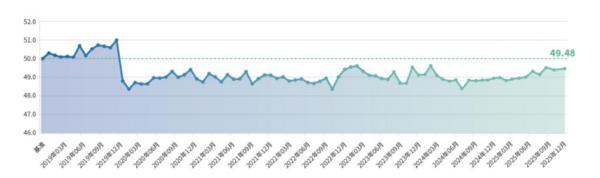
新华指数|2025年12月普惠金融-景气指数:融资精准有力 经营温和回暖
Xin Hua She· 2026-01-22 06:09
Core Insights - The Inclusive Finance Prosperity Index reached 49.48 points in December 2025, an increase of 0.12 points from November and 0.61 points higher than the same period last year, indicating a stable financial support for small and micro enterprises [1] Financing Dimension - The financing prosperity index stood at 54.82 points in December, a slight decrease of 0.01 points from November, with continuous growth in credit scale and historically low financing costs [2] - In 2025, new loans totaled 16.27 trillion yuan, with corporate loans accounting for 15.47 trillion yuan, reflecting effective credit demand from enterprises and residents [2] Operating Dimension - The operating prosperity index increased to 48.44 points in December, up by 0.16 points from November, with manufacturing and non-manufacturing PMIs indicating expansion [3] - The consumer price index rose by 0.8% year-on-year in December, improving corporate profit expectations and boosting market confidence [3] Industry Prosperity - Among nine major industries, six showed an increase in operating prosperity, particularly in agriculture and transportation due to seasonal demand, while three industries experienced a decline [6] - The real estate sector showed some improvement, while industrial, construction, and wholesale retail sectors saw a decrease in operating prosperity [6] Regional Prosperity - Among seven regions, three experienced an increase in operating prosperity, specifically Northeast, South China, and Southwest regions, while four regions saw a decline [7] - The indices for North China, East China, Central China, and Northwest regions were lower, indicating regional disparities in economic performance [7]

湖北2025“年中答卷”:GDP增6.2%,外贸首破4千亿元
2 1 Shi Ji Jing Ji Bao Dao· 2025-07-18 12:10
Economic Overview - Hubei Province achieved a GDP of 29,642.61 billion yuan in the first half of 2025, with a year-on-year growth of 6.2%, accelerating by 0.4 percentage points compared to the previous year and exceeding the national average by 0.9 percentage points [1][2] Sector Performance - The first industry added value was 1,914.07 billion yuan, growing by 3.3%; the second industry added value was 11,544.28 billion yuan, growing by 6.4%; and the third industry added value was 16,184.26 billion yuan, also growing by 6.4% [2] - Key industrial metrics showed significant growth: industrial added value increased by 7.9%, service industry revenue rose by 12.2%, fixed asset investment grew by 6.5%, retail sales of consumer goods increased by 6.9%, and total import and export volume surged by 28.4% [2] Innovation and Investment - High-tech manufacturing added value grew by 14.4%, contributing 27.5% to the industrial sector; production of computers, smartphones, optical fibers, and lithium-ion batteries saw increases of 31.5%, 19.9%, 25.7%, and 62.1% respectively [2] - Investment in high-tech industries rose by 8.8%, with high-tech service industry investment increasing by 24.6% [3] Consumption and Trade - Total investment in Hubei increased, with 19,250 construction projects, a growth of 7.1%; project investment (excluding real estate) grew by 9.8%, surpassing the national average by 3.2 percentage points [4] - Retail sales in wholesale and retail sectors grew by 5.9% and 8.7% respectively, with significant increases in consumer spending on durable goods and services [5][6] - Hubei's foreign trade reached a new high, with total imports and exports exceeding 400 billion yuan, reaching 402.31 billion yuan, with exports growing by 38.5% and imports by 7.4% [6][7] Agricultural and Income Growth - Agricultural output increased by 3.6%, with summer grain production reaching 9.901 billion jin, a year-on-year growth of 0.9% [8] - Per capita disposable income in Hubei reached 18,930 yuan, growing by 5.3%, with urban and rural income disparities narrowing [8]