智能产品制造业

Search documents
爱上“中国范儿” 外国人来华过年购物成为新风尚
Xin Hua Wang· 2026-02-20 02:53
Group 1 - The number of international tourists visiting China during the Spring Festival is increasing, with a predicted daily average of over 2.05 million people crossing borders, representing a year-on-year growth of 14.1% [2] - Foreign tourists' flight bookings to China have surged by over 400% compared to the previous year, indicating a strong interest in experiencing traditional Chinese culture [2] - The consumption patterns of inbound tourists are evolving, with a notable increase in the purchase of unique Chinese products, reflecting a shift from mere sightseeing to cultural engagement [2] Group 2 - The popularity of products featuring zodiac elements and traditional designs has risen, with tourists expressing a desire to take home a piece of the festive atmosphere [3] - High-tech Chinese products are gaining attention, with many tourists eager to experience and purchase innovative items, leading to a perception shift from "cheap alternatives" to "Chinese intelligence" [3][4] - The Chinese government is enhancing entry convenience through visa policies, with the number of visa-free countries increasing to 48 by 2025, which is expected to boost inbound tourism significantly [4] Group 3 - The number of duty-free shops in China has reached 12,252, with over 7,000 offering "immediate refund" services, facilitating easier shopping for international tourists [4] - The Chinese government is investing in digital services to improve the internationalization and convenience of inbound services, with an initial funding of 1 billion yuan allocated for pilot projects in 15 cities [6]


权威发布丨五个关键词解码七月经济
Ren Min Ri Bao· 2025-08-16 02:15
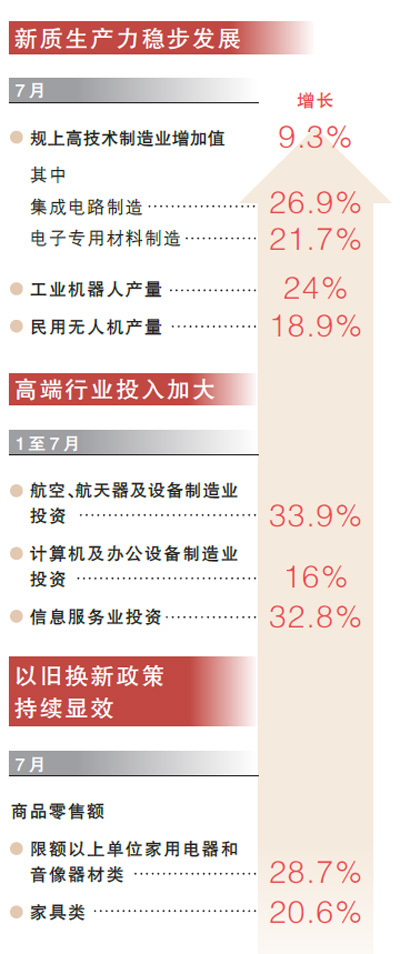
Economic Overview - The core viewpoint is that despite facing risks and challenges, China's economy is showing steady progress with new growth drivers emerging, supported by effective macro policies and expanding market demand [2][10]. New Productive Forces - In July, the added value of high-tech manufacturing above designated size increased by 9.3% year-on-year, outpacing the overall industrial growth by 3.6 percentage points [3]. - The digital economy is rapidly developing, with the added value of digital product manufacturing increasing by 8.4% in July [3]. - Production of green and low-carbon products is also on the rise, with new energy vehicles, lithium-ion batteries, and wind turbine generators seeing year-on-year growth of 17.1%, 29.4%, and 19.3% respectively [3]. Foreign Trade - In July, the total value of goods imports and exports grew by 6.7% year-on-year, with exports increasing by 8% and imports by 4.8% [4]. - The diversification of trade partners is evident, with exports to ASEAN, the EU, and Belt and Road countries growing by 14.8%, 8.2%, and 11.7% respectively from January to July [4]. - The export of high-tech products increased by 7.2%, with integrated circuit exports rising by 21.8% [4]. Consumption - Retail sales of consumer goods in July grew by 3.7% year-on-year, with service retail sales increasing by 5.2% from January to July [5][6]. - The "trade-in" policy has positively impacted sales, with significant growth in home appliances, furniture, and communication equipment retail sales [5]. - Tourism and leisure-related consumption saw double-digit growth, indicating a recovery in consumer demand [6]. Investment - Fixed asset investment grew by 1.6% year-on-year from January to July, with actual growth (adjusted for price factors) estimated between 4% and 5% [7][8]. - Manufacturing investment increased by 6.2%, with high-tech industries such as aerospace and information services seeing substantial investment growth of 33.9% and 32.8% respectively [8]. - Infrastructure investment in key areas like water management grew by 12.6%, indicating ongoing support for economic transformation [8]. Price Trends - In July, the Consumer Price Index (CPI) showed positive changes, with a month-on-month increase of 0.4% and a core CPI year-on-year increase of 0.8% [9]. - The Producer Price Index (PPI) saw a month-on-month decline of 0.2%, but the rate of decline has narrowed, marking the first reduction in the rate since March [9].