
数字产品制造业

Search documents
国家统计局:2025年GDP首破140万亿!人均可支配收入43377元,同比增长5.0%,A股累计筹资12583亿元
Xin Lang Cai Jing· 2026-02-28 04:14
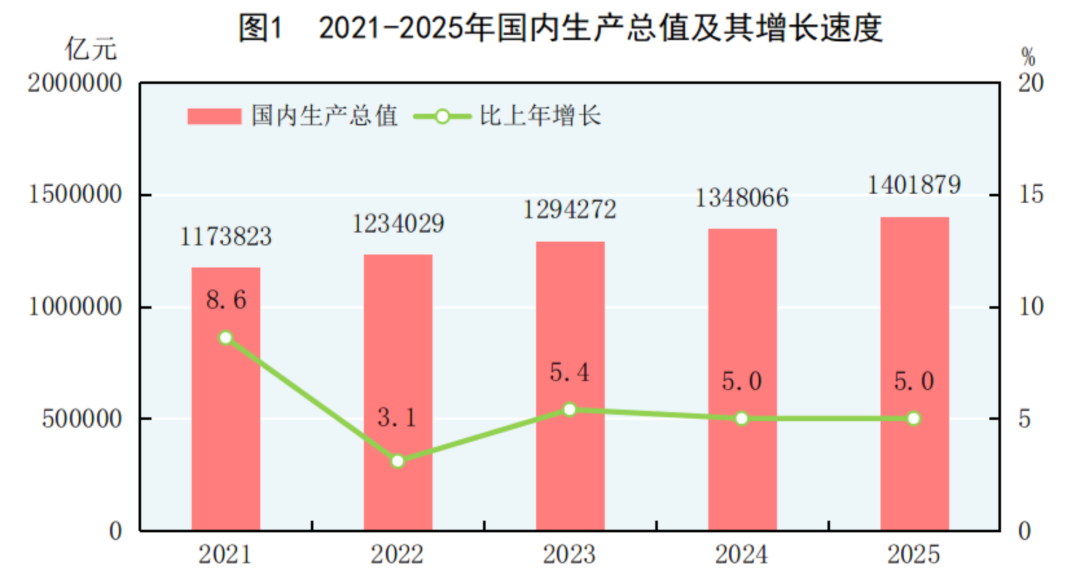
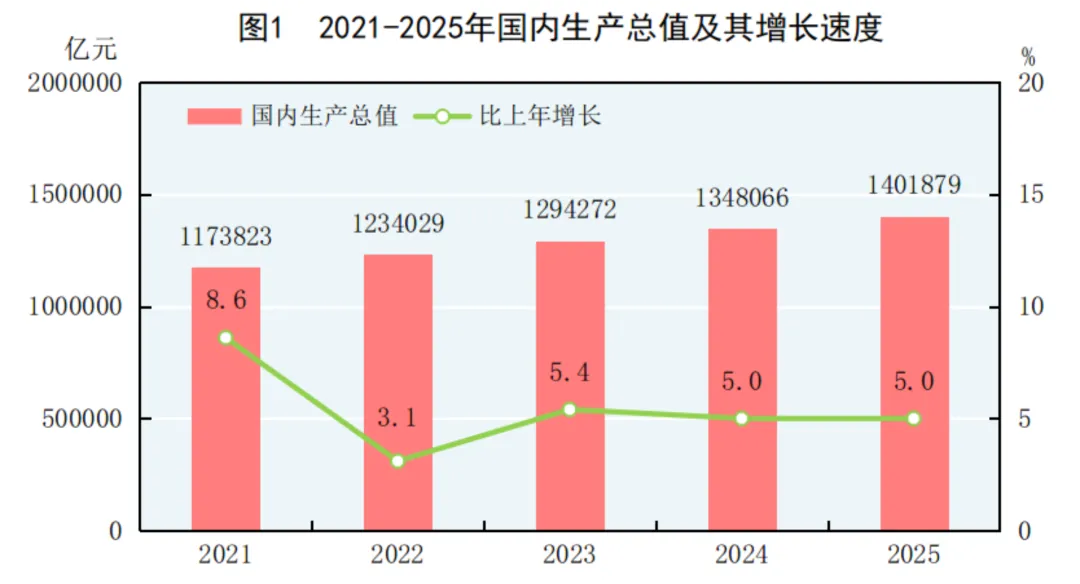
Economic Overview - In 2025, China's GDP reached 1401879 billion yuan, growing by 5.0% compared to the previous year [2][25] - The primary industry added value was 93347 billion yuan (3.9% growth), the secondary industry was 499653 billion yuan (4.5% growth), and the tertiary industry was 808879 billion yuan (5.4% growth) [2][25] - The contribution of final consumption expenditure to GDP growth was 2.6 percentage points, while capital formation contributed 0.8 percentage points and net exports contributed 1.6 percentage points [2][25] Population and Employment - The national population at the end of 2025 was 140489 million, a decrease of 339 million from the previous year, with urban residents accounting for 95380 million [5][28] - The total employment was 72504 million, with urban employment at 47535 million (65.6% of total employment) [5][29] - The urban surveyed unemployment rate averaged 5.2% for the year, with a year-end rate of 5.1% [5][29] Consumer Prices and Spending - The overall consumer price index remained stable compared to the previous year, while industrial producer prices fell by 2.6% [7][30] - The average per capita consumption expenditure was 29476 yuan, an increase of 4.4% year-on-year [15][38] - The Engel coefficient for residents was 29.3%, with urban residents at 28.3% and rural residents at 31.8% [15][38] Investment and Financing - The total fundraising through the Shanghai and Shenzhen stock exchanges reached 12583 billion yuan, an increase of 8332 billion yuan from the previous year [19][42] - A total of 90 new A-share listings raised 1242 billion yuan, with 19 on the Sci-Tech Innovation Board raising 381 billion yuan [19][42] - The bond issuance across various entities through the exchanges totaled 16.3 trillion yuan [21][44] Industrial Growth - The value added of the equipment manufacturing industry grew by 9.2%, accounting for 36.8% of the total industrial output [9][32] - High-tech manufacturing saw a 9.4% increase in value added, contributing 17.1% to the industrial total [9][32] - E-commerce transactions reached 467339 billion yuan, growing by 2.5% year-on-year [9][32] Green Development - Carbon dioxide emissions per ten thousand yuan of GDP decreased by 5.0% [13][36] - The production of new energy vehicles reached 1652.4 million units, a 25.1% increase from the previous year [13][36] - Clean energy generation increased by 14.4%, totaling 42481 billion kilowatt-hours [13][36]

重磅!中华人民共和国2025年国民经济和社会发展统计公报
中汽协会数据· 2026-02-28 04:09
Core Viewpoint - The 2025 National Economic and Social Development Statistical Bulletin highlights China's economic performance, emphasizing steady growth, structural transformation, and advancements in various sectors amidst complex domestic and international challenges [1]. Economic Overview - The GDP for 2025 reached 140,187.9 billion yuan, growing by 5.0% year-on-year, with the primary industry contributing 93.3 billion yuan (3.9% growth), the secondary industry 499.7 billion yuan (4.5% growth), and the tertiary industry 808.9 billion yuan (5.4% growth) [3]. - Per capita GDP was 99,665 yuan, reflecting a 5.1% increase from the previous year [3]. - The national total income was 1,393,700 million yuan, also up by 5.1% [3]. Population and Employment - The national population at year-end was 1,404.89 million, a decrease of 3.39 million from the previous year, with an urban population of 953.8 million [6][7]. - The urban employment rate was 65.6%, with a total of 72.5 million employed individuals [7]. - The average urban unemployment rate was 5.2%, with a year-end rate of 5.1% [7]. Industrial and Agricultural Performance - The total industrial output value increased by 5.8%, with significant growth in manufacturing sectors such as automotive (11.5% growth) and high-tech manufacturing (9.4% growth) [22][23]. - Agricultural production saw a grain output of 714.88 million tons, a 1.2% increase, with notable increases in corn (2.1% growth) and soybean production (1.3% growth) [18][20]. Investment and Trade - Fixed asset investment decreased by 3.9% to 491,109 billion yuan, with significant declines in real estate investment (17.2% decrease) [42][46]. - The total value of imports and exports reached 454,685 billion yuan, a 3.8% increase, with exports growing by 6.1% [47][50]. Financial and Monetary Indicators - The general public budget revenue was 216,045 billion yuan, down by 1.7%, while expenditures increased by 1.0% to 287,395 billion yuan [60]. - The broad money supply (M2) grew by 8.5% to 340.3 trillion yuan [62].

国家统计局重磅发布:2025年GDP增长5%,全国人均可支配收入43377元,人均消费支出29476元!
Xin Lang Cai Jing· 2026-02-28 03:43
Economic Overview - The GDP for the year reached 140,187.9 billion yuan, growing by 5.0% compared to the previous year [1] - The contribution to GDP growth from final consumption expenditure was 2.6 percentage points, while capital formation contributed 0.8 percentage points, and net exports contributed 1.6 percentage points [1] - The per capita GDP was 99,665 yuan, reflecting a growth of 5.1% year-on-year [1] Population and Employment - The national population at year-end was 1,404.89 million, a decrease of 3.39 million from the previous year [4] - The urban employment population was 47,535 million, accounting for 65.6% of total employment [4] - The average urban survey unemployment rate was 5.2%, with a year-end rate of 5.1% [4] Foreign Exchange and Prices - The national foreign exchange reserves increased by 155.5 billion USD to 33,579 billion USD [7] - The average exchange rate for the year was 1 USD to 7.1429 yuan, a depreciation of 0.3% from the previous year [7] - The consumer price index remained stable, while industrial producer prices fell by 2.6% [8] Industrial and Technological Growth - The value added of the equipment manufacturing industry grew by 9.2%, accounting for 36.8% of the total industrial value added [11] - High-tech manufacturing value added increased by 9.4%, with profits rising by 13.3% [11] - E-commerce transaction volume reached 467,339 billion yuan, growing by 2.5% [11] Regional Development - The urbanization rate reached 67.89%, an increase of 0.89 percentage points from the previous year [12] - The GDP growth rates for different regions were: Eastern region 5.0%, Central region 5.2%, Western region 5.1%, and Northeast region 4.1% [12] Environmental and Energy Transition - Carbon dioxide emissions per unit of GDP decreased by 5.0% [14] - Clean energy generation increased by 14.4%, with renewable energy sources like hydropower and solar power contributing significantly [14] - The production of new energy vehicles rose by 25.1%, with a total of 16.524 million units produced [14] Income and Consumption - The per capita disposable income was 43,377 yuan, a growth of 5.0% [14][15] - The average per capita consumption expenditure was 29,476 yuan, reflecting a growth of 4.4% [16] - The Engel coefficient for residents was 29.3%, indicating the proportion of income spent on food [16]
国家统计局副局长盛来运评读《2025年国民经济和社会发展统计公报》
Guo Jia Tong Ji Ju· 2026-02-28 03:01
Core Viewpoint - The 2025 National Economic and Social Development Statistical Bulletin reflects China's economic resilience and progress amid complex domestic and international challenges, showcasing a commitment to stability and growth under the leadership of the central government [2][3]. Group 1: Economic Growth and Development - In 2025, China's GDP grew by 5.0%, surpassing 140 trillion yuan for the first time, marking a significant achievement in the "14th Five-Year Plan" [3]. - The per capita GDP reached 99,665 yuan, a 5.1% increase from the previous year, translating to approximately 13,953 USD, maintaining a level above 13,000 USD for three consecutive years [4]. - China's contribution to global economic growth is projected to remain around 30%, solidifying its position as the world's second-largest economy [5]. Group 2: Modernization and Technological Advancement - The investment in R&D increased by 8.1%, reaching 2.80% of GDP, surpassing the OECD average for the first time, with basic research funding accounting for 7.08% [6][7]. - The high-tech manufacturing sector saw a value-added growth of 9.4%, with its share of total industrial value-added rising to 17.1% [7]. - The digital economy flourished, with the value-added of the digital product manufacturing industry increasing by 9.3% [8]. Group 3: Domestic and International Circulation - Domestic consumption reached over 50 trillion yuan, growing by 3.7%, with domestic demand contributing 67.3% to economic growth [10]. - The total import and export volume exceeded 45 trillion yuan, marking a 3.8% increase, and maintaining China's position as a key player in global supply chains [11]. Group 4: High-Quality Development and Structural Reforms - The establishment of a unified national market progressed, with the market access negative list reduced to 106 items [12]. - The average urban unemployment rate was 5.2%, with 12.67 million new urban jobs created, reflecting a stable employment situation [15]. - The clean energy consumption ratio reached 30.4%, with significant reductions in energy consumption per unit of GDP and CO2 emissions [14]. Group 5: Social Welfare and Quality of Life - The average disposable income for urban residents increased by 5.0%, aligning with economic growth, while the share of service consumption in total spending reached 46.1% [15]. - The healthcare system expanded, with over 1 million hospital beds and 13.4 million healthcare professionals by year-end [16]. - Social insurance coverage increased, with 1.08 billion people enrolled in basic pension insurance and 1.33 billion in medical insurance [16].
2025年GDP增长5%,全国人均可支配收入43377元,国家统计局最新发布
Di Yi Cai Jing Zi Xun· 2026-02-28 02:44
Core Viewpoint - The National Bureau of Statistics of China released the "Statistical Bulletin on National Economic and Social Development for 2025," highlighting significant economic growth and development strategies under the leadership of the Communist Party of China, emphasizing high-quality development and modernization efforts. Economic Performance - The GDP for 2025 reached 140,187.9 billion yuan, growing by 5.0% compared to the previous year [2] - The primary industry added value was 93.3 billion yuan (3.9% growth), the secondary industry 499.7 billion yuan (4.5% growth), and the tertiary industry 808.9 billion yuan (5.4% growth) [2] - The contribution of final consumption expenditure to GDP growth was 2.6 percentage points, capital formation contributed 0.8 percentage points, and net exports contributed 1.6 percentage points [2] Employment and Population - The total population at the end of the year was 1,404.9 million, a decrease of 3.39 million from the previous year [6] - The urban employment population was 47.5 million, with an urban unemployment rate of 5.1% at year-end [6] - The total number of migrant workers reached 30.1 million, with an increase of 0.5% [6] Consumer Prices and Production - The consumer price index remained stable year-on-year, while industrial producer prices decreased by 2.6% [8] - The value added of high-tech manufacturing grew by 9.4%, contributing to 17.1% of the total industrial value added [10] - E-commerce transactions reached 467.3 billion yuan, growing by 2.5% [10] Regional Development - The urbanization rate reached 67.89%, an increase of 0.89 percentage points from the previous year [11] - The GDP growth rates for different regions were: Eastern region 5.0%, Central region 5.2%, Western region 5.1%, and Northeast region 4.1% [11] Income and Consumption - The per capita disposable income for residents was 43,377 yuan, a 5.0% increase [14] - The Engel coefficient for residents was 29.3%, indicating a stable consumption pattern [15] - Per capita consumption expenditure was 29,476 yuan, growing by 4.4% [15] Green Development - Carbon dioxide emissions per ten thousand yuan of GDP decreased by 5.0% [16] - The production of new energy vehicles reached 16.5 million units, a growth of 25.1% [16] Technological Advancements - A total of 92 space launches were completed, including 50 commercial launches [19] - Significant advancements in quantum computing and artificial intelligence were reported, with successful clinical trials for brain-machine interfaces [19]
透过税收看制造强国建设丨财金纵横
Xin Lang Cai Jing· 2026-02-04 05:06
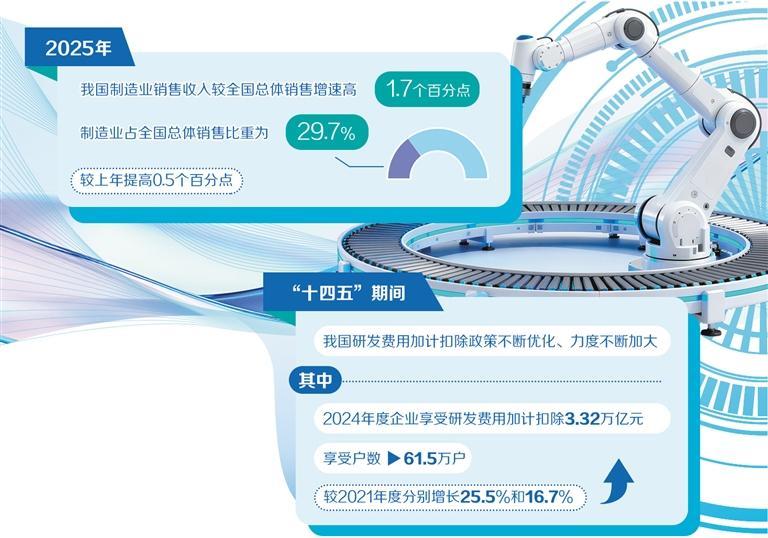
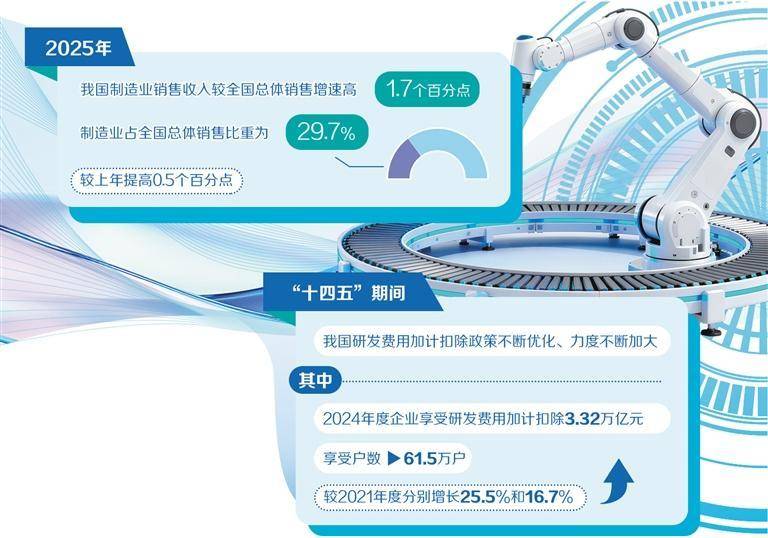
Core Insights - The manufacturing sector in China is expected to see a sales revenue growth rate that exceeds the national average by 1.7 percentage points by 2025, with its share of total sales rising to 29.7% [3] - The transition towards intelligent, green, and integrated manufacturing is accelerating, highlighting the sector's role as an economic stabilizer [3] Intelligent Upgrade - By 2025, the procurement of automation and digital equipment by manufacturing enterprises is projected to increase by 11.3% and 10% year-on-year, respectively [3] - The sales revenue of the intelligent equipment manufacturing sector is expected to grow by 28.1%, with industrial robots and special operation robots seeing year-on-year growth of 17.4% and 42.1% [3] Tax Incentives and Support - Tax policies are being tailored to support the intelligent, green, and integrated development of the manufacturing sector, focusing on technological innovation and reducing R&D costs [4] - The R&D expense deduction policy is being optimized, with an expected deduction of 3.32 trillion yuan for 2024, benefiting 615,000 enterprises, marking increases of 25.5% and 16.7% from 2021 [5] Green Development - The sales revenue of the new energy vehicle industry is projected to grow at an annual rate of 49.5%, while clean energy generation is expected to grow by 13.9% annually during the 14th Five-Year Plan period [6] - By 2025, the new energy vehicle manufacturing sector is anticipated to grow by 14.3%, and the clean energy generation sector's revenue is expected to increase by 17.3%, accounting for 38.5% of total electricity production revenue [6] Digital Integration - The sales revenue of the digital product manufacturing sector is expected to grow by 9.4% year-on-year, with manufacturing enterprises' procurement of digital technologies increasing by 10.4% [9] - The automotive industry is set to enhance its digital transformation, with policies aiming for significant improvements in smart manufacturing capabilities by 2027 and overall digital development by 2030 [9] Local Tax Administration Initiatives - Local tax authorities are implementing tailored services to support green and low-carbon initiatives, including customized tax incentive packages for enterprises [7] - Collaborative platforms between tax and environmental departments are being established to enhance compliance and streamline tax reporting processes [8] Future Directions - Continued focus on intelligent, green, and integrated manufacturing is essential, with a need for targeted support based on regional industrial characteristics [10] - The integration of compliance guidance and risk prevention into tax services is crucial for enhancing the competitiveness of manufacturing enterprises [10]
透过税收看制造强国建设
Sou Hu Cai Jing· 2026-02-03 23:08
Core Insights - The manufacturing sector in China is expected to see a sales revenue growth rate that exceeds the national average by 1.7 percentage points by 2025, with its share of total sales rising to 29.7% [2] - The acceleration of intelligent, green, and integrated development in manufacturing is highlighted as a key focus for future growth [3][6] Intelligent Upgrading - By 2025, the procurement of automation and digital equipment by manufacturing enterprises is projected to increase by 11.3% and 10% year-on-year, respectively [3] - The sales revenue of the intelligent equipment manufacturing sector is expected to grow by 28.1%, with industrial robots and special operation robots seeing increases of 17.4% and 42.1% [3] - Tax incentives are being utilized to support the intelligent transformation of manufacturing, with a focus on technology innovation and reducing R&D costs [4][5] Green Development - The sales revenue of the new energy vehicle manufacturing sector is projected to grow by 14.3% year-on-year by 2025, while the clean energy generation sector is expected to see a 17.3% increase [6] - The share of clean energy generation in total electricity production revenue is anticipated to rise to 38.5%, an increase of 6.9 percentage points since 2021 [6] Digital Integration - The sales revenue of the digital product manufacturing sector is expected to grow by 9.4% year-on-year by 2025, with a 10.4% increase in the procurement of digital technologies by manufacturing enterprises [9] - The automotive manufacturing sector is set to enhance its digital capabilities significantly by 2027, with a focus on improving smart manufacturing maturity [9] - Tax authorities are enhancing digital services to improve compliance and efficiency in tax reporting for manufacturing enterprises [10][11]
我国科技创新与产业创新融合发展加快
Xin Lang Cai Jing· 2026-01-27 22:08
Group 1: Strategic Emerging Industries - In 2025, China's high-tech industry sales revenue is expected to grow by 13.9% year-on-year, with high-tech manufacturing and high-tech services increasing by 10.1% and 16.6% respectively [1] - Key sectors such as lithium-ion battery manufacturing, service robots manufacturing, industrial robots manufacturing, and biopharmaceutical manufacturing are projected to see significant sales revenue growth of 25.1%, 60.7%, 17.4%, and 7.7% respectively [1] Group 2: Technology Transformation - The sales revenue of China's scientific and technological service industry is anticipated to increase by 20.4% year-on-year, indicating a stronger application of technological achievements [1] - The sales revenue of knowledge-intensive industries, particularly those focused on intellectual property (patents), is expected to grow by 10.7% [1] - The national technology contract transaction amount is projected to rise by 19.1% in 2025, reflecting active innovation elements [1] Group 3: Digital Economy Integration - In 2025, the sales revenue of the core digital economy industries is expected to grow by 9.4%, with digital product manufacturing and digital technology application industries increasing by 9.4% and 13.8% respectively [2] - The amount spent by enterprises on digital technology is projected to increase by 9.6%, with manufacturing sector spending on digital technology rising by 10.4% [2] Group 4: Traditional Industry Upgrading - Traditional industries are accelerating their transformation, with automation being a key focus area [2] - The procurement of automation equipment in traditional sectors such as petrochemicals, steelmaking, and ironmaking is expected to grow by 17.3%, 11.7%, and 12.7% respectively [2]
2025年高技术产业销售收入同比增长13.9%
Zhong Guo Zheng Quan Bao· 2026-01-27 20:57
Group 1 - The core viewpoint of the article highlights the accelerated integration of technological innovation and industrial innovation in China by 2025, with significant growth in strategic emerging industries and enhanced conversion of scientific achievements [1][3] Group 2 - In terms of strategic emerging industries, sales revenue in high-tech industries is projected to grow by 13.9% year-on-year in 2025, with high-tech manufacturing and high-tech services increasing by 10.1% and 16.6% respectively [1] - Key sectors such as lithium-ion battery manufacturing, service robots, industrial robots, and biopharmaceuticals are expected to see remarkable sales revenue growth of 25.1%, 60.7%, 17.4%, and 7.7% respectively [1] Group 3 - The conversion of scientific achievements is reflected in a 20.4% year-on-year increase in sales revenue for the scientific research and technical services industry, and a 10.7% increase for knowledge-intensive industries [2] - The national technology contract transaction amount is projected to grow by 19.1% year-on-year, indicating an increase in the application of scientific achievements [2] Group 4 - The integration of digital technology with the real economy is highlighted by a 9.4% year-on-year growth in sales revenue for core digital economy industries, with related digital product manufacturing and digital technology application growing by 9.4% and 13.8% respectively [2] - The amount spent by enterprises on digital technology is expected to increase by 9.6%, with manufacturing sector spending rising by 10.4% [2] Group 5 - Traditional industries are accelerating their transformation and upgrading, with automation being a key focus, particularly in sectors like petrochemicals, steelmaking, and ironmaking, which are seeing increases in automation equipment purchases of 17.3%, 11.7%, and 12.7% respectively [2] Group 6 - The data reflects solid achievements in China's technological self-reliance and the cultivation of new productive forces, driven by precise policy support and accelerated gathering of innovative elements [3] - This progress not only promotes the upgrading of industrial structure towards high-end development but also strengthens the technological innovation support for the 14th Five-Year Plan, injecting strong and sustainable internal momentum for high-quality development [3]
高技术产业销售收入同比增长13.9%
Xin Lang Cai Jing· 2026-01-27 18:56
Group 1 - The core viewpoint of the articles highlights the accelerated integration of technological innovation and industrial innovation in China by 2025, with significant growth in high-tech industries and enhanced conversion of scientific achievements [1][2] - In 2025, the sales revenue of high-tech industries in China is projected to increase by 13.9% year-on-year, with high-tech manufacturing and high-tech services growing by 10.1% and 16.6% respectively [1] - Key sectors such as lithium-ion battery manufacturing, service robots, industrial robots, and biopharmaceuticals show remarkable sales growth, with increases of 25.1%, 60.7%, 17.4%, and 7.7% respectively [1] Group 2 - The sales revenue of the scientific and technological service industry is expected to rise by 20.4% year-on-year, indicating a stronger application of scientific achievements [1] - The sales revenue of knowledge-intensive industries, particularly those focused on intellectual property, is projected to grow by 10.7%, reflecting an increase in the conversion of technological achievements [1] - The transaction amount of technology contracts nationwide is anticipated to grow by 19.1% year-on-year, indicating active innovation elements and accelerated aggregation [1] Group 3 - In terms of the integration of digital technology and the real economy, the sales revenue of core digital economy industries is expected to increase by 9.4% year-on-year [2] - The manufacturing of digital products and digital technology applications are projected to grow by 9.4% and 13.8% respectively, reflecting rapid development in digital industrialization [2] - The amount spent by enterprises on digital technology is expected to rise by 9.6%, with manufacturing sector spending increasing by 10.4%, indicating an upgrade in industrial digitalization [2]