智能经济

Search documents
坚定信心谋发展 铆足干劲再出发
Xin Lang Cai Jing· 2026-02-08 23:41
Group 1 - The government work report summarizes significant achievements of Nanning during the 14th Five-Year Plan and outlines goals for 2025, emphasizing economic growth and industrial development [1] - Nanning aims to build a modern industrial system, enhance innovation-driven development, and promote digital and intelligent economies by 2025 [1] - The report is characterized by clear themes, detailed content, and specific actionable measures, reflecting a high-quality approach to governance [1] Group 2 - Representatives at the Nanning People's Congress discussed strengthening industrial foundations, integrating technological and industrial innovation, and enhancing the China-ASEAN community [2] - The report provides a rational and objective analysis of challenges faced during the 14th Five-Year Plan, offering a basis for future decision-making [2] - The focus on high-quality development is evident, with significant achievements in industrial capacity and urban resilience highlighted [3]
愉悦资本刘二海:向具身发展是非常可能的中国路径之一
Xin Lang Cai Jing· 2026-01-15 10:58
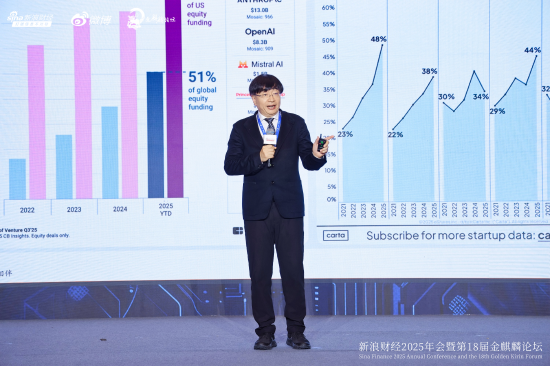
Core Insights - The annual "2025 Technology Wind List" event highlighted the transition from automation to autonomy in the tech industry, emphasizing the need for theoretical breakthroughs for rapid industry development [1][3][4] - The speaker noted that both China and the U.S. share similarities and differences in their technological advancements, with China's industrial development playing a crucial role in achieving significant progress [1][3] - The potential for smart driving to extend into embodied intelligence was discussed, indicating that the shift from electrification to intelligent systems will generate a significant influx of talent and investment [1][3] Industry Trends - The core of the smart economy is identified as the shift from automation to autonomy, suggesting that this evolution is not merely a continuation of the internet economy [4] - The development of autonomous intelligent agents and models, grounded in industrial scenarios, is seen as a vital pathway for the growth of China's smart economy [4] - The unpredictable nature of AI development necessitates organizations to adapt quickly and agilely to changes in the landscape [4]

好评中国丨“智能经济”势如破竹 为经济注入“智慧芯”
Xin Lang Cai Jing· 2025-12-25 13:18
Core Insights - Resilience is identified as a key term for understanding China's economy in 2025, highlighting the vibrant domestic demand driven by new consumption phenomena [1] - The rise of the intelligent economy is seen as a core engine for high-quality economic development in China, reshaping the industrial landscape through deep integration of smart technologies [3][6] Intelligent Economy - The intelligent economy is characterized by a shift from traditional manufacturing to smart manufacturing, focusing on "data + computing power + algorithms" to achieve a qualitative change from automation to intelligence [3] - China's intelligent manufacturing is supported by a dual-driven model of "top-level design + grassroots practice," ensuring that smart technologies are integrated into the industrial fabric [3] - The intelligent economy is transforming various sectors, including low-altitude economy, smart vehicles, and smart hotels, enhancing efficiency and consumer experience [4] Market Dynamics - China's large-scale market serves as a natural testing ground for smart technologies, creating a virtuous cycle where demand drives technological iteration and vice versa [5] - The comprehensive industrial system in China facilitates seamless integration from research and development to implementation, avoiding bottlenecks in technology [5] - The open and collaborative approach of China's intelligent economy contrasts with the monopolistic tendencies seen in some Western countries, promoting cross-sectoral development [5] Future Outlook - The intelligent economy is expected to provide intrinsic momentum for China's economic growth, moving away from traditional dependency paths and driving high-quality development through technological innovation [6] - The structural optimization of the economy is anticipated, with traditional industries being upgraded and emerging industries flourishing, leading to a multi-polar industrial landscape [6] - China's competitive edge in global markets is expected to strengthen, particularly in key areas like artificial intelligence and smart manufacturing, contributing to global economic governance [6]