
数字经济

Search documents
中金 | 提质谋新,砥砺前行——“十五五”规划纲要解读
中金点睛· 2026-03-15 23:48
Core Viewpoint - The article discusses the key points of the "15th Five-Year Plan" (2021-2025) of China, emphasizing its strategic goals, development indicators, and major tasks, which aim to guide the country's economic and social development in the coming years [1]. Overall Orientation - The "15th Five-Year Plan" is positioned as a critical period for achieving significant breakthroughs in strategic tasks related to Chinese-style modernization, moving from merely starting well to achieving major breakthroughs [2]. - The development environment has shifted from a period of significant strategic opportunities to one characterized by increased uncertainty and complexity, necessitating proactive and high-quality policy responses [2]. Development Goals - The plan outlines seven major goals, including achieving significant results in high-quality development, enhancing self-reliance in technology, and improving national security [3]. - By 2035, the plan aims for substantial increases in economic, technological, and defense capabilities, with a focus on achieving a per capita GDP level comparable to that of developed countries [3]. Development Indicators - The plan sets 20 key indicators across five areas: economic development, innovation-driven growth, social welfare, green low-carbon initiatives, and security [4]. - Economic indicators emphasize maintaining GDP growth within a reasonable range while focusing on structural optimization and quality improvement [4]. - Innovation indicators include a target for R&D expenditure to grow by over 7% annually and an increase in the digital economy's contribution to GDP from 10.5% in 2024 to 12.5% by 2030 [5]. Major Strategic Tasks - The plan prioritizes building a modern industrial system, emphasizing the importance of advanced manufacturing and the development of emerging industries such as AI, biotechnology, and renewable energy [6]. - It highlights the need for a strong domestic market and effective demand stimulation, with specific measures to boost consumption and investment [7]. - The plan also focuses on promoting common prosperity, improving population development strategies, and enhancing social welfare [8]. Security and Development - The plan emphasizes the modernization of the national security system and the importance of ensuring economic security, food security, and public safety [10]. - It outlines 109 major engineering projects aimed at supporting the strategic tasks, with a focus on modern infrastructure, green transformation, and urban-rural integration [11]. Capital Market Outlook - The "15th Five-Year Plan" is expected to reshape investment logic in China's capital markets, promoting a virtuous cycle of policy direction, capital allocation, and market ecology [12]. - The plan's clarity and long-term vision are anticipated to boost investor confidence and contribute positively to the capital market [13]. - Long-term conditions for a stable and gradual market growth are seen as more favorable, with a focus on new quality productivity and structural reforms [14]. Investment Opportunities - Key sectors for medium to long-term investment include digital technology, space economy, high-end manufacturing, new consumption patterns, and biotechnology [15]. - The plan's emphasis on modern industrial systems and green low-carbon initiatives presents significant investment opportunities in related industries [16].


“十五五”规划解读 | 结构重塑与改革赋能(申万宏观·赵伟团队)
申万宏源宏观· 2026-03-14 13:05
Core Viewpoint - The "14th Five-Year Plan" to the "15th Five-Year Plan" reflects a significant shift in development strategy and policy logic in response to increasing external uncertainties and internal structural challenges, emphasizing the need for reform and transformation to achieve high-quality development [2][10]. Group 1: Strategic Changes - The "15th Five-Year Plan" highlights a proactive historical spirit, focusing on gaining strategic initiative amid intense international competition and addressing uncertainties through high-quality development [2][10]. - The structure of the plan has been streamlined from 19 chapters in the "14th Five-Year Plan" to 18 chapters in the "15th Five-Year Plan," with a greater emphasis on comprehensive reform and new productive forces [12][17]. Group 2: Key Reform Areas - The plan emphasizes the construction of a unified national market and the need to eliminate barriers to competition, with specific measures for capacity monitoring and a simplified exit mechanism for businesses [4][23]. - It accelerates fiscal and monetary policy reforms to ensure sustainable financial systems, including increasing the proportion of direct taxes and improving the tax system to maintain a reasonable macro tax burden [4][39]. - The plan establishes a foundation for high-level openness, promoting orderly expansion in sectors like telecommunications and healthcare, and aims to enhance service industry quality to stimulate consumption [5][45][48]. Group 3: Industrial Policy Changes - The "15th Five-Year Plan" prioritizes technological breakthroughs, particularly in smart technology, and emphasizes the integration of the real economy with the digital economy [6][54]. - It aims to boost domestic consumption by focusing on income growth and upgrading consumption structures, with specific measures to improve minimum wage standards and enhance social security systems [6][33]. - The real estate sector is integrated into the social welfare framework, shifting focus from short-term economic stimulus to long-term quality development [7][19].

\十五五\ 规划纲要解读:\十五五\:结构重塑与改革赋能
Shenwan Hongyuan Securities· 2026-03-14 12:57
Group 1: Strategic Shifts - The "14th Five-Year Plan" to "15th Five-Year Plan" marks a significant shift in development strategy, emphasizing proactive historical spirit and high-quality development to address external uncertainties and internal structural issues[2] - The "15th Five-Year Plan" has been streamlined to 18 chapters and 62 sections, focusing on comprehensive reform and new productive forces, with a specific emphasis on enhancing operational vitality and macroeconomic governance[14] Group 2: Key Reform Areas - The plan emphasizes the construction of a unified national market and aims to eliminate barriers to competition, with specific measures for capacity monitoring and a simplified exit mechanism for businesses[18] - Green and low-carbon strategies are elevated, focusing on controlling high-energy-consuming projects and accelerating technological innovation, linking ecological goals with industrial upgrades[19] Group 3: Economic Indicators - The "15th Five-Year Plan" continues to guide GDP growth within a reasonable range while placing greater emphasis on quality indicators such as labor productivity and the digital economy's contribution to GDP, with a target of 12.5% for the digital economy by 2025[17] - The plan sets a target for grain production capacity at approximately 1.45 trillion jin and energy production capacity at 5.8 billion tons of standard coal, reflecting a focus on absolute quantitative goals[17] Group 4: Consumption and Social Welfare - The plan aims to enhance consumer spending by improving income distribution and social security systems, with specific measures to adjust minimum wage standards and support flexible employment[24] - It highlights the need to optimize service consumption experiences in areas such as elderly care and childcare, aiming to increase the service consumption ratio significantly[25]
律师绘制“出海”风险地图,有哪些应当守住的条款底线?
第一财经· 2026-03-10 15:55
Core Viewpoint - The article discusses the complexities and risks associated with Chinese companies' overseas investments, emphasizing the need for a comprehensive risk management framework that adapts to different legal environments and industry sensitivities [2][3]. Group 1: Risk Identification and Management - Companies should implement a unified and dynamic global risk management framework to identify and adjust to risks in various legal jurisdictions [3]. - The risk map should be constructed based on three dimensions: industry sensitivity, legal jurisdiction, and risk type [4]. - High-risk industries include heavy asset sectors like renewable energy and infrastructure, which are heavily reliant on host country governments [4][5]. Group 2: Legal Jurisdictions - Developed economies are often seen as "compliance mazes," while underdeveloped regions are viewed as "legal deserts," but the reality is more nuanced [5]. - In underdeveloped regions, companies face rapid changes in legal rules and significant discretionary enforcement, which can create substantial pressure on foreign enterprises [5]. - Developed markets are increasingly introducing uncertainties through security reviews and export controls, which pose new risks for Chinese investors [5][6]. Group 3: Common Risk Types - National security reviews have expanded beyond traditional sectors to include data flow, cloud services, and critical software, affecting various operational stages [7]. - Tax risks are often underestimated, with issues arising from tax incentives, transfer pricing disputes, and audits that can compound administrative challenges [7][8]. Group 4: Negotiation Strategies - Companies often focus heavily on commercial terms while neglecting defensive clauses related to dispute resolution and compliance, which can lead to vulnerabilities in times of crisis [10]. - It is crucial for companies to maintain a "never compromise" list regarding legal remedies, including choice of law and dispute resolution mechanisms [13]. - Companies should be proactive during crises, leveraging negotiation leverage and preparing multiple action plans to respond effectively [12].
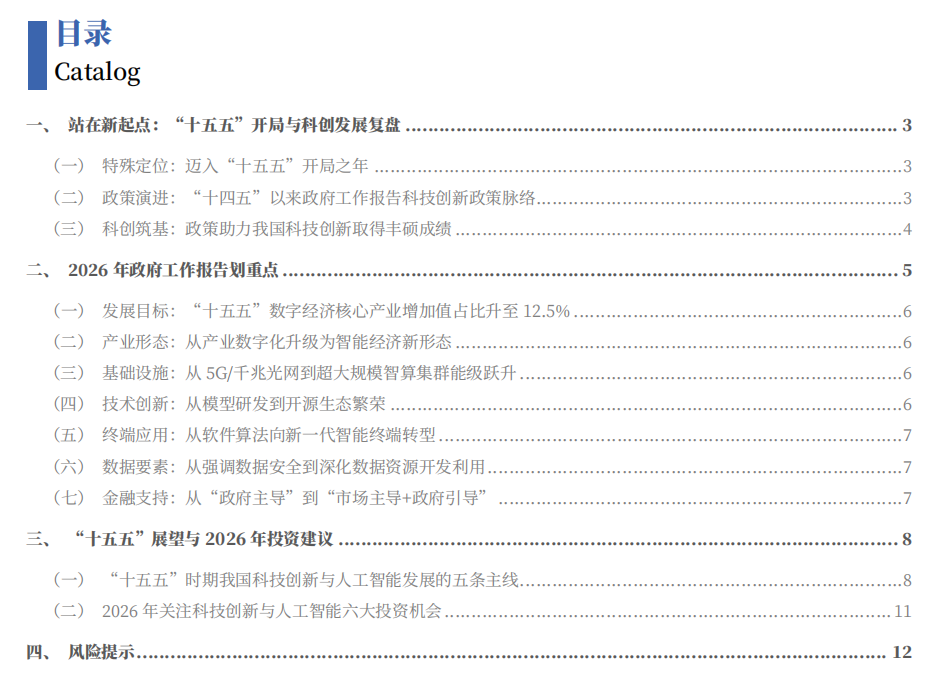
中国银河证券:从“人工智能+”到“智能经济”,2026年政府工作报告科技创新工作解读
智通财经网· 2026-03-07 04:14
Core Insights - The 2026 government work report emphasizes the strategic task of increasing the value added of the digital economy's core industries to 12.5% of GDP, indicating a systematic policy shift towards the digital economy as a growth engine and stabilizer for the national economy [1][21] - The report introduces the concept of "intelligent economy," elevating artificial intelligence from a mere tool to a core economic form, signifying a shift in its impact on economic operations [1][22] Summary by Sections 1. Policy Evolution - The evolution of technology innovation policies since the 14th Five-Year Plan shows a clear path: initial focus on foundational infrastructure (2021-2022), followed by integration of digital technologies with traditional industries (2023-2024), and culminating in the emergence of an "intelligent economy" (2025-2026) [2][11][12] 2. Key Tasks in the 2026 Government Work Report - The report outlines ten key tasks, with a focus on nurturing new driving forces and accelerating high-level technological self-reliance, maintaining consistency with previous reports [17] - The goal of increasing the digital economy's core industries' value added to 12.5% of GDP is set, with an expected annual increase of 0.4 percentage points [21] - The transition from digitalization to an intelligent economy is highlighted, emphasizing AI as a core driver for new industries and business models [22][23] 3. Investment Opportunities in 2026 - Six major investment opportunities are identified, including AI smart terminals, computing power infrastructure, industrial digitalization, AI large models, data elements and security, and satellite internet [4][49] - The AI smart terminal market is expected to grow significantly, supported by government initiatives and consumer demand [50] - The computing power infrastructure sector is positioned as a core focus, with investments in hardware, operations, and green solutions [51] - Industrial digitalization is set to receive substantial support, with a focus on software, internet platforms, and intelligent manufacturing [52] - The AI large model sector is anticipated to see commercialization and scaling in various industries [53] - The data element market is highlighted for its potential in creating high-quality datasets and enhancing data security [54] - The satellite internet sector is recognized as a key area for investment, with a focus on manufacturing, ground equipment, and operational applications [55]

2026年政府工作报告科技创新工作解读:从“人工智能+”到“智能经济”
Yin He Zheng Quan· 2026-03-06 09:25
Group 1: Key Economic Goals - The core value added of the digital economy is targeted to reach 12.5% of GDP by 2026, up from 10.5% at the end of the 14th Five-Year Plan[10] - The digital economy's core industry value added increased from 7.8% at the end of 2020 to 10.5% by the end of 2025, achieving an average annual increase of 0.54 percentage points[25] - The government aims for an average annual increase of 0.4 percentage points in the digital economy's GDP share during the 15th Five-Year Plan[25] Group 2: Strategic Shifts in Technology and Infrastructure - The government report introduces the concept of "intelligent economy," positioning AI as a core driver for new industries and business models[26] - Infrastructure focus has shifted from 5G coverage to large-scale intelligent computing clusters and energy-efficient computing solutions[28] - The policy emphasizes the transition from model development to a thriving open-source ecosystem, aiming to lower technological barriers[29] Group 3: Investment Opportunities - Six key investment areas identified for 2026 include AI smart terminals, computing infrastructure, industrial digitalization, AI large models, data elements, and satellite internet[52] - The government plans to support the promotion of new generation smart terminals with a special bond issuance of 250 billion yuan for consumer electronics upgrades[53] - The industrial digital transformation is set to receive significant funding, with 200 billion yuan allocated for large-scale equipment updates[55]
股指期货专题报告:以更大决心推动经济高质量发展
Yin He Qi Huo· 2026-03-06 03:04
Report Industry Investment Rating - Not provided Core Viewpoints - The "15th Five-Year Plan" draft provides positive signals and stable support for the market, and the A-share market is more likely to form a "stable and improving" pattern [3][12] - The economic growth in 2026 may exceed expectations, which is conducive to boosting confidence and supporting the development of the capital market [1][7] - The capital market will serve the development of new productive forces and support high-quality development [2][10] Summary by Directory Targets are reasonable and practical, leaving room for development from quantity to quality - The "15th Five-Year Plan" draft refines 20 main indicators, including 3 in economic development, with GDP growth to be kept in a reasonable range and determined annually as appropriate [6] - The 2026 economic growth target of 4.5% - 5% is practical and leaves room, and the actual growth may reach 5.2% [6][7] Emphasize new productive forces, achieve scientific and technological self-reliance, and embrace the new round of scientific and technological revolution - In the innovation-driven aspect, the draft proposes 3 indicators, including an average annual growth of over 7% in R & D expenditure, and the added value of the digital economy's core industries to account for 12.5% of GDP [8] - It proposes 28 projects to lead the development of new productive forces, and emphasizes seizing the opportunity of the scientific and technological revolution to promote in-depth integration of scientific and technological and industrial innovation [2][8] - The capital market will serve the development of new productive forces, support the construction of a modern industrial system, and enhance the quality of listed companies [2][10] Highlight people's well - being, boost consumer confidence, and realize people's aspiration for a better life - The draft proposes 7 indicators in people's well - being and 25 projects, aiming to improve people's living quality and boost long - term consumer confidence [11] - In the green - low - carbon and safety -保障 aspects, it proposes relevant indicators and projects to ensure national security and environmental protection [12]
【华创策略】AI视角下的政府工作报告投资要点
Huachuang Securities· 2026-03-05 10:07
Core Conclusions - The government work report continues the previous "dual expansion" monetary and fiscal policy framework, creating a favorable macroeconomic environment for the stock market to maintain its upward trend. The economic growth target for 2026 is set at 4.5%-5%, which is more pragmatic; the fiscal policy is "more proactive" with an increased deficit scale: a deficit rate of 4%, with a deficit size of 5.9 trillion yuan, an increase of 230 billion yuan from the previous year; the monetary policy is "moderately loose," providing space for reserve requirement ratio cuts and interest rate reductions to create liquidity easing [3][25]. - Greater expectations are placed on the performance of listed companies in 2026. The report explicitly states the goal of "promoting the overall price level from negative to positive, with consumer prices reasonably and moderately rebounding." The monetary policy also emphasizes "promoting stable economic growth and reasonable price recovery as important considerations." A 4% deficit rate and a 5.9 trillion yuan fiscal deficit imply an expected nominal GDP growth rate of about 5%, suggesting a potential rebound in the GDP deflator to 0-0.5%. The return of inflation is expected to drive up the performance of listed companies, thereby digesting the currently relatively high static valuations, shifting the stock market's main logic from liquidity-driven financial re-inflation in the first half to EPS-driven physical re-inflation in the second half [3][25]. - Focus on cyclical and technological innovation sectors. 1) Cyclical: Major engineering projects during the "14th Five-Year Plan" period and fiscal policies are expected to provide new demand support for cyclical assets, with performance likely to continue improving under tight supply constraints. 2) Technological innovation: The 2026 government work tasks explicitly propose to develop emerging pillar industries such as integrated circuits, aerospace, biomedicine, and low-altitude economy; cultivate future industries like future energy, quantum technology, embodied intelligence, brain-computer interfaces, and 6G, which are expected to enhance the risk appetite for technological innovation [3][25]. Theme Word Frequency Distribution - From 2010 to 2026, the government work reports show a shift from "macroeconomic layout" to "precise policies and support," with "investment" and "support" gaining significant weight, becoming core to most themes. The term "high quality" runs through various fields, indicating a deepening of development requirements from "quantity" to "quality." The frequency of terms like "safety, governance, employment, and security" highlights a stronger emphasis on bottom-line guarantees and people's livelihood concerns while promoting development [4][7]. Policy Strength Analysis - In 2026, the policy strength score for "economic situation judgment" and "expanding domestic demand" themes remains stable compared to last year, reflecting the continuity of previous policies aimed at stabilizing growth and expanding domestic demand. The themes of "macroeconomic policy" and "opening up" also generally follow previous trends [14][19]. - The policy strength score for "risk prevention" is the only theme that saw both an increase in strength and a rise in its share of the report, indicating a growing concern for the health of the capital market and its sustainable development [19][20]. AI Interpretation of Government Work Report: 2026 Economic and Social Development Overall Requirements and Policy Orientation - The report emphasizes that 2026 is the first year of the "14th Five-Year Plan," with the core of government work being to adhere to the work guideline of seeking progress while maintaining stability, fully implementing the new development concept, and accelerating the construction of a new development pattern. The focus is on promoting high-quality development through more proactive macro policies, enhancing policy coordination, and continuously expanding domestic demand [26]. - The main expected targets for 2026 include an economic growth target of 4.5%-5%, a target urban survey unemployment rate of around 5.5%, and a target consumer price increase of about 2%, aiming to promote a positive turnaround in prices. Other key targets include a grain output of around 1.4 trillion jin and a reduction of carbon dioxide emissions per unit of GDP by about 3.8% [26][27]. 2026 Government Work Tasks - The core task is to coordinate the promotion of consumption and investment. On the consumption side, special actions to boost consumption will be implemented, including a special fund to support the replacement of consumer goods. On the investment side, the focus will be on new quality productivity and major projects, with specific funding allocated to stimulate private investment [27]. - The report emphasizes the need to develop new quality productivity tailored to local conditions, support the upgrading of traditional industries, and cultivate emerging and future industries, including integrated circuits and quantum technology [27]. - The report also highlights the importance of enhancing independent innovation capabilities, strengthening original innovation and key core technology breakthroughs, and promoting the deep integration of technological and industrial innovation [27].
19号线南延、三大公园联通等,大兴精耕482个“十五五”重点项目
Bei Jing Ri Bao Ke Hu Duan· 2026-02-28 04:11
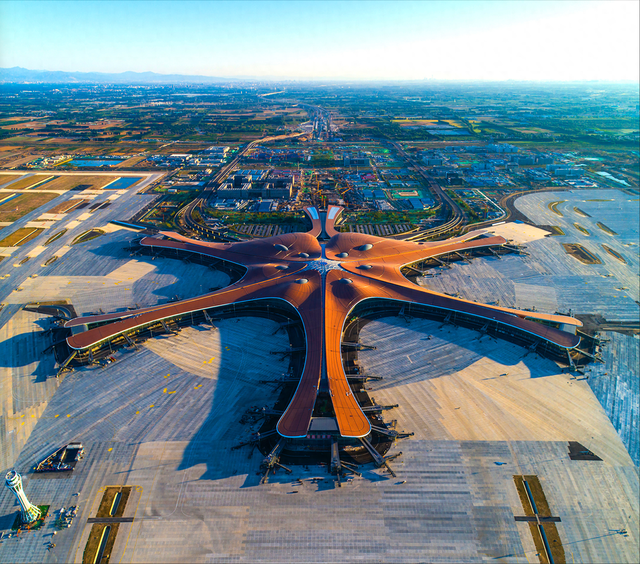
Core Viewpoint - Daxing District is seizing new opportunities in the "14th Five-Year Plan" period, with 482 key projects underway across various sectors, including transportation, ecology, healthcare, education, and industry, aimed at injecting new momentum into high-quality development in southern Beijing [1][3]. Group 1: Transportation Development - Daxing is promoting the south extension of Metro Line 19, which will activate the area east of the Jingkai Expressway [4] - The southern road network will be further improved to support development around Beijing Daxing International Airport [4] - The planned Daxing International Tourism Resort will leverage the airport's "magnetic" and "first station" effects to attract entertainment projects [4] Group 2: Ecological Initiatives - Daxing will connect three major parks and create new public parks, garden blocks, urban galleries, and small green spaces to integrate a "15-minute park leisure circle" into residents' lives [6] - Infrastructure in key areas will be enhanced, with the introduction of quality medical and educational resources from institutions like Capital Medical University and An Ding Hospital [6] Group 3: Industrial Development - Daxing's industrial strategy focuses on the integration of innovation, industry, finance, and talent [6] - The district aims to attract high-end talent and facilitate the transformation of scientific achievements from central urban areas [6] - Key industrial parks will undergo upgrades, with a focus on aviation, biomedicine, hydrogen energy, digital economy, and commercial aerospace sectors [9]
京津冀自贸试验区搭台助企业融入“大市场”
Xin Lang Cai Jing· 2026-02-27 17:29
Group 1 - The Beijing-Tianjin-Hebei Free Trade Zone focuses on key sectors such as biomedicine, digital economy, and modern logistics, creating a collaborative development opportunity list for 41 key enterprises [1][2] - In the biomedicine sector, the opportunity list integrates information from various stages including research, production, distribution, and clinical application, highlighting collaboration opportunities in AI drug development, gene editing, and clinical trial services [1] - A specific example includes a biomedical company in Changping seeking partners for gene editing technology applications in crops and synthetic biology product development [1] Group 2 - The digital economy sector's opportunity list includes information on computing power, data, security, and application scenarios, promoting collaboration in data sharing, cross-border data flow, and digital empowerment [2] - Beijing International Computing Power Service Co. aims to collaborate with enterprises in healthcare, finance, and autonomous driving to develop high-quality data sets and address compliance issues in data transactions [2] - In the modern logistics sector, the opportunity list covers international logistics, transportation services, and supply chain finance, with companies like SF Express looking to connect with international clients and provide supply chain solutions for automotive enterprises in Hebei and Tianjin [2]