
桌游

Search documents
大模型桌游试玩员来了:用五大画像模拟「千人千面」,评分精准度超越GPT-5.1
3 6 Ke· 2026-02-12 11:30
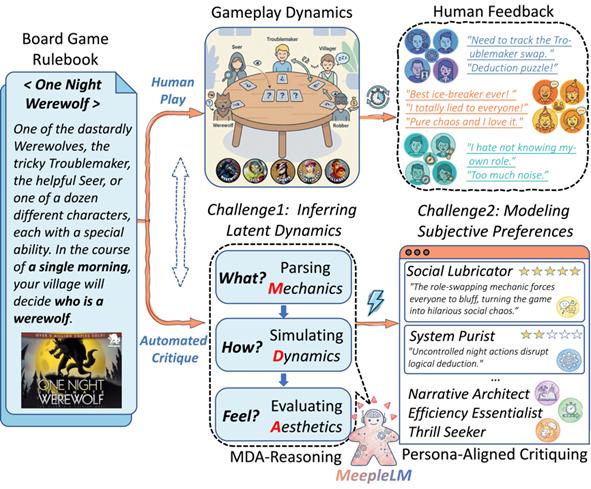
Core Insights - The article discusses the introduction of MeepleLM, a virtual playtester developed by a collaborative research team, which can simulate real player perspectives and provide constructive feedback based on dynamic gaming experiences. Group 1: MeepleLM Overview - MeepleLM is the first virtual playtester capable of simulating real player perspectives and offering constructive criticism based on dynamic game experiences [1][2] - The model utilizes a dataset of 1,727 structured board game rulebooks and 150,000 player reviews to create a mapping from objective rules to subjective experiences [1][5] - MeepleLM significantly outperforms general models like GPT-5.1 and Gemini3-Pro in accurately reflecting player reviews and rating distributions [1][11] Group 2: Design Challenges in Board Games - The board game industry is experiencing rapid growth, but the design process faces significant challenges due to its reliance on social interactions and emergent gameplay [2] - Traditional design processes are heavily dependent on manual playtesting, which is time-consuming and often fails to cover diverse player preferences [2] Group 3: Data and Methodology - The research team employed a stratified sampling strategy to select 1,727 representative games, converting unstructured PDF rulebooks into structured documents [5] - An automated processing workflow was designed to filter through 1.8 million comments, ultimately selecting about 8% that deeply relate game mechanics to dynamic experiences [6] Group 4: MDA Framework - MeepleLM incorporates the MDA (Mechanics-Dynamics-Aesthetics) framework to understand the causes of enjoyment in games, establishing a cognitive link from rules to player experiences [8] - The MDA framework allows the model to logically deduce experience outcomes rather than making random guesses [8] Group 5: Player Personas - The research identified five distinct player personas through clustering analysis, each with unique preferences and reactions to game mechanics [9] - MeepleLM can role-play these personas to provide feedback that reflects specific player preferences [9] Group 6: Performance Evaluation - Extensive testing was conducted on 207 games, including new releases for 2024-2025, to validate MeepleLM's effectiveness [11] - MeepleLM demonstrated superior performance in preference alignment, review quality, and utility compared to other models [12] Group 7: Insights and Practical Value - MeepleLM effectively identifies both strengths and critical flaws in games, providing a more nuanced understanding of player feedback compared to general models [13] - The model captures unique player voices and adapts its feedback style based on the persona being simulated, enhancing its authenticity [16] Group 8: New Paradigm for Interaction Systems - By linking static rules with dynamic experiences, MeepleLM establishes a new paradigm for automated virtual testing in interactive systems [19] - This approach facilitates design iteration based on expected market feedback and aids players in making personalized choices [19]

日媒:玩不了“剧本杀”?关税动摇美国桌游市场
Huan Qiu Shi Bao· 2025-05-12 22:54
Core Viewpoint - The U.S. tariff policy poses a significant threat to the tabletop gaming industry, potentially leading to substantial losses and forcing many companies to relocate their operations overseas [1][2]. Industry Overview - The global tabletop gaming market, which includes card games, board games, miniature games, and role-playing games, is valued at approximately $20 billion [2]. - The market was projected to grow to over $31 billion by 2030, but this forecast may be jeopardized due to tariffs affecting disposable income and increasing manufacturing costs [2]. Impact on Companies - Many U.S. tabletop game companies are either shutting down or shifting their focus to international markets that offer better opportunities [2]. - The industry relies heavily on overseas imports for complex game components, which are essential for production [2][3]. - A notable example is CMON, a Singapore-based publisher, which announced a halt on new game development due to financial losses exceeding $3 million and a 17% drop in revenue [4]. Challenges for Small Companies - Smaller companies and creators are particularly vulnerable to the adverse effects of the tariff policy, which threatens their ability to operate and innovate [5][6]. - The tariff policy has led to increased costs for small publishers, with some reporting a significant rise in expenses due to tariffs, impacting their financial viability [6]. Community Response - The majority of tabletop game studios publicly oppose the tariff policy, with some companies taking a more aggressive stance against it [6]. - Stonemaier Games highlighted the financial burden of tariffs, stating that they now pay unprecedented tariffs that significantly increase their production costs [6].