桥隧建设

Search documents
中国第一批没有论文的工科博士毕业了
猿大侠· 2026-02-10 04:11
Core Viewpoint - The article discusses the introduction of a new type of doctoral degree in China, the "practical doctoral degree," which emphasizes practical achievements over traditional thesis requirements, aiming to cultivate top engineers and enhance national innovation capabilities [2][42]. Group 1: Introduction of Practical Doctoral Degrees - China has officially launched practical doctoral degrees that do not require a thesis, focusing instead on hard-core practical outputs [1][4]. - This initiative is part of a broader strategy to elevate the country's overall innovation capacity by training top-tier engineers [2][42]. Group 2: Implementation and Examples - Since September 2022, at least 11 individuals have been awarded practical doctoral degrees across various critical technology fields, including energy equipment and aerospace [9][40]. - Notable examples include: - Yuan Xiaohu from Chongqing University, who developed high-temperature oxidation-resistant coatings, achieving over 100 million yuan in economic benefits [12][15]. - Wei Lianfeng from Harbin Institute of Technology, who addressed welding issues in nuclear materials [17][18]. - Nie Hailiang from Tsinghua University, who innovated in steel dust treatment technologies [20][23]. - Qiu from Xi'an Jiaotong University, who worked on hydraulic control systems for heavy equipment [25][26]. - Huang Lingcai from Northwestern Polytechnical University, who contributed to amphibious aircraft design [28][32]. Group 3: Legal and Policy Framework - The legal foundation for this new degree type was established with the implementation of the "Degree Law of the People's Republic of China" on January 1, 2025, which recognizes practical achievements as valid for doctoral graduation [42][44]. - The development of practical doctoral degrees has been a long-term effort, with significant policy milestones dating back to 2011, culminating in a comprehensive reform framework [44][46]. Group 4: Future Implications - The shift towards practical doctoral degrees is expected to produce a new generation of engineers who are adept at hands-on innovation, becoming a core force in engineering education [41][46]. - The program aims to align educational outcomes with national needs, fostering talent capable of addressing complex engineering challenges [48][49].


中国第一批没有论文的工科博士毕业了
量子位· 2026-02-08 01:40
Core Viewpoint - The article discusses the introduction of a new type of doctoral degree in China, known as the "practical doctoral degree," which emphasizes practical achievements over traditional thesis requirements, aiming to cultivate top engineers and enhance national innovation capabilities [2][42]. Group 1: Introduction of Practical Doctoral Degree - China has officially launched a practical doctoral degree that does not require a thesis, focusing instead on hard-core practical outputs [1][4]. - This initiative is part of a broader strategy to elevate the country's overall innovation capacity by training top engineers [2][42]. Group 2: Implementation and Examples - Since September 2022, at least 11 individuals have been awarded practical doctoral degrees across various critical technology fields, including energy equipment and aerospace [9][10]. - Notable examples include: - Yuan Xiaohu from Chongqing University, who developed a high-temperature oxidation-resistant coating for turbine valves, achieving over 100 million yuan in economic benefits [12][15]. - Wei Lianfeng from Harbin Institute of Technology, who worked on vacuum laser welding technology, addressing critical issues in nuclear material welding [17][19]. - Nie Hailiang from Tsinghua University, who developed a technology for steel furnace dust treatment, recognized for its industrial application value [21][23]. - Qiu from Xi'an Jiaotong University, who focused on digital hydraulic servo systems for heavy equipment, receiving high praise from industry experts [25][26]. Group 3: Legal and Policy Framework - The core shift in the doctoral degree awarding system is anchored in the implementation of the "Degree Law of the People's Republic of China" on January 1, 2025, which recognizes practical achievements as valid for doctoral graduation [42][43]. - This legal framework marks a significant departure from the traditional emphasis on thesis-based evaluations, promoting a more diversified and legally grounded assessment of doctoral candidates [43][46]. Group 4: Historical Context and Future Outlook - The development of practical doctoral degrees has been a long-term effort, beginning with the establishment of engineering doctoral programs in 2011 and evolving through various policy reforms [44][46]. - The future of doctoral education in engineering is expected to see an increase in practical talent, with a complete reform cycle established from top-level design to nationwide implementation [46].

济南“轨道上的黄河时代”加速到来
Qi Lu Wan Bao· 2026-01-02 17:25
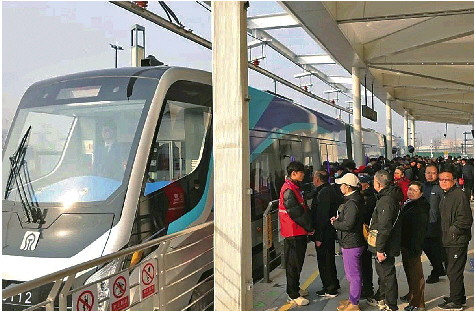
Core Viewpoint - The opening of the Jiyang Line marks a significant transformation in transportation for the northern bank of the Yellow River, enhancing connectivity and urban development in Jinan [4][10]. Group 1: Jiyang Line Overview - The Jiyang Line, which spans 36.1 kilometers, connects Jinan East Station to Jiyang District, effectively breaking the physical barrier of the Yellow River [4]. - The line features a peak service interval of approximately 15 minutes and a non-peak interval of about 20 minutes, ensuring efficient capacity management [5]. - The average distance between stations is 3.2 kilometers, providing comprehensive coverage for residential and commercial areas along the route [5]. Group 2: Impact on Commuters - Commuters have reported significant time and cost savings; for example, one individual reduced their commuting time from nearly one hour to just 30 minutes, with monthly commuting costs dropping from over 1000 yuan to around 100 yuan [5]. - The Jiyang Line facilitates a two-way flow of resources, allowing cultural and tourism resources from Jiyang to reach the main city quickly, while also enabling easier access to commercial, medical, and educational resources for northern bank residents [5][10]. Group 3: Future Developments - The Jiyang Line is part of a broader strategy to enhance Jinan's cross-river transportation network, with multiple planned and under-construction lines, including the Jinan Metro Line 7, which will further improve connectivity [6][9]. - The ongoing construction of additional cross-river tunnels and bridges aims to create a dense network of transportation options, with an average spacing of less than 3 kilometers between crossings [8][9]. Group 4: Urban Development and Integration - The development of the Jiyang Line and associated infrastructure is expected to transform the northern bank of the Yellow River into a vital urban area, integrating it into the main city’s development framework [7][10]. - The enhanced transportation network is anticipated to attract talent and investment, facilitating the transition of the northern bank from a peripheral area to a central hub for industry and services [10].