
汽车及汽车零部件

Search documents
汽车及汽车零部件行业研究:智驾行业2026年投资策略:从辅助驾驶走向物理AI
SINOLINK SECURITIES· 2026-03-02 05:13
Investment Rating - The report suggests a positive investment outlook for the smart driving industry, particularly focusing on companies that can leverage cost advantages and regulatory benefits in the evolving landscape of intelligent driving technology [5]. Core Insights - The smart driving sector is expected to maintain high growth momentum, driven by the trend of "Smart Driving Equality 2.0," which will see advanced features like urban NOA (Navigation on Autopilot) becoming more accessible to consumers in the 100,000 to 200,000 RMB price range [1][12]. - The L2 level of autonomous driving is entering a strong regulatory phase, which will benefit testing institutions and lead to a significant expansion of the market for compliance testing [2][29]. - The concept of scaling law is identified as a deterministic technological trend, with advancements in end-to-end architectures approaching L4 level capabilities [3][50]. - The Robotaxi business model has shown initial validation, indicating that the industry is on the verge of a significant turning point, particularly with the potential success of Tesla's Robotaxi [4][50]. Summary by Sections Section 1: Smart Driving Equality 2.0 - The trend of smart driving equality is expected to strengthen, with urban NOA features penetrating the 100,000 to 200,000 RMB price segment, supported by robust supply and demand dynamics [1][12]. - The penetration rate of urban NOA hardware configurations is projected to increase from 16% in 2025 to 25% in 2026, with sales expected to reach 5.45 million units, reflecting a year-on-year growth of over 50% [1][12]. Section 2: L2 Regulatory Phase - The L2 level is entering a strong regulatory phase, with the implementation of stringent standards that will benefit testing institutions and expand the market for compliance testing [2][29]. - The L3/L4 autonomous driving regulatory framework is gradually being established, moving from local trials to a national legal framework [2][40]. Section 3: Scaling Law and Technological Trends - The scaling law is recognized as a key technological trend, with the end-to-end architecture reaching preliminary L4 thresholds [3][50]. - The demand for computational power on the vehicle side is expected to grow alongside the increase in model parameters, necessitating companies to develop integrated software and hardware capabilities to remain competitive [3][50]. Section 4: Robotaxi Business Model - The Robotaxi model has been validated through successful regional operations by leading L4 manufacturers, indicating a growing consumer demand for such services [4][50]. - The success of Tesla's Robotaxi is seen as a potential catalyst for the industry, with significant implications for the advancement of high-level autonomous driving technologies [4][50].






节日出行,别让酒驾超速破坏团圆
Zhong Guo Qi Che Bao Wang· 2026-02-14 06:36
Group 1 - The recent accident involving a speeding vehicle in Chengdu has raised concerns about the safety of electric vehicles, highlighting that drunk driving and speeding are critical factors in traffic safety [2] - The driver was reported to have been driving at speeds exceeding 200 km/h before the crash, with a collision speed of over 160 km/h, significantly above the speed limit [2] - Data indicates that approximately 50% of fatal traffic accidents involve speeding, with a high mortality rate for vehicles exceeding 160 km/h [2] Group 2 - The debate over the safety design of electric vehicles has intensified, but this should not excuse the responsibility of drivers [3] - Experts emphasize that vehicle passive safety has limits, and extreme speeding increases risks exponentially, indicating that good crash test results do not guarantee safety under reckless driving conditions [3] - As the Spring Festival approaches, traffic authorities are intensifying enforcement against drunk driving and speeding, but the ultimate responsibility lies with the drivers themselves [3]


6年损失近万亿欧元,德国反思竞争力:解决结构性缺陷,反对“筑贸易壁垒”
Huan Qiu Shi Bao· 2026-02-09 22:53
Core Insights - Germany's economy has suffered significant losses due to multiple crises since 2020, totaling nearly €1 trillion, driven by the pandemic, the Russia-Ukraine conflict, and tariff disputes [1][2] - The economic outlook remains bleak, with only a slight projected growth of 0.2% in 2025, overshadowed by stagnant labor markets and an unclear export future [1][4] Economic Losses - The estimated economic loss for Germany, adjusted for inflation, reached €940 billion from 2020 to 2025, with €1,850 billion lost in 2020 alone due to the pandemic [2] - The economic losses in 2022 were approximately €850 billion, with subsequent losses of €1,400 billion and €2,000 billion in the following years [2] - A quarter of the total losses occurred in the past year, with the peak loss projected at €2,350 billion in 2025 [2] Employment Impact - The crises have resulted in an average loss of over €20,000 per employed person, equating to about one-fifth of their annual economic output [3] Structural Challenges - To regain economic leadership, Germany must address structural issues such as high energy prices, rising social insurance costs, and bureaucratic inefficiencies [3] Export and Trade Dynamics - Despite a slight increase in exports by 1% in 2025, challenges remain due to U.S. tariff policies, euro appreciation, and intensified international competition [4] - Germany's exports of automobiles, machinery, and chemical products are expected to decline, highlighting ongoing structural weaknesses in the export sector [4] Policy Responses - Germany opposes the EU's plan to prioritize public procurement for European companies, arguing that competitiveness cannot be built through isolationist measures [5][6] - The German government advocates for a "Made with Europe" strategy, emphasizing collaboration with reliable global partners rather than erecting trade barriers [6]
我省入选智能制造“揭榜挂帅”项目数全国最多
Xin Hua Ri Bao· 2026-01-07 00:16
Core Insights - The Ministry of Industry and Information Technology and the State Administration for Market Regulation have jointly announced the list of projects selected for the 2025 Smart Manufacturing System Solutions "Challenge" initiative, with a total of 73 projects nationwide, including 14 from Jiangsu, the highest number in the country [1] Group 1: Project Selection - The selection process was conducted to implement the "Digital Transformation Action Plan for Manufacturing" and the tasks outlined in the "14th Five-Year Plan for Smart Manufacturing Development" [1] - The selected projects were determined through recommendations from provincial departments, expert evaluations, and public announcements [1] Group 2: Jiangsu Projects - Jiangsu's selected projects include solutions such as the "Fan Efficiency Optimization Control Solution for the Steel Industry" by Langkun Smart Technology Co., Ltd. and the "Intelligent Cleaning Robot Solution for Industrial Sites" by Nanjing Tevos Clean Equipment Co., Ltd. [1] - These projects signify national recognition of the innovative achievements of these companies in the field of smart manufacturing [1] Group 3: Industry Focus - The key industries served by the selected projects include steel, building materials, automotive and auto parts, medical equipment, engineering machinery, textiles, pharmaceuticals, electronic devices, photovoltaics, and integrated circuits, all of which are key and advantageous industries for Jiangsu [1] - The next steps for the selected companies involve further deepening the integration of artificial intelligence with industrial scenarios to support the digital transformation and high-quality development of the industry [1]
“胡润全球TOP1000企业榜”揭晓 中国以158家公司位居第二
证券时报· 2025-12-16 12:42
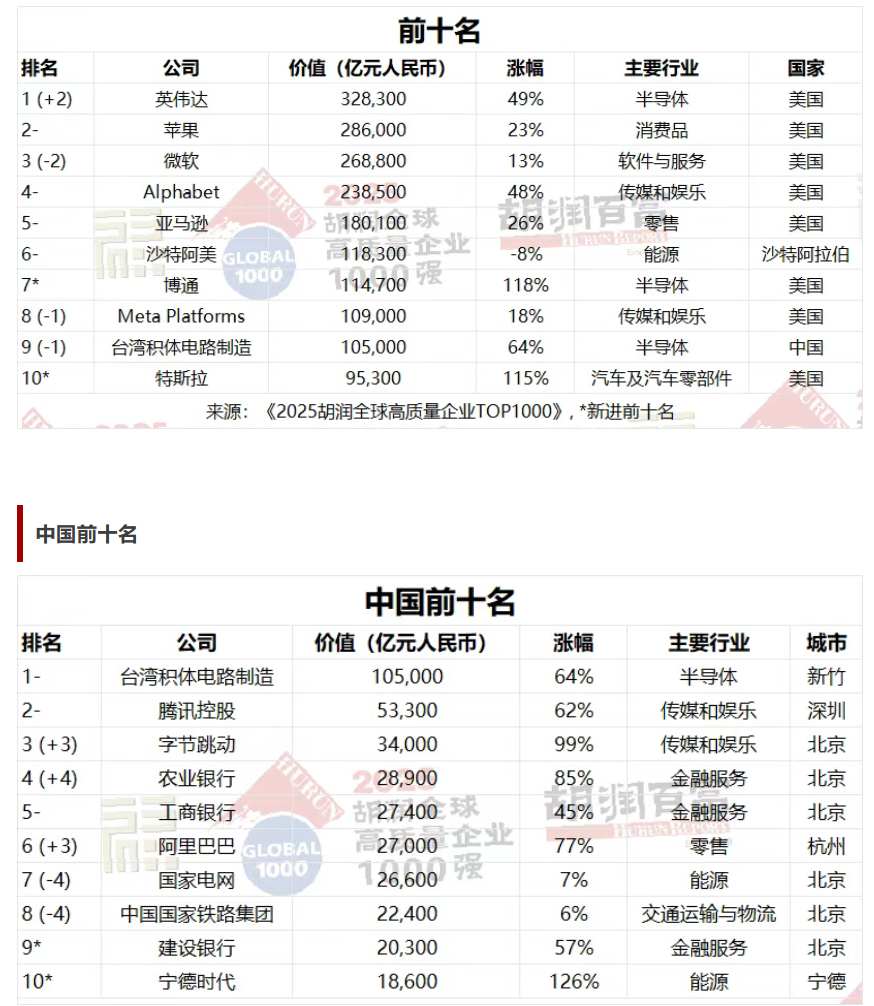
Core Insights - The 2025 Hurun Global High-Quality Enterprises TOP 1000 list highlights the highest valued companies globally, focusing on market capitalization, innovation, sustainability, social responsibility, and market influence [1][7] - 79% of the companies on the list saw an increase in value compared to the previous year, with 171 new entrants and only 21% experiencing a decline [1] - The total value of the listed companies reached 785 trillion RMB, with the entry threshold rising from 1.4 trillion RMB to 1.8 trillion RMB [1] Group 1: Top Companies - Nvidia is now the highest valued company globally, valued at 328.3 trillion RMB, with a 49% increase driven by demand for AI chips [4][5] - Apple remains in second place with a value of 286 trillion RMB, benefiting from strong device and service revenues, while Microsoft dropped to third with a value of 268.8 trillion RMB, growing 13% [4][5] - Alphabet ranks fourth with a value of 239.5 trillion RMB, up 48%, followed by Amazon at fifth with 180.1 trillion RMB, reflecting improvements in e-commerce and AWS [4][5] Group 2: Notable Trends - Saudi Aramco, the highest valued energy company, saw an 8% decline in value to 118.3 trillion RMB due to a weak oil market [5] - Broadcom entered the top ten with a remarkable 118% increase, reflecting the semiconductor boom and AI demand [5] - Tesla re-entered the top ten with a 115% increase, valued at 95.3 trillion RMB, driven by strong demand for electric vehicles and AI integration [6] Group 3: Chinese Companies - China has 158 companies on the list, with TSMC leading at 105 trillion RMB, a 64% increase, followed by Tencent at 53.3 trillion RMB, up 62% [8][9] - ByteDance saw a 99% increase in value to 34 trillion RMB, while Agricultural Bank of China grew 85% to 28.9 trillion RMB [8][9] - Notable mentions include Alibaba, which increased by 77% to 27 trillion RMB, and CATL, which surged 126% to 18.6 trillion RMB [9] Group 4: Geographic Insights - Beijing remains the top city with five new companies, followed by Tokyo and New York, while San Francisco and Houston also saw significant representation [10] - The growth of AI, semiconductors, and cloud computing continues to drive value in major tech hubs [10] Group 5: AI Sector Growth - The AI sector has shown exceptional growth, with 11 companies valued at over a trillion RMB, compared to only four in 2020 [11][12] - The top ten companies' total value nearly doubled from 69 trillion RMB in 2020 to 184 trillion RMB [12] - Nvidia, Broadcom, and TSMC lead in computing power, while Alphabet, Microsoft, and OpenAI dominate in software [12][13]




《2025胡润全球高质量企业TOP1000》发布 英伟达(NVDA.US)成为全球价值最高的公司
Zhi Tong Cai Jing· 2025-12-16 09:10
Core Insights - Nvidia has become the world's most valuable company, surpassing Microsoft and Apple, with a valuation of 3.28 trillion RMB, reflecting a 49% increase [1][2] - Apple remains in second place with a valuation of 2.86 trillion RMB, growing by 23% [1][2] - Microsoft has dropped to third place, with a valuation of 2.69 trillion RMB, marking a 13% increase [1][2] - Alphabet and Amazon round out the top five, with valuations of 2.39 trillion RMB (up 48%) and 1.8 trillion RMB (up 26%), respectively [1][2] Company Rankings - Nvidia ranks first with a valuation of 3.28 trillion RMB and a growth rate of 49% in the semiconductor industry [3][4] - Apple ranks second with a valuation of 2.86 trillion RMB and a growth rate of 23% in consumer goods [3][4] - Microsoft ranks third with a valuation of 2.69 trillion RMB and a growth rate of 13% in software and services [3][4] - Alphabet ranks fourth with a valuation of 2.39 trillion RMB and a growth rate of 48% in media and entertainment [3][4] - Amazon ranks fifth with a valuation of 1.8 trillion RMB and a growth rate of 26% in retail [3][4] - Saudi Aramco, the only state-owned enterprise in the top ten, ranks sixth with a valuation of 1.18 trillion RMB, down 8% [1][3] Notable Growth - Nvidia experienced the highest value increase this year, adding 1.08 trillion RMB [2] - Alphabet and Broadcom followed, with increases of 770 billion RMB and 620 billion RMB, respectively [2] - The number of companies valued over 100 billion USD has doubled from 115 to 226 in five years, with the US leading with 410 companies [2] Chinese Companies - Taiwan Semiconductor Manufacturing Company (TSMC) ranks first among Chinese companies with a valuation of 1.05 trillion RMB, growing by 64% [4] - Tencent Holdings ranks second with a valuation of 533 billion RMB, growing by 62% [4] - ByteDance ranks third with a valuation of 340 billion RMB, showing a remarkable growth of 99% [4] - Agricultural Bank of China ranks fourth with a valuation of 289 billion RMB, growing by 85% [4]


2025年在中国的美国企业特别报告
Sou Hu Cai Jing· 2025-11-06 12:18
Core Insights - The report highlights the significance of the Chinese market for American companies, with 70 sampled firms generating $312.7 billion in revenue in China for the fiscal year 2024, surpassing the U.S.-China trade deficit of $295.4 billion. China contributed 12% to the global revenue of these companies, becoming the second-largest market for 50% of the sampled firms [1][6][9]. Industry Performance - The information technology sector achieved double-digit growth in both global and Chinese markets, with semiconductor companies being the main drivers of this growth [1][48]. - The consumer goods sector in China experienced an annual compound growth rate of 14%, double that of the global market [1][43]. - The industrial sector saw a growth of 2.4% in China, outperforming the global stagnation [1][43]. - The energy and chemical sectors, along with the healthcare industry, reported a decline in revenue in China [1][43]. Company Highlights - Apple led the revenue rankings in China with $66.95 billion, followed by Qualcomm, Tesla, and Walmart. Companies like Nvidia and Advanced Micro Devices showed significant revenue growth [1][6][27]. - Successful strategies employed by American companies in China include supply chain localization, technological innovation, and deepening localization strategies, with Apple, Tesla, Walmart, and Procter & Gamble serving as notable examples [1][10]. Investment Outlook - Despite challenges such as U.S.-China trade tensions, competition from local firms, and regulatory compliance, nearly 70% of surveyed American companies in the consumer sector plan to increase their investments in China by 2025. The improving business environment and vast market potential in China continue to make it a strategic priority for American firms [1][10][14].


日本质疑美国关税公告与协议不一致 要求纠正
Xin Hua She· 2025-08-06 13:49
Group 1 - Japan's Economic Revitalization Minister, Akizawa Ryozo, stated that the U.S. announcement regarding tariffs starting August 7 is inconsistent with the previously agreed terms, leading to higher tariffs for Japan [1] - The agreed "equivalent tariff" rate for Japan is set to increase from 10% to 15% due to the inclusion of a 10% "base tariff" that has been in effect since April [1] - Akizawa emphasized the need for the U.S. to clarify the situation and adhere to the previously established agreement, as the new U.S. announcement imposes an additional 15% on already taxed goods, which is detrimental to Japan [1] Group 2 - Japan and the U.S. have reached an agreement to reduce tariffs on automobiles and auto parts to 15%, but the specific timeline for this reduction has not yet been determined [1] - The current tariff on Japanese automobiles and auto parts is 27.5%, causing significant daily losses to the related industries [1] - Regarding Japan's commitment to invest $550 billion in the U.S., Akizawa stated that Japan cannot cooperate if it does not benefit Japanese companies and the economy [2]
中国政府对全球企业“支配力”最大
日经中文网· 2025-04-27 07:16
如果按出资对象企业总部所在的国家和地区,对中国政府的NPF进行归类,除中国外最多的是澳 大利亚。NPF约为5460亿美元。对基础设施和资源相关企业具有强大的支配力。 将特定组织和企业作为股东具有影响力的企业等的营业收入规模视为"支配力",将子公司和孙公 司等间接出资包括在内的出资关系视为网络,并在考虑持股比例的基础上进行计算。以压倒性优 势排在第一位的是中国政府…… 《日经商务周刊》与日本早稻田大学和国立情报学研究所合作,利用约2亿条数据分析了全球企 业的资本结构,结果显示中国政府在各国拥有强大的支配力。美国大型基金的支配力跻身前列。 美国企业和中国政府的"资本战争"正在展开。 分析采用了日本早稻田大学的栗崎周平副教授和日本国立情报学研究所水野贵之副教授开发的自 主指数"NPF(Network power flow)"。将特定组织和企业作为股东具有影响力的企业等的营业收入 规模视为"支配力",将子公司和孙公司等间接出资包括在内的出资关系视为网络,并在考虑持股 比例的基础上进行计算。 以压倒性优势排在第一位的是中国政府。NPF将网络上的所有旗下企业都计算在内。各行业的核 心企业多是中国的国有企业,因此获得了很高 ...
2024在中国的美国企业特别报告
上海胡润百富投资管理咨询· 2025-03-03 07:37
Group 1: Market Overview - In 2023, 70 sample American companies generated over $3,000 billion in revenue from the Chinese market, contributing 12% to their global revenue[6] - The total global revenue of these companies exceeded $2.5 trillion, with a year-on-year growth of 1.1%[6] - The average revenue from the Chinese market for these companies was $4.39 billion, with a median of $2.16 billion[30] Group 2: Investment Trends - In 2023, the actual foreign investment in China reached $163.25 billion, ranking China as the second-largest recipient of foreign investment globally[15] - The number of newly established foreign-invested enterprises in China increased by 39.7% year-on-year, totaling 54,000[15] - The compound annual growth rate of U.S. investment in China from 2020 to 2023 was 13.5%, significantly higher than the overall growth rate of 3% for foreign investment in China[20] Group 3: Industry Performance - The consumer sector in China saw a compound annual growth rate of 19.4% from 2020 to 2023, double the global growth rate of 9.1%[50] - The healthcare sector in China grew by 16.8% during the same period, while the global healthcare market declined by 2%[59] - The information technology sector contributed the highest revenue share, averaging 25.7% of total revenue from the Chinese market[30]
