
涉税专业服务

Search documents
【实用】@涉税专业服务机构,3月31日前,年度报告和特定业务要素信息报告请填写!
蓝色柳林财税室· 2026-03-23 09:17
Core Viewpoint - The article outlines the requirements and procedures for tax-related professional service institutions to report their annual performance and specific business elements to the tax authorities by March 31 each year, as mandated by the "Management Measures for Tax-Related Professional Services (Trial)" [2][4]. Reporting Entities - Entities engaged in tax-related professional services include tax firms, accounting firms, law firms, bookkeeping agencies, tax agencies, and financial consulting companies [2][4]. - Institutions with a "service status" of suspension or those newly registered in 2026 are not required to report [2]. Reporting Deadline - Institutions must submit their annual reports by March 31 of the following year, verifying and correcting the automatically reported data through the national electronic tax bureau [2][4]. Operational Guidelines - Institutions can log into the electronic tax bureau and navigate to the relevant sections to manage their reporting [2][4]. - The reporting process includes verifying the existence of unreported annual reports and correcting any discrepancies in previously submitted reports [3][5]. Specific Business Element Reporting - Institutions that complete specific services such as professional tax consulting, tax compliance planning, tax certification, and tax situation reviews must report additional business element information by March 31 of the following year [4][5]. Credit Evaluation Management - The "Credit Evaluation Management Measures for Tax-Related Professional Services" will be implemented starting January 1, 2026, introducing a credit scoring system for institutions based on their compliance with reporting requirements [6][11]. - Institutions failing to report or providing inaccurate information may face penalties, including credit score deductions and being classified as untrustworthy [6][15]. Incentives and Penalties - Institutions achieving a high credit score (TSC5) will receive benefits such as expedited tax services and preferential treatment in government procurement [14]. - Conversely, institutions classified as untrustworthy will face public announcements, risk warnings to clients, and restrictions on their ability to process tax-related business [15].


海南将加强立法 完善与高水平自贸港相适应的政策制度体系
Zhong Guo Xin Wen Wang· 2026-01-29 07:33
Core Viewpoint - Hainan Province is focusing on legislative efforts to enhance the policy and institutional framework for its Free Trade Port, with significant developments expected by 2026, the first year of full operation after the island's closure [1][2]. Legislative Developments - The Hainan Provincial People's Congress will prioritize legislation that supports the Free Trade Port, including regulations on cross-border finance, low-altitude economy, and urban renewal [1]. - New regulations will be introduced to improve port management and facilitate customs processes, including a trial regulation for port management services and credit management for "second-line ports" [2]. Economic and Industry Initiatives - Hainan is modifying its marine usage management laws to promote marine development while protecting ecological boundaries, focusing on the acquisition and regulation of marine usage rights [3]. - The province is advancing its tourism sector by establishing a tourism regulation that aligns national support policies with local laws, easing foreign investment in tourism [3]. - New regulations are being implemented to support the modern service industry, including tax-related services and logistics, aimed at reducing costs and enhancing efficiency [3]. - Hainan is also promoting the development of the private economy by addressing operational challenges faced by private enterprises and fostering a fair competitive environment [3].
涉及虚开发票等行为 税务部门再次曝光8起涉税中介违法违规案件
Yang Shi Xin Wen· 2025-11-28 04:59
Core Points - The article highlights the recent exposure of eight tax-related intermediary illegal cases by tax authorities in multiple regions, marking the third such exposure this year [1] - The tax authorities emphasize that these "black intermediaries" not only violate legal boundaries but also disrupt tax collection order and harm the rights of taxpayers [1] - Measures have been taken against the involved intermediary companies and their main responsible persons, including being listed as untrustworthy entities in tax services [1] - Cases involving suspected criminal activities have been handed over to judicial authorities for further processing [1] - The tax authorities will continue to support and regulate the development of the tax service industry while strictly investigating illegal activities by tax intermediaries [1] Industry Summary - Some intermediaries manipulate shell companies to facilitate tax evasion for their client companies [2] - Certain intermediaries assist client companies in fraudulently obtaining export tax rebates [2] - Some intermediaries act as brokers for issuing false invoices [2] - Certain intermediaries illegally provide bank accounts and invoices, becoming accomplices in tax evasion for businesses [2]
全国首个规范涉税专业服务行为的地方性法规将在海南实施
Zhong Guo Xin Wen Wang· 2025-10-31 12:02
Core Points - The "Regulations on Tax-related Professional Services in Hainan Free Trade Port" will be implemented on November 1, marking the first local regulation in China to standardize tax-related professional services [1][2] - The regulation aims to support the high-quality development of modern service industries in Hainan Free Trade Port, especially as it approaches its customs closure operation [1] Group 1: Regulatory Framework - The regulation establishes a framework that draws from existing laws such as the Asset Appraisal Law and the Certified Public Accountant Law, defining the scope of services applicable to tax-related professional services in the free trade port [1] - It includes various service providers such as tax firms, accounting firms, law firms, bookkeeping agencies, and customs agencies, covering seven types of services including tax declaration assistance and general tax consulting [1] Group 2: International Collaboration - The regulation facilitates cross-border tax services and investment financing, allowing foreign tax service providers to participate in local services under national and local regulations [1][2] - It encourages industry associations to create international and digital platforms to enhance service alignment with international standards and promote global cooperation [1] Group 3: Talent Development - The regulation addresses the shortage of international tax talent in Hainan by allowing foreign professionals to take tax certification exams and supporting collaboration with foreign institutions [2] - This initiative aims to strengthen local firms' international business capabilities to better serve cross-border tax needs of enterprises [2] Group 4: Service Assurance - The regulation emphasizes a balance between management and service, establishing a trust system for tax-related professional services, where tax authorities will recognize the integrity and professionalism of reports and opinions from service providers [2] - It aims to assist tax authorities in ensuring tax revenue collection while helping market entities fully utilize preferential policies [2]
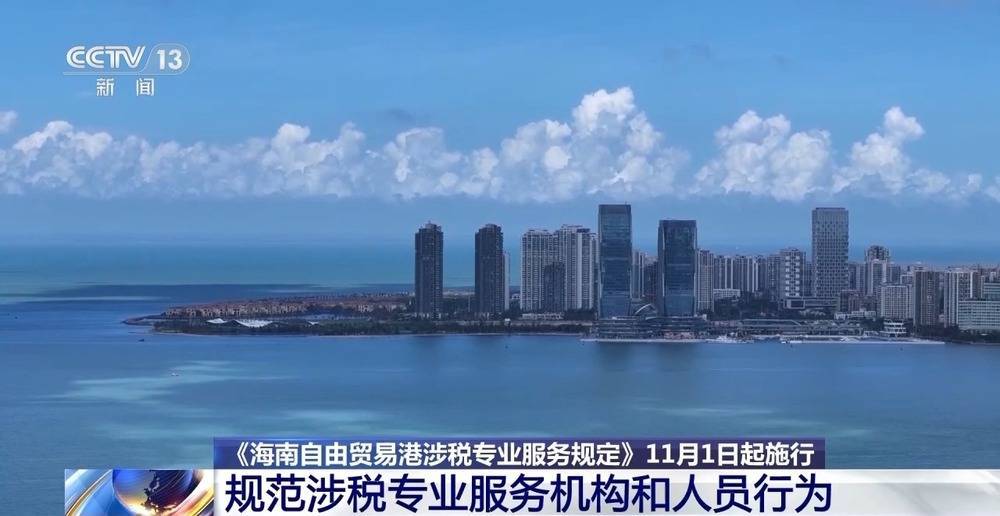
《海南自由贸易港涉税专业服务规定》将于11月1日起施行
Yang Shi Xin Wen· 2025-10-16 18:07
Core Points - The "Regulations on Tax-related Professional Services in Hainan Free Trade Port" have been announced and will take effect on November 1, marking a significant step in the high-quality development of modern service industries in Hainan Free Trade Port [1] - This is the first local regulation in China to standardize tax-related professional services, reflecting the increasing demands for such services as the free trade port approaches its operational closure [1] - The regulations aim to facilitate the smooth implementation of special tax systems, ensuring that tax authorities can collect all due revenues while enabling businesses and individuals to fully benefit from tax incentives in the free trade port, thereby promoting trade and investment flow [1] Summary by Categories Regulations - The newly published regulations are crucial for the high-quality development of Hainan's modern service industry and are the first of their kind in China [1] - The regulations will come into effect on November 1, indicating a timeline for compliance and implementation [1] Taxation - The regulations are designed to enhance the management of tax-related professional services, ensuring that tax authorities can achieve full revenue collection [1] - They also aim to help businesses and individuals take full advantage of the tax benefits offered by the free trade port [1] Economic Impact - The implementation of these regulations is expected to significantly promote the free flow of trade and investment in Hainan, contributing to the region's high-level openness [1]
事关海南自贸港涉税专业服务 这项规定11月起施行
Sou Hu Cai Jing· 2025-10-16 15:09
Core Viewpoint - The "Regulations on Tax-Related Professional Services in Hainan Free Trade Port" will take effect on November 1, marking a significant step in the high-quality development of modern service industries in Hainan Free Trade Port and establishing the first local regulation to standardize tax-related professional services in China [1][3]. Group 1: Regulatory Framework - The regulations aim to enhance the implementation of special tax systems and ensure that tax authorities can collect all due revenues while enabling businesses and individuals to fully enjoy tax benefits [1][3]. - The regulations are expected to facilitate the smooth operation of the special tax system, promoting trade and investment flow in Hainan Free Trade Port [1]. Group 2: International Engagement - The regulations focus on three main areas to align with international standards: - Innovating cross-border tax services to meet the needs of cross-border personnel and investment [3]. - Expanding industry openness by allowing foreign tax service institutions and personnel to participate in local services [3]. - Promoting internationalization of industry associations to enhance cooperation and compliance with international rules [3]. Group 3: Scope of Services - The specific tax-related professional services outlined in the regulations include tax declaration agency, general tax consulting, professional tax advisory, tax compliance planning, tax certification, and tax situation review [5].
涉税专业服务执业每一课之《涉税专业服务机构信用积分提升攻略》
蓝色柳林财税室· 2025-09-10 12:26
Core Viewpoint - The article discusses the credit scoring system for tax-related professional service institutions, detailing how to achieve high credit scores through compliance with various regulations and management practices [3][4][5]. Group 1: Credit Scoring System Overview - The credit scoring system assigns a total of 210 points automatically to institutions identified as "tax-related professional service institutions" [3]. - Key scoring categories include: - Tax authority evaluation: 30 points - Submission of real-name information: 30 points - Retention of tax reports and documents: 20 points - Timely tax declaration representation: 100 points [3][4]. Group 2: Management and Compliance - Institutions can earn an additional 90 points through effective daily management practices, such as: - Client satisfaction evaluations, which can yield up to 10 points if clients do not respond within 15 days [4]. - Reporting real-name information of service personnel before providing services [4]. - Accurate reporting of service agreements to tax authorities [4] . Group 3: Performance Improvement - Institutions can gain up to 200 points by enhancing service quality and management practices, including: - Previous evaluation cycle credit status: 100 points - Client tax credit status: 20 points - Average revenue per service personnel: 10 points [4][5]. - Joining industry associations can yield additional points, such as 25 points for joining a tax professional association [4]. Group 4: Penalties for Non-compliance - The system imposes penalties for non-compliance, with some indicators having no upper limit on point deductions, potentially lowering credit ratings significantly [5]. - For example, failing to report specific business information on time can result in deductions ranging from 10 to 200 points, depending on the severity of the infraction [5].

济源税务:精准培训引导涉税机构合规精进
Sou Hu Cai Jing· 2025-08-21 03:38
Core Insights - The article emphasizes the importance of compliance in the tax service industry, highlighting a shift from passive compliance to proactive improvement among service institutions [1][2] Group 1: Training Initiatives - The Jiyuan Tax Bureau organized specialized training for over 60 tax service institutions, focusing on policy interpretation and case warnings to enhance compliance awareness [1] - The training addressed high-frequency business practices such as equity transfer and R&D expense deductions, providing practical policy insights and legal case studies [1] - A dual mechanism of "one account one file + bi-monthly training" was established to ensure dynamic management and precise understanding of business operations [1] Group 2: Future Directions - The Jiyuan Tax Bureau plans to continue refining services and improving regulatory mechanisms to support the healthy development of tax service institutions [2] - The focus will be on providing professional and reliable services to taxpayers while maintaining strict compliance with regulations [2]
@涉税专业服务机构,提分六步全攻略
蓝色柳林财税室· 2025-07-04 14:22
Core Viewpoint - The article provides a comprehensive guide for tax-related service institutions to improve their credit scores through timely and accurate reporting of information, adherence to regulations, and strategic actions to avoid penalties and enhance scores. Group 1: Steps to Improve Credit Score - Step 1: Timely and Accurate Reporting of Real Name Information is crucial for tax service institutions to submit their basic information to tax authorities before providing services and to update it as necessary [1][2]. - Step 2: Accurate Reporting of Tax Service Agreement Information is essential, requiring institutions to report agreement details to tax authorities within specified timeframes [4][5]. - Step 3: Timely Submission of Annual Reports is mandated, with institutions required to submit the previous year's report by March 31 each year [7]. - Step 4: Timely Submission of Special Reports is required for various tax-related services, with a deadline of March 31 of the following year [8][10]. Group 2: Common Penalty Points - Institutions must report any changes in basic information within 30 days to avoid penalties [2]. - Failing to submit required reports or submitting them late can result in significant point deductions, with severe violations leading to being listed as untrustworthy [6][11][13]. - Misreporting or failing to correct information can incur penalties of up to 200 points and potential loss of credibility [6][12][13]. Group 3: Strategies for Score Enhancement - Institutions can earn additional points by establishing a party organization, uploading professional certificates, and joining industry associations [3]. - Encouraging clients to provide satisfaction evaluations within 15 days can yield additional points based on their feedback [6]. - Regularly submitting business reports after completing tax services can also contribute to score improvement, with a cap of 20 points per year [14]. Group 4: Compliance and Ethical Standards - Strict adherence to professional norms can prevent point deductions and enhance credit scores, with compliance being a core principle throughout the service process [20]. - Violations of tax laws or unethical practices can lead to severe penalties, including significant point deductions and being placed on a blacklist [18][20].

中山首设涉税中介办税服务专区 将中介“信用”转化为办税“便利”
Nan Fang Ri Bao Wang Luo Ban· 2025-05-29 08:56
Group 1 - The establishment of the "Tax-related Professional Service Agency Tax Service Zone" in Zhongshan marks the beginning of a "one-stop" tax service model for tax intermediaries with high credit ratings [1] - The service zone is designed for intermediaries with a TSC level of 5 (the highest level) and provides comprehensive services from business initiation to completion [1] - On the opening day, representatives from 8 local tax service agencies engaged with tax authorities to understand the zone's functions and services [1] Group 2 - The initiative is part of the implementation of the "Intermediary Tax Service Management Measures (Trial)" aimed at promoting compliance among economic entities and creating a win-win situation for enterprises, taxes, and the market [2] - Since the introduction of specialized centralized management for tax service agencies in 2024, the overall credit level of the industry in Zhongshan has significantly improved, with over 1,400 TSC level 5 agencies, accounting for 78.1% of the total [2] - The number of TSC level 5 tax firms has increased by 18 year-on-year, with a 36 percentage point rise in their proportion [2]