电子废弃物回收

Search documents
六部门发文促进光伏组件综合利用,我国陆生野生动植物保护取得积极进展
GUOTAI HAITONG SECURITIES· 2026-03-10 07:25
Investment Rating - The report does not explicitly provide an investment rating for the industry Core Insights - The report highlights significant policy developments aimed at promoting the comprehensive utilization of photovoltaic components, which is expected to alleviate future solid waste pressure and ensure the security of key metal resources, thereby consolidating China's leading position in the global photovoltaic industry and supporting the achievement of carbon neutrality goals [5][6] - The ecological environment department has revised the technical specifications for the treatment of waste electrical and electronic products, addressing the complexities of electronic waste and enhancing the recycling and utilization system [7][10] - The report notes that the protection rate of key terrestrial wild animal and plant species in China has exceeded 80%, indicating positive progress in biodiversity conservation [11][12] - The launch of the first carbon credit product for government office systems marks a significant step in promoting green and low-carbon transformation in public institutions [15][17] - The report discusses international developments, including the first issuance of carbon credits under the Paris Agreement and projections from the International Energy Agency regarding the future of global electricity generation [18][20] Policy Developments - The Ministry of Industry and Information Technology and five other departments issued guidelines to promote the comprehensive utilization of photovoltaic components, aiming for a cumulative utilization of 250,000 tons by 2027 and enhanced technological capabilities by 2030 [5][6] - The ecological environment department's new technical specifications for waste electrical and electronic products will take effect in March 2026, expanding the categories of waste and detailing pollution control requirements throughout the storage and dismantling processes [7][9] Industry Trends - The National Forestry and Grassland Administration reported that the protection rate of key terrestrial wild animal and plant species has surpassed 80%, with ongoing efforts to improve habitat quality and species conservation [11][12] - The launch of the "Qingpu Gold Carbon" product represents the first carbon credit for government office systems, facilitating the transformation of energy-saving measures into tradable carbon assets [15][17] International Events - The first carbon credit issuance under the Paris Agreement's mechanism signifies a shift towards operationalizing international carbon markets [18][19] - The International Energy Agency forecasts that by 2030, 50% of global electricity will come from renewable sources and nuclear energy, with significant growth expected in solar energy generation [20][21] Corporate Developments - China Huaneng Group has initiated the first international standard for carbon capture monitoring and management, aiming to enhance public understanding of carbon capture technologies [23] - Haitai New Energy is collaborating with Beijing Energy International to advance green energy transitions, focusing on green electricity and hydrogen transportation [24]
韩气候环境部计划构建核心矿物回收再利用体系
Shang Wu Bu Wang Zhan· 2026-02-11 17:32
Core Insights - The demand for core minerals is rapidly increasing due to advanced industries such as electric vehicles and wind power generation, making supply chain stability a national priority [1] - The South Korean Ministry of Environment plans to develop a strategy for recycling and reusing core minerals from various future waste resources, including electric vehicle batteries, communication devices, and permanent magnets [1] - Currently, South Korea does not recover a significant amount of core minerals from electronic waste, leading to the export of e-waste or its disposal as scrap metal [1] - A collaborative team consisting of experts from the Ministry of Environment, National Institute of Environmental Research, Korea Environment Institute, and Korea Institute of Geoscience and Mineral Resources will analyze the current state of recycling technologies and infrastructure to formulate practical recycling and reuse plans [1]
回收的废旧手机去了哪里?如何变废为宝?一文了解
Yang Shi Xin Wen· 2025-04-28 15:51
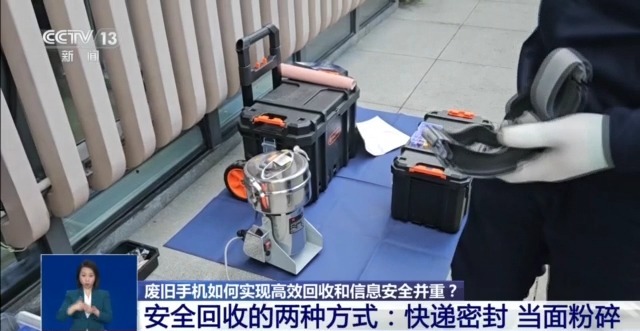
Core Insights - The market for recycling and processing discarded electronic products in China is expected to exceed 150 billion yuan in 2024, with a significant focus on the recycling of old mobile phones due to rapid technological upgrades and concerns over information security [1] - The total number of idle mobile phones in China is projected to reach 6 billion during the 14th Five-Year Plan period, with information security concerns being a major barrier to recycling [1] Group 1: Recycling Process - A citizen in Shenzhen utilized the "Chip Shredder" app to arrange for the collection of old mobile phones, highlighting the convenience of on-site recycling services [3] - The recycling service offers two methods for ensuring data security: free shipping of phones in sealed packaging for destruction at a facility, or an on-site destruction service for a fee [5][18] - The phones are processed using a 2000-watt shredder, which reduces them to small fragments while minimizing environmental pollution [7] Group 2: Processing and Recovery - The China Resource Recycling Group has established a national platform for safe recycling and processing of mobile phones, with a demonstration project launched in Shantou, Guangdong [8] - Recycled phones are sent to a processing facility where they are disassembled, and components are sorted for further processing [10] - The shredded materials are melted at high temperatures to extract valuable metals, resulting in copper ingots that contain gold, silver, and palladium [14] Group 3: Economic Aspects - The processing of one ton of mobile circuit boards can yield copper ingots valued at approximately 360,000 yuan, translating to about 7 yuan per individual phone [19] - Users can choose free recycling options or pay for enhanced security measures, but currently, they do not receive cash benefits from the recycling process due to associated logistics and processing costs [18][19] - The China Resource Recycling Group aims to create an integrated recycling chain that addresses the challenges of electronic waste management [19]