
疾病防控

Search documents
春节期间传染病形势平稳可控
Xin Lang Cai Jing· 2026-02-09 05:51
Core Insights - The overall epidemic situation of infectious diseases in China is currently stable, with acute respiratory infectious diseases showing a downward trend [1] - The flu has decreased to moderate and low epidemic levels in most regions, while respiratory syncytial virus remains a primary pathogen detected [1] Group 1: Current Epidemic Situation - Acute respiratory infectious diseases are in a high incidence season but are trending downwards [1] - The detection rate of respiratory syncytial virus is decreasing, while other viruses like rhinovirus, parainfluenza virus, and common coronavirus are still active at certain levels [1] - The positive detection rate for COVID-19 and other monitored respiratory pathogens remains low [1] Group 2: Mosquito-borne Diseases - Mosquito-borne diseases are currently in a non-epidemic season, but risks from imported cases of diseases like dengue fever and malaria persist due to ongoing outbreaks in neighboring countries [1] - There is a risk of local sporadic cases from imported cases or overwintering mosquitoes in warmer southern regions [1] Group 3: Precautionary Measures - Increased cross-border and cross-regional movement during the Spring Festival may heighten the risk of disease transmission [1] - The National Health Commission emphasizes the need for local authorities to strengthen responses to major infectious disease outbreaks and monitor key diseases like COVID-19 and Nipah virus [1]
宁波大学:“微专业西行”赋能西部公共卫生人才培养
Xin Lang Cai Jing· 2026-01-29 12:37
Core Viewpoint - Ningbo University is innovatively enhancing public health talent training in the western regions of China through a micro-major program, establishing a comprehensive support system that integrates online courses, practical training, and long-term mechanisms [1][4]. Group 1: Program Development - Ningbo University and Tarim University have signed an agreement to establish a "Public Health and Preventive Medicine" micro-major teaching practice base and virtual teaching and research office, marking a new phase in the "micro-major westward" initiative [1]. - The micro-major program, initiated in 2023, addresses the weaknesses in professional backgrounds and practical skills of public health personnel in regions like Kuqa, becoming the first domestic public health micro-major aid practice aimed at the western regions [1][3]. - The program has successfully entered the first batch of the Ministry of Education's "Double Thousand Plan" projects after two years of refinement [1]. Group 2: Curriculum and Teaching Methodology - The micro-major has developed a curriculum matrix that combines professionalism and cutting-edge content, including three national first-class online courses and a newly added artificial intelligence course that fills knowledge gaps in digital public health for grassroots in the west [2]. - The courses utilize the Zhihuishu platform for intelligent transformation, creating a public health knowledge map that connects fragmented knowledge points, enabling personalized learning plans based on student data [2]. Group 3: Collaboration and Impact - A cooperation agreement was signed between Ningbo City CDC and Kuqa City CDC in August 2024, transitioning the collaboration from "one-way assistance" to "mutual benefit" [3]. - The program has attracted 113 students from over 20 institutions and has provided six smart courses benefiting over 66,000 students across more than 500 universities [3]. - The collaboration model involving universities, disease control centers, and local governments is effectively aligning educational and medical resources with local needs, establishing a multi-layered and sustainable support mechanism [4].
印度暴发尼帕病毒病疫情,有何影响?中国疾控中心专家解答
Xin Hua She· 2026-01-28 02:50
Core Viewpoint - The recent outbreak of Nipah virus disease in India has raised concerns, but its impact on China is assessed to be relatively low due to geographical and transmission factors [1][3]. Group 1: Nipah Virus Overview - Nipah virus was first identified in Malaysia in 1998 and has primarily been reported in South Asia over the past decade [2]. - The virus is zoonotic, primarily found in fruit bats, and can infect humans through direct contact with infected animals or contaminated food [2]. - Human-to-human transmission mainly occurs within families and healthcare settings, with a mortality rate ranging from 40% to 75% [2]. Group 2: Impact on China - The outbreak in West Bengal, India, does not border China, reducing the likelihood of direct transmission [3]. - Currently, there are no reported cases of Nipah virus disease in China, but there is a need for vigilance against potential imported cases [3]. Group 3: Preparedness and Response - China has been monitoring Nipah virus disease and has established guidelines for prevention and control since 2021 [4]. - The country has developed a nucleic acid testing method for Nipah virus and has prepared test kits with independent intellectual property rights [4]. - Enhanced surveillance and emergency response capabilities are in place, particularly at border areas and ports [5].
印度暴发尼帕病毒病疫情,有何影响?
Xin Hua She· 2026-01-27 12:37
Core Viewpoint - The recent outbreak of Nipah virus disease in India has raised concerns, but its impact on China is assessed to be relatively low due to geographical and transmission factors [1][2]. Group 1: Overview of Nipah Virus - Nipah virus was first identified in Malaysia in 1998 and has primarily been reported in South Asia over the past decade [1]. - It belongs to the paramyxovirus family and can infect both animals and humans, with fruit bats being the main natural reservoir [1]. - Human transmission occurs through direct contact with infected animals or contaminated food, as well as close contact with infected patients [1]. - Symptoms include fever, cough, respiratory difficulties, and neurological issues, with a mortality rate ranging from 40% to 75% [1]. Group 2: Impact on China - The outbreak in West Bengal, India, does not border China, reducing the likelihood of direct transmission [2]. - There have been no reported cases of Nipah virus disease in China, but there is a need for vigilance against potential imported cases [2]. - Chinese health authorities are closely monitoring the situation and conducting risk assessments [2]. Group 3: Preparedness Measures in China - The Chinese CDC has been monitoring Nipah virus dynamics and has established guidelines for prevention and control since 2021 [3]. - A nucleic acid testing method for Nipah virus has been developed, and testing kits have been prepared and stored [3]. - Provincial CDCs are equipped to conduct laboratory testing for Nipah virus, ensuring timely detection and confirmation [3]. Group 4: Risk Mitigation Strategies - The primary focus is on preventing the importation of Nipah virus, with enhanced monitoring at border areas and key populations [4]. - Travelers to affected regions are advised to maintain good personal hygiene and avoid contact with bats and sick animals [4]. - Immediate medical attention is recommended for individuals exhibiting symptoms after potential exposure [4].
我国尚未发现尼帕病毒病例
21世纪经济报道· 2026-01-27 09:37
Group 1 - The core viewpoint of the article is that the recent outbreak of Nipah virus disease in India poses a relatively low risk to China, as there have been no reported cases within the country, although there is a need for vigilance against potential imported cases [1][2][3] - The Nipah virus primarily spreads through direct contact with infected animals, patients, or contaminated materials, and the virus has a weak environmental survival rate, making the chances of infection for the general public relatively low [1][2] - China's health authorities have been closely monitoring the Nipah virus situation abroad and have established a nucleic acid testing method for the virus, along with the preparation and storage of emergency testing kits with independent intellectual property rights [1][2] Group 2 - Following the outbreak in India, China's disease control departments have taken timely actions, including risk assessments, training for healthcare professionals, and enhancing monitoring and response capabilities, especially in border areas [2] - The Nipah virus, belonging to the paramyxovirus family, is primarily found in fruit bats and can infect humans through direct contact with infected animals or contaminated food [2] - Symptoms of Nipah virus infection include fever, cough, respiratory difficulties, and neurological symptoms, with a mortality rate ranging from 40% to 75%, and there are currently no specific treatments or vaccines available [2]


上海第六轮加强公共卫生体系建设三年行动计划全面完成
Jie Fang Ri Bao· 2026-01-17 03:09
Core Viewpoint - Shanghai has launched the sixth round of its three-year action plan to strengthen the public health system, achieving all target tasks, and has developed a disease risk forecasting service based on meteorological big data, recognized as a model case by the World Health Organization [1] Group 1: Public Health System Enhancement - The action plan aims to build a "national regional public health center" relying on the Shanghai CDC to enhance core disease control capabilities [1] - The plan includes improving monitoring, early warning, emergency response, and major infectious disease medical treatment systems, positioning Shanghai as a global model for public health safety [1] Group 2: Data and Technology Utilization - The Shanghai CDC has developed various early warning model tools using big data and artificial intelligence, capable of predicting trends for diseases like COVID-19 and influenza two weeks in advance [1] - The risk assessment scale has been refined from "administrative districts" to "sub-districts," achieving prediction accuracy at an internationally advanced level [1]
全省传染病监测预警体系完成数字化转型
Liao Ning Ri Bao· 2025-12-13 01:34
Group 1 - The deployment of the national infectious disease intelligent monitoring and early warning software marks a significant shift from manual reporting to automated data capture in disease monitoring [1] - This transition enhances the province's infectious disease monitoring and early warning system, moving from passive response to proactive prevention, thereby improving regional capabilities [1] - The software utilizes artificial intelligence to accurately identify and capture infectious disease-related information, improving the sensitivity, specificity, and precision of monitoring and early warning [1] Group 2 - The provincial government prioritizes the deployment of this software as a key measure to enhance public health emergency response capabilities [2] - Local health departments are coordinating the deployment, forming specialized technical teams to assist medical institutions in overcoming practical challenges [2] - Future efforts will focus on integrating multi-channel infectious disease monitoring data with clinical information, enhancing data quality, and promoting information sharing [2]
苏州市艾滋病抗病毒治疗覆盖率、治疗成功率均超97%
Su Zhou Ri Bao· 2025-12-01 00:30
Core Insights - The event on November 30, 2025, highlighted the ongoing efforts in Suzhou to combat HIV/AIDS, with a reported total of 8,113 living HIV-infected individuals and AIDS patients as of October 2025, indicating a sustained low prevalence level [1] - New reported cases from January to October 2025 totaled 551, reflecting a 7.08% decrease compared to the same period last year, showcasing a positive trend in epidemic control [1] Group 1: Epidemiological Data - The current transmission routes in Suzhou show effective interruption of blood and mother-to-child transmission, with new cases primarily resulting from sexual transmission [1] - Among new cases, male-to-male transmission accounts for 64.43%, while heterosexual transmission represents 35.57%, indicating a focus on curbing sexual transmission as a key priority in the city's HIV prevention efforts [1] Group 2: Testing and Treatment Services - Suzhou has established a comprehensive three-tier testing network across 221 institutions, consisting of confirmation laboratories, screening laboratories, and testing points [1] - An innovative online testing platform via WeChat has been launched to enhance service accessibility and privacy, offering risk assessments, anonymous appointments, consultation, and self-test kit applications [1] - Eight designated hospitals in the city provide "one-stop" comprehensive services for antiviral treatment, with both treatment coverage and success rates consistently above 97% [1]
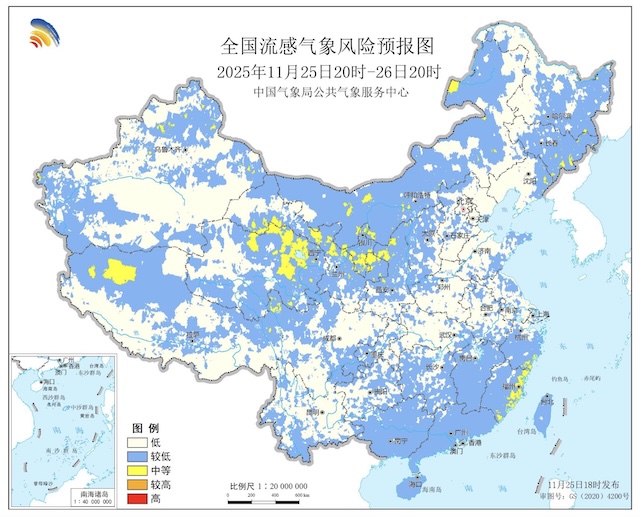
多地推出流感气象风险预报,为何流感发生与气象条件密切相关
Di Yi Cai Jing· 2025-11-25 10:47
Core Viewpoint - The flu activity in China is on the rise, with many provinces reaching moderate to high epidemic levels, prompting the release of flu meteorological risk forecasts by national and local authorities [1][2][3] Group 1: National and Local Forecasts - The China Meteorological Administration issued a flu meteorological risk forecast for November 25-26, indicating moderate risk in regions such as western Tibet and eastern Fujian [1] - Shanxi Province's meteorological service also forecasted favorable conditions for flu occurrence from November 26-27 [2] - Inner Mongolia reported moderate to high flu risk for November 23-24 [2] Group 2: New Services and Technologies - Jiangsu Province launched a flu meteorological index prediction service, providing weekly forecasts during the flu season [2][4] - The service combines traditional and AI models to analyze meteorological data and flu transmission patterns, offering scientific predictions for public health protection [4] Group 3: Meteorological Impact on Flu - The onset of winter, with significant temperature drops and increased indoor activity, raises the risk of respiratory pathogens, including flu [4] - Experts indicate that various meteorological factors can lower human immunity, making individuals more susceptible to flu infections [4] Group 4: Public Health Recommendations - The public is advised to adopt a dual defense strategy of vaccination and good hygiene practices, as the current flu season is characterized by the circulation of H3N2 and other flu strains [5]
句容开展学生常见病和健康影响因素监测工作
Zhen Jiang Ri Bao· 2025-11-04 00:06
Core Insights - The monitoring work for common diseases and health influencing factors among students in Jurong City is being conducted collaboratively by the local CDC and three community health service centers [1] Group 1: Monitoring Overview - The monitoring covers multiple educational stages, including high school, middle school, primary school, and kindergarten, involving a total of 1,840 students from seven schools [1] - The monitoring consists of three main components: physical examinations, health questionnaire surveys, and environmental health monitoring [1] Group 2: Monitoring Components - Physical examinations assess students' height, weight, vision, oral health, spine, and gait [1] - Health questionnaire surveys include students' dietary habits, eye usage habits, and psychological status [1] - Environmental health monitoring focuses on classroom area, lighting conditions, and the suitability of desks and chairs [1] Group 3: Objectives and Goals - The CDC aims to scientifically analyze the current status of common diseases among students and their main influencing factors through this monitoring [1] - The findings will enable targeted interventions for identified issues, enhancing the prevention of multiple common diseases among students and promoting the health of children and adolescents [1]