第三方快递

Search documents
极兔速递获100亿元贷款融资 创始人李杰掌握55%表决权
Sou Hu Cai Jing· 2025-10-21 09:08
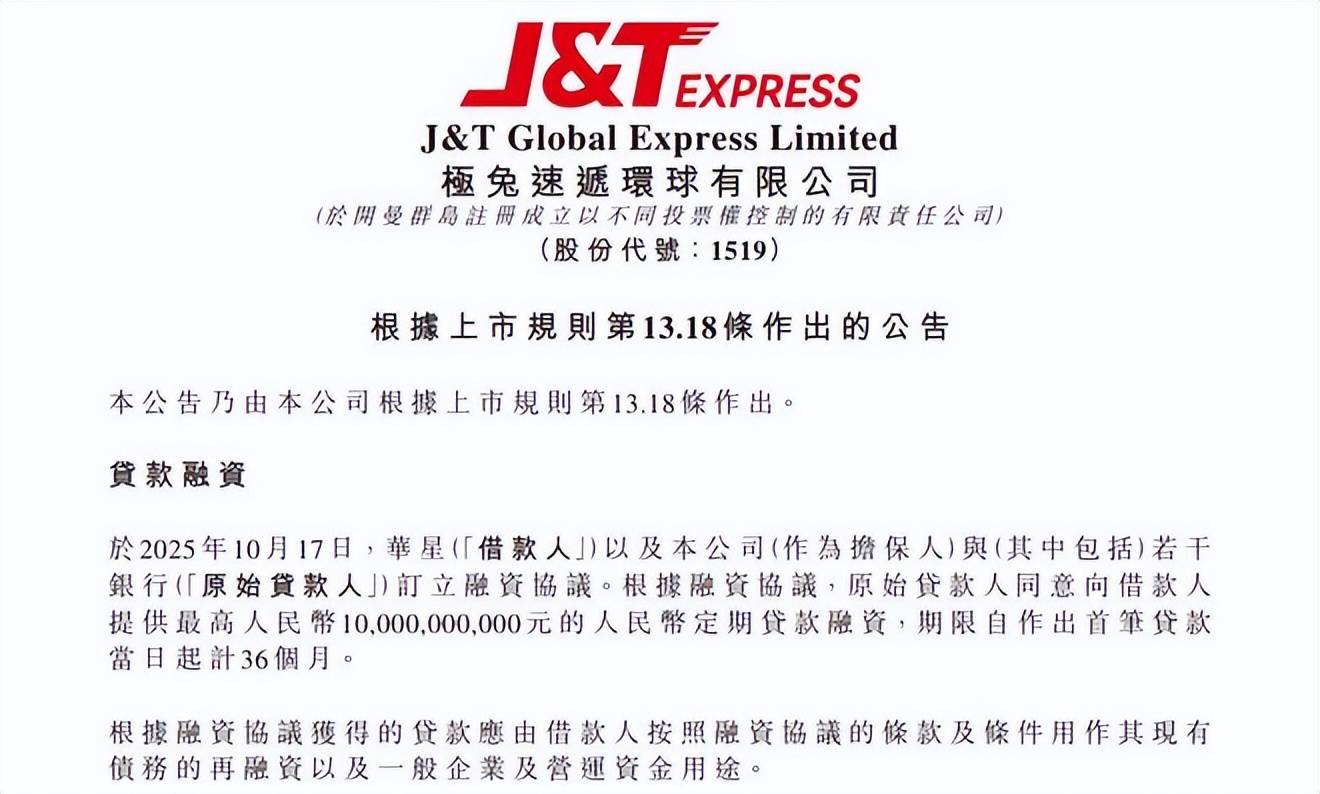
Group 1: Financing and Control - Jitu Express announced a financing agreement through its wholly-owned subsidiary Huaxing Group, securing up to 10 billion RMB in term loans with a duration of 36 months [1][4] - The financing will primarily be used for refinancing existing debt, general corporate operating funds, and optimizing capital structure [1][4] - The financing agreement is closely tied to the control of the company by founder and CEO Li Jie, who holds approximately 55.09% of the voting rights [1][4][6] Group 2: Strategic Shift in China - Jitu Express is experiencing a significant strategic shift in the Chinese market, with business volume growth slowing to 14.7% in Q2 2025, compared to over 30% in the previous year [7][8] - The company has reduced its network by 300 outlets and cut 600 vehicles for third-party transportation in China since 2025 [7] - Adjusted EBIT in the Chinese market plummeted by 78.3% in the first half of 2025, with a profit margin of only 0.4% [7][8] Group 3: Growth in Southeast Asia - In contrast to its Chinese operations, Jitu Express has seen a substantial increase in its Southeast Asian market, with package volume growing by 78.7% year-on-year in Q3 2025 [8][9] - The Southeast Asian market contributes approximately 30% of Jitu's revenue, despite accounting for less than 20% of total business volume [8] - The adjusted EBIT per package in Southeast Asia increased to $0.073, with total adjusted EBIT rising by 74.0% to $160 million in the first half of 2025 [8][9] Group 4: E-commerce and Competitive Landscape - Jitu's success in Southeast Asia is attributed to its deep integration with major e-commerce platforms, with over 90% of its business volume linked to these platforms [9][10] - The Southeast Asian e-commerce market is projected to reach $306.26 billion by 2025, with a year-on-year growth of 28.5% [9] - However, competition is intensifying, particularly from Shopee's self-operated delivery service SPX, which is increasing its delivery capacity [10] Group 5: Market Response and Future Outlook - The recent financing is expected to provide Jitu with the necessary resources for its strategic transformation, with the stock price rising over 60% since 2025 [11][13] - Recent investments from major firms such as D1 Capital and Sequoia Capital reflect investor confidence in Jitu's future prospects [11][13] - Jitu's global strategy and operational optimizations are anticipated to yield positive financial results, with the company aiming for profitability in global markets by 2024 [10][13]

42页|2024年度中国物流科技市场数据报告
Sou Hu Cai Jing· 2025-05-02 04:23
Core Viewpoint - The report from the Net Economy Research Center defines logistics technology as an ecosystem supported by e-commerce, encompassing various logistics categories such as comprehensive e-commerce logistics, cross-border logistics, instant logistics, warehousing logistics, freight O2O, third-party express delivery, last-mile delivery, smart logistics service providers, logistics supply chains, and bulk logistics [1][16]. Industry Overview - The logistics technology industry chain includes major players across different categories: 1. Comprehensive e-commerce logistics: Cainiao Network, JD Logistics, Suning Logistics, Anxun Logistics [1][16] 2. Cross-border logistics: Yunquna, Disifang, Zongteng Group [1][16] 3. Instant logistics: Dada Express, Meituan Delivery, SF City, Fengniao Delivery [1][16] 4. Warehousing logistics: Paixun Intelligent, Hairou Innovation, Syrius [1][16] 5. Freight O2O: UU Runner, Flash Delivery, Didi Freight, Huoyun [2][16] 6. Third-party express delivery: SF Express, Shentong Express, YTO Express, Zhongtong Express, Yunda Express, Jitu Express [2][16] 7. Last-mile delivery: Fengchao, Jinlinbao [2][16] 8. Smart logistics service providers: Dizhantian, Yazuishou, Fenghuodi [2][16] 9. Bulk logistics network: Wangsheng Yunze, Chuanhua Zhili [2][16] 10. Logistics supply chain: ProLogis, Riri Shun [2][16] Geographic Distribution - The report indicates that the most logistics technology companies are located in "Beijing, Shanghai, Guangdong, and Zhejiang." - Beijing: JD Logistics, G7 Yiliu, Flash Delivery, Didi Freight [20] - Shanghai: Dada, Debang Express, KuaiCang, Aneng Logistics, Jitu Express, Zhongtong Express [20] - Zhejiang: Cainiao, Songjianxia, SF City, Kuaihuoyun, Yunda, Shentong Express, Baishi Logistics [20] - Guangdong: Fengchao, Yunyi Tong, Shunyou Logistics, Yuancang Overseas Warehouse, Ruiyun Cold Chain, SF Express, Huoyun [20] Policy Developments - Key policies impacting the logistics technology sector include: 1. March 1: Ministry of Transport issued the "Express Market Management Measures," requiring express delivery personnel to obtain user consent before delivering to smart lockers [22]. 2. April 26: Ministry of Commerce released the "Digital Commerce Three-Year Action Plan (2024-2026)," promoting data sharing in logistics and green packaging transformation [22]. 3. July 31: Central Committee of the Communist Party and State Council issued opinions on accelerating the green transformation of economic and social development, aiming for a 9.5% reduction in carbon emissions from operational transport vehicles by 2030 [22]. Market Data - The report provides various market data for the logistics sector: 1. The express delivery industry revenue is projected to reach 1.52 trillion yuan in 2024, with a growth rate of 8.57% [31]. 2. The instant logistics market is expected to exceed 420 billion yuan in 2024, showing a significant growth of 68% [34]. 3. The same-city freight market is projected to be approximately 1.9964 trillion yuan, with a year-on-year growth of 17.48% [37]. 4. The smart express cabinet market is estimated to reach 58 billion yuan, growing by 16% [40]. 5. The cross-border e-commerce logistics market is expected to reach 3.28 trillion yuan, with a growth of 30.15% [45]. 6. The cold chain logistics market is projected to be 536.1 billion yuan, with a growth of 3.69% [48]. 7. The global e-commerce logistics market is expected to reach 9.65 trillion yuan, with an increase of 8.61% [52].