线下演出

Search documents
2026消费风向标:精打细算的我们,为何仍愿为一场狂欢买单?
Sou Hu Cai Jing· 2026-02-05 11:34
Group 1 - The core position of consumption as the "mainstay" of China's economy is solidified, with final consumption contributing 52% to economic growth in 2025, indicating that over half of economic growth is supported by consumer spending [3] - The adjustment of the new energy vehicle purchase tax from full exemption to a 5% rate starting January 1, 2026, signals a shift from policy-driven support to market-driven growth, leading to a last-minute buying spree in late 2025 [3][12] - The consumer landscape is evolving, with over 60% of consumers adopting defensive saving behaviors while simultaneously showing a willingness to spend extravagantly on experiences like concerts, indicating a complex consumption pattern [4] Group 2 - Consumers in 2026 exhibit a "liquid personality," easily switching between different consumer identities based on context, with 50.4% identifying as "life accountants" focused on savings [6] - The trend of "rational emotionalism" emerges, where consumers save resources through careful budgeting to allocate for meaningful experiences, with 75.2% consciously managing their psychological accounts [7] - The "in-place awakening" trend highlights a growing preference for local culture and brands, with consumers favoring products that reflect local cultural elements and stories, pushing brands to be more transparent and authentic [8] Group 3 - The integration of AI into daily life has transformed it from a mere tool to a partner in various aspects, with over 80% of consumers using AI frequently across multiple dimensions of life [10] - Investment opportunities in 2026 are seen in traditional sectors like liquor, which may experience a value rebound, and companies with strong cash flow and dividend yields above 4% are worth monitoring [11][12] - Emerging fields such as discount retail, AI-enhanced consumer products, and local cultural experiences present structural growth opportunities for brands, emphasizing the importance of user experience alongside technological advancements [13]


大麦娱乐(01060):FY26H1 业绩点评报告:阿里鱼驱动 FY26H1 收入高增,经营效益提升
Guohai Securities· 2025-11-18 15:00
Investment Rating - The report assigns a "Buy" rating for the company, marking its first coverage [2][12]. Core Insights - The company has shown strong revenue growth in FY26H1, with a total revenue of 4.047 billion RMB, representing a year-over-year increase of 32.7% and a half-year increase of 10.8% [5]. - The company is positioned as a leader in the domestic offline ticketing market, with significant IP licensing capabilities, including partnerships with major brands like Sanrio and Chiikawa [12]. - The report highlights the robust growth potential in the live performance and IP sectors, driven by a stable supply of top-tier artists and successful events [6][12]. Financial Performance Summary - **Revenue and Profitability**: In FY26H1, the company achieved a gross profit margin of 35.7%, with a net profit of 520 million RMB, reflecting a year-over-year increase of 54.3% [5]. - **Segment Performance**: The live performance and technology segment generated 1.339 billion RMB in revenue, up 14.5% year-over-year, while the IP derivatives segment saw a remarkable 105.2% increase in revenue, reaching 1.16 billion RMB [6][7]. - **Cost Management**: The company has effectively reduced both sales and management expenses, leading to improved operational efficiency [10]. Future Projections - The company is projected to achieve revenues of 8.107 billion RMB in FY2026, with a net profit forecast of 996 million RMB, indicating a significant growth trajectory [11][12]. - The expected growth rates for revenue and net profit are 21% and 174% respectively for FY2026, showcasing strong financial health and operational performance [12][13].
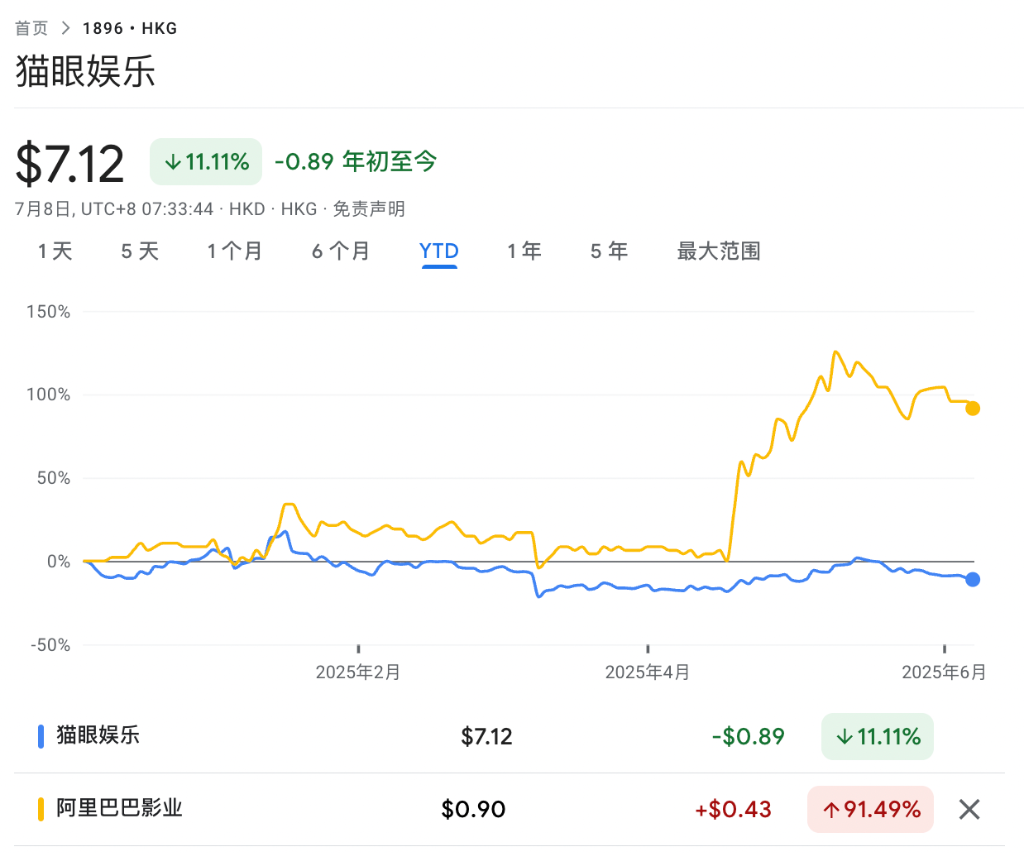
涨91%与跌10%,大麦与猫眼的走势为何差距这么大?
Hua Er Jie Jian Wen· 2025-07-08 00:54
Core Insights - The Chinese entertainment industry is experiencing a divergence, with Damai Entertainment's stock price rising by 91% year-to-date, while Maoyan Entertainment's stock price has fallen by 10% [1][5]. Company Performance - Damai Entertainment has successfully diversified its business by shifting focus from movie ticketing to IP derivatives and offline entertainment activities, projecting a revenue growth of 33% to 6.7 billion RMB for FY2025 [4][13]. - In contrast, Maoyan Entertainment is heavily reliant on the domestic film market, expecting a revenue decline of 14% to 4.1 billion RMB for 2024 due to a 23% drop in movie box office revenue [4][15]. Strategic Differences - The divergence in stock performance is attributed to the fundamental differences in strategic direction between the two companies. Damai's transformation has allowed it to capture the benefits of consumer upgrades and post-pandemic entertainment demand, while Maoyan's reliance on the film market has left it vulnerable [6][15]. - Damai's revenue from movie-related activities is expected to constitute only 37% of its total revenue by FY2026, whereas Maoyan's movie-related revenue will account for over 80% [6][15]. Market Growth and Projections - The offline performance market in China is projected to grow at a compound annual growth rate (CAGR) of 81% from 2022 to 2024, with market revenue expected to reach 80 billion RMB in 2024 [7][8]. - Damai is estimated to achieve 2.1 billion RMB in event ticketing revenue in 2024, with expectations of further growth to 2.5 billion RMB and 3 billion RMB in FY2026 and FY2027, respectively [8][10]. Financial Outlook - Damai's adjusted EBITA is projected to grow by 61% to 809 million RMB for FY2025, with revenues expected to reach 8 billion RMB in FY2026 and 9.3 billion RMB in FY2027, exceeding market consensus by 4% and 7% [13][14]. - Conversely, Maoyan's adjusted EBITA is forecasted to plummet by 70% to 328 million RMB for 2024, with revenues expected to grow only 8% and 4% in FY2025 and FY2026, respectively, falling short of market consensus by 9% and 13% [15][18]. Valuation and Market Sentiment - Morgan Stanley maintains an "overweight" rating for Damai with a target price of 1.2 HKD, while downgrading Maoyan to "neutral" with a target price of 6.8 HKD, reflecting cautious expectations for Maoyan's future performance [6][19].