航天能源

Search documents
C电科(688818):卫星能源龙头 深度受益于商业航天高速发展
Xin Lang Cai Jing· 2026-02-12 06:33
Core Viewpoint - The company is a leading supplier of advanced electric energy systems and core products in China, focusing on research, production, sales, and services across various applications from deep sea to deep space [1][6]. Group 1: Business Overview - The company operates in three main business segments: aerospace power, special power, and new energy applications and services [2]. - In aerospace power, the company covers the entire industry chain, with a market share exceeding 50%, supplying products for major projects like the Shenzhou spacecraft and Tiangong space station [2][6]. - The special power segment includes the development of high-energy density lithium-ion batteries, with applications in defense and special vehicles, and has over 300 product models [3]. Group 2: Financial Performance - For the first three quarters of 2025, the company achieved revenue and net profit of 1.708 billion and 65 million yuan, respectively, representing a year-on-year growth of 6.02% and 7.84% [3]. - The company expects its full-year revenue to grow between 0.35% and 9.85%, while net profit may vary from a decrease of 3.18% to an increase of 6.81% compared to the previous year [3]. - The gross margin and net margin for the first half of 2025 were 24.74% and 5.34%, reflecting a decline from the previous year's full-year figures due to revenue recognition timing [3]. Group 3: Industry Trends - The commercial aerospace sector is entering a rapid development phase, with significant advancements in low-orbit satellite operations and multiple private rocket launches [4]. - The satellite energy system is projected to become a core growth area, with its value expected to increase significantly as satellite technology evolves [4]. - The company is well-positioned to benefit from the anticipated growth in satellite energy systems, which are expected to account for 15%-20% of the total satellite value [4]. Group 4: Investment and Innovation - The company has raised 1.579 billion yuan for the industrialization of aerospace power systems, with a total planned investment of approximately 1.995 billion yuan [5]. - The successful development of the fifth-generation lithium-ion battery, with a capacity of 300Wh/kg, positions the company at the forefront of technology in the industry [5][6]. - The company is expected to see significant revenue growth, with projected revenues of 3.314 billion, 4.306 billion, and 6.003 billion yuan for 2025-2027 [6].
钧达股份:现阶段主流传统能源方案在成本控制、轻量化设计及柔性适配等方面存在局限性
Zheng Quan Ri Bao Wang· 2025-12-23 14:12
Core Viewpoint - The market demand for energy solutions has evolved from a focus on "reliability and efficiency" to a comprehensive system capability that emphasizes "high efficiency, lightweight, low cost, and flexibility" due to the scaling deployment of low-orbit satellites and the commercialization of space computing power [1] Group 1 - The current mainstream traditional energy solutions face limitations in cost control, lightweight design, and flexible adaptation, making them inadequate for the needs of mass deployment and cost-sensitive commercial aerospace [1]

中俄共建月球核电站,是遥远的未来吗?
Guan Cha Zhe Wang· 2025-05-16 05:44
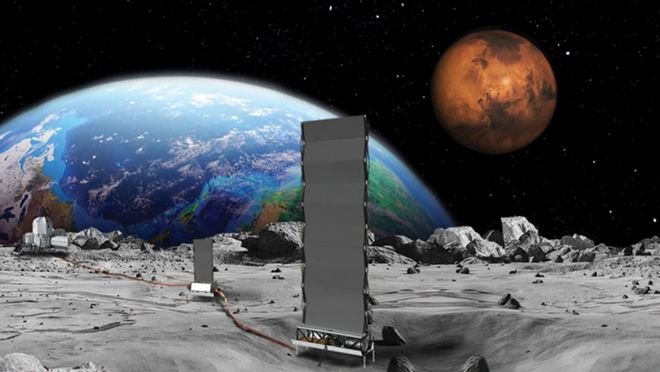
Core Viewpoint - The collaboration between China and Russia to build a lunar nuclear power station is seen as a significant step in deep space energy systems, but the necessity and feasibility of such a project at this stage are questioned [1][3][11]. Group 1: Project Overview - A memorandum was signed in May 2025 for the construction of a lunar nuclear power station to support the International Lunar Research Station (ILRS) led by China and Russia, with plans to deploy a nuclear reactor on the moon between 2033 and 2035 [1][3]. - The current phase of the ILRS is still in its basic construction stage, focusing on resource exploration and environmental monitoring, without the need for continuous power supply for long-term human presence [3][4]. Group 2: Energy Solutions - Solar energy systems are considered a viable alternative for the lunar research station, even in limited sunlight conditions, as vertical solar panels can significantly enhance power generation efficiency [5][6]. - A solar array consisting of 12 vertical solar panels could generate approximately 30,000 kWh during the lunar day, sufficient for 6-10 days of scientific operations [5]. - The challenge lies in energy storage during the lunar night, which lasts about 14 Earth days, necessitating advanced storage solutions that are currently feasible with existing battery technologies [6][7]. Group 3: Technical and Logistical Challenges - The construction of a nuclear power station on the moon involves complex engineering challenges, including autonomous deployment, dust resistance, and long-term stability, which have not yet been validated in space [9][10]. - China's current launch capabilities are limited, with the Long March 10 rocket expected to have a payload capacity of about 27 tons, raising questions about prioritizing a high-risk nuclear project over other critical missions [10]. - Russia's current space capabilities are declining, making it uncertain whether they can contribute effectively to such a high-stakes project [10]. Group 4: Strategic Considerations - The memorandum for the lunar nuclear power station lacks binding legal force and is more of a political acknowledgment of mutual interest rather than a concrete plan [11]. - While the long-term vision of a lunar nuclear power station is acknowledged, the immediate focus should be on reliable solar energy systems and operational strategies that do not require continuous human presence [13][14].