设备生产

Search documents
数说“十四五”成绩单,看金融之笔如何绘就科技新图景
21世纪经济报道· 2025-12-11 10:13
Core Viewpoint - The article emphasizes the rapid development of China's technology-driven economy during the "14th Five-Year Plan" period, highlighting the role of financial services in supporting innovation and the growth of technology enterprises [1][5][27]. Group 1: Development of Technology Enterprises - During the "14th Five-Year Plan," China's robot industry is accelerating, with the number of robot patent applications expected to account for two-thirds of the global total by 2024 [5]. - Over 100,000 specialized and innovative small and medium-sized enterprises (SMEs) have been added since the beginning of the "14th Five-Year Plan," with a total exceeding 140,000, including over 14,600 "little giant" enterprises [9]. - As of September 2025, Agricultural Bank of China (ABC) has collaborated with over 70% of these specialized and innovative "little giant" enterprises [9]. Group 2: Financial Services for Technology Enterprises - ABC has established a dedicated credit service system for technology enterprises, focusing on diverse financial needs and building a comprehensive evaluation system centered on future repayment capabilities [5]. - The annual growth rate of loans to technology SMEs has exceeded 20% during the "14th Five-Year Plan" period [17]. - By September 2025, ABC has issued "Kejie Loans" totaling 8.255 billion yuan to 2,175 technology SMEs [17]. Group 3: Supportive Policies and Initiatives - The People's Bank of China and other ministries have jointly established a policy tool for technology innovation and technological transformation re-loans, aimed at supporting early-stage and growth-stage technology SMEs [21]. - As of September 2025, ABC has provided approximately 24 billion yuan in funding support to over 10,000 enterprises on the re-loan list, effectively reducing financing costs for technology enterprises [22]. Group 4: Future Outlook - ABC aims to continue enhancing the breadth, depth, and warmth of its technology financial services, contributing to high-level technological self-reliance and modernization in China [27].



退市不免责!涉财务造假,恒立实业及19人被重罚
Shang Hai Zheng Quan Bao· 2025-11-21 14:35
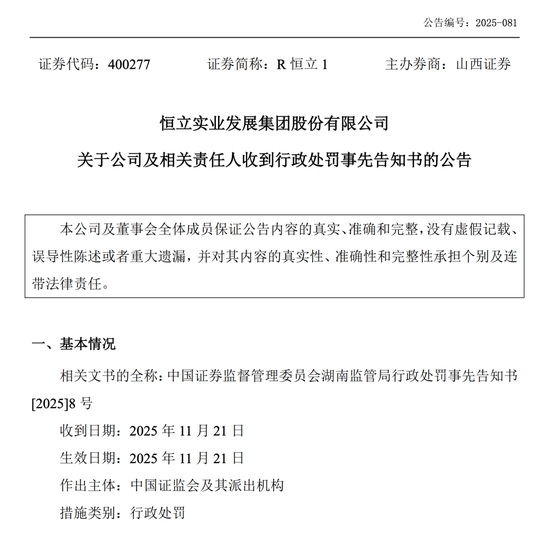
Core Viewpoint - The regulatory authority demonstrates a "zero tolerance" approach towards violations in the capital market, as evidenced by the administrative penalties imposed on Hengli Industrial Development Group Co., Ltd. for false financial disclosures [3][10][14]. Summary by Sections Regulatory Actions - On November 21, the Hunan Securities Regulatory Bureau issued an administrative penalty notice to Hengli Industrial and 19 related individuals, proposing a total fine of 39.4 million yuan [3][9]. - The penalties reflect the regulatory body's commitment to addressing illegal activities in the capital market, with ongoing investigations into Hengli Industrial's irregularities [3][10]. Financial Misconduct - Hengli Industrial was found to have inflated its revenue and costs through fictitious transactions in its glycol trading business, leading to significant discrepancies in its financial reports from 2020 to the first half of 2023 [4][5]. - The company reported inflated revenues of approximately 227 million yuan, 181 million yuan, 135 million yuan, and 51.19 million yuan for the respective years, constituting 74.24%, 52.27%, 55.08%, and 47.77% of the reported revenues [5]. Accountability of Executives - Key executives, including the chairman and president, were identified as directly responsible for the violations, with penalties totaling 31.4 million yuan for these individuals [6][9]. - Additional executives and board members were also implicated for failing to exercise due diligence regarding the company's trading activities and financial disclosures [7][8]. Consequences of Delisting - Hengli Industrial's stock was delisted on July 16 due to failure to disclose its 2024 annual report within the legal timeframe, marking a significant decline in its operational status [10][14]. - The company faced two separate investigations within a month, highlighting the regulatory body's swift action against non-compliance [13][14]. Investor Protection - Despite the company's delisting, the protection of investor rights remains a priority, with ongoing legal actions against companies for false disclosures, reinforcing the message that delisting does not equate to immunity from accountability [14].